
Homework Answers

Add Answer to:
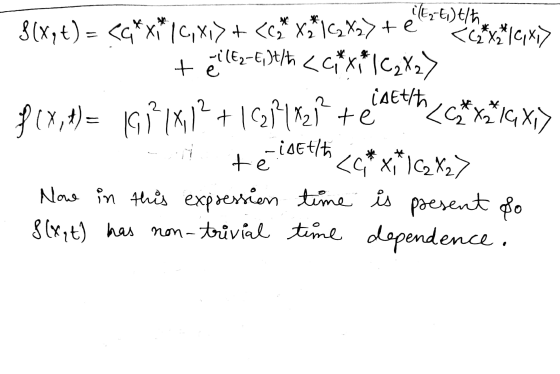
Check your understanding Given (x, t = 0) = (1X1(x) + c2X2(x) where ÑX1 = EjX1...
2) For the given equations: V(z) = { é o se} V(,0) = V $(x) +...
 2) For the given equations: V(z) = { é o se} V(,0) = V $(x) + V1() + vee(r) a) Write the expression for 4A (x,t). b) What is the expectation value for (E) ? Write the expression in E.. c) Write the expression for W.(x,t) at E2 for t>t, and what is the probabilities at t2 > ti d) Write the another expression for WB(x, 0) with the same value of (E). e) Write the another expression for c(x,0)...
Given the velocity field u = xte1 + yte2 (where e1 and e2 are unit vectors...
 Given the velocity field u = xte1 + yte2 (where e1 and e2 are
unit vectors in the x and y direction, respectively) determine how
the density of the fluid varies with time. Assume the density is
independent of spatial position and that ρ = ρo at t = 0
I know that I need to substitute u into the equation of
continuity which is
ρo(∂s/∂t) + ∇*(ρo*û ) = 0 and solve for s but not
really sure how...
Given the velocity field u = xte1 + yte2 (where e1 and e2 are
unit vectors in the x and y direction, respectively) determine how
the density of the fluid varies with time. Assume the density is
independent of spatial position and that ρ = ρo at t = 0
I know that I need to substitute u into the equation of
continuity which is
ρo(∂s/∂t) + ∇*(ρo*û ) = 0 and solve for s but not
really sure how...
Check the existence of the Laplace transform for the given function and hence show that -...
 Check the existence of the Laplace transform for the given function and hence show that - cos 20 1s² + 4 L = In t s2 where L{f(t)} is represent the Laplace transform of f(t). [Hint: 2 cos A cos B = COSIA+B) + cos(A - B) sin(A + B) + sin(A - B) = sinA cosB, sin(A + B) – sin(A - ?) = os AsmB] [2+ Find the Fourier Sine series of [8 f(x) = e-*,0<x<. Using the...
Show that the retarded potentials given by 0(x, t) = 176f d (,4)ret A(x, t) =...
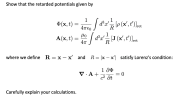 Show that the retarded potentials given by 0(x, t) = 176f d (,4)ret A(x, t) = | APAB (X,1"). where we define R= x - x' and R= |x - x' satisfy Lorenz's condition: 1 ag V: A+ 2 ət = 0 Carefully explain your calculations.
3.9. A particle of mass m is confined in the potential well 0 0<x < L...
 3.9. A particle of mass m is confined in the potential well 0 0<x < L oo elsewhere (a) At time t 0, the wave function for the particle is the one given in Problem 3.3. Calculate the probability that a measurement of the energy yields the value En, one of the allowed energies for a particle in the box. What are the numerical values for the probabilities of obtaining the ground-state energy E1 and the first-excited-state energy E2? Note:...
2. Phasors At a given position x-0 two time-dependent electric fields E,t) and E,(t) interfere: E...
 2. Phasors At a given position x-0 two time-dependent electric fields E,t) and E,(t) interfere: E,(t)-2"cos(ot) and E2(1) = 3~cos(ot-π) Using the method of phasors, a) Evaluate the resultant field EE()+E(t) at that position. b) Using the complex plane, draw the three phasors at two arbitrarily different times. 4
2. Phasors At a given position x-0 two time-dependent electric fields E,t) and E,(t) interfere: E,(t)-2"cos(ot) and E2(1) = 3~cos(ot-π) Using the method of phasors, a) Evaluate the resultant field EE()+E(t)...
2. Phasors At a given position x-0 two time-dependent electric fields E,t) and E,(t) interfere: E,(t)-2"cos(ot) and E2(1) = 3~cos(ot-π) Using the method of phasors, a) Evaluate the resultant field EE()+E(t) at that position. b) Using the complex plane, draw the three phasors at two arbitrarily different times. 4
2. Phasors At a given position x-0 two time-dependent electric fields E,t) and E,(t) interfere: E,(t)-2"cos(ot) and E2(1) = 3~cos(ot-π) Using the method of phasors, a) Evaluate the resultant field EE()+E(t)...
= 0 over the domains 0<x<1 and t>0, where x is space and t is time...
 = 0 over the domains 0<x<1 and t>0, where x is space and t is time at ax ди (1,1) = 0 ax Dirichlet and Neumann BCs are u(0, t)=80; Find the solution of the PDE that satisfies the given IC and BCs a. IC: u(x,0) 25sin (nx)
CHECK YOUR UNDERSTANDING GRAPHICAL ANALYSIS EXERCISES Suppose that you've elevated the en was the subject of...
 CHECK YOUR UNDERSTANDING GRAPHICAL ANALYSIS EXERCISES Suppose that you've elevated the en was the subject of the Check Your U Leated the end of the air track from which you released the glider whose motion Check Your Understanding exercise in Graphing Experimental Data. You n as a function of time and obtain the following set of data. release the glider and measure its position as a function of time and obtain 0.00 0.30 0.60 0.90 1.20 1.50 1.80 2.10 2.40...
2. Consider the following 1-D wave equation with initial condition u (x, 0)- F (x) where F(x) is a given function. a) Show that u (x, t)-F (x - t) is a solution to the given PDE. b) If the function F...
 2. Consider the following 1-D wave equation with initial condition u (x, 0)- F (x) where F(x) is a given function. a) Show that u (x, t)-F (x - t) is a solution to the given PDE. b) If the function F is given as 1; x< 10 x > 10 u(x, 0) = F(x) = use part (a) to write the solution u(x, t) c) Sketch u(x,0) and u(x,1) on the same u-versus-x graph d) Explain in your own...
4. Given ä(t) + 250, 4(0) + 1) = 40, () where U (0) is the...
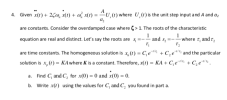 4. Given ä(t) + 250, 4(0) + 1) = 40, () where U (0) is the unit step input and A and az are constants. Consider the overdamped case where t > 1. The roots of the characteristic equation are real and distinct. Let's say the roots are s=-- and s, =-- where t, and T, are time constants. The homogeneous solution is xy(t) = " + C,e" solution is x,0) = KA where K is a constant. Therefore, X(t)...
 2) For the given equations: V(z) = { é o se} V(,0) = V $(x) + V1() + vee(r) a) Write the expression for 4A (x,t). b) What is the expectation value for (E) ? Write the expression in E.. c) Write the expression for W.(x,t) at E2 for t>t, and what is the probabilities at t2 > ti d) Write the another expression for WB(x, 0) with the same value of (E). e) Write the another expression for c(x,0)...
 Given the velocity field u = xte1 + yte2 (where e1 and e2 are
unit vectors in the x and y direction, respectively) determine how
the density of the fluid varies with time. Assume the density is
independent of spatial position and that ρ = ρo at t = 0
I know that I need to substitute u into the equation of
continuity which is
ρo(∂s/∂t) + ∇*(ρo*û ) = 0 and solve for s but not
really sure how...
Given the velocity field u = xte1 + yte2 (where e1 and e2 are
unit vectors in the x and y direction, respectively) determine how
the density of the fluid varies with time. Assume the density is
independent of spatial position and that ρ = ρo at t = 0
I know that I need to substitute u into the equation of
continuity which is
ρo(∂s/∂t) + ∇*(ρo*û ) = 0 and solve for s but not
really sure how...
 Check the existence of the Laplace transform for the given function and hence show that - cos 20 1s² + 4 L = In t s2 where L{f(t)} is represent the Laplace transform of f(t). [Hint: 2 cos A cos B = COSIA+B) + cos(A - B) sin(A + B) + sin(A - B) = sinA cosB, sin(A + B) – sin(A - ?) = os AsmB] [2+ Find the Fourier Sine series of [8 f(x) = e-*,0<x<. Using the...
 Show that the retarded potentials given by 0(x, t) = 176f d (,4)ret A(x, t) = | APAB (X,1"). where we define R= x - x' and R= |x - x' satisfy Lorenz's condition: 1 ag V: A+ 2 ət = 0 Carefully explain your calculations.
 3.9. A particle of mass m is confined in the potential well 0 0<x < L oo elsewhere (a) At time t 0, the wave function for the particle is the one given in Problem 3.3. Calculate the probability that a measurement of the energy yields the value En, one of the allowed energies for a particle in the box. What are the numerical values for the probabilities of obtaining the ground-state energy E1 and the first-excited-state energy E2? Note:...
 2. Phasors At a given position x-0 two time-dependent electric fields E,t) and E,(t) interfere: E,(t)-2"cos(ot) and E2(1) = 3~cos(ot-π) Using the method of phasors, a) Evaluate the resultant field EE()+E(t) at that position. b) Using the complex plane, draw the three phasors at two arbitrarily different times. 4
2. Phasors At a given position x-0 two time-dependent electric fields E,t) and E,(t) interfere: E,(t)-2"cos(ot) and E2(1) = 3~cos(ot-π) Using the method of phasors, a) Evaluate the resultant field EE()+E(t)...
2. Phasors At a given position x-0 two time-dependent electric fields E,t) and E,(t) interfere: E,(t)-2"cos(ot) and E2(1) = 3~cos(ot-π) Using the method of phasors, a) Evaluate the resultant field EE()+E(t) at that position. b) Using the complex plane, draw the three phasors at two arbitrarily different times. 4
2. Phasors At a given position x-0 two time-dependent electric fields E,t) and E,(t) interfere: E,(t)-2"cos(ot) and E2(1) = 3~cos(ot-π) Using the method of phasors, a) Evaluate the resultant field EE()+E(t)...
 = 0 over the domains 0<x<1 and t>0, where x is space and t is time at ax ди (1,1) = 0 ax Dirichlet and Neumann BCs are u(0, t)=80; Find the solution of the PDE that satisfies the given IC and BCs a. IC: u(x,0) 25sin (nx)
 CHECK YOUR UNDERSTANDING GRAPHICAL ANALYSIS EXERCISES Suppose that you've elevated the en was the subject of the Check Your U Leated the end of the air track from which you released the glider whose motion Check Your Understanding exercise in Graphing Experimental Data. You n as a function of time and obtain the following set of data. release the glider and measure its position as a function of time and obtain 0.00 0.30 0.60 0.90 1.20 1.50 1.80 2.10 2.40...
 2. Consider the following 1-D wave equation with initial condition u (x, 0)- F (x) where F(x) is a given function. a) Show that u (x, t)-F (x - t) is a solution to the given PDE. b) If the function F is given as 1; x< 10 x > 10 u(x, 0) = F(x) = use part (a) to write the solution u(x, t) c) Sketch u(x,0) and u(x,1) on the same u-versus-x graph d) Explain in your own...
 4. Given ä(t) + 250, 4(0) + 1) = 40, () where U (0) is the unit step input and A and az are constants. Consider the overdamped case where t > 1. The roots of the characteristic equation are real and distinct. Let's say the roots are s=-- and s, =-- where t, and T, are time constants. The homogeneous solution is xy(t) = " + C,e" solution is x,0) = KA where K is a constant. Therefore, X(t)...
Most questions answered within 3 hours.
-
Where is the error in this code sequence?
String s1 = "Hello";
String s2 = "ello";...
asked 10 months ago -
Financial data for Joel de Paris, Inc., for last year
follow:
Joel de Paris, Inc.
Balance...
asked 10 months ago -
Consider this reaction:
Al2(SO4)3 (aq)+ BaCl3
(aq) Al2Cl6 (aq)- +
3BaSO4(s) . What is the...
asked 10 months ago -
Suppose that Savneet is considering increasing her
recent random sample from 20 car rentals to 40...
asked 10 months ago -
Trucks arrive at an unloading terminal at an average rate of 120
per hour.
Trucks arrive...
asked 10 months ago -
Why are methanol and ethanol completely soluble in water while
octanol is not very little soluble....
asked 10 months ago -
A facilities manager at a university reads in a research report
that the mean amount of...
asked 10 months ago -
When the CuSO4 is rehydrated by adding water to the anhydrous
compound, is this an endothermic...
asked 10 months ago -
A ray of sunlight is passing from diamond into crown glass; the
angle of incidence is...
asked 10 months ago -
A block of mass 0.249 kg is placed on top of a light, vertical
spring of...
asked 10 months ago -
how do the kidneys compensate in the presences of acidosis
a) trigger hyperventilate
b) reserve acid...
asked 10 months ago -
Question 501 pts
The rental rate of capital to the firm increases. Which of the
following...
asked 10 months ago