
Homework Answers
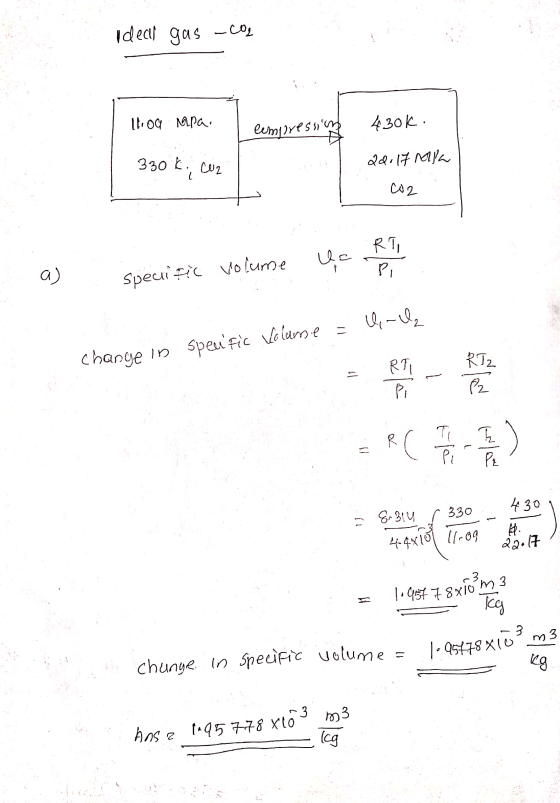
Change in specific volume will decrease in nature ,kita will equal to 1.95778 *10^(-3) m^3 /Kg
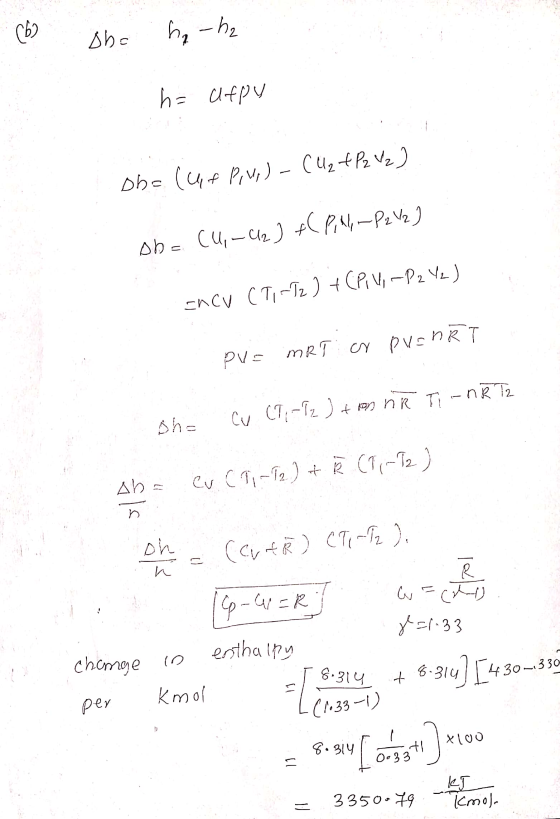
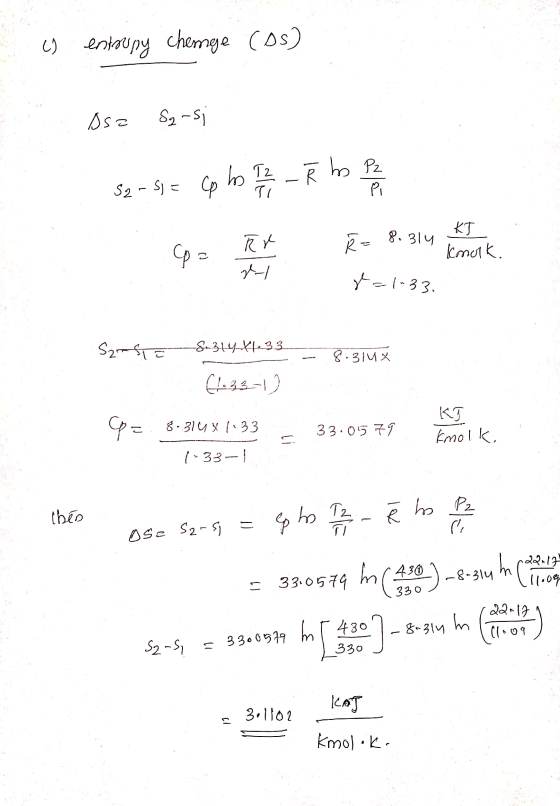
Asper HomeworkLib policy we are helpless for 2nd part of the question we cannot use outside source of datas.sorry sir if you are update this question with chart and graph , i will 100% helpful for you.....
Add Answer to:
Carbon dioxide (CO2) is initially at 11.09 MPa, 3300K and then is compressed to 430°K and...
Carbon dioxide (CO2) is initially at 11.09 MPa, 330°K and then is compressed to 430°K and...
 Carbon dioxide (CO2) is initially at 11.09 MPa, 330°K and then is compressed to 430°K and 22.17 MPa. a Treating carbon dioxide as an ideal gas: Find the change in specific volume between the initial & final states Find the change in enthalpy between the initial & final states per kmol Find the change in entropy between the initial & final states per kmol b Treating carbon dioxide as a real gas: Use the generalized charts to determine the change...
A piston-cylinder contains 1.8 kg of carbon dioxide at 190°C and 1.7 MPa. It is compressed...
 A piston-cylinder contains 1.8 kg of carbon dioxide at 190°C and 1.7 MPa. It is compressed t<o 3.4 MPa through a polytropic process whereP「--const. Determine the final temperature treating the carbon dioxide as (a) an ideal gas T2 and (b) a ver der Waals gas.
Calculate the change in enthalpy (ΔH) for 1.0 mol of carbon dioxide (CO2) initially at a...
Calculate the change in enthalpy (ΔH) for 1.0 mol of carbon dioxide (CO2) initially at a volume of 5.00 L and a temperature of 298 K to a final volume of 10.00 L and a temperature of 373 K. Explicitly state all assumptions along with a justification for any and all assumptions made. Express your answer in units of kilojoules per mole (kJ/mol). Assume an ideal gas.
Problem #4 Carbon dioxide is compressed adiabatically in a piston – cylinder arrangement form 500 kPa...
Problem #4 Carbon dioxide is compressed adiabatically in a piston – cylinder arrangement form 500 kPa and 310 K to 2.5 MPa. What is the minimum work required for the compression process if the initial volume is 0.04 m3 . Consider carbon dioxide as ideal gas with: a) constant specific heat. b) Variable specific heat.
An ideal gas mixture contains 4 moles of carbon dioxide and 8 moles of nitrogen. The...
An ideal gas mixture contains 4 moles of carbon dioxide and 8 moles of nitrogen. The mixture is compressed adiabatically from100kPa and 20°C to 0.5 MPa. What is the final temperature of the gas mixture? Use second law word, entropy change.
A 17.0-L tank of carbon dioxide gas (CO2) is at a pressure of 9.40 ✕ 105...
A 17.0-L tank of carbon dioxide gas (CO2) is at a pressure of 9.40 ✕ 105 Pa and temperature of 23.0°C. (a) Calculate the temperature of the gas in Kelvin. (b) Use the ideal gas law to calculate the number of moles of gas in the tank. mol (c) Use the periodic table to compute the molecular weight of carbon dioxide, expressing it in grams per mole. g/mol (d) Obtain the number of grams of carbon dioxide in the tank. (g) (e)...
An equimolar gaseous mixture of CO2 and CH4 is at 37.8 C and 8.618 MPa. The partial molar volumes...
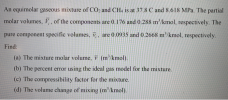 An equimolar gaseous mixture of CO2 and CH4 is at 37.8 C and 8.618 MPa. The partial molar volumes, 7,, of the components are o.176 and 0.288 m /Ikmol, respectively. The pure component specific volumes, v, are 0.0935 and 0.2668 m3/kmol, respectively Find: (a) The mixture molar volume, v (m/kmol) (b) The percent error using the ideal gas model for the mixture (c) The compressibility factor for the mixture. (d) The volume change of mixing (m/kmol).
An equimolar gaseous mixture...
An equimolar gaseous mixture of CO2 and CH4 is at 37.8 C and 8.618 MPa. The partial molar volumes, 7,, of the components are o.176 and 0.288 m /Ikmol, respectively. The pure component specific volumes, v, are 0.0935 and 0.2668 m3/kmol, respectively Find: (a) The mixture molar volume, v (m/kmol) (b) The percent error using the ideal gas model for the mixture (c) The compressibility factor for the mixture. (d) The volume change of mixing (m/kmol).
An equimolar gaseous mixture...
Calculate the change in entropy for 5 moles of carbon dioxide gas as it is compressed...
Calculate the change in entropy for 5 moles of carbon dioxide gas as it is compressed isothermally from 20L to 5L at a temperature of 300K. Consider CO 2 is an (a) ideal gas (b) Van der Waals gas
A piston-cylinder arrangement contains Carbon dioxide (CO2) initially at 66 kPa and 400 K, undergoes an...
 A piston-cylinder arrangement contains Carbon dioxide (CO2) initially at 66 kPa and 400 K, undergoes an expansion process with pressure-volume relationship of PV 1.2 = Costant.to a final temperature of 298 K. Assuming the gas to be an ideal gas, determine the final pressure (kPa), the work done and the heat transfer each in kJ.
Calculate the change in enthalpy (ΔH) for 1.0 mol of carbon dioxide (CO2) initially at a...
Calculate the change in enthalpy (ΔH) for 1.0 mol of carbon dioxide (CO2) initially at a volume of 5.00 L and a temperature of 298 K to a final volume of 10.00 L and a temperature of 373 K. Explicitly state all assumptions along with a justification for any and all assumptions made. Express your answer in units of kilojoules per mole (kJ/mol)
 Carbon dioxide (CO2) is initially at 11.09 MPa, 330°K and then is compressed to 430°K and 22.17 MPa. a Treating carbon dioxide as an ideal gas: Find the change in specific volume between the initial & final states Find the change in enthalpy between the initial & final states per kmol Find the change in entropy between the initial & final states per kmol b Treating carbon dioxide as a real gas: Use the generalized charts to determine the change...
 A piston-cylinder contains 1.8 kg of carbon dioxide at 190°C and 1.7 MPa. It is compressed t<o 3.4 MPa through a polytropic process whereP「--const. Determine the final temperature treating the carbon dioxide as (a) an ideal gas T2 and (b) a ver der Waals gas.
 An equimolar gaseous mixture of CO2 and CH4 is at 37.8 C and 8.618 MPa. The partial molar volumes, 7,, of the components are o.176 and 0.288 m /Ikmol, respectively. The pure component specific volumes, v, are 0.0935 and 0.2668 m3/kmol, respectively Find: (a) The mixture molar volume, v (m/kmol) (b) The percent error using the ideal gas model for the mixture (c) The compressibility factor for the mixture. (d) The volume change of mixing (m/kmol).
An equimolar gaseous mixture...
An equimolar gaseous mixture of CO2 and CH4 is at 37.8 C and 8.618 MPa. The partial molar volumes, 7,, of the components are o.176 and 0.288 m /Ikmol, respectively. The pure component specific volumes, v, are 0.0935 and 0.2668 m3/kmol, respectively Find: (a) The mixture molar volume, v (m/kmol) (b) The percent error using the ideal gas model for the mixture (c) The compressibility factor for the mixture. (d) The volume change of mixing (m/kmol).
An equimolar gaseous mixture...
 A piston-cylinder arrangement contains Carbon dioxide (CO2) initially at 66 kPa and 400 K, undergoes an expansion process with pressure-volume relationship of PV 1.2 = Costant.to a final temperature of 298 K. Assuming the gas to be an ideal gas, determine the final pressure (kPa), the work done and the heat transfer each in kJ.
Most questions answered within 3 hours.
-
Where is the error in this code sequence?
String s1 = "Hello";
String s2 = "ello";...
asked 10 months ago -
Financial data for Joel de Paris, Inc., for last year
follow:
Joel de Paris, Inc.
Balance...
asked 10 months ago -
Consider this reaction:
Al2(SO4)3 (aq)+ BaCl3
(aq) Al2Cl6 (aq)- +
3BaSO4(s) . What is the...
asked 10 months ago -
Suppose that Savneet is considering increasing her
recent random sample from 20 car rentals to 40...
asked 10 months ago -
Trucks arrive at an unloading terminal at an average rate of 120
per hour.
Trucks arrive...
asked 10 months ago -
Why are methanol and ethanol completely soluble in water while
octanol is not very little soluble....
asked 10 months ago -
A facilities manager at a university reads in a research report
that the mean amount of...
asked 10 months ago -
When the CuSO4 is rehydrated by adding water to the anhydrous
compound, is this an endothermic...
asked 10 months ago -
A ray of sunlight is passing from diamond into crown glass; the
angle of incidence is...
asked 10 months ago -
A block of mass 0.249 kg is placed on top of a light, vertical
spring of...
asked 10 months ago -
how do the kidneys compensate in the presences of acidosis
a) trigger hyperventilate
b) reserve acid...
asked 10 months ago -
Question 501 pts
The rental rate of capital to the firm increases. Which of the
following...
asked 10 months ago