
Homework Answers
Request Answer!
We need at least 10 more requests to produce the answer.
0 / 10 have requested this problem solution
The more requests, the faster the answer.
Add Answer to:
The activation energy in a catalyzed reaction is lower than the activation energy in the same...
Uncatalyzed Catalyzed Enzyme-substrate Complex In the above reaction, the lower curve is an enzyme-catalyzed reaction where...
 Uncatalyzed Catalyzed Enzyme-substrate Complex In the above reaction, the lower curve is an enzyme-catalyzed reaction where the activation energy is notably lower than the uncatalyzed reaction. Suppose the enzyme in the diagram was mutated in such a way that its affinity for the substrate increased 100 fold, thereby affecting the enzyme-substrate complex portion of the curve. Assume that there was no other effect. Would you expect the reaction rate catalyzed by the altered enzyme to be faster, slower, or equal...
Comparing an uncatalyzed reaction to the same reaction with a catalyst, which one of the following...
 Comparing an uncatalyzed reaction to the same reaction with a catalyst, which one of the following is always true? O The catalyzed reaction will be exergonic. O The catalyzed reaction will have higher activation energy. O The catalyzed reaction will be endergonic. O The catalyzed reaction will have lower activation energy.
The activation energy of a certain uncatalyzed biochemical reaction is 46.7 kJ/mol. In the presence of...
The activation energy of a certain uncatalyzed biochemical reaction is 46.7 kJ/mol. In the presence of a catalyst at 39ºC, the rate constant for the reaction increases by a factor of 2030 as compared with the uncatalyzed reaction. Assuming the frequency factor A is the same for both the catalyzed and uncatalyzed reactions, calculate the activation energy for the catalyzed reaction. Activation energy = kJ/mol
The activation energy of a certain uncatalyzed biochemical reaction is 47.2 kJ/mol. In the presence of...
The activation energy of a certain uncatalyzed biochemical reaction is 47.2 kJ/mol. In the presence of a catalyst at 38ºC, the rate constant for the reaction increases by a factor of 2050 as compared with the uncatalyzed reaction. Assuming the frequency factor A is the same for both the catalyzed and uncatalyzed reactions, calculate the activation energy for the catalyzed reaction. Activation energy = kJ/mol
The uncatalyzed decomposition of CH3CHO has an activation energy of 188 kJ mol-1. I2 catalyzes the...
The uncatalyzed decomposition of CH3CHO has an activation energy of 188 kJ mol-1. I2 catalyzes the reaction, and at 600 K the catalyzed reaction is ten million times faster than the uncatalyzed reaction. Therefore, assuming that the pre-exponential factor, A, is the same for both the uncatalyzed and catalyzed reactions, the activation energy of the catalyzed reaction is, in kJ mol- 80.4 B. 71.0 C. 108 D. 117 E. 172
2. A reaction proceeds with ∆ H = -60 kJ/mol. The energy of activation of the...
2. A reaction proceeds with ∆ H = -60 kJ/mol. The energy of activation of the uncatalyzed reaction is 140 kJ/mol, whereas it is 85 kJ/mol for the catalyzed reaction. How many times faster is the catalyzed reaction than the uncatalyzed reaction at 25°C? Express your answer in scientific notation to two significant figures
Question #5 Here are the relevant data to determine the activation energy of the reaction. Rate...
 Question #5 Here are the relevant data to determine the activation energy of the reaction. Rate constant (units not shown) Temperature (K) .13 293 0.11 308 Use the data above to determine the activation energy of the reaction? 83 kJ/mol Submit This value is not correct. Please check your calculations and try again. Question #6 Here are your data for trial of Lab 7 (the trial at room temperature without the catalyst): [103 initial (S203 initial Initial Rate .0023 M...
Part B The graph shows three reaction pathways for the same biological reaction One reaction pathway...
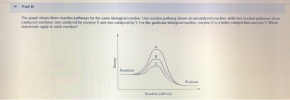 Part B The graph shows three reaction pathways for the same biological reaction One reaction pathway shows an uncatalyzed reaction, while two reaction pathways show catalyzed reactions: one catalyzed by enzyme X and one catalyzed by Y. For this particular biological reaction, enzyme X is a better catalyst than enzyme Y. Which statements apply to each reaction? Products Reaction pathway Reset slowest reaction catalyzed by enzyme X uncatalyzed reaction lowest activation energy fastest reaction highest activation energy catalyzed by enzyme...
For each of the following statements, determine if it is TRUE or FALSE. If false, explain...
For each of the following statements, determine if it is TRUE or FALSE. If false, explain why or rewrite the statement such that it is true. 1. Reactions generally start at equilibrium and stay there. 2. In cells, the product of one reaction is often the substrate for another reaction. 3. The energy of reactants at the start of an uncatalyzed reaction is different from the energy of reactants at the start of a catalyzed reaction. 4. An uncatalyzed reaction...
The activation energy for a reaction is changed from 184 kJ/mol to 58.1 kJ/mol at 600....
The activation energy for a reaction is changed from 184 kJ/mol to 58.1 kJ/mol at 600. K by the introduction of a catalyst. If the uncatalyzed reaction takes about 2574 years to occur, about how long will the catalyzed reaction take? Assume the frequency factor A is constant and assume the initial concentrations are the same.
 Uncatalyzed Catalyzed Enzyme-substrate Complex In the above reaction, the lower curve is an enzyme-catalyzed reaction where the activation energy is notably lower than the uncatalyzed reaction. Suppose the enzyme in the diagram was mutated in such a way that its affinity for the substrate increased 100 fold, thereby affecting the enzyme-substrate complex portion of the curve. Assume that there was no other effect. Would you expect the reaction rate catalyzed by the altered enzyme to be faster, slower, or equal...
 Comparing an uncatalyzed reaction to the same reaction with a catalyst, which one of the following is always true? O The catalyzed reaction will be exergonic. O The catalyzed reaction will have higher activation energy. O The catalyzed reaction will be endergonic. O The catalyzed reaction will have lower activation energy.
 Question #5 Here are the relevant data to determine the activation energy of the reaction. Rate constant (units not shown) Temperature (K) .13 293 0.11 308 Use the data above to determine the activation energy of the reaction? 83 kJ/mol Submit This value is not correct. Please check your calculations and try again. Question #6 Here are your data for trial of Lab 7 (the trial at room temperature without the catalyst): [103 initial (S203 initial Initial Rate .0023 M...
 Part B The graph shows three reaction pathways for the same biological reaction One reaction pathway shows an uncatalyzed reaction, while two reaction pathways show catalyzed reactions: one catalyzed by enzyme X and one catalyzed by Y. For this particular biological reaction, enzyme X is a better catalyst than enzyme Y. Which statements apply to each reaction? Products Reaction pathway Reset slowest reaction catalyzed by enzyme X uncatalyzed reaction lowest activation energy fastest reaction highest activation energy catalyzed by enzyme...
Most questions answered within 3 hours.
-
Where is the error in this code sequence?
String s1 = "Hello";
String s2 = "ello";...
asked 11 months ago -
Financial data for Joel de Paris, Inc., for last year
follow:
Joel de Paris, Inc.
Balance...
asked 11 months ago -
Consider this reaction:
Al2(SO4)3 (aq)+ BaCl3
(aq) Al2Cl6 (aq)- +
3BaSO4(s) . What is the...
asked 11 months ago -
Suppose that Savneet is considering increasing her
recent random sample from 20 car rentals to 40...
asked 11 months ago -
Trucks arrive at an unloading terminal at an average rate of 120
per hour.
Trucks arrive...
asked 11 months ago -
Why are methanol and ethanol completely soluble in water while
octanol is not very little soluble....
asked 11 months ago -
A facilities manager at a university reads in a research report
that the mean amount of...
asked 11 months ago -
When the CuSO4 is rehydrated by adding water to the anhydrous
compound, is this an endothermic...
asked 11 months ago -
A ray of sunlight is passing from diamond into crown glass; the
angle of incidence is...
asked 11 months ago -
A block of mass 0.249 kg is placed on top of a light, vertical
spring of...
asked 11 months ago -
how do the kidneys compensate in the presences of acidosis
a) trigger hyperventilate
b) reserve acid...
asked 11 months ago -
Question 501 pts
The rental rate of capital to the firm increases. Which of the
following...
asked 11 months ago