
Homework Answers
Add Answer to:
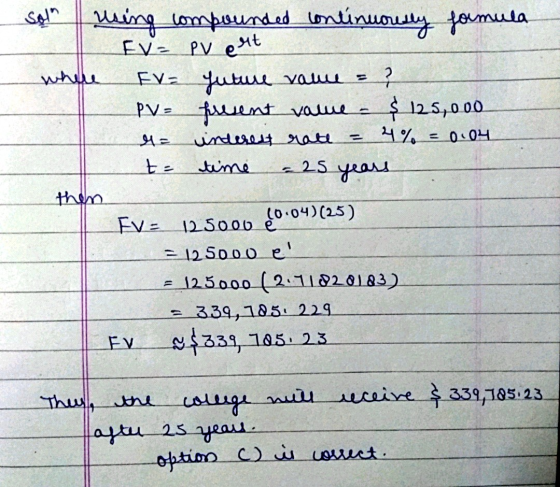
Question 1 (5 points) A philanthropist deposits $125,000 into a trust fund that pays 4% interest,...
A philanthropist deposits $125,000 into a trust fund that pays 4% interest, compounded continuously. The balance...
 A philanthropist deposits $125,000 into a trust fund that pays 4% interest, compounded continuously. The balance will be given to the college from which the philanthropist graduated after the money has earned interest for 25 years. How much will the college receive? OA) $336,448.50 B) $339,220.64 OC) $338,101.73 D) $339,766.61 E) $333,229.54 OF) $339,785.23 G) $250,000.00
Complete the table to determine the amount of money P that should be invested at rater...
 Complete the table to determine the amount of money P that should be invested at rater to produce a final balance of $140,000 int years. (Round your answers to two decimal places.) r = 8%, compounded daily Trust Fund A deposit of $20,000 is made in a trust fund that pays 7% Interest, compounded continuously. It is specified that the balance will be given to the college from which the donor graduated after the money has earned interest for 50...
4. Juan deposits of $1,000 in a savings account that pays 8% compounded annually. Exactly 2...
 4. Juan deposits of $1,000 in a savings account that pays 8% compounded annually. Exactly 2 years later he deposits $3,000; 2 years later he deposits $4,000; and 4 years later he withdraws all of the interest earned to date and transfers it to a fund that pays 10%compounded annually. How much money will be in each fund 4 years after the transfer?
3.26 Georgi Rostov deposits $4,000 in a savings account that pays 8% interest com- pounded monthly....
 3.26 Georgi Rostov deposits $4,000 in a savings account that pays 8% interest com- pounded monthly. Three years later, he deposits $5,000. Two years after the $5,000 deposit, he makes another deposit in the amount of $7000. Four years after the $7,000 deposit, half of the accumulated money is transferred to a fund that pays 9% interest compounded quarterly. How much money will be in each account six years after the transfer?
Mary has created a college trust fund for her son when he turned 8 by making...
Mary has created a college trust fund for her son when he turned 8 by making equal deposits every 6 months for 10 years and leaving money in the account afterwards. At age 21, her son started receiving $4000 at the beginning of every quarter for 4 years, leaving 0 balance in the account after the last payment. a. find the amount of semi annual deposits of money earning 6.5% interest compounded monthly b. what was the total interest accumulated...
3. Linda invests $3000 in a bond trust that pays 8% interest compounded monthly. Her friend...
 3. Linda invests $3000 in a bond trust that pays 8% interest compounded monthly. Her friend Lyla invests $3000 in a certificate of deposit that pays 7.75% compounded continuously. For Linda: a. State which formula should be used to solve this problem. b. Write the resulting function for Linda. c. Determine how much Linda would have in her account after 20 years. For Lyla: a. State which formula should be used to solve this problem. b. Write the resulting function...
A young man is the beneficiary of a trust fund established for him 21 yr ago...
 A young man is the beneficiary of a trust fund established for him 21 yr ago at his birth. If the original amount placed in trust was $50,000, how much will he receive if the money has earned interest at the rate of 10%/year compounded annually? Compounded quarterly? Compounded monthly? (Round your answers to the nearest cent.) compounded annually $ compounded quarterly $ compounded monthly $ Need Help? Read Talk to a Tutor MY NOTES PRACTICE ANOTHER 4. [-/0.1 Points]...
Raj deposits 50 into a fund at the end of each month for 5 years. The fund pays interest at an an...
Raj deposits 50 into a fund at the end of each month for 5 years. The fund pays interest at an annual effective rate of i. The total amount of interest earned during the last month of year 5 is 13. Calculate the accumulated amount in Raj's account at the end of year 5 A) 3325 B) 3350 C) 3375 D) 3400 E) 3425
A man donated a certain amount on a trust fund that will provide an end of...
A man donated a certain amount on a trust fund that will provide an end of the month scholarship grantee for poor deserving students for a period of 10 years. This amount earns an interest rate of 8% compounded monthly. The scholarship amounts to P15,000 every month and the first grant is to be given three years after donation. A. What was the amount of the actual donation? B. How much amount of money will be still available on the...
10). Following the birth of his child, Benjamin deposits $10,000 in a college trust fund where...
 10). Following the birth of his child, Benjamin deposits $10,000 in a college trust fund where interest is 3.9%, compounded semiannually. Find the amount of money in the account at t = 21 years. (Show the correct formula/function and your work.) (Section 5.2) II). The exponential function D(t) = 347(1.024)' gives the number of bachelor's degrees, in thousands, camed in the United Statest years after 1970 (Sources: National Center for Educational Statistics; U.S. Department of Education). Estimate the number of...
 A philanthropist deposits $125,000 into a trust fund that pays 4% interest, compounded continuously. The balance will be given to the college from which the philanthropist graduated after the money has earned interest for 25 years. How much will the college receive? OA) $336,448.50 B) $339,220.64 OC) $338,101.73 D) $339,766.61 E) $333,229.54 OF) $339,785.23 G) $250,000.00
 Complete the table to determine the amount of money P that should be invested at rater to produce a final balance of $140,000 int years. (Round your answers to two decimal places.) r = 8%, compounded daily Trust Fund A deposit of $20,000 is made in a trust fund that pays 7% Interest, compounded continuously. It is specified that the balance will be given to the college from which the donor graduated after the money has earned interest for 50...
 4. Juan deposits of $1,000 in a savings account that pays 8% compounded annually. Exactly 2 years later he deposits $3,000; 2 years later he deposits $4,000; and 4 years later he withdraws all of the interest earned to date and transfers it to a fund that pays 10%compounded annually. How much money will be in each fund 4 years after the transfer?
 3.26 Georgi Rostov deposits $4,000 in a savings account that pays 8% interest com- pounded monthly. Three years later, he deposits $5,000. Two years after the $5,000 deposit, he makes another deposit in the amount of $7000. Four years after the $7,000 deposit, half of the accumulated money is transferred to a fund that pays 9% interest compounded quarterly. How much money will be in each account six years after the transfer?
 3. Linda invests $3000 in a bond trust that pays 8% interest compounded monthly. Her friend Lyla invests $3000 in a certificate of deposit that pays 7.75% compounded continuously. For Linda: a. State which formula should be used to solve this problem. b. Write the resulting function for Linda. c. Determine how much Linda would have in her account after 20 years. For Lyla: a. State which formula should be used to solve this problem. b. Write the resulting function...
 A young man is the beneficiary of a trust fund established for him 21 yr ago at his birth. If the original amount placed in trust was $50,000, how much will he receive if the money has earned interest at the rate of 10%/year compounded annually? Compounded quarterly? Compounded monthly? (Round your answers to the nearest cent.) compounded annually $ compounded quarterly $ compounded monthly $ Need Help? Read Talk to a Tutor MY NOTES PRACTICE ANOTHER 4. [-/0.1 Points]...
 10). Following the birth of his child, Benjamin deposits $10,000 in a college trust fund where interest is 3.9%, compounded semiannually. Find the amount of money in the account at t = 21 years. (Show the correct formula/function and your work.) (Section 5.2) II). The exponential function D(t) = 347(1.024)' gives the number of bachelor's degrees, in thousands, camed in the United Statest years after 1970 (Sources: National Center for Educational Statistics; U.S. Department of Education). Estimate the number of...
Most questions answered within 3 hours.
-
Where is the error in this code sequence?
String s1 = "Hello";
String s2 = "ello";...
asked 10 months ago -
Financial data for Joel de Paris, Inc., for last year
follow:
Joel de Paris, Inc.
Balance...
asked 10 months ago -
Consider this reaction:
Al2(SO4)3 (aq)+ BaCl3
(aq) Al2Cl6 (aq)- +
3BaSO4(s) . What is the...
asked 10 months ago -
Suppose that Savneet is considering increasing her
recent random sample from 20 car rentals to 40...
asked 10 months ago -
Trucks arrive at an unloading terminal at an average rate of 120
per hour.
Trucks arrive...
asked 10 months ago -
Why are methanol and ethanol completely soluble in water while
octanol is not very little soluble....
asked 10 months ago -
A facilities manager at a university reads in a research report
that the mean amount of...
asked 10 months ago -
When the CuSO4 is rehydrated by adding water to the anhydrous
compound, is this an endothermic...
asked 10 months ago -
A ray of sunlight is passing from diamond into crown glass; the
angle of incidence is...
asked 10 months ago -
A block of mass 0.249 kg is placed on top of a light, vertical
spring of...
asked 10 months ago -
how do the kidneys compensate in the presences of acidosis
a) trigger hyperventilate
b) reserve acid...
asked 10 months ago -
Question 501 pts
The rental rate of capital to the firm increases. Which of the
following...
asked 10 months ago