
Homework Answers

Add Answer to:
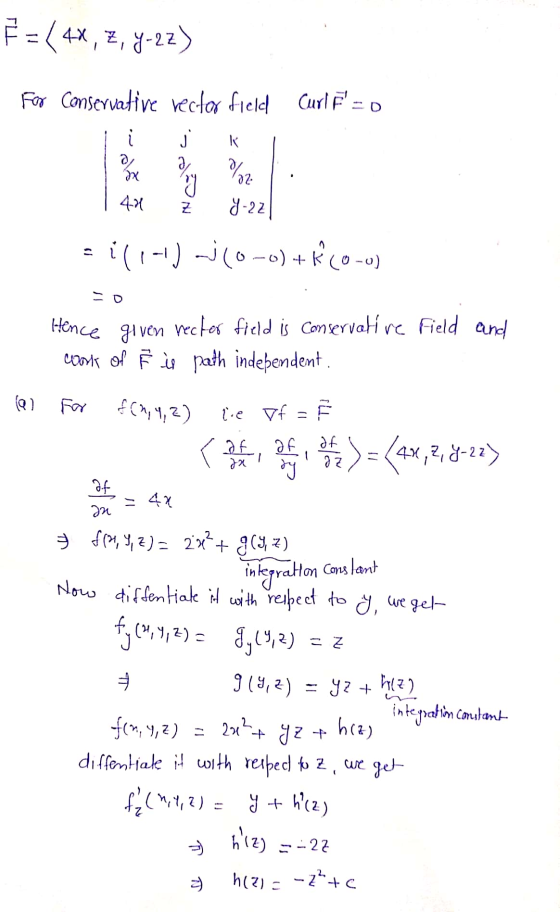
Prove that the following vector field F = 4xi +z j +(y – 2z)k is a...
Line Integral & Path Independency Problem 1 Prove that the vector field = (2x-3yz)i +(2-3x-2) 1-6xyzk...
 Line Integral & Path Independency Problem 1 Prove that the vector field = (2x-3yz)i +(2-3x-2) 1-6xyzk is the gradient of a scalar function f(x,y,z). Hint: find the curl of F, is it a zero vector? Integrate and find f(x,y,z), called a potential, like from potential energy? Show all your work, Then, use f(x,y,z) to compute the line integral, or work of the force F: Work of F= di from A:(-1,0, 2) to B:(3,-4,0) along any curve that goes from A...
(1 point) Consider the vector field F(x, y, z) = (2z + 3y)i + (2z +...
 (1 point) Consider the vector field F(x, y, z) = (2z + 3y)i + (2z + 3x)j + (2y + 2x)k. a) Find a function f such that F = Vf and f(0,0,0) = 0. f(x, y, z) = b) Suppose C is any curve from (0,0,0) to (1,1,1). Use part a) to compute the line integral / F. dr. (1 point) Verify that F = V and evaluate the line integral of F over the given path: F =...
(2) For the vector field f 2z(ri yi)(22)k use the definition of line integral to evaluate the line integral J f.dr along the helical path r-costi + sintj+tk, 0St (3) You are given that the vector fie...
 (2) For the vector field f 2z(ri yi)(22)k use the definition of line integral to evaluate the line integral J f.dr along the helical path r-costi + sintj+tk, 0St (3) You are given that the vector field f in Q2 is conservative. Find the corresponding potential function and use this to check the line integral evaluated in Q2
(2) For the vector field f 2z(ri yi)(22)k use the definition of line integral to evaluate the line integral J f.dr along...
(2) For the vector field f 2z(ri yi)(22)k use the definition of line integral to evaluate the line integral J f.dr along the helical path r-costi + sintj+tk, 0St (3) You are given that the vector field f in Q2 is conservative. Find the corresponding potential function and use this to check the line integral evaluated in Q2
(2) For the vector field f 2z(ri yi)(22)k use the definition of line integral to evaluate the line integral J f.dr along...
Please make it simple and clear to understand 3. A vector field is given by (a) Show that the vector field r is conserva...
 Please make it simple and
clear to understand
3. A vector field is given by (a) Show that the vector field r is conservative. Then find a scalar potential function f(r,y,) such that r - gradf and f(0,0,0) 0 (b) By the result of (a) the following line integral is path independent. Using the scalar potential obtained in (a) evaluate the integral from (0,0,2) (where-y-0) to (4,2,3) (where -1,y 0,2) 4.2,3) J(0,0,2)
3. A vector field is given by (a)...
Please make it simple and
clear to understand
3. A vector field is given by (a) Show that the vector field r is conservative. Then find a scalar potential function f(r,y,) such that r - gradf and f(0,0,0) 0 (b) By the result of (a) the following line integral is path independent. Using the scalar potential obtained in (a) evaluate the integral from (0,0,2) (where-y-0) to (4,2,3) (where -1,y 0,2) 4.2,3) J(0,0,2)
3. A vector field is given by (a)...
This is all one question please answer asap Line Integral & Path Independency Problem 1 Prove...
 This is all one question please
answer asap
Line Integral & Path Independency Problem 1 Prove that the vector field F = (2x – 3yz?) { +(2 – 3xz) j-6xyzk is the gradient of a scalar function f(x,y,z). Hint: find the curl of F, is it a zero vector? Integrate and find f(x,y,z), called a potential, like from potential energy? Show all your work. Then, use f(x,y,z) to compute the line integral, or work of the force F: Work of...
This is all one question please
answer asap
Line Integral & Path Independency Problem 1 Prove that the vector field F = (2x – 3yz?) { +(2 – 3xz) j-6xyzk is the gradient of a scalar function f(x,y,z). Hint: find the curl of F, is it a zero vector? Integrate and find f(x,y,z), called a potential, like from potential energy? Show all your work. Then, use f(x,y,z) to compute the line integral, or work of the force F: Work of...
MA330 Homework #4 1. This exercise concerns the function its gradient vector field F-vo See the p...
 the excercise concerns the function (x^2 + y^2)* e^(1-x^2 -
y^2)
please do all parts
MA330 Homework #4 1. This exercise concerns the function its gradient vector field F-vo See the plots of each below. a) Compute the partial derivatives os and ty to find the gradient field vo. (b) In MA231, learned 1, you learned that mixed second-order partial derivatives of reasonable functions Verity that here by computing day and dys and checking that they are the same. should...
the excercise concerns the function (x^2 + y^2)* e^(1-x^2 -
y^2)
please do all parts
MA330 Homework #4 1. This exercise concerns the function its gradient vector field F-vo See the plots of each below. a) Compute the partial derivatives os and ty to find the gradient field vo. (b) In MA231, learned 1, you learned that mixed second-order partial derivatives of reasonable functions Verity that here by computing day and dys and checking that they are the same. should...
calc 3 7) Fundamental Theorem of Line Integrals. a) Show that the vector field, F(x,y) =...
 calc 3
7) Fundamental Theorem of Line Integrals. a) Show that the vector field, F(x,y) = (2x - 2)i - 23e2v j, is conservative. b) Find a potential function for F. c) Evaluate F. dr if C is the path connecting the three line segments from (1,0) to (2,5) then from (2,5) to (-2,5) and finally from (-2,5) to (-1,0).
calc 3
7) Fundamental Theorem of Line Integrals. a) Show that the vector field, F(x,y) = (2x - 2)i - 23e2v j, is conservative. b) Find a potential function for F. c) Evaluate F. dr if C is the path connecting the three line segments from (1,0) to (2,5) then from (2,5) to (-2,5) and finally from (-2,5) to (-1,0).
Decide whether or not the vector field is a gradient field (i.e. is conservative). If it is conservative, find a potential function. (ii) F(x,y)-6ญ่-12xVJ (iv) F(x, y, z)-< ye", e + z,y >...
 Decide whether or not the vector field is a gradient field (i.e. is conservative). If it is conservative, find a potential function. (ii) F(x,y)-6ญ่-12xVJ (iv) F(x, y, z)-< ye", e + z,y >
Decide whether or not the vector field is a gradient field (i.e. is conservative). If it is conservative, find a potential function. (ii) F(x,y)-6ญ่-12xVJ (iv) F(x, y, z)-
Decide whether or not the vector field is a gradient field (i.e. is conservative). If it is conservative, find a potential function. (ii) F(x,y)-6ญ่-12xVJ (iv) F(x, y, z)-< ye", e + z,y >
Decide whether or not the vector field is a gradient field (i.e. is conservative). If it is conservative, find a potential function. (ii) F(x,y)-6ญ่-12xVJ (iv) F(x, y, z)-
D Question 11 12 pts to Consider the vector field F (x, y, z) =< 2x...
 D Question 11 12 pts to Consider the vector field F (x, y, z) =< 2x – yz, 2y – az,2z – xy>. a) (3) Is this vector field conservative? Justify your answer. b) (9) Find the amount of work done by this vector field in moving a particle along the curve (t) =< 3cost, cos’t, cos” (2t) > from t = 0 tot = 1
Construct and evaluate a surface integral that represents the work done by the vector field F(x, y, z)-(x, 2z, 3y), around the triangular section of the plane 2x + y + z traversed counterclockwise. 8...
 Construct and evaluate a surface integral that represents the work done by the vector field F(x, y, z)-(x, 2z, 3y), around the triangular section of the plane 2x + y + z traversed counterclockwise. 8 in the first octant
Construct and evaluate a surface integral that represents the work done by the vector field F(x, y, z)-(x, 2z, 3y), around the triangular section of the plane 2x + y + z traversed counterclockwise. 8 in the first octant
Construct and evaluate a surface integral that represents the work done by the vector field F(x, y, z)-(x, 2z, 3y), around the triangular section of the plane 2x + y + z traversed counterclockwise. 8 in the first octant
 Line Integral & Path Independency Problem 1 Prove that the vector field = (2x-3yz)i +(2-3x-2) 1-6xyzk is the gradient of a scalar function f(x,y,z). Hint: find the curl of F, is it a zero vector? Integrate and find f(x,y,z), called a potential, like from potential energy? Show all your work, Then, use f(x,y,z) to compute the line integral, or work of the force F: Work of F= di from A:(-1,0, 2) to B:(3,-4,0) along any curve that goes from A...
 (1 point) Consider the vector field F(x, y, z) = (2z + 3y)i + (2z + 3x)j + (2y + 2x)k. a) Find a function f such that F = Vf and f(0,0,0) = 0. f(x, y, z) = b) Suppose C is any curve from (0,0,0) to (1,1,1). Use part a) to compute the line integral / F. dr. (1 point) Verify that F = V and evaluate the line integral of F over the given path: F =...
 (2) For the vector field f 2z(ri yi)(22)k use the definition of line integral to evaluate the line integral J f.dr along the helical path r-costi + sintj+tk, 0St (3) You are given that the vector field f in Q2 is conservative. Find the corresponding potential function and use this to check the line integral evaluated in Q2
(2) For the vector field f 2z(ri yi)(22)k use the definition of line integral to evaluate the line integral J f.dr along...
(2) For the vector field f 2z(ri yi)(22)k use the definition of line integral to evaluate the line integral J f.dr along the helical path r-costi + sintj+tk, 0St (3) You are given that the vector field f in Q2 is conservative. Find the corresponding potential function and use this to check the line integral evaluated in Q2
(2) For the vector field f 2z(ri yi)(22)k use the definition of line integral to evaluate the line integral J f.dr along...
 Please make it simple and
clear to understand
3. A vector field is given by (a) Show that the vector field r is conservative. Then find a scalar potential function f(r,y,) such that r - gradf and f(0,0,0) 0 (b) By the result of (a) the following line integral is path independent. Using the scalar potential obtained in (a) evaluate the integral from (0,0,2) (where-y-0) to (4,2,3) (where -1,y 0,2) 4.2,3) J(0,0,2)
3. A vector field is given by (a)...
Please make it simple and
clear to understand
3. A vector field is given by (a) Show that the vector field r is conservative. Then find a scalar potential function f(r,y,) such that r - gradf and f(0,0,0) 0 (b) By the result of (a) the following line integral is path independent. Using the scalar potential obtained in (a) evaluate the integral from (0,0,2) (where-y-0) to (4,2,3) (where -1,y 0,2) 4.2,3) J(0,0,2)
3. A vector field is given by (a)...
 This is all one question please
answer asap
Line Integral & Path Independency Problem 1 Prove that the vector field F = (2x – 3yz?) { +(2 – 3xz) j-6xyzk is the gradient of a scalar function f(x,y,z). Hint: find the curl of F, is it a zero vector? Integrate and find f(x,y,z), called a potential, like from potential energy? Show all your work. Then, use f(x,y,z) to compute the line integral, or work of the force F: Work of...
This is all one question please
answer asap
Line Integral & Path Independency Problem 1 Prove that the vector field F = (2x – 3yz?) { +(2 – 3xz) j-6xyzk is the gradient of a scalar function f(x,y,z). Hint: find the curl of F, is it a zero vector? Integrate and find f(x,y,z), called a potential, like from potential energy? Show all your work. Then, use f(x,y,z) to compute the line integral, or work of the force F: Work of...
 the excercise concerns the function (x^2 + y^2)* e^(1-x^2 -
y^2)
please do all parts
MA330 Homework #4 1. This exercise concerns the function its gradient vector field F-vo See the plots of each below. a) Compute the partial derivatives os and ty to find the gradient field vo. (b) In MA231, learned 1, you learned that mixed second-order partial derivatives of reasonable functions Verity that here by computing day and dys and checking that they are the same. should...
the excercise concerns the function (x^2 + y^2)* e^(1-x^2 -
y^2)
please do all parts
MA330 Homework #4 1. This exercise concerns the function its gradient vector field F-vo See the plots of each below. a) Compute the partial derivatives os and ty to find the gradient field vo. (b) In MA231, learned 1, you learned that mixed second-order partial derivatives of reasonable functions Verity that here by computing day and dys and checking that they are the same. should...
 calc 3
7) Fundamental Theorem of Line Integrals. a) Show that the vector field, F(x,y) = (2x - 2)i - 23e2v j, is conservative. b) Find a potential function for F. c) Evaluate F. dr if C is the path connecting the three line segments from (1,0) to (2,5) then from (2,5) to (-2,5) and finally from (-2,5) to (-1,0).
calc 3
7) Fundamental Theorem of Line Integrals. a) Show that the vector field, F(x,y) = (2x - 2)i - 23e2v j, is conservative. b) Find a potential function for F. c) Evaluate F. dr if C is the path connecting the three line segments from (1,0) to (2,5) then from (2,5) to (-2,5) and finally from (-2,5) to (-1,0).
 Decide whether or not the vector field is a gradient field (i.e. is conservative). If it is conservative, find a potential function. (ii) F(x,y)-6ญ่-12xVJ (iv) F(x, y, z)-< ye", e + z,y >
Decide whether or not the vector field is a gradient field (i.e. is conservative). If it is conservative, find a potential function. (ii) F(x,y)-6ญ่-12xVJ (iv) F(x, y, z)-
Decide whether or not the vector field is a gradient field (i.e. is conservative). If it is conservative, find a potential function. (ii) F(x,y)-6ญ่-12xVJ (iv) F(x, y, z)-< ye", e + z,y >
Decide whether or not the vector field is a gradient field (i.e. is conservative). If it is conservative, find a potential function. (ii) F(x,y)-6ญ่-12xVJ (iv) F(x, y, z)-
 D Question 11 12 pts to Consider the vector field F (x, y, z) =< 2x – yz, 2y – az,2z – xy>. a) (3) Is this vector field conservative? Justify your answer. b) (9) Find the amount of work done by this vector field in moving a particle along the curve (t) =< 3cost, cos’t, cos” (2t) > from t = 0 tot = 1
 Construct and evaluate a surface integral that represents the work done by the vector field F(x, y, z)-(x, 2z, 3y), around the triangular section of the plane 2x + y + z traversed counterclockwise. 8 in the first octant
Construct and evaluate a surface integral that represents the work done by the vector field F(x, y, z)-(x, 2z, 3y), around the triangular section of the plane 2x + y + z traversed counterclockwise. 8 in the first octant
Construct and evaluate a surface integral that represents the work done by the vector field F(x, y, z)-(x, 2z, 3y), around the triangular section of the plane 2x + y + z traversed counterclockwise. 8 in the first octant
Most questions answered within 3 hours.
-
Where is the error in this code sequence?
String s1 = "Hello";
String s2 = "ello";...
asked 11 months ago -
Financial data for Joel de Paris, Inc., for last year
follow:
Joel de Paris, Inc.
Balance...
asked 11 months ago -
Consider this reaction:
Al2(SO4)3 (aq)+ BaCl3
(aq) Al2Cl6 (aq)- +
3BaSO4(s) . What is the...
asked 11 months ago -
Suppose that Savneet is considering increasing her
recent random sample from 20 car rentals to 40...
asked 11 months ago -
Trucks arrive at an unloading terminal at an average rate of 120
per hour.
Trucks arrive...
asked 11 months ago -
Why are methanol and ethanol completely soluble in water while
octanol is not very little soluble....
asked 11 months ago -
A facilities manager at a university reads in a research report
that the mean amount of...
asked 11 months ago -
When the CuSO4 is rehydrated by adding water to the anhydrous
compound, is this an endothermic...
asked 11 months ago -
A ray of sunlight is passing from diamond into crown glass; the
angle of incidence is...
asked 11 months ago -
A block of mass 0.249 kg is placed on top of a light, vertical
spring of...
asked 11 months ago -
how do the kidneys compensate in the presences of acidosis
a) trigger hyperventilate
b) reserve acid...
asked 11 months ago -
Question 501 pts
The rental rate of capital to the firm increases. Which of the
following...
asked 11 months ago