
Homework Answers
3. Use Newton's method to find solution accurate to within 10-3 for x3 + 3x2 –...
 3. Use Newton's method to find solution accurate to within 10-3 for x3 + 3x2 – 1 = 0 on (-3,-2]. Use po -2,5. 4. Use Secant method to find the solution P4 for In(x - 1) + cos(x - 1) = 0 on [1.3,2]. Use po 1.3 and p1 = 1.5. 5. Use False position method to find the solution P4 for 3x – e* = 0 on [1,2]. Use - Ро 1 and P1 2.
2. Let e1(x) = 1, ez(x) = x, p1(x) = 1 – x and p2(x) =...
 2. Let e1(x) = 1, ez(x) = x, p1(x) = 1 – x and p2(x) = –2 + x. Let E = (e1,e2) and B = (P1, P2). 2 a) Show that B is a basis for P1(R). 4 b) Let ce : R → R3 be the change of coordinates from E to ß. Find the matrix representation of C. Leave your answer as a single simplified matrix. 6 c) Let (:,:) be an inner product on P1(R). Suppose...
3. Let Po(x) respectively. Find the monic Legendre polynomials of degree 2, 3 and 4 using...
 3. Let Po(x) respectively. Find the monic Legendre polynomials of degree 2, 3 and 4 using the orthogonality relation f P(x)Pm(x)dx = 0, mn and m,n E N. 1 and P1(x) = x be two Legendre polynomials of degree 0 and 1,
3. Let Po(x) respectively. Find the monic Legendre polynomials of degree 2, 3 and 4 using the orthogonality relation f P(x)Pm(x)dx = 0, mn and m,n E N. 1 and P1(x) = x be two Legendre polynomials of...
3. Let Po(x) respectively. Find the monic Legendre polynomials of degree 2, 3 and 4 using the orthogonality relation f P(x)Pm(x)dx = 0, mn and m,n E N. 1 and P1(x) = x be two Legendre polynomials of degree 0 and 1,
3. Let Po(x) respectively. Find the monic Legendre polynomials of degree 2, 3 and 4 using the orthogonality relation f P(x)Pm(x)dx = 0, mn and m,n E N. 1 and P1(x) = x be two Legendre polynomials of...
Exercise 2 Let B= (Po, P1, P2) be the standard basis for P2 and B= (91,92,93)...
 Exercise 2 Let B= (Po, P1, P2) be the standard basis for P2 and B= (91,92,93) where: 91 = 1+2,92 = x+r2 and 43 = 2 + x + x2 1. Show that S is a basis for P2. 2. Find the transition matrix PsB 3. Find the transition matrix PB-5 4. Let u=3+ 2.c + 2.ra. Deduce the coordinate vector for u relative to S.
(Generalized Riccati Equation) Let po, p1, p2 : I -> R be continuous functions defined on an interval I of R. Then the 1st-order differential equations of the type Not sure how to solve y using th...
 (Generalized Riccati Equation) Let po, p1, p2 : I -> R be
continuous functions defined on an interval I of R. Then the
1st-order differential equations of the type
Not sure how to solve y using the Ansatz v(x) := y(x)p2(x)
Help is greatly appreciated :D
(Generalized Riccati Equation) Let po, p1, p2 I -R be continous functions defined on an interval T of R. Then the 1st-order differential equations of the type is called generalized Riccati equations. It is...
(Generalized Riccati Equation) Let po, p1, p2 : I -> R be
continuous functions defined on an interval I of R. Then the
1st-order differential equations of the type
Not sure how to solve y using the Ansatz v(x) := y(x)p2(x)
Help is greatly appreciated :D
(Generalized Riccati Equation) Let po, p1, p2 I -R be continous functions defined on an interval T of R. Then the 1st-order differential equations of the type is called generalized Riccati equations. It is...
Problem 2. Let A = {4,5, 7} and B = {y, z}. Let p1 and p2...
 Problem 2. Let A = {4,5, 7} and B = {y, z}. Let p1 and p2 be the projections of A x B onto the first and second coordinates (components). That is, for each pair (a,b) E AXB, pi(a,b) = a and p2 (a,b) = b. Answer the following questions: (2.1) Find p1(4, y) and p1(7,z). (2.2) What is the range of pı? (2.3) Find p2(4, y) and p2(7,2). (2.4) What is the range of p2?
3. (25 pts) Suppose f(x) is twice continuously differentiable for all r, and f"(x) > 0...
 3. (25 pts) Suppose f(x) is twice continuously differentiable for all r, and f"(x) > 0 for all , and f(x) has a root at p satisfying f'(p) < 0. Let p, be Newton's method's sequence of approximations for initial guess po < p. Prove pi > po and pı < p Remember, Newton's method is Pn+1 = pn - f(pn)/f'(P/) and 1 f"(En P+1 P2 f(pP-p)2. between pn and p for some
3. (25 pts) Suppose f(x) is twice...
3. (25 pts) Suppose f(x) is twice continuously differentiable for all r, and f"(x) > 0 for all , and f(x) has a root at p satisfying f'(p) < 0. Let p, be Newton's method's sequence of approximations for initial guess po < p. Prove pi > po and pı < p Remember, Newton's method is Pn+1 = pn - f(pn)/f'(P/) and 1 f"(En P+1 P2 f(pP-p)2. between pn and p for some
3. (25 pts) Suppose f(x) is twice...
Let Ps have the inner product given by evaluation at -2, -1, 1, and 2. Let po(t)-1. P,()-t, and p...
 Let Ps have the inner product given by evaluation at -2, -1, 1, and 2. Let po(t)-1. P,()-t, and p20)- a. Compute the orthogonal projection of p2 onto the subspace spanned by Po and P1 b. Find a polynomial q that is orthogonal to Po and p,, such that Po P is an orthogonal basis for Span(Po P1, P2). Scale the polynomial q so that its vector of values at a2(Simplify your answer.)
Let Ps have the inner product given...
Let Ps have the inner product given by evaluation at -2, -1, 1, and 2. Let po(t)-1. P,()-t, and p20)- a. Compute the orthogonal projection of p2 onto the subspace spanned by Po and P1 b. Find a polynomial q that is orthogonal to Po and p,, such that Po P is an orthogonal basis for Span(Po P1, P2). Scale the polynomial q so that its vector of values at a2(Simplify your answer.)
Let Ps have the inner product given...
2. Find a root ofthe functionf(x)=cos(x) +sin(x)-2x2 to fourdeci mal places for!f(xn +1 )1< 0.001...
 2. Find a root ofthe functionf(x)=cos(x) +sin(x)-2x2 to fourdeci mal places for!f(xn +1 )1< 0.001 and Ixn-1-Xnl0.001 for each of the following rootfinding methods and initial guesses: a) Newton's Method, for xo = 0.2. b) Secant Method, for x-,-0.2 and xo = 0.5. c) Considering the following fixed point problern for xo=0.2 cos(xn)sin(n) d) Write a code to approximate the root of f(x) for each a), b) andc
2. Find a root ofthe functionf(x)=cos(x) +sin(x)-2x2 to fourdeci mal places for!f(xn...
2. Find a root ofthe functionf(x)=cos(x) +sin(x)-2x2 to fourdeci mal places for!f(xn +1 )1< 0.001 and Ixn-1-Xnl0.001 for each of the following rootfinding methods and initial guesses: a) Newton's Method, for xo = 0.2. b) Secant Method, for x-,-0.2 and xo = 0.5. c) Considering the following fixed point problern for xo=0.2 cos(xn)sin(n) d) Write a code to approximate the root of f(x) for each a), b) andc
2. Find a root ofthe functionf(x)=cos(x) +sin(x)-2x2 to fourdeci mal places for!f(xn...
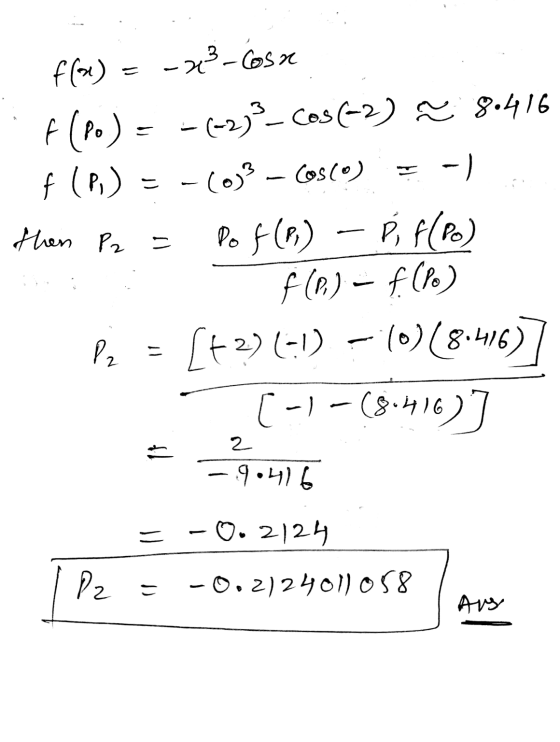
You are given the values p0 = 0 , p1 = 1 and f(p1) = -1...
You are given the values p0 = 0 , p1 = 1 and f(p1) = -1 . One interaction of the Secand method using p0 and p1 has been applied to f(x) to obtain p2 Aitken's delta^2 is the used. The result is p3 = 2/3. Determine f(p0)
 3. Use Newton's method to find solution accurate to within 10-3 for x3 + 3x2 – 1 = 0 on (-3,-2]. Use po -2,5. 4. Use Secant method to find the solution P4 for In(x - 1) + cos(x - 1) = 0 on [1.3,2]. Use po 1.3 and p1 = 1.5. 5. Use False position method to find the solution P4 for 3x – e* = 0 on [1,2]. Use - Ро 1 and P1 2.
 2. Let e1(x) = 1, ez(x) = x, p1(x) = 1 – x and p2(x) = –2 + x. Let E = (e1,e2) and B = (P1, P2). 2 a) Show that B is a basis for P1(R). 4 b) Let ce : R → R3 be the change of coordinates from E to ß. Find the matrix representation of C. Leave your answer as a single simplified matrix. 6 c) Let (:,:) be an inner product on P1(R). Suppose...
 3. Let Po(x) respectively. Find the monic Legendre polynomials of degree 2, 3 and 4 using the orthogonality relation f P(x)Pm(x)dx = 0, mn and m,n E N. 1 and P1(x) = x be two Legendre polynomials of degree 0 and 1,
3. Let Po(x) respectively. Find the monic Legendre polynomials of degree 2, 3 and 4 using the orthogonality relation f P(x)Pm(x)dx = 0, mn and m,n E N. 1 and P1(x) = x be two Legendre polynomials of...
3. Let Po(x) respectively. Find the monic Legendre polynomials of degree 2, 3 and 4 using the orthogonality relation f P(x)Pm(x)dx = 0, mn and m,n E N. 1 and P1(x) = x be two Legendre polynomials of degree 0 and 1,
3. Let Po(x) respectively. Find the monic Legendre polynomials of degree 2, 3 and 4 using the orthogonality relation f P(x)Pm(x)dx = 0, mn and m,n E N. 1 and P1(x) = x be two Legendre polynomials of...
 Exercise 2 Let B= (Po, P1, P2) be the standard basis for P2 and B= (91,92,93) where: 91 = 1+2,92 = x+r2 and 43 = 2 + x + x2 1. Show that S is a basis for P2. 2. Find the transition matrix PsB 3. Find the transition matrix PB-5 4. Let u=3+ 2.c + 2.ra. Deduce the coordinate vector for u relative to S.
 (Generalized Riccati Equation) Let po, p1, p2 : I -> R be
continuous functions defined on an interval I of R. Then the
1st-order differential equations of the type
Not sure how to solve y using the Ansatz v(x) := y(x)p2(x)
Help is greatly appreciated :D
(Generalized Riccati Equation) Let po, p1, p2 I -R be continous functions defined on an interval T of R. Then the 1st-order differential equations of the type is called generalized Riccati equations. It is...
(Generalized Riccati Equation) Let po, p1, p2 : I -> R be
continuous functions defined on an interval I of R. Then the
1st-order differential equations of the type
Not sure how to solve y using the Ansatz v(x) := y(x)p2(x)
Help is greatly appreciated :D
(Generalized Riccati Equation) Let po, p1, p2 I -R be continous functions defined on an interval T of R. Then the 1st-order differential equations of the type is called generalized Riccati equations. It is...
 Problem 2. Let A = {4,5, 7} and B = {y, z}. Let p1 and p2 be the projections of A x B onto the first and second coordinates (components). That is, for each pair (a,b) E AXB, pi(a,b) = a and p2 (a,b) = b. Answer the following questions: (2.1) Find p1(4, y) and p1(7,z). (2.2) What is the range of pı? (2.3) Find p2(4, y) and p2(7,2). (2.4) What is the range of p2?
 3. (25 pts) Suppose f(x) is twice continuously differentiable for all r, and f"(x) > 0 for all , and f(x) has a root at p satisfying f'(p) < 0. Let p, be Newton's method's sequence of approximations for initial guess po < p. Prove pi > po and pı < p Remember, Newton's method is Pn+1 = pn - f(pn)/f'(P/) and 1 f"(En P+1 P2 f(pP-p)2. between pn and p for some
3. (25 pts) Suppose f(x) is twice...
3. (25 pts) Suppose f(x) is twice continuously differentiable for all r, and f"(x) > 0 for all , and f(x) has a root at p satisfying f'(p) < 0. Let p, be Newton's method's sequence of approximations for initial guess po < p. Prove pi > po and pı < p Remember, Newton's method is Pn+1 = pn - f(pn)/f'(P/) and 1 f"(En P+1 P2 f(pP-p)2. between pn and p for some
3. (25 pts) Suppose f(x) is twice...
 Let Ps have the inner product given by evaluation at -2, -1, 1, and 2. Let po(t)-1. P,()-t, and p20)- a. Compute the orthogonal projection of p2 onto the subspace spanned by Po and P1 b. Find a polynomial q that is orthogonal to Po and p,, such that Po P is an orthogonal basis for Span(Po P1, P2). Scale the polynomial q so that its vector of values at a2(Simplify your answer.)
Let Ps have the inner product given...
Let Ps have the inner product given by evaluation at -2, -1, 1, and 2. Let po(t)-1. P,()-t, and p20)- a. Compute the orthogonal projection of p2 onto the subspace spanned by Po and P1 b. Find a polynomial q that is orthogonal to Po and p,, such that Po P is an orthogonal basis for Span(Po P1, P2). Scale the polynomial q so that its vector of values at a2(Simplify your answer.)
Let Ps have the inner product given...
 2. Find a root ofthe functionf(x)=cos(x) +sin(x)-2x2 to fourdeci mal places for!f(xn +1 )1< 0.001 and Ixn-1-Xnl0.001 for each of the following rootfinding methods and initial guesses: a) Newton's Method, for xo = 0.2. b) Secant Method, for x-,-0.2 and xo = 0.5. c) Considering the following fixed point problern for xo=0.2 cos(xn)sin(n) d) Write a code to approximate the root of f(x) for each a), b) andc
2. Find a root ofthe functionf(x)=cos(x) +sin(x)-2x2 to fourdeci mal places for!f(xn...
2. Find a root ofthe functionf(x)=cos(x) +sin(x)-2x2 to fourdeci mal places for!f(xn +1 )1< 0.001 and Ixn-1-Xnl0.001 for each of the following rootfinding methods and initial guesses: a) Newton's Method, for xo = 0.2. b) Secant Method, for x-,-0.2 and xo = 0.5. c) Considering the following fixed point problern for xo=0.2 cos(xn)sin(n) d) Write a code to approximate the root of f(x) for each a), b) andc
2. Find a root ofthe functionf(x)=cos(x) +sin(x)-2x2 to fourdeci mal places for!f(xn...
Most questions answered within 3 hours.
-
Where is the error in this code sequence?
String s1 = "Hello";
String s2 = "ello";...
asked 11 months ago -
Financial data for Joel de Paris, Inc., for last year
follow:
Joel de Paris, Inc.
Balance...
asked 11 months ago -
Consider this reaction:
Al2(SO4)3 (aq)+ BaCl3
(aq) Al2Cl6 (aq)- +
3BaSO4(s) . What is the...
asked 11 months ago -
Suppose that Savneet is considering increasing her
recent random sample from 20 car rentals to 40...
asked 11 months ago -
Trucks arrive at an unloading terminal at an average rate of 120
per hour.
Trucks arrive...
asked 11 months ago -
Why are methanol and ethanol completely soluble in water while
octanol is not very little soluble....
asked 11 months ago -
A facilities manager at a university reads in a research report
that the mean amount of...
asked 11 months ago -
When the CuSO4 is rehydrated by adding water to the anhydrous
compound, is this an endothermic...
asked 11 months ago -
A ray of sunlight is passing from diamond into crown glass; the
angle of incidence is...
asked 11 months ago -
A block of mass 0.249 kg is placed on top of a light, vertical
spring of...
asked 11 months ago -
how do the kidneys compensate in the presences of acidosis
a) trigger hyperventilate
b) reserve acid...
asked 11 months ago -
Question 501 pts
The rental rate of capital to the firm increases. Which of the
following...
asked 11 months ago