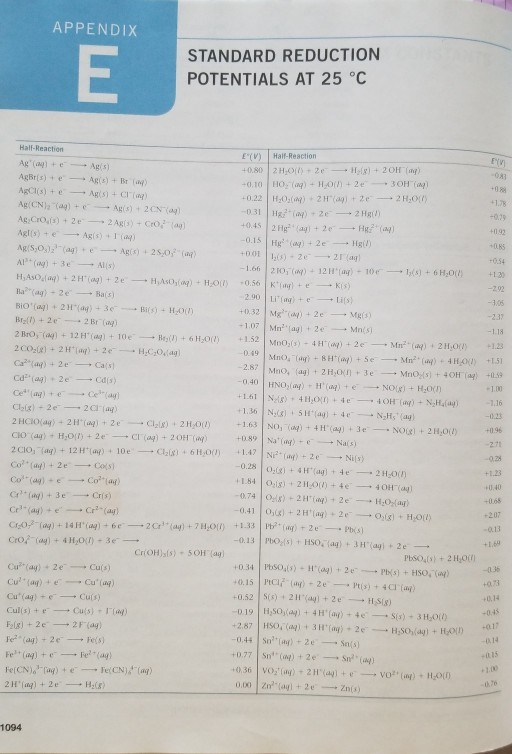
please help. I have included Appendix E. I do not know
what to look for in it. Thank you

Homework Answers
Request Answer!
We need at least 10 more requests to produce the answer.
0 / 10 have requested this problem solution
The more requests, the faster the answer.
Add Answer to:
please help. I have included Appendix E. I do not know
what to look for in...
Using data found in Appendix E of your textbook calculate the nonstandard emf for each of...
 Using data found in Appendix E of your textbook calculate the
nonstandard emf for each of the following reactions if the
concentration of each of the ions in these reactions is 0.0005
molar and everything else is standard (use 298 K for the
temperature, R = 8.314 J/mol-K, and F = 96,485 C/mol):
Using data found in Appendix E of your textbook calculate the nonstandard emf for each of the following reactions if the concentration of each of the ions...
Using data found in Appendix E of your textbook calculate the
nonstandard emf for each of the following reactions if the
concentration of each of the ions in these reactions is 0.0005
molar and everything else is standard (use 298 K for the
temperature, R = 8.314 J/mol-K, and F = 96,485 C/mol):
Using data found in Appendix E of your textbook calculate the nonstandard emf for each of the following reactions if the concentration of each of the ions...
2. Using the decay chain for 238U, calculate the amount of time it takes 5.0 kg...
 2. Using the decay chain for 238U, calculate the amount of time it takes 5.0 kg of 238U to decay to 2.5 kg. What mass of 206Pb is produced? (5 points) (V) Helpful Stuff Thermodynamics: AG° = AH-TAS Nernst Equation: 6 = 6 - (RT/nF)InQ AG=RTIK At 25°C: 8 = 6 - (0.0591/n)logQ ΔGIRT Ke=e AGⓇ = -nF8° Units/Constants: Volt: 1 V=1/C Faraday: 1 F -96,485 C/mol e Arrhenius Equation: k = Ae Ea/RT R= 8.314 J/mol K Integrated Rate...
5. How much faster would a reaction be if a catalyst is used that lowers the...
 5. How much faster would a reaction be if a catalyst is used that lowers the activation energy from 20.0 kJ/mol to 10.0 kJ/mol? Do the calculation at two temperatures: first at 25.0°C and then at 0.0°C. (20 points) (V) Helpful Stuff Thermodynamics: AG° = AH-TAS Nernst Equation: 6 = 6 - (RT/nF)InQ AG=RTIK At 25°C: 8 = 6 - (0.0591/n)logQ AGRT Ke=e AGⓇ =-nF8° Units/Constants: Volt: 1 V = 1 J/C Faraday: 1 F = 96,485 C/mole Arrhenius Equation:...
1. How do I read the half reaction table? 2. If im asked for the best...
 1. How do I read the half reaction table?
2. If im asked for the best reducing agent from Cu+, Ag+, F2, and
Fe3+, where do I look first in the table? before the arrow or after
the arrow?
3. Sometimes a value that has originally a positive (V) from the
table it will have the negative sign in a homework problem, and
viceversa, so the question is, how do I use the positive and
negative signs in respect to...
1. How do I read the half reaction table?
2. If im asked for the best reducing agent from Cu+, Ag+, F2, and
Fe3+, where do I look first in the table? before the arrow or after
the arrow?
3. Sometimes a value that has originally a positive (V) from the
table it will have the negative sign in a homework problem, and
viceversa, so the question is, how do I use the positive and
negative signs in respect to...
help!! (CH3),CBr + 1 → (CH3),CI + Br the following data were collected: [(CH3)3Br] (M) Time...
 help!!
(CH3),CBr + 1 → (CH3),CI + Br the following data were collected: [(CH3)3Br] (M) Time (s) 0.600 0 0.424 10.0 0.300 20.0 0.212 30.0 0.150 40.0 Determine the rate law for this reaction and calculate the rate constant. (20 points) E (V) Thermodynamics: AGº - AH-TAS Nernst Equation: 8 = 8°-(RT/nF)InQ AGⓇ--RTINK At 25°C: 8-6° -0.0591/n)logQ AG RT K-e AG° = -nF8° Units/Constants: Volt: 1 V-1 JC Faraday: 1 F -96,485 C/mole Ea/RT Arrhenius Equation: k = Ae R-8.314...
help!!
(CH3),CBr + 1 → (CH3),CI + Br the following data were collected: [(CH3)3Br] (M) Time (s) 0.600 0 0.424 10.0 0.300 20.0 0.212 30.0 0.150 40.0 Determine the rate law for this reaction and calculate the rate constant. (20 points) E (V) Thermodynamics: AGº - AH-TAS Nernst Equation: 8 = 8°-(RT/nF)InQ AGⓇ--RTINK At 25°C: 8-6° -0.0591/n)logQ AG RT K-e AG° = -nF8° Units/Constants: Volt: 1 V-1 JC Faraday: 1 F -96,485 C/mole Ea/RT Arrhenius Equation: k = Ae R-8.314...
Consider the following species. Cut Ce3+ Ag+ Zn2+ What is the standard potential for the reaction...
 Consider the following species. Cut Ce3+ Ag+ Zn2+ What is the standard potential for the reaction of Cut with Zn2+ to produce Cu2+ and Zn? E = 0.28 X v Will Cut be able to reduce Zn2+ to Zn? no (yes or no) What is the standard potential for the reaction of Ce3+ with Ag! to produce Ag? Ex= 0.90 x v Will Cell be able to reduce Ag! to Ag? yes (yer or no) Ered (V) 0.68 0.52 0.40...
7. Using the following reaction progress diagram, answer the questions below: wiring Energy A G Rxn....
 7. Using the following reaction progress diagram, answer the questions below: wiring Energy A G Rxn. a. How many steps are in the reaction? How do you know? (4 points) b. Which letter corresponds to the rate-determining-step? Explain your choice. (6 points) c. Is the reaction exothermic or endothermic? How do you know? (4 points) d. If the energy at point B is lowered, what will happen to the rate of the reaction will it increase, decrease, or stay the...
Fill in the Blanks 0.34 Half Reaction E. (V) Half Reaction Erd® (V) F + 2e...
 Fill in the Blanks 0.34 Half Reaction E. (V) Half Reaction Erd® (V) F + 2e →2F 0+ 2H + 2e →H,02 0.68 Ag* + e → Ag Cu* + e → Cu 0.52 Co? + e Co? O2 + 2H,0 + 4e → 40H 0.40 H,O, + 2H + 2e → 2H,0 Cu2+ + 2e → Cu Cet+e → Ces Cu2+ + e → Cut 0.16 PbO, + 4H+ +50,2 +2e → PbSO, + 2H,0 2H* + 2e →...
2.87 Ered® (V) 0.68 0.52 0.40 0.34 0.16 Half Reaction F,+ 2e →2F Ag* + e...
 2.87 Ered® (V) 0.68 0.52 0.40 0.34 0.16 Half Reaction F,+ 2e →2F Ag* + e → Ag Co3 + e + CO2- H2O2 + 2H+ + 2e → 2H,0 Ce4+ + e → Ce+ PbO, + 4H+ + SO42- + 2e → PbSO, + 2H,0 Mno, + 4H+ + 3e → MnO2 + 2H,0 2e + 2H+ + 10, → 103 + H2O Mn0, +8H+ + 5e → Mn2+ + 4H,0 Aul+ + 3e → Au Cl2 + 2e...
1. Which metal can reduce Ni2+ ions but not Fe2+ ions? Cd²⁺,Cr,Sn²⁺,Sn,Cd 2.Which species can oxidize...
 1. Which metal can reduce Ni2+ ions but not Fe2+ ions?
Cd²⁺,Cr,Sn²⁺,Sn,Cd
2.Which species can oxidize Sn but not Fe?
Ni,Ni²⁺,Pb²⁺,Cd,Pb
1.68 1.51 1.50 1.09 1.00 0.96 0.95 FAO) + 2 H,0,1a) + 2H(aq) + 2e PO4 + 4H"(aq) + S0,00) + 2€ Mno. (aq) + 4H(aq) + 3e Mno,aq) + 8H(aq) + 5e Au?+ (aq) + 3€ PbO (8) + 4H(aq) + 2 Cl@) + 2 Cr,0,?" (aq) + 14 H*(aq) + 6e 0,(@) + 4H(aq) + 4e MnO...
1. Which metal can reduce Ni2+ ions but not Fe2+ ions?
Cd²⁺,Cr,Sn²⁺,Sn,Cd
2.Which species can oxidize Sn but not Fe?
Ni,Ni²⁺,Pb²⁺,Cd,Pb
1.68 1.51 1.50 1.09 1.00 0.96 0.95 FAO) + 2 H,0,1a) + 2H(aq) + 2e PO4 + 4H"(aq) + S0,00) + 2€ Mno. (aq) + 4H(aq) + 3e Mno,aq) + 8H(aq) + 5e Au?+ (aq) + 3€ PbO (8) + 4H(aq) + 2 Cl@) + 2 Cr,0,?" (aq) + 14 H*(aq) + 6e 0,(@) + 4H(aq) + 4e MnO...
 Using data found in Appendix E of your textbook calculate the
nonstandard emf for each of the following reactions if the
concentration of each of the ions in these reactions is 0.0005
molar and everything else is standard (use 298 K for the
temperature, R = 8.314 J/mol-K, and F = 96,485 C/mol):
Using data found in Appendix E of your textbook calculate the nonstandard emf for each of the following reactions if the concentration of each of the ions...
Using data found in Appendix E of your textbook calculate the
nonstandard emf for each of the following reactions if the
concentration of each of the ions in these reactions is 0.0005
molar and everything else is standard (use 298 K for the
temperature, R = 8.314 J/mol-K, and F = 96,485 C/mol):
Using data found in Appendix E of your textbook calculate the nonstandard emf for each of the following reactions if the concentration of each of the ions...
 2. Using the decay chain for 238U, calculate the amount of time it takes 5.0 kg of 238U to decay to 2.5 kg. What mass of 206Pb is produced? (5 points) (V) Helpful Stuff Thermodynamics: AG° = AH-TAS Nernst Equation: 6 = 6 - (RT/nF)InQ AG=RTIK At 25°C: 8 = 6 - (0.0591/n)logQ ΔGIRT Ke=e AGⓇ = -nF8° Units/Constants: Volt: 1 V=1/C Faraday: 1 F -96,485 C/mol e Arrhenius Equation: k = Ae Ea/RT R= 8.314 J/mol K Integrated Rate...
 5. How much faster would a reaction be if a catalyst is used that lowers the activation energy from 20.0 kJ/mol to 10.0 kJ/mol? Do the calculation at two temperatures: first at 25.0°C and then at 0.0°C. (20 points) (V) Helpful Stuff Thermodynamics: AG° = AH-TAS Nernst Equation: 6 = 6 - (RT/nF)InQ AG=RTIK At 25°C: 8 = 6 - (0.0591/n)logQ AGRT Ke=e AGⓇ =-nF8° Units/Constants: Volt: 1 V = 1 J/C Faraday: 1 F = 96,485 C/mole Arrhenius Equation:...
 1. How do I read the half reaction table?
2. If im asked for the best reducing agent from Cu+, Ag+, F2, and
Fe3+, where do I look first in the table? before the arrow or after
the arrow?
3. Sometimes a value that has originally a positive (V) from the
table it will have the negative sign in a homework problem, and
viceversa, so the question is, how do I use the positive and
negative signs in respect to...
1. How do I read the half reaction table?
2. If im asked for the best reducing agent from Cu+, Ag+, F2, and
Fe3+, where do I look first in the table? before the arrow or after
the arrow?
3. Sometimes a value that has originally a positive (V) from the
table it will have the negative sign in a homework problem, and
viceversa, so the question is, how do I use the positive and
negative signs in respect to...
 help!!
(CH3),CBr + 1 → (CH3),CI + Br the following data were collected: [(CH3)3Br] (M) Time (s) 0.600 0 0.424 10.0 0.300 20.0 0.212 30.0 0.150 40.0 Determine the rate law for this reaction and calculate the rate constant. (20 points) E (V) Thermodynamics: AGº - AH-TAS Nernst Equation: 8 = 8°-(RT/nF)InQ AGⓇ--RTINK At 25°C: 8-6° -0.0591/n)logQ AG RT K-e AG° = -nF8° Units/Constants: Volt: 1 V-1 JC Faraday: 1 F -96,485 C/mole Ea/RT Arrhenius Equation: k = Ae R-8.314...
help!!
(CH3),CBr + 1 → (CH3),CI + Br the following data were collected: [(CH3)3Br] (M) Time (s) 0.600 0 0.424 10.0 0.300 20.0 0.212 30.0 0.150 40.0 Determine the rate law for this reaction and calculate the rate constant. (20 points) E (V) Thermodynamics: AGº - AH-TAS Nernst Equation: 8 = 8°-(RT/nF)InQ AGⓇ--RTINK At 25°C: 8-6° -0.0591/n)logQ AG RT K-e AG° = -nF8° Units/Constants: Volt: 1 V-1 JC Faraday: 1 F -96,485 C/mole Ea/RT Arrhenius Equation: k = Ae R-8.314...
 Consider the following species. Cut Ce3+ Ag+ Zn2+ What is the standard potential for the reaction of Cut with Zn2+ to produce Cu2+ and Zn? E = 0.28 X v Will Cut be able to reduce Zn2+ to Zn? no (yes or no) What is the standard potential for the reaction of Ce3+ with Ag! to produce Ag? Ex= 0.90 x v Will Cell be able to reduce Ag! to Ag? yes (yer or no) Ered (V) 0.68 0.52 0.40...
 7. Using the following reaction progress diagram, answer the questions below: wiring Energy A G Rxn. a. How many steps are in the reaction? How do you know? (4 points) b. Which letter corresponds to the rate-determining-step? Explain your choice. (6 points) c. Is the reaction exothermic or endothermic? How do you know? (4 points) d. If the energy at point B is lowered, what will happen to the rate of the reaction will it increase, decrease, or stay the...
 Fill in the Blanks 0.34 Half Reaction E. (V) Half Reaction Erd® (V) F + 2e →2F 0+ 2H + 2e →H,02 0.68 Ag* + e → Ag Cu* + e → Cu 0.52 Co? + e Co? O2 + 2H,0 + 4e → 40H 0.40 H,O, + 2H + 2e → 2H,0 Cu2+ + 2e → Cu Cet+e → Ces Cu2+ + e → Cut 0.16 PbO, + 4H+ +50,2 +2e → PbSO, + 2H,0 2H* + 2e →...
 2.87 Ered® (V) 0.68 0.52 0.40 0.34 0.16 Half Reaction F,+ 2e →2F Ag* + e → Ag Co3 + e + CO2- H2O2 + 2H+ + 2e → 2H,0 Ce4+ + e → Ce+ PbO, + 4H+ + SO42- + 2e → PbSO, + 2H,0 Mno, + 4H+ + 3e → MnO2 + 2H,0 2e + 2H+ + 10, → 103 + H2O Mn0, +8H+ + 5e → Mn2+ + 4H,0 Aul+ + 3e → Au Cl2 + 2e...
 1. Which metal can reduce Ni2+ ions but not Fe2+ ions?
Cd²⁺,Cr,Sn²⁺,Sn,Cd
2.Which species can oxidize Sn but not Fe?
Ni,Ni²⁺,Pb²⁺,Cd,Pb
1.68 1.51 1.50 1.09 1.00 0.96 0.95 FAO) + 2 H,0,1a) + 2H(aq) + 2e PO4 + 4H"(aq) + S0,00) + 2€ Mno. (aq) + 4H(aq) + 3e Mno,aq) + 8H(aq) + 5e Au?+ (aq) + 3€ PbO (8) + 4H(aq) + 2 Cl@) + 2 Cr,0,?" (aq) + 14 H*(aq) + 6e 0,(@) + 4H(aq) + 4e MnO...
1. Which metal can reduce Ni2+ ions but not Fe2+ ions?
Cd²⁺,Cr,Sn²⁺,Sn,Cd
2.Which species can oxidize Sn but not Fe?
Ni,Ni²⁺,Pb²⁺,Cd,Pb
1.68 1.51 1.50 1.09 1.00 0.96 0.95 FAO) + 2 H,0,1a) + 2H(aq) + 2e PO4 + 4H"(aq) + S0,00) + 2€ Mno. (aq) + 4H(aq) + 3e Mno,aq) + 8H(aq) + 5e Au?+ (aq) + 3€ PbO (8) + 4H(aq) + 2 Cl@) + 2 Cr,0,?" (aq) + 14 H*(aq) + 6e 0,(@) + 4H(aq) + 4e MnO...
Most questions answered within 3 hours.
-
Where is the error in this code sequence?
String s1 = "Hello";
String s2 = "ello";...
asked 10 months ago -
Financial data for Joel de Paris, Inc., for last year
follow:
Joel de Paris, Inc.
Balance...
asked 10 months ago -
Consider this reaction:
Al2(SO4)3 (aq)+ BaCl3
(aq) Al2Cl6 (aq)- +
3BaSO4(s) . What is the...
asked 10 months ago -
Suppose that Savneet is considering increasing her
recent random sample from 20 car rentals to 40...
asked 10 months ago -
Trucks arrive at an unloading terminal at an average rate of 120
per hour.
Trucks arrive...
asked 10 months ago -
Why are methanol and ethanol completely soluble in water while
octanol is not very little soluble....
asked 10 months ago -
A facilities manager at a university reads in a research report
that the mean amount of...
asked 10 months ago -
When the CuSO4 is rehydrated by adding water to the anhydrous
compound, is this an endothermic...
asked 10 months ago -
A ray of sunlight is passing from diamond into crown glass; the
angle of incidence is...
asked 10 months ago -
A block of mass 0.249 kg is placed on top of a light, vertical
spring of...
asked 10 months ago -
how do the kidneys compensate in the presences of acidosis
a) trigger hyperventilate
b) reserve acid...
asked 10 months ago -
Question 501 pts
The rental rate of capital to the firm increases. Which of the
following...
asked 10 months ago