
Homework Answers
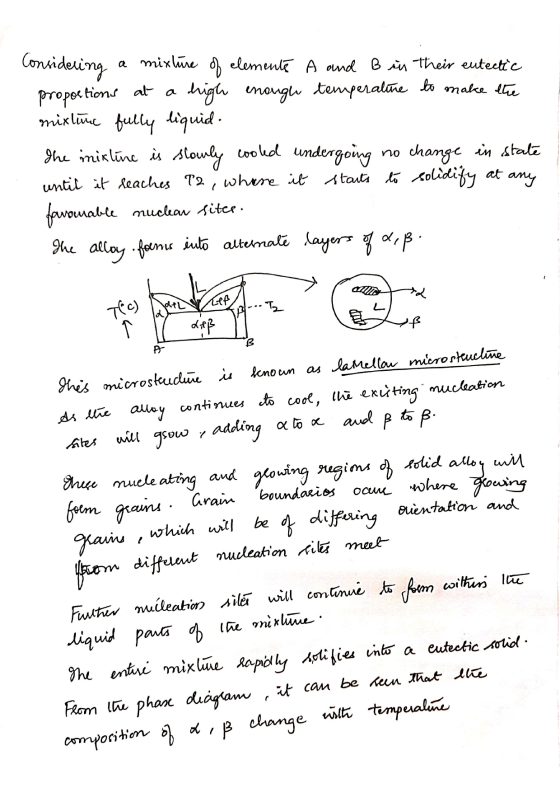
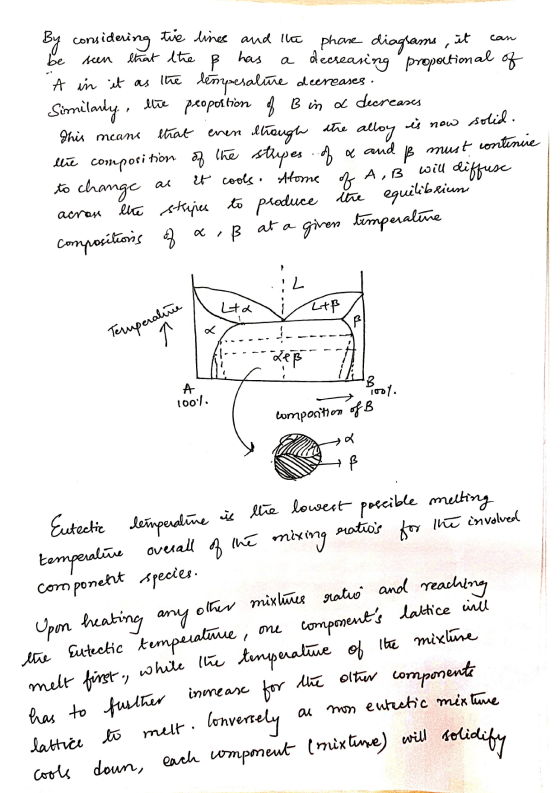
pls look below for detailed solution
Add Answer to:
Briefly explain why, upon solidification, an alloy of eutectic composition forms a microstructure consisting of alternating...
Briefly explain why, upon solidification, an alloy of eutectic composition forms a microstructure consisting of alternating...
 Briefly explain why, upon solidification, an alloy of eutectic composition forms a microstructure consisting of alternating layers of the two solid phases. What is this structure called? What kind of effect does this structure have on the melting point of the alloy and why? (5 points)
4. Briefly explain why, upon solidification, an alloy of eutectic composition forms a microstructure consisting of...
 4. Briefly explain why, upon solidification, an alloy of eutectic composition forms a microstructure consisting of alternating layers of the two solid phases. What is this structure called? What kind of effect does this structure have on the melting point of the alloy and why? (5 points)
Would you expect an amorphous piece of solid polyethylene (PE) to be isotropic or anisotropic? Briefly...
 Would you expect an amorphous piece of solid polyethylene (PE) to be isotropic or anisotropic? Briefly explain............(2 points) Briefly explain why, upon solidification, an alloy of eutectic composition forms a microstructure consisting of alternating layers of the two solid phases. What is this structure called? What kind of effect does this structure have on the melting point of the alloy and why? (5 points)
10. In the following phase diagram for Zn-Cu Alloy. Label one eutectic, eutectoid and peritectic point...
 10. In the following phase diagram for Zn-Cu Alloy. Label one eutectic, eutectoid and peritectic point and write down the reactions and all other relevant details. Also explain the eutectoid reaction i.e. why does one solid phase convert to two solid phases as the alloy cools down.....(5 points) Composition (at% Zn) 20 40 60 80 12000 100 2200 2000 a + L a+2 Liquid 1000 1800 BUL 1600 800 a 1400 B Temperature (°C) a Temperature (°F) B 8 +L...
10. In the following phase diagram for Zn-Cu Alloy. Label one eutectic, eutectoid and peritectic point...
 10. In the following phase diagram for Zn-Cu Alloy. Label one eutectic, eutectoid and peritectic point and write down the reactions and all other relevant details. Also explain the eutectoid reaction i.e. why does one solid phase convert to two solid phases as the alloy cools down.....(5 points) a)The figure needs to be part of your answer sheet Composition (at% Zn) 20 1200 40 60 100 12200 80 2000 a+L Liquid 1000 1800 B+L 1600 800 1400 3 B Temperature...
10. In the following phase diagram for Zn-Cu Alloy. Label one eutectic, eutectoid and peritectic point...
 10. In the following phase diagram for Zn-Cu Alloy. Label one eutectic, eutectoid and peritectic point and write down the reactions and all other relevant details. Also explain the eutectoid reaction i.e. why does one solid phase convert to two solid phases as the alloy cools down.....(5 points) Composition (at% Zn) 20 40 60 80 12000 100 2200 2000 a + L a+2 Liquid 1000 1800 BUL 1600 800 a 1400 B Temperature (°C) a Temperature (°F) B 8 +L...
10. In the following phase diagram for Zn-Cu Alloy. Label one eutectic, eutectoid and peritectic point...
 10. In the following phase diagram for Zn-Cu Alloy. Label one eutectic, eutectoid and peritectic point and write down the reactions and all other relevant details. Also explain the eutectoid reaction i.e. why does one solid phase convert to two solid phases as the alloy cools down.....(5 points) a)The figure needs to be part of your answer sheet Composition (at% Zn) 20 40 60 80 1200 100 2200 2000 a + L Liquid 1000 1800 B+L 1600 800 1400 €...
In the following phase diagram for Zn-Cu Alloy. Label one eutectic, eutectoid and peritectic point and...
 In the following phase diagram for Zn-Cu Alloy. Label one eutectic, eutectoid and peritectic point and write down the reactions and all other relevant details. Also explain the eutectoid reaction i.e. why does one solid phase convert to two solid phases as the alloy cools down. a)The figure needs to be part of your answer sheet Composition (at% Zn) 0 20 40 60 80 1200 100 12200 2000 a + L Liquid 1000 1800 B+L 1600 800 + 1400 B...
When do cored structures (grains) form during cooling of an alloy – Equilibrium or non-equilibrium cooling?...
 When do cored structures (grains) form during cooling of an alloy – Equilibrium or non-equilibrium cooling? Why? ..........(4 points) a)Note: Explain what component (higher or lower melting point) forms the core (center) and the boundary (outer edges) of the cored structure (grain)? Draw a single repeat unit of each; polyvinylchloride (PVC) and polystyrene (PS). Which is more likely to be crystalline, linear syndiotactic PVC or linear atactic PS? Briefly explain..... (4 points)
Quostion 5 Alloy phase diagrams are useful in determining the freezing range of various metals and...
 Quostion 5 Alloy phase diagrams are useful in determining the freezing range of various metals and alloys. The binary phase diagram for Lead (Pb) Tin (Sn) is given below for the full compositional range. Of the compositions given, which is expected to have the lowest fluidity? (a) Pure Lead (Pb) [Owt% Sn] (b) 10wt% Sn (c) 20wt% Sn (d) 60wt% Sn (e) Pure Tin (Sn) [100wt% Sn] 400 327 °C 350 Liquidus Line Liquid 300 232 "C 250 aPb +L...
 Briefly explain why, upon solidification, an alloy of eutectic composition forms a microstructure consisting of alternating layers of the two solid phases. What is this structure called? What kind of effect does this structure have on the melting point of the alloy and why? (5 points)
 4. Briefly explain why, upon solidification, an alloy of eutectic composition forms a microstructure consisting of alternating layers of the two solid phases. What is this structure called? What kind of effect does this structure have on the melting point of the alloy and why? (5 points)
 Would you expect an amorphous piece of solid polyethylene (PE) to be isotropic or anisotropic? Briefly explain............(2 points) Briefly explain why, upon solidification, an alloy of eutectic composition forms a microstructure consisting of alternating layers of the two solid phases. What is this structure called? What kind of effect does this structure have on the melting point of the alloy and why? (5 points)
 10. In the following phase diagram for Zn-Cu Alloy. Label one eutectic, eutectoid and peritectic point and write down the reactions and all other relevant details. Also explain the eutectoid reaction i.e. why does one solid phase convert to two solid phases as the alloy cools down.....(5 points) Composition (at% Zn) 20 40 60 80 12000 100 2200 2000 a + L a+2 Liquid 1000 1800 BUL 1600 800 a 1400 B Temperature (°C) a Temperature (°F) B 8 +L...
 10. In the following phase diagram for Zn-Cu Alloy. Label one eutectic, eutectoid and peritectic point and write down the reactions and all other relevant details. Also explain the eutectoid reaction i.e. why does one solid phase convert to two solid phases as the alloy cools down.....(5 points) a)The figure needs to be part of your answer sheet Composition (at% Zn) 20 1200 40 60 100 12200 80 2000 a+L Liquid 1000 1800 B+L 1600 800 1400 3 B Temperature...
 10. In the following phase diagram for Zn-Cu Alloy. Label one eutectic, eutectoid and peritectic point and write down the reactions and all other relevant details. Also explain the eutectoid reaction i.e. why does one solid phase convert to two solid phases as the alloy cools down.....(5 points) Composition (at% Zn) 20 40 60 80 12000 100 2200 2000 a + L a+2 Liquid 1000 1800 BUL 1600 800 a 1400 B Temperature (°C) a Temperature (°F) B 8 +L...
 10. In the following phase diagram for Zn-Cu Alloy. Label one eutectic, eutectoid and peritectic point and write down the reactions and all other relevant details. Also explain the eutectoid reaction i.e. why does one solid phase convert to two solid phases as the alloy cools down.....(5 points) a)The figure needs to be part of your answer sheet Composition (at% Zn) 20 40 60 80 1200 100 2200 2000 a + L Liquid 1000 1800 B+L 1600 800 1400 €...
 In the following phase diagram for Zn-Cu Alloy. Label one eutectic, eutectoid and peritectic point and write down the reactions and all other relevant details. Also explain the eutectoid reaction i.e. why does one solid phase convert to two solid phases as the alloy cools down. a)The figure needs to be part of your answer sheet Composition (at% Zn) 0 20 40 60 80 1200 100 12200 2000 a + L Liquid 1000 1800 B+L 1600 800 + 1400 B...
 When do cored structures (grains) form during cooling of an alloy – Equilibrium or non-equilibrium cooling? Why? ..........(4 points) a)Note: Explain what component (higher or lower melting point) forms the core (center) and the boundary (outer edges) of the cored structure (grain)? Draw a single repeat unit of each; polyvinylchloride (PVC) and polystyrene (PS). Which is more likely to be crystalline, linear syndiotactic PVC or linear atactic PS? Briefly explain..... (4 points)
 Quostion 5 Alloy phase diagrams are useful in determining the freezing range of various metals and alloys. The binary phase diagram for Lead (Pb) Tin (Sn) is given below for the full compositional range. Of the compositions given, which is expected to have the lowest fluidity? (a) Pure Lead (Pb) [Owt% Sn] (b) 10wt% Sn (c) 20wt% Sn (d) 60wt% Sn (e) Pure Tin (Sn) [100wt% Sn] 400 327 °C 350 Liquidus Line Liquid 300 232 "C 250 aPb +L...
Most questions answered within 3 hours.
-
Where is the error in this code sequence?
String s1 = "Hello";
String s2 = "ello";...
asked 11 months ago -
Financial data for Joel de Paris, Inc., for last year
follow:
Joel de Paris, Inc.
Balance...
asked 11 months ago -
Consider this reaction:
Al2(SO4)3 (aq)+ BaCl3
(aq) Al2Cl6 (aq)- +
3BaSO4(s) . What is the...
asked 11 months ago -
Suppose that Savneet is considering increasing her
recent random sample from 20 car rentals to 40...
asked 11 months ago -
Trucks arrive at an unloading terminal at an average rate of 120
per hour.
Trucks arrive...
asked 11 months ago -
Why are methanol and ethanol completely soluble in water while
octanol is not very little soluble....
asked 11 months ago -
A facilities manager at a university reads in a research report
that the mean amount of...
asked 11 months ago -
When the CuSO4 is rehydrated by adding water to the anhydrous
compound, is this an endothermic...
asked 11 months ago -
A ray of sunlight is passing from diamond into crown glass; the
angle of incidence is...
asked 11 months ago -
A block of mass 0.249 kg is placed on top of a light, vertical
spring of...
asked 11 months ago -
how do the kidneys compensate in the presences of acidosis
a) trigger hyperventilate
b) reserve acid...
asked 11 months ago -
Question 501 pts
The rental rate of capital to the firm increases. Which of the
following...
asked 11 months ago