
Homework Answers
If you find the answer helpful, please give a upvote/like/thumbs up. Thank you in advance. It means alot to us!!
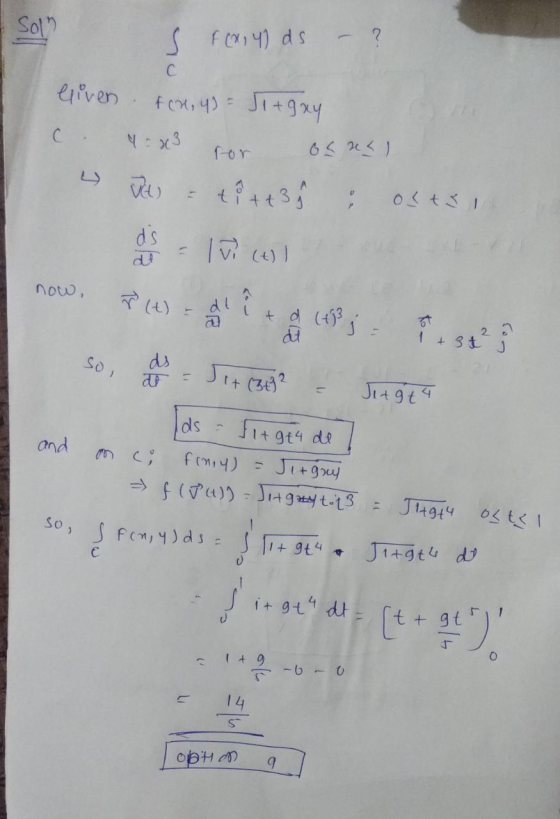
Evaluate Scf(x, y)dS where C is the curve y = x3 for 0 SX S1 and...
 Evaluate Scf(x, y)dS where C is the curve y = x3 for 0 SX S1 and the surface is f(x, y) = V1 + 9xy Select one: 15 a. 7 IS b. 13 5 13 O c. 1 7 O d. d. 1 14 5
I lost in this I need help please thank you 5) [8] Evaluate ds , where...
 I lost in this I need help please thank you
5) [8] Evaluate ds , where C is the curve y=-x4 1<x<2. 7 X
I lost in this I need help please thank you
5) [8] Evaluate ds , where C is the curve y=-x4 1<x<2. 7 X
:) IS (x+y+z)ds X-1 (b): Find the work done by F over the curve in the...
 :) IS (x+y+z)ds X-1 (b): Find the work done by F over the curve in the direction of increasing t, where F =< x² + y, y2 + 1, ze >, r(t) =< cost, sint,t/27 >, Osts 27. y-2=2-3 =+ C) -1-2 I-3
Sc 3x?yz ds, where C: x=t, y =ť, z = {1,0 <t<l.
 Sc 3x?yz ds, where C: x=t, y =ť, z = {1,0 <t<l.
using this formula 2. Evaluate the surface integral F. dS, where F(x, y, z) = xi+yj+zk...
 using this formula
2. Evaluate the surface integral F. dS, where F(x, y, z) = xi+yj+zk is taken over the paraboloid z=1 – x2 - y2, z > 0. SA errom bove de SS (-P (- Puerto Q + R) dA dy
using this formula
2. Evaluate the surface integral F. dS, where F(x, y, z) = xi+yj+zk is taken over the paraboloid z=1 – x2 - y2, z > 0. SA errom bove de SS (-P (- Puerto Q + R) dA dy
F. dr Find a function of such that of 8 and then evaluate where F(x, y)...
 F. dr Find a function of such that of 8 and then evaluate where F(x, y) = < 3 + 2kg", 2y) and C is any smooth curve from (-2, 1) to (1,2).
Evaluate the surface integral lis(r,y,z) (x, y, z) ds where f(x, y, z) = x +...
 Evaluate the surface integral lis(r,y,z) (x, y, z) ds where f(x, y, z) = x + y + z and o is the is the surface of the cube defined by the inequalities 0 < x < 5,0 Sy < 5 and 0 <3 < 5. [Hint: integrate over each face separately.] 1 f(x, y, z) ds =
Let S be the surface of the box given by {(x, y, z) – 2 <<<0,...
 Let S be the surface of the box given by {(x, y, z) – 2 <<<0, -1<y<2, 0<z<3} with outward orientation. Let Ę =< -æln(yz), yln(yz), –22 > be a vector field in R3. Using the Divergence Theorem, compute the flux of F across S. That is, use the Divergence Theorem to compute SS F. ds S
for x<4 Evaluate m(-3) where m(x) = {22.4 for 45x< 1 |vx-1 for x 21 0-13...
 for x<4 Evaluate m(-3) where m(x) = {22.4 for 45x< 1 |vx-1 for x 21 0-13 O 2, 5, 2i O2 O 2.5 O 5
2y + y + 2y = g(t), (O) = 0, y'(0) = 0 where g) 5...
 2y + y + 2y = g(t), (O) = 0, y'(0) = 0 where g) 5 St<20 10, 0<t<5 and t > 20
 Evaluate Scf(x, y)dS where C is the curve y = x3 for 0 SX S1 and the surface is f(x, y) = V1 + 9xy Select one: 15 a. 7 IS b. 13 5 13 O c. 1 7 O d. d. 1 14 5
 I lost in this I need help please thank you
5) [8] Evaluate ds , where C is the curve y=-x4 1<x<2. 7 X
I lost in this I need help please thank you
5) [8] Evaluate ds , where C is the curve y=-x4 1<x<2. 7 X
 :) IS (x+y+z)ds X-1 (b): Find the work done by F over the curve in the direction of increasing t, where F =< x² + y, y2 + 1, ze >, r(t) =< cost, sint,t/27 >, Osts 27. y-2=2-3 =+ C) -1-2 I-3
 Sc 3x?yz ds, where C: x=t, y =ť, z = {1,0 <t<l.
 using this formula
2. Evaluate the surface integral F. dS, where F(x, y, z) = xi+yj+zk is taken over the paraboloid z=1 – x2 - y2, z > 0. SA errom bove de SS (-P (- Puerto Q + R) dA dy
using this formula
2. Evaluate the surface integral F. dS, where F(x, y, z) = xi+yj+zk is taken over the paraboloid z=1 – x2 - y2, z > 0. SA errom bove de SS (-P (- Puerto Q + R) dA dy
 F. dr Find a function of such that of 8 and then evaluate where F(x, y) = < 3 + 2kg", 2y) and C is any smooth curve from (-2, 1) to (1,2).
 Evaluate the surface integral lis(r,y,z) (x, y, z) ds where f(x, y, z) = x + y + z and o is the is the surface of the cube defined by the inequalities 0 < x < 5,0 Sy < 5 and 0 <3 < 5. [Hint: integrate over each face separately.] 1 f(x, y, z) ds =
 Let S be the surface of the box given by {(x, y, z) – 2 <<<0, -1<y<2, 0<z<3} with outward orientation. Let Ę =< -æln(yz), yln(yz), –22 > be a vector field in R3. Using the Divergence Theorem, compute the flux of F across S. That is, use the Divergence Theorem to compute SS F. ds S
 for x<4 Evaluate m(-3) where m(x) = {22.4 for 45x< 1 |vx-1 for x 21 0-13 O 2, 5, 2i O2 O 2.5 O 5
 2y + y + 2y = g(t), (O) = 0, y'(0) = 0 where g) 5 St<20 10, 0<t<5 and t > 20
Most questions answered within 3 hours.
-
Where is the error in this code sequence?
String s1 = "Hello";
String s2 = "ello";...
asked 11 months ago -
Financial data for Joel de Paris, Inc., for last year
follow:
Joel de Paris, Inc.
Balance...
asked 11 months ago -
Consider this reaction:
Al2(SO4)3 (aq)+ BaCl3
(aq) Al2Cl6 (aq)- +
3BaSO4(s) . What is the...
asked 11 months ago -
Suppose that Savneet is considering increasing her
recent random sample from 20 car rentals to 40...
asked 11 months ago -
Trucks arrive at an unloading terminal at an average rate of 120
per hour.
Trucks arrive...
asked 11 months ago -
Why are methanol and ethanol completely soluble in water while
octanol is not very little soluble....
asked 11 months ago -
A facilities manager at a university reads in a research report
that the mean amount of...
asked 11 months ago -
When the CuSO4 is rehydrated by adding water to the anhydrous
compound, is this an endothermic...
asked 11 months ago -
A ray of sunlight is passing from diamond into crown glass; the
angle of incidence is...
asked 11 months ago -
A block of mass 0.249 kg is placed on top of a light, vertical
spring of...
asked 11 months ago -
how do the kidneys compensate in the presences of acidosis
a) trigger hyperventilate
b) reserve acid...
asked 11 months ago -
Question 501 pts
The rental rate of capital to the firm increases. Which of the
following...
asked 11 months ago