
Homework Answers
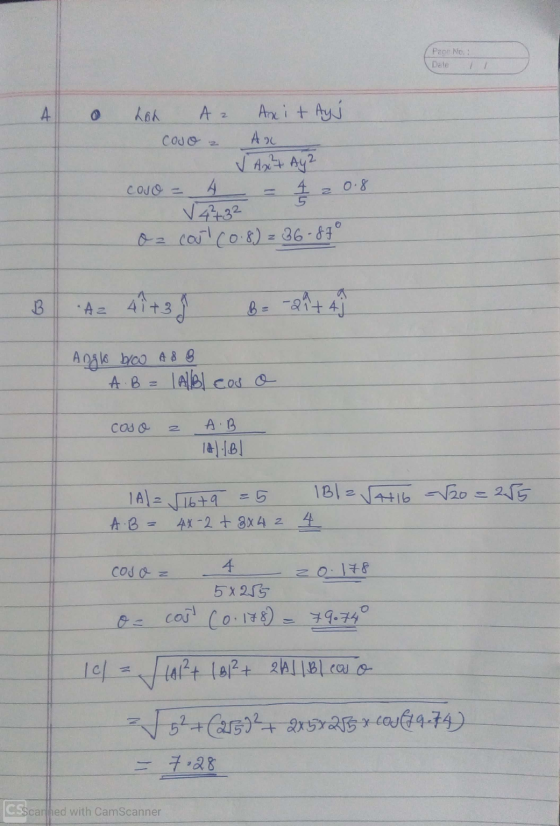
A) 36.87o
B) 7.28
Consider the two vectors, A and B. À = 5i + 3j B = -2î+4j Answer...
 Consider the two vectors, A and B. À = 5i + 3j B = -2î+4j Answer the two questions below, using three significant figures. Part A: What angle (0) does the vector A make with the x-axis? 0 = deg Part B: If the vector C is such that C = A + B, what is the magnitude of C?
Consider the two vectors, A and B. A = 4 + 2] B = -2 +...
 Consider the two vectors, A and B. A = 4 + 2] B = -2 + 4 Answer the two questions below, using three significant figures. Part A: What angle (0) does the vector A make with the x-axis? 0 = deg Part B: If the vector C is such that C = A + B, what is the magnitude of C? C=
Question 1 of 8 > Consider the two vectors, A and B. A = sî +...
 Question 1 of 8 > Consider the two vectors, A and B. A = sî + 2 B = -2 + S Answer the two questions below, using three significant figures. Part A: What angle (0) does the vector A make with the x-axis? deg Part B: If the vector C is such that C = A + B, what is the magnitude of C?
Learning Goal: To use geometric and component addition of vectors. Four vectors A, B, C, and...
 Learning Goal:
To use geometric and component addition of vectors.
Four vectors A, B,
C, and D are shown (not to
scale). Vector A has magnitude 18.9 and acts at an
angle of 13.3 degrees with respect to the positive x axis.
Vector B has magnitude 14.1 and acts at an angle
of 71.3 degrees with respect to the positive x axis.
Vector C has magnitude 46.1 and acts at an angle
of 147.5 degrees with respect to the positive...
Learning Goal:
To use geometric and component addition of vectors.
Four vectors A, B,
C, and D are shown (not to
scale). Vector A has magnitude 18.9 and acts at an
angle of 13.3 degrees with respect to the positive x axis.
Vector B has magnitude 14.1 and acts at an angle
of 71.3 degrees with respect to the positive x axis.
Vector C has magnitude 46.1 and acts at an angle
of 147.5 degrees with respect to the positive...
Part A Review For the three vectors shown in (Figure 1), AB+C-1j. What is vector B?...
 Part A Review For the three vectors shown in (Figure 1), AB+C-1j. What is vector B? Write B in component form. Express your answer in terms of the unit vectors i and j. Use the 'unit vector' button to denote unit vectors in your answer 0四 Subnit Part B What is the magnitude of B? Express yo ur answer using two significant figures. Figure 1 of 1> Submit Part C What is the direction angle of B measured clockwise from...
Exercise 1.44 Part A: Given two vectors A = 4.00i + 7.00j and B = 5.00i...
 Exercise 1.44
Part A: Given two vectors
A = 4.00i + 7.00j and B = 5.00i - 2.00j
Find the vector product A x B (expressed in unit vectors).
Express your answer in terms of the unit vectors I, j, and k.
Express your answer using three significant figures.
Part B:
What is the magnitude of the vector product?
Given two vectors A 4.00i + 7.00, and B = 5.00i-200j. find the vector product A x B (expressed in unit...
Exercise 1.44
Part A: Given two vectors
A = 4.00i + 7.00j and B = 5.00i - 2.00j
Find the vector product A x B (expressed in unit vectors).
Express your answer in terms of the unit vectors I, j, and k.
Express your answer using three significant figures.
Part B:
What is the magnitude of the vector product?
Given two vectors A 4.00i + 7.00, and B = 5.00i-200j. find the vector product A x B (expressed in unit...
1- Two vectors are given as u = 2î – 5j and v=-î +3j. a- Find...
 1- Two vectors are given as u = 2î – 5j and v=-î +3j. a- Find the vector 2u + 3v (by calculation, not by drawing). (4 pts) b- Find the magnitudes lil and 17% of the two vectors. (4 pts) c- Calculate the scalar product uov. (5 pts) d- Find the angle 0 between the vectors ū and . (6 pts) e-Calculate the vector product u xv. (6 pts)
Consider the two vectors A (a) Calculate A + B 5i-3 j and Bi - 4j...
 Consider the two vectors A (a) Calculate A + B 5i-3 j and Bi - 4j (b) Calculate A - B (c) Calculate |A + B (d) Calculate A -B (e) Calculate the directions of A + B and A -B A +B A B "(counterclockwise from the +x axis) o (counterclockwise from the +x axis) Need Help? Ir Read it |||| Master lt An engineer designs a roller coaster so that a car travels horizontally for 192 ft, then...
What is the x-component of vector B? For the three vectors shown in the figure, the...
 What is the x-component of vector B? For the three vectors shown in the figure, the vector sum D=A+B+C has components D. = 2 and D, = 0. (Figure 1) O ALV B. Submit Request Answer Figure 1 of 1 Part B What is the y-component of vector B? VALO By = Submit Request Answer - Part 6 For the three vectors shown in the figure, the vector sum D = A + B + C has components D, =...
Three forces of magnitudes F1=4.0N, F2=6.0N, and F3=8.0N are applied to a block of mass m=2.0kg, initially at rest, at...
 Three forces of magnitudes F1=4.0N, F2=6.0N, and F3=8.0N are
applied to a block of mass m=2.0kg, initially at rest, at angles
shown on the diagram. (Figure 1) In this problem, you will
determine the resultant (net) force by combining the three
individual force vectors. All angles should be measured
counterclockwise from the positive x axis (i.e., all angles are
positive).Part A: Calculate the magnitude of the resultant force F? r=F?
1+F? 2+F? 3 acting on the block.Express the magnitude of...
Three forces of magnitudes F1=4.0N, F2=6.0N, and F3=8.0N are
applied to a block of mass m=2.0kg, initially at rest, at angles
shown on the diagram. (Figure 1) In this problem, you will
determine the resultant (net) force by combining the three
individual force vectors. All angles should be measured
counterclockwise from the positive x axis (i.e., all angles are
positive).Part A: Calculate the magnitude of the resultant force F? r=F?
1+F? 2+F? 3 acting on the block.Express the magnitude of...
 Consider the two vectors, A and B. À = 5i + 3j B = -2î+4j Answer the two questions below, using three significant figures. Part A: What angle (0) does the vector A make with the x-axis? 0 = deg Part B: If the vector C is such that C = A + B, what is the magnitude of C?
 Consider the two vectors, A and B. A = 4 + 2] B = -2 + 4 Answer the two questions below, using three significant figures. Part A: What angle (0) does the vector A make with the x-axis? 0 = deg Part B: If the vector C is such that C = A + B, what is the magnitude of C? C=
 Question 1 of 8 > Consider the two vectors, A and B. A = sî + 2 B = -2 + S Answer the two questions below, using three significant figures. Part A: What angle (0) does the vector A make with the x-axis? deg Part B: If the vector C is such that C = A + B, what is the magnitude of C?
 Learning Goal:
To use geometric and component addition of vectors.
Four vectors A, B,
C, and D are shown (not to
scale). Vector A has magnitude 18.9 and acts at an
angle of 13.3 degrees with respect to the positive x axis.
Vector B has magnitude 14.1 and acts at an angle
of 71.3 degrees with respect to the positive x axis.
Vector C has magnitude 46.1 and acts at an angle
of 147.5 degrees with respect to the positive...
Learning Goal:
To use geometric and component addition of vectors.
Four vectors A, B,
C, and D are shown (not to
scale). Vector A has magnitude 18.9 and acts at an
angle of 13.3 degrees with respect to the positive x axis.
Vector B has magnitude 14.1 and acts at an angle
of 71.3 degrees with respect to the positive x axis.
Vector C has magnitude 46.1 and acts at an angle
of 147.5 degrees with respect to the positive...
 Part A Review For the three vectors shown in (Figure 1), AB+C-1j. What is vector B? Write B in component form. Express your answer in terms of the unit vectors i and j. Use the 'unit vector' button to denote unit vectors in your answer 0四 Subnit Part B What is the magnitude of B? Express yo ur answer using two significant figures. Figure 1 of 1> Submit Part C What is the direction angle of B measured clockwise from...
 Exercise 1.44
Part A: Given two vectors
A = 4.00i + 7.00j and B = 5.00i - 2.00j
Find the vector product A x B (expressed in unit vectors).
Express your answer in terms of the unit vectors I, j, and k.
Express your answer using three significant figures.
Part B:
What is the magnitude of the vector product?
Given two vectors A 4.00i + 7.00, and B = 5.00i-200j. find the vector product A x B (expressed in unit...
Exercise 1.44
Part A: Given two vectors
A = 4.00i + 7.00j and B = 5.00i - 2.00j
Find the vector product A x B (expressed in unit vectors).
Express your answer in terms of the unit vectors I, j, and k.
Express your answer using three significant figures.
Part B:
What is the magnitude of the vector product?
Given two vectors A 4.00i + 7.00, and B = 5.00i-200j. find the vector product A x B (expressed in unit...
 1- Two vectors are given as u = 2î – 5j and v=-î +3j. a- Find the vector 2u + 3v (by calculation, not by drawing). (4 pts) b- Find the magnitudes lil and 17% of the two vectors. (4 pts) c- Calculate the scalar product uov. (5 pts) d- Find the angle 0 between the vectors ū and . (6 pts) e-Calculate the vector product u xv. (6 pts)
 Consider the two vectors A (a) Calculate A + B 5i-3 j and Bi - 4j (b) Calculate A - B (c) Calculate |A + B (d) Calculate A -B (e) Calculate the directions of A + B and A -B A +B A B "(counterclockwise from the +x axis) o (counterclockwise from the +x axis) Need Help? Ir Read it |||| Master lt An engineer designs a roller coaster so that a car travels horizontally for 192 ft, then...
 What is the x-component of vector B? For the three vectors shown in the figure, the vector sum D=A+B+C has components D. = 2 and D, = 0. (Figure 1) O ALV B. Submit Request Answer Figure 1 of 1 Part B What is the y-component of vector B? VALO By = Submit Request Answer - Part 6 For the three vectors shown in the figure, the vector sum D = A + B + C has components D, =...
 Three forces of magnitudes F1=4.0N, F2=6.0N, and F3=8.0N are
applied to a block of mass m=2.0kg, initially at rest, at angles
shown on the diagram. (Figure 1) In this problem, you will
determine the resultant (net) force by combining the three
individual force vectors. All angles should be measured
counterclockwise from the positive x axis (i.e., all angles are
positive).Part A: Calculate the magnitude of the resultant force F? r=F?
1+F? 2+F? 3 acting on the block.Express the magnitude of...
Three forces of magnitudes F1=4.0N, F2=6.0N, and F3=8.0N are
applied to a block of mass m=2.0kg, initially at rest, at angles
shown on the diagram. (Figure 1) In this problem, you will
determine the resultant (net) force by combining the three
individual force vectors. All angles should be measured
counterclockwise from the positive x axis (i.e., all angles are
positive).Part A: Calculate the magnitude of the resultant force F? r=F?
1+F? 2+F? 3 acting on the block.Express the magnitude of...
Most questions answered within 3 hours.
-
Where is the error in this code sequence?
String s1 = "Hello";
String s2 = "ello";...
asked 10 months ago -
Financial data for Joel de Paris, Inc., for last year
follow:
Joel de Paris, Inc.
Balance...
asked 10 months ago -
Consider this reaction:
Al2(SO4)3 (aq)+ BaCl3
(aq) Al2Cl6 (aq)- +
3BaSO4(s) . What is the...
asked 10 months ago -
Suppose that Savneet is considering increasing her
recent random sample from 20 car rentals to 40...
asked 10 months ago -
Trucks arrive at an unloading terminal at an average rate of 120
per hour.
Trucks arrive...
asked 10 months ago -
Why are methanol and ethanol completely soluble in water while
octanol is not very little soluble....
asked 10 months ago -
A facilities manager at a university reads in a research report
that the mean amount of...
asked 10 months ago -
When the CuSO4 is rehydrated by adding water to the anhydrous
compound, is this an endothermic...
asked 10 months ago -
A ray of sunlight is passing from diamond into crown glass; the
angle of incidence is...
asked 10 months ago -
A block of mass 0.249 kg is placed on top of a light, vertical
spring of...
asked 10 months ago -
how do the kidneys compensate in the presences of acidosis
a) trigger hyperventilate
b) reserve acid...
asked 10 months ago -
Question 501 pts
The rental rate of capital to the firm increases. Which of the
following...
asked 10 months ago