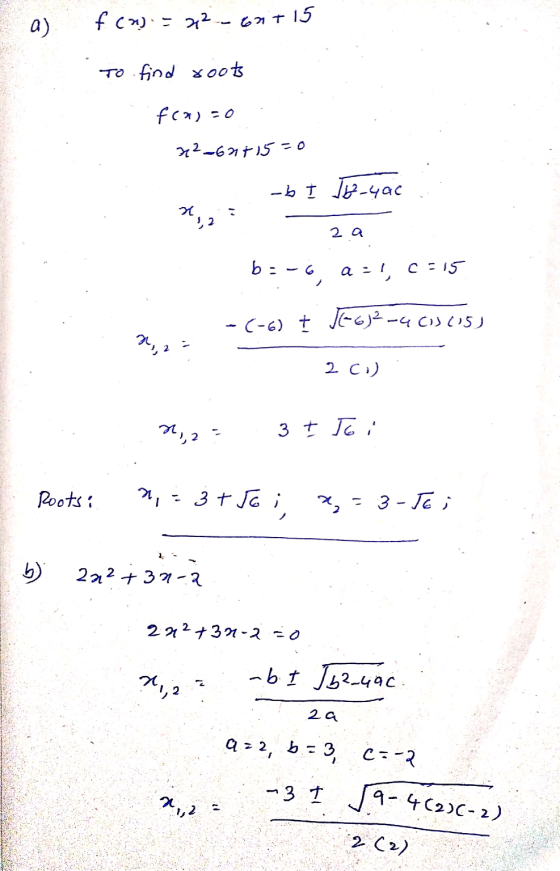
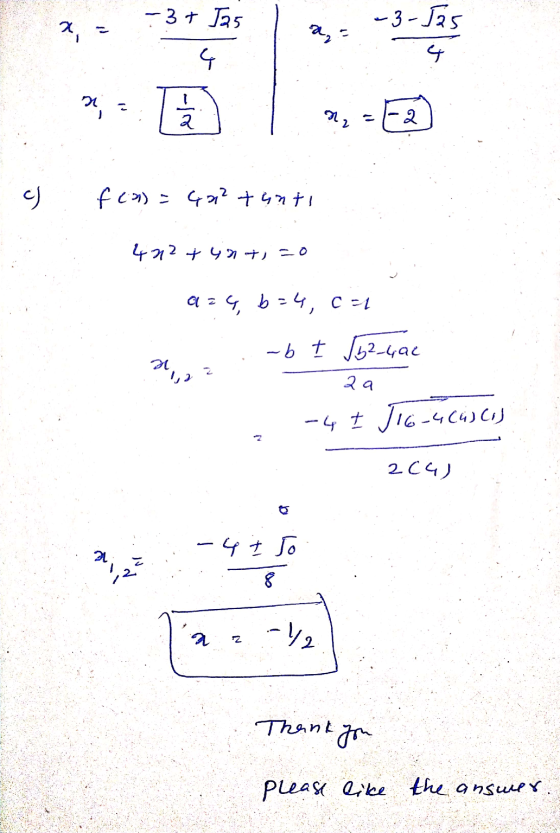
Determine the root(s), if they exist, of the quadratic functions: a. ?(?)=?2−6?+15 b. ?(?)=2?2+3?−2 c. ?(?)=4?2+4?+1
Determine the root(s), if they exist, of the quadratic
functions:
a. ?(?)=?2−6?+15
b. ?(?)=2?2+3?−2
c. ?(?)=4?2+4?+1
Homework Answers
Add Answer to:
Determine the root(s), if they exist, of the quadratic
functions:
a. ?(?)=?2−6?+15
b. ?(?)=2?2+3?−2
c. ?(?)=4?2+4?+1
3. Produce the function quadratic(a,b,c) where a, b, and c are the coeffi- cients of the...
 3. Produce the function quadratic(a,b,c) where a, b, and c are the coeffi- cients of the quadratic ax2 + bx +c. The function should return: 1. a list of the two roots of ax2 + bx +c= 0, when two roots exist 2. the first root is the smaller of the two 3. if ax2 + bx +c=0 has no real roots, then return None. 4. if the quadratic has one real root only, then return a list with a...
A quadratic equation is generally represented as, ax^2 + bx + c The root(s) of the...
A quadratic equation is generally represented as, ax^2 + bx + c The root(s) of the above quadratic equation is computed using the following formula, root1 = (-b + sqrt(D))/ 2a root2 = (-b - sqrt(D))/2a Where D is the discriminant of the quadratic equation and is computed as, D = b^2 - 4ac Given the value of D, the roots of a quadratic equation can be categorized as follows, D > 0 : Two distinct real roots D =...
Root -locus for following equations b)G24645) c) G(s)- 3s2+5s+1 s(s+2) (S+3) (s+4) (s2+2s+4)
 with an angle of departure and arrivals
Root -locus for following equations b)G24645) c) G(s)- 3s2+5s+1 s(s+2) (S+3) (s+4) (s2+2s+4)
Root -locus for following equations b)G24645) c) G(s)- 3s2+5s+1 s(s+2) (S+3) (s+4) (s2+2s+4)
with an angle of departure and arrivals
Root -locus for following equations b)G24645) c) G(s)- 3s2+5s+1 s(s+2) (S+3) (s+4) (s2+2s+4)
Root -locus for following equations b)G24645) c) G(s)- 3s2+5s+1 s(s+2) (S+3) (s+4) (s2+2s+4)
6) (15 total points) For the root locus plot shown below: a) b) c) Find the...
 6) (15 total points) For the root locus plot shown below: a) b) c) Find the open-loop transfer function G(s) (show as factors) (3 points) Assuming unity feedback H-1, find the characteristic equation of the closed loop transfer function (3 points). Find the gain K that the system goes unstable. Hint: express the characteristic equation in (a) as s2 + 2ơs + -0, and determine the point ơ becomes negative (6 points). Find the natural frequency of the closed loop...
Factor the quadratic functions below to determine the zeros of each function. 3. 49x2 = -21x-2...
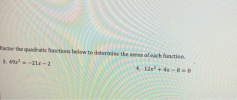 Factor the quadratic functions below to determine the zeros of each function. 3. 49x2 = -21x-2 4. 12x2 + 4x - 8 = 0
a) 1 square root of g b) 2 square root of g c) 3 square root...
 a) 1 square root of g
b) 2 square root of g
c) 3 square root of g
d) 4 square root of g
e) 5 square root of g
A triangular channel whose top width is three times the water depth (T-3y), n 0.025 passes a discharge of 3.32 m3/s. Find the critical depth (v) a) 2 m b) 1.5 m c) 0.5 m d) 2.5 m e) 1 m 4. 5. A triangular channel whose top width is...
a) 1 square root of g
b) 2 square root of g
c) 3 square root of g
d) 4 square root of g
e) 5 square root of g
A triangular channel whose top width is three times the water depth (T-3y), n 0.025 passes a discharge of 3.32 m3/s. Find the critical depth (v) a) 2 m b) 1.5 m c) 0.5 m d) 2.5 m e) 1 m 4. 5. A triangular channel whose top width is...
2. Determine the Laplace transforms of the periodic functions in Fig. An 1 2 3 4...
 2. Determine the Laplace transforms of the periodic functions in Fig. An 1 2 3 4 0 246 3. Determine the inverse Laplace transform of each of the following functions: (a) F(s)4+ (b) G(s) 3s+ H)+3) (d) J(s) = (s +2)2(s + 4) Find the inverse Laplace transform of: s s+1 s+4 4 12 4. s+13 s(S +4s
L. Determine the real root(s) off(x)--5xs + 14x3 + 20x2 + 10x a. Graphically on a graph paper. b....
 l. Determine the real root(s) off(x)--5xs + 14x3 + 20x2 + 10x a. Graphically on a graph paper. b. Using Bisection method c. Using False Position method to determine the root, employing initial guesses of x-2 d. Using the Newton Raphson methods to determine the root, employing initial guess to determine the root, employing initial guesses ofxn-2 and Xu-4 and Es= 18%. and r 5.0 andas answer. 1%. was this method the best for these initial guesses? Explain your xo--l...
A plant with the transfer function Gp(s)-- with unity feedback has the root locus shown in the figure below: (s+2)(s+4) Root Locus 1.5 C(s) 0.5 0.5 1.5 .3 Real Axis (seconds) (a) Determine K of G...
 A plant with the transfer function Gp(s)-- with unity feedback has the root locus shown in the figure below: (s+2)(s+4) Root Locus 1.5 C(s) 0.5 0.5 1.5 .3 Real Axis (seconds) (a) Determine K of Gp(s) if it is desired that the uncompensated system has a 10% OS (overshoot) to a step input. (4 points) a 5% overshoot and a peak time Tp 3.1 meets the requirements described in part (b) and achieves zero steady state (b) Compute the desired...
For the following functions, determine minimal SOP realizations: a. F(a, b, c) = ∑ (0, 1,...
For the following functions, determine minimal SOP realizations: a. F(a, b, c) = ∑ (0, 1, 2, 3, 4, 5, 6, 7) b. F(a, b, c) = ∑ (1, 2, 3, 4, 5, 7) c. F(a, b, c) = ∑ (0, 2, 4, 6)
 3. Produce the function quadratic(a,b,c) where a, b, and c are the coeffi- cients of the quadratic ax2 + bx +c. The function should return: 1. a list of the two roots of ax2 + bx +c= 0, when two roots exist 2. the first root is the smaller of the two 3. if ax2 + bx +c=0 has no real roots, then return None. 4. if the quadratic has one real root only, then return a list with a...
 with an angle of departure and arrivals
Root -locus for following equations b)G24645) c) G(s)- 3s2+5s+1 s(s+2) (S+3) (s+4) (s2+2s+4)
Root -locus for following equations b)G24645) c) G(s)- 3s2+5s+1 s(s+2) (S+3) (s+4) (s2+2s+4)
with an angle of departure and arrivals
Root -locus for following equations b)G24645) c) G(s)- 3s2+5s+1 s(s+2) (S+3) (s+4) (s2+2s+4)
Root -locus for following equations b)G24645) c) G(s)- 3s2+5s+1 s(s+2) (S+3) (s+4) (s2+2s+4)
 6) (15 total points) For the root locus plot shown below: a) b) c) Find the open-loop transfer function G(s) (show as factors) (3 points) Assuming unity feedback H-1, find the characteristic equation of the closed loop transfer function (3 points). Find the gain K that the system goes unstable. Hint: express the characteristic equation in (a) as s2 + 2ơs + -0, and determine the point ơ becomes negative (6 points). Find the natural frequency of the closed loop...
 Factor the quadratic functions below to determine the zeros of each function. 3. 49x2 = -21x-2 4. 12x2 + 4x - 8 = 0
 a) 1 square root of g
b) 2 square root of g
c) 3 square root of g
d) 4 square root of g
e) 5 square root of g
A triangular channel whose top width is three times the water depth (T-3y), n 0.025 passes a discharge of 3.32 m3/s. Find the critical depth (v) a) 2 m b) 1.5 m c) 0.5 m d) 2.5 m e) 1 m 4. 5. A triangular channel whose top width is...
a) 1 square root of g
b) 2 square root of g
c) 3 square root of g
d) 4 square root of g
e) 5 square root of g
A triangular channel whose top width is three times the water depth (T-3y), n 0.025 passes a discharge of 3.32 m3/s. Find the critical depth (v) a) 2 m b) 1.5 m c) 0.5 m d) 2.5 m e) 1 m 4. 5. A triangular channel whose top width is...
 2. Determine the Laplace transforms of the periodic functions in Fig. An 1 2 3 4 0 246 3. Determine the inverse Laplace transform of each of the following functions: (a) F(s)4+ (b) G(s) 3s+ H)+3) (d) J(s) = (s +2)2(s + 4) Find the inverse Laplace transform of: s s+1 s+4 4 12 4. s+13 s(S +4s
 l. Determine the real root(s) off(x)--5xs + 14x3 + 20x2 + 10x a. Graphically on a graph paper. b. Using Bisection method c. Using False Position method to determine the root, employing initial guesses of x-2 d. Using the Newton Raphson methods to determine the root, employing initial guess to determine the root, employing initial guesses ofxn-2 and Xu-4 and Es= 18%. and r 5.0 andas answer. 1%. was this method the best for these initial guesses? Explain your xo--l...
 A plant with the transfer function Gp(s)-- with unity feedback has the root locus shown in the figure below: (s+2)(s+4) Root Locus 1.5 C(s) 0.5 0.5 1.5 .3 Real Axis (seconds) (a) Determine K of Gp(s) if it is desired that the uncompensated system has a 10% OS (overshoot) to a step input. (4 points) a 5% overshoot and a peak time Tp 3.1 meets the requirements described in part (b) and achieves zero steady state (b) Compute the desired...
Most questions answered within 3 hours.
-
Where is the error in this code sequence?
String s1 = "Hello";
String s2 = "ello";...
asked 11 months ago -
Financial data for Joel de Paris, Inc., for last year
follow:
Joel de Paris, Inc.
Balance...
asked 11 months ago -
Consider this reaction:
Al2(SO4)3 (aq)+ BaCl3
(aq) Al2Cl6 (aq)- +
3BaSO4(s) . What is the...
asked 11 months ago -
Suppose that Savneet is considering increasing her
recent random sample from 20 car rentals to 40...
asked 11 months ago -
Trucks arrive at an unloading terminal at an average rate of 120
per hour.
Trucks arrive...
asked 11 months ago -
Why are methanol and ethanol completely soluble in water while
octanol is not very little soluble....
asked 11 months ago -
A facilities manager at a university reads in a research report
that the mean amount of...
asked 11 months ago -
When the CuSO4 is rehydrated by adding water to the anhydrous
compound, is this an endothermic...
asked 11 months ago -
A ray of sunlight is passing from diamond into crown glass; the
angle of incidence is...
asked 11 months ago -
A block of mass 0.249 kg is placed on top of a light, vertical
spring of...
asked 11 months ago -
how do the kidneys compensate in the presences of acidosis
a) trigger hyperventilate
b) reserve acid...
asked 11 months ago -
Question 501 pts
The rental rate of capital to the firm increases. Which of the
following...
asked 11 months ago