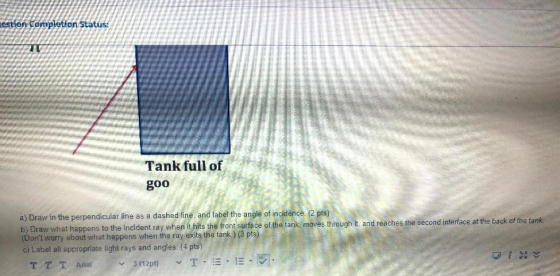
A) draw in the perpendicular line as a dashed line, and label the angle of incidence
B) draw what happens to the incident ray when it hits the front surface of the tank, moves through it, and reaches the second intersurface at the back of the tank
C) label all appropriate light rays and angles
Homework Answers
At the first surface, the ray will bend towards the normal due
to higher refractive index of material. At the second surface the
ray will bend away from the normal due to lower refractive index of
air.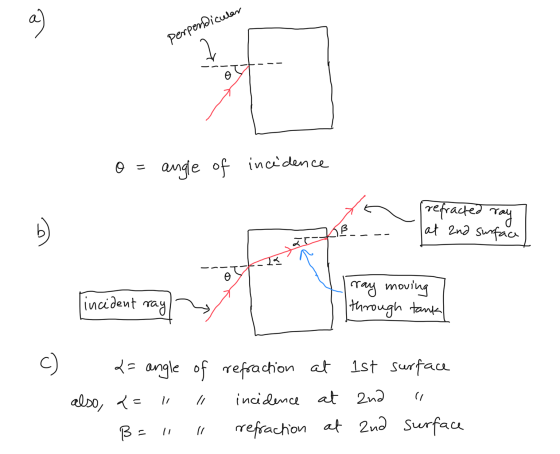
Add Answer to:
A) draw in the perpendicular line as a dashed line, and label
the angle of incidence...
You’ve been abducted by aliens! You wake up aboard a spaceship to find yourself completely immersed...
 You’ve been abducted by aliens! You wake up aboard a spaceship
to find yourself completely immersed in a tank full of dense green
goo. The aliens are scanning you with a laser aimed at the tank, as
shown in the figure below. The tank has a shiny surface, but is
also clear enough for you to see the room around you and the laser
shining in. The incoming laser light ray hits the surface at an
angle.
a) Draw in...
You’ve been abducted by aliens! You wake up aboard a spaceship
to find yourself completely immersed in a tank full of dense green
goo. The aliens are scanning you with a laser aimed at the tank, as
shown in the figure below. The tank has a shiny surface, but is
also clear enough for you to see the room around you and the laser
shining in. The incoming laser light ray hits the surface at an
angle.
a) Draw in...
Measure and record the angle of incidence and angle of reflection at the convex interface. (d)...
 Measure and record the angle of incidence and angle of
reflection at the convex interface. (d) Measure and record the
angle of incidence and angle of reflection at the concave
interface. Please make image clear as I do not have a protractor
and must draw to scale based on your image. Thank you.
Attention: Zero point will be given if you use a compass to draw the arc and label the center. CORELLES Figure 1: Flip a dinner plate (7"...
Measure and record the angle of incidence and angle of
reflection at the convex interface. (d) Measure and record the
angle of incidence and angle of reflection at the concave
interface. Please make image clear as I do not have a protractor
and must draw to scale based on your image. Thank you.
Attention: Zero point will be given if you use a compass to draw the arc and label the center. CORELLES Figure 1: Flip a dinner plate (7"...
Is my understanding right? The first perpendicular line is the wavefront (not the ray of light),...
 Is my understanding right?
The first perpendicular line is the wavefront (not the
ray of light), and the second slanted line is the
surface.
Rays of light are always perpendicular to the wavefront, and the
ray of light bends towards the normal when it passes from rarer
medium to the denser medium,
therefore, the answer should be C.
2. The wave front shown at the left for light in air reaches the plane surface (shown by a slanted line) that...
Is my understanding right?
The first perpendicular line is the wavefront (not the
ray of light), and the second slanted line is the
surface.
Rays of light are always perpendicular to the wavefront, and the
ray of light bends towards the normal when it passes from rarer
medium to the denser medium,
therefore, the answer should be C.
2. The wave front shown at the left for light in air reaches the plane surface (shown by a slanted line) that...
Light strikes a 5.0-cm thick sheet of glass at an angle of incidence in air of...
Light strikes a 5.0-cm thick sheet of glass at an angle of incidence in air of 50°. The sheet has parallel faces and the glass has an index of refraction 1.50. NEED the Visual Representations Draw a ray diagram Draw a line normal to the boundary Show the ray bending in the correct direction Label angles of incidence and refraction measured from the normal
Reflection from Plane & Convave Mirrors Snell's n sin 02 Law n2 sine, For the plane...
 Reflection from Plane & Convave Mirrors Snell's n sin 02 Law n2 sine, For the plane mirror, we assume the mirror is placed on this page so that it stands vertically along the blue line below, with its length parallel to the page. Take the light source and arrange it to emit a ray of light that lies in the plane of this page. Cast the light ray onto the mirror, so that the ray hits the mirror at an...
Assume now that you mistakenly filled the tank up to the blue line in the figure...
 Assume now that you mistakenly filled the tank up to the blue line in the figure below. Using your ruler and protractor, draw the reflected and refracted rays for both incoming rays and read from the figure their angles (again, the red ray is 1 and the green one is 2) ang Note: the point of incidence is now where each ray crosses the blue line. The angles from the normal lines in those two points are those calculated in...
Light strikes a 5.0-cm thick sheet of glass at an angle of incidence in air of...
 Light strikes a 5.0-cm thick sheet of glass at an angle of incidence in air of 50°. The sheet has parallel faces and the glass has an index of refraction 1.50. (a) What is the angle of refraction in the glass? (6) After traveling through the glass the light re-emerges into the air. What is the final angle of refraction in air? () As it leaves the glass, by what distance is the path of the ray is displaced from...
Problem Statement A glass plate whose index of refraction is 1.56 is immersed in a liquid....
 Problem Statement A glass plate whose index of refraction is 1.56 is immersed in a liquid. The surface of the glass is inclined at an angle of 42.0° with the vertical. A horizontal ray in the glass is incident on the interface. When the liquid is a certain alcohol, the incident ray arrives at the interface at the critical angle. What is the index of refraction of the alcohol? Visual Representation • Draw a ray diagram • Draw a line...
Using Figure 9.7 and a protractor, draw the refracted rays that exit the curved surface of...
 Using Figure 9.7 and a protractor, draw the refracted rays that
exit the curved surface of the lens. Assume that the light is
traveling through the air into the lens and then back out into air.
Also assume that the lens is made of acrylic. Describe what happens
to the refracted rays,and whether they converge to a point.
First Interface Light Ray Incident Angle, (°) Refracted Angle, e, (°) 1 0 0 2 0 0 3 0 0 40° 4...
Using Figure 9.7 and a protractor, draw the refracted rays that
exit the curved surface of the lens. Assume that the light is
traveling through the air into the lens and then back out into air.
Also assume that the lens is made of acrylic. Describe what happens
to the refracted rays,and whether they converge to a point.
First Interface Light Ray Incident Angle, (°) Refracted Angle, e, (°) 1 0 0 2 0 0 3 0 0 40° 4...
Snell's Law and the Law of Reflection explain how light is redirected when it encounters a...
Snell's Law and the Law of Reflection explain how light is redirected when it encounters a surface between two media. In the extreme, light may only reflect at a boundary, and go back into the medium it was in. More often, some of it reflects and some goes through. If the boundary is plane and flat, then these laws are easy to interpret. When the boundary is curved, they describe happens at every point on the surface. One of the...
 You’ve been abducted by aliens! You wake up aboard a spaceship
to find yourself completely immersed in a tank full of dense green
goo. The aliens are scanning you with a laser aimed at the tank, as
shown in the figure below. The tank has a shiny surface, but is
also clear enough for you to see the room around you and the laser
shining in. The incoming laser light ray hits the surface at an
angle.
a) Draw in...
You’ve been abducted by aliens! You wake up aboard a spaceship
to find yourself completely immersed in a tank full of dense green
goo. The aliens are scanning you with a laser aimed at the tank, as
shown in the figure below. The tank has a shiny surface, but is
also clear enough for you to see the room around you and the laser
shining in. The incoming laser light ray hits the surface at an
angle.
a) Draw in...
 Measure and record the angle of incidence and angle of
reflection at the convex interface. (d) Measure and record the
angle of incidence and angle of reflection at the concave
interface. Please make image clear as I do not have a protractor
and must draw to scale based on your image. Thank you.
Attention: Zero point will be given if you use a compass to draw the arc and label the center. CORELLES Figure 1: Flip a dinner plate (7"...
Measure and record the angle of incidence and angle of
reflection at the convex interface. (d) Measure and record the
angle of incidence and angle of reflection at the concave
interface. Please make image clear as I do not have a protractor
and must draw to scale based on your image. Thank you.
Attention: Zero point will be given if you use a compass to draw the arc and label the center. CORELLES Figure 1: Flip a dinner plate (7"...
 Is my understanding right?
The first perpendicular line is the wavefront (not the
ray of light), and the second slanted line is the
surface.
Rays of light are always perpendicular to the wavefront, and the
ray of light bends towards the normal when it passes from rarer
medium to the denser medium,
therefore, the answer should be C.
2. The wave front shown at the left for light in air reaches the plane surface (shown by a slanted line) that...
Is my understanding right?
The first perpendicular line is the wavefront (not the
ray of light), and the second slanted line is the
surface.
Rays of light are always perpendicular to the wavefront, and the
ray of light bends towards the normal when it passes from rarer
medium to the denser medium,
therefore, the answer should be C.
2. The wave front shown at the left for light in air reaches the plane surface (shown by a slanted line) that...
 Reflection from Plane & Convave Mirrors Snell's n sin 02 Law n2 sine, For the plane mirror, we assume the mirror is placed on this page so that it stands vertically along the blue line below, with its length parallel to the page. Take the light source and arrange it to emit a ray of light that lies in the plane of this page. Cast the light ray onto the mirror, so that the ray hits the mirror at an...
 Assume now that you mistakenly filled the tank up to the blue line in the figure below. Using your ruler and protractor, draw the reflected and refracted rays for both incoming rays and read from the figure their angles (again, the red ray is 1 and the green one is 2) ang Note: the point of incidence is now where each ray crosses the blue line. The angles from the normal lines in those two points are those calculated in...
 Light strikes a 5.0-cm thick sheet of glass at an angle of incidence in air of 50°. The sheet has parallel faces and the glass has an index of refraction 1.50. (a) What is the angle of refraction in the glass? (6) After traveling through the glass the light re-emerges into the air. What is the final angle of refraction in air? () As it leaves the glass, by what distance is the path of the ray is displaced from...
 Problem Statement A glass plate whose index of refraction is 1.56 is immersed in a liquid. The surface of the glass is inclined at an angle of 42.0° with the vertical. A horizontal ray in the glass is incident on the interface. When the liquid is a certain alcohol, the incident ray arrives at the interface at the critical angle. What is the index of refraction of the alcohol? Visual Representation • Draw a ray diagram • Draw a line...
 Using Figure 9.7 and a protractor, draw the refracted rays that
exit the curved surface of the lens. Assume that the light is
traveling through the air into the lens and then back out into air.
Also assume that the lens is made of acrylic. Describe what happens
to the refracted rays,and whether they converge to a point.
First Interface Light Ray Incident Angle, (°) Refracted Angle, e, (°) 1 0 0 2 0 0 3 0 0 40° 4...
Using Figure 9.7 and a protractor, draw the refracted rays that
exit the curved surface of the lens. Assume that the light is
traveling through the air into the lens and then back out into air.
Also assume that the lens is made of acrylic. Describe what happens
to the refracted rays,and whether they converge to a point.
First Interface Light Ray Incident Angle, (°) Refracted Angle, e, (°) 1 0 0 2 0 0 3 0 0 40° 4...
Most questions answered within 3 hours.
-
Where is the error in this code sequence?
String s1 = "Hello";
String s2 = "ello";...
asked 10 months ago -
Financial data for Joel de Paris, Inc., for last year
follow:
Joel de Paris, Inc.
Balance...
asked 10 months ago -
Consider this reaction:
Al2(SO4)3 (aq)+ BaCl3
(aq) Al2Cl6 (aq)- +
3BaSO4(s) . What is the...
asked 10 months ago -
Suppose that Savneet is considering increasing her
recent random sample from 20 car rentals to 40...
asked 10 months ago -
Trucks arrive at an unloading terminal at an average rate of 120
per hour.
Trucks arrive...
asked 10 months ago -
Why are methanol and ethanol completely soluble in water while
octanol is not very little soluble....
asked 10 months ago -
A facilities manager at a university reads in a research report
that the mean amount of...
asked 10 months ago -
When the CuSO4 is rehydrated by adding water to the anhydrous
compound, is this an endothermic...
asked 10 months ago -
A ray of sunlight is passing from diamond into crown glass; the
angle of incidence is...
asked 10 months ago -
A block of mass 0.249 kg is placed on top of a light, vertical
spring of...
asked 10 months ago -
how do the kidneys compensate in the presences of acidosis
a) trigger hyperventilate
b) reserve acid...
asked 10 months ago -
Question 501 pts
The rental rate of capital to the firm increases. Which of the
following...
asked 10 months ago