
Homework Answers
Add Answer to:
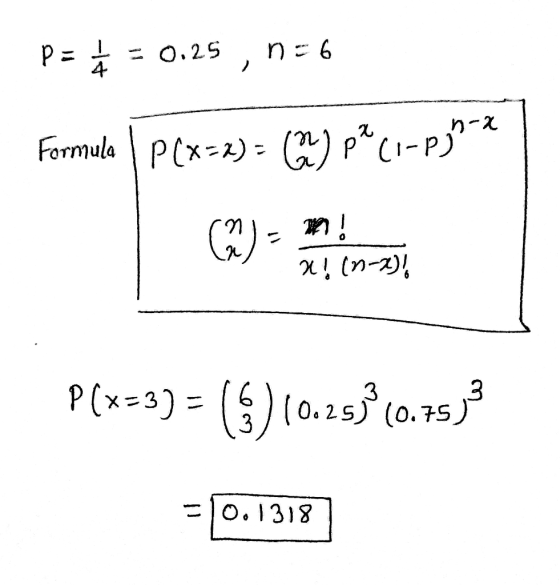
Q5. Professor Paymon ran out of time while taking the multiple-choice final exam and he guessed...
A student ran out of time on a multiple choice exam and randomly guessed the answers...
 A student ran out of time on a multiple choice exam and randomly guessed the answers for two problems. Each problem had 5 answer choices - a, b, c, d. e - and only one correct answer. What is the probability that she answered neither of the problems correctly?
Problem 5 (Bayes’ rule). A student is taking a multiple-choice exam in which each question has...
Problem 5 (Bayes’ rule). A student is taking a multiple-choice exam in which each question has four possible answers. She knows the answers to 60% of the questions and guesses at the others. What is the probability that she guessed given that she guessed question 12 right?
Professor Elderman has given the same multiple-choice final exam in his Principles of Microeconomics class for...
Professor Elderman has given the same multiple-choice final exam in his Principles of Microeconomics class for many years. After examining his records from the past 10 years, he finds that the scores have a mean of 76 and a standard deviation of 12. What is the probability that a class of 15 students will have a class average greater than 70 on Professor Elderman’s final exam?
. There are n questions on a multiple choice exam, and for each question, there are...
. There are n questions on a multiple choice exam, and for each question, there are four choices. To pass the exam, one must correctly answer at least 70% of the questions. The student has not studied, so he/she has to resort to guessing on every question. a. Find the probability of the student passing for n = 10. b. Find the expected number of questions answered correctly for n = 20. c. Find the variance for the number of...
Multiple-Choice Exam A student takes a 13-question, multiple-choice exam with two choices for each question and...
 Multiple-Choice Exam A student takes a 13-question, multiple-choice exam with two choices for each question and guesses on each question. Find the probability of guessing at least 9 out of 13 correctly. Assume the variable is binomial. Round the intermediate and final answers to three decimal places. P (guessing at least 9 out of 13 correctly) = x
A student answers a multiple choice examination with questions that have four possible answers each. Suppose...
A student answers a multiple choice examination with questions that have four possible answers each. Suppose that the probability that the student knows the answer to a question is 0.80 and the probability that the student guesses is 0.20. If the student guesses, the probability of guessing the correct answer is 0.25. The questions are independent, that is, knowing the answer on one question is not influenced by the other question. (a) If there is one question on the exam...
An exam consists of 20 multiple choice questions with four choices in each question. Use the...
An exam consists of 20 multiple choice questions with four choices in each question. Use the binomial distribution to find the probability of getting exactly 5 multiple choice questions correct on the exam. Round your answer to the nearest tenth of a percent.
Mary's Final Exam for Psychology has 10 True/False questions and 10 multiple choice questions with 4 choices for each answer. Assuming Mary randomly guesses on every question: **Write answers usi...
 Mary's Final Exam for Psychology has 10 True/False questions and 10 multiple choice questions with 4 choices for each answer. Assuming Mary randomly guesses on every question: **Write answers using 3 decimal places* a.) What's the probability that she gets at least 8 of the 10 true/false questions correct? b.) What's the probability that she gets at least 6 of the 10 multiple choice questions correct? c.) If the multiple choice questions had 5 choices for answers instead of 4,...
A student is taking a multiple-choice exam in which each question has two choices. Assuming that...
A student is taking a multiple-choice exam in which each question has two choices. Assuming that she has no knowledge of the correct answers to any of the questions, she has decided on a strategy in which she will place two balls (marked Upper A and Upper BA and B) into a box. She randomly selects one ball for each question and replaces the ball in the box. The marking on the ball will determine her answer to the question....
Suppose you are taking an exam that only includes multiple choice questions. Each question has four...
Suppose you are taking an exam that only includes multiple choice questions. Each question has four possible choices and only one of them is correct answer per question. Questions are not related to the material you know, so you guess the answer randomly in the order of questions written and independently. The probability that you will answer at most one correct answer among five questions is ?
 A student ran out of time on a multiple choice exam and randomly guessed the answers for two problems. Each problem had 5 answer choices - a, b, c, d. e - and only one correct answer. What is the probability that she answered neither of the problems correctly?
 Multiple-Choice Exam A student takes a 13-question, multiple-choice exam with two choices for each question and guesses on each question. Find the probability of guessing at least 9 out of 13 correctly. Assume the variable is binomial. Round the intermediate and final answers to three decimal places. P (guessing at least 9 out of 13 correctly) = x
 Mary's Final Exam for Psychology has 10 True/False questions and 10 multiple choice questions with 4 choices for each answer. Assuming Mary randomly guesses on every question: **Write answers using 3 decimal places* a.) What's the probability that she gets at least 8 of the 10 true/false questions correct? b.) What's the probability that she gets at least 6 of the 10 multiple choice questions correct? c.) If the multiple choice questions had 5 choices for answers instead of 4,...
Most questions answered within 3 hours.
-
Where is the error in this code sequence?
String s1 = "Hello";
String s2 = "ello";...
asked 10 months ago -
Financial data for Joel de Paris, Inc., for last year
follow:
Joel de Paris, Inc.
Balance...
asked 10 months ago -
Consider this reaction:
Al2(SO4)3 (aq)+ BaCl3
(aq) Al2Cl6 (aq)- +
3BaSO4(s) . What is the...
asked 10 months ago -
Suppose that Savneet is considering increasing her
recent random sample from 20 car rentals to 40...
asked 10 months ago -
Trucks arrive at an unloading terminal at an average rate of 120
per hour.
Trucks arrive...
asked 10 months ago -
Why are methanol and ethanol completely soluble in water while
octanol is not very little soluble....
asked 10 months ago -
A facilities manager at a university reads in a research report
that the mean amount of...
asked 10 months ago -
When the CuSO4 is rehydrated by adding water to the anhydrous
compound, is this an endothermic...
asked 10 months ago -
A ray of sunlight is passing from diamond into crown glass; the
angle of incidence is...
asked 10 months ago -
A block of mass 0.249 kg is placed on top of a light, vertical
spring of...
asked 10 months ago -
how do the kidneys compensate in the presences of acidosis
a) trigger hyperventilate
b) reserve acid...
asked 10 months ago -
Question 501 pts
The rental rate of capital to the firm increases. Which of the
following...
asked 10 months ago