

Homework Answers
Add Answer to:
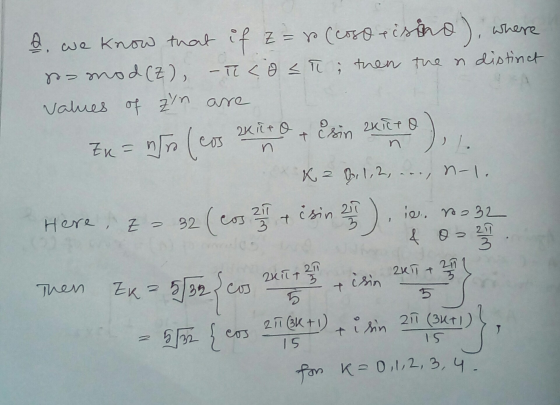
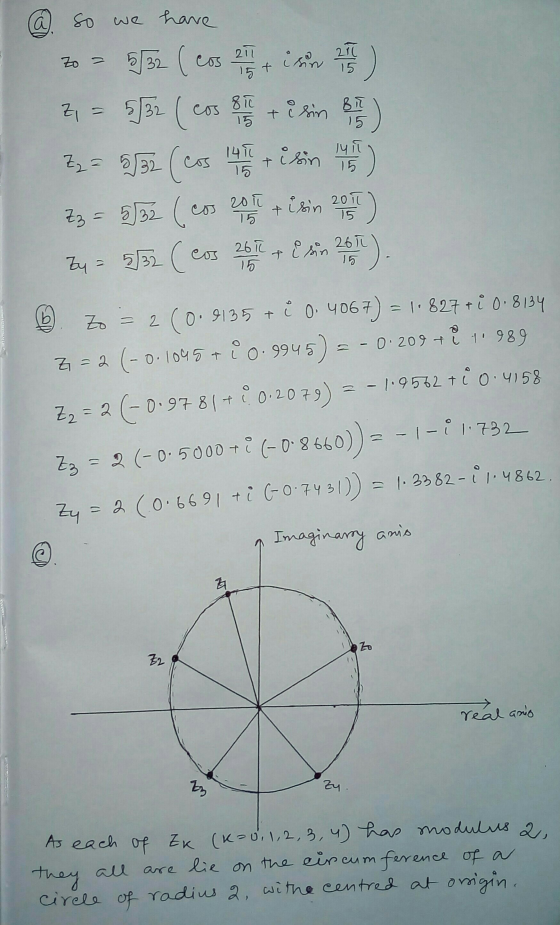
Consider the following Fifth roots of 32 Cos 1 32(cos 2* * is 2) (a) Use...
5 Points] DETAILS LARTRIG10 4.5.039. MY NOTES ASK YOUR TEACHER PRAS Consider the following. Square roots...
 5 Points] DETAILS LARTRIG10 4.5.039. MY NOTES ASK YOUR TEACHER PRAS Consider the following. Square roots of 5(cos 120° + i sin 120°) + 360° (a) Use the formula 24 - Vicos + i sin 0 + 360° to find the indicated roots of the complex number (Enter your answers in trigonometric form. Let 0 < < 100%) n П ZO 21 (b) Write each of the roots in standard form. 20- 2, Imaginary (c) Represent each of the roots...
Consider the following. 729 Cube roots of - -(1 + (31) + 2 tek = Volco...
 Consider the following. 729 Cube roots of - -(1 + (31) + 2 tek = Volco (a) Use the formula Zk 0 + 2tk cos + i sin to find the indicated roots of the complex number. (Enter your answers in trigonometric form. Let 0 3 0 < 21.) n Zo = 21 = 22 = (b) Write each of the roots in standard form. (Round all numerical values to four decimal places.) 20 = 21 = 22
0 + 360° Square roots of 5(cos 120° + i sin 120°) 0 + 360° (a)...
 0 + 360° Square roots of 5(cos 120° + i sin 120°) 0 + 360° (a) Use the formula zk = V(cos 75 (cos 60° + i sin 60°) + i sin to find the indicated roots of the complex number. (Enter your answers in trigonometric form. Let 0 so< 360°.) n n 20 = 21 = V5 (cos 240° + i sin 240°) x (b) Write each of the roots in standard form. Zo = 5 2 + i...
Represent the complex number graphically, and find the standard form of the number. 51 10 cos...
 Represent the complex number graphically, and find the standard form of the number. 51 10 cos Imaginary axis 10+ Imaginary axis 10F 5 5 Real axis 10 -10 Real axis 10 -5 -10 -5 5 -101 -10 Imaginary axis 10 Imaginary axis 104 51 Real axis 10 -10 -5 5 Real axis 10 -10 -5 -101 -101 CO x
The purpose of this question is to calculate the three cubic roots of a complex number....
 The purpose of this question is to calculate the three cubic roots of a complex number. A complex number is of the form a + ib where i is v-1. The magnitude r of a complex number is Vab. The complex number a + ib can be written as r(cos θ + i sin θ). Therefore a -r cose and b rsin0 and b/a (r sin0)/(r cos0) - tane e- arctan(b/a). The 3 cubic roots of a complex number are...
2. For each of the following representations of a Quadratic function, determine if its roots are...
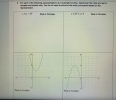 2. For each of the following representations of a Quadratic function, determine if its roots are real or complex and explain why. You do not need to solve for the roots, just predict based on the representation y = (x-6) Real or Complex y = 2x²+x+5 Real or Complex 20 20 10 10 -10 10 -10 10 10 -10 Real or Complex Real or Complex
Graph and determine the magnitudes of the following complex numbers. 1. 3+5i 2. -1 + 3i...
 Graph and determine the magnitudes of the following complex numbers. 1. 3+5i 2. -1 + 3i 3. 2-4 Write each of the following complex numbers in trigonometric form. 17.-3-i 23. 2-2i Write each of the complex numbers in standard form. 570 COS 6 29. 51 +isin 6 30. cos - +isin 3 costising
roblem 5i Consider the circuit with an ideal transformer shown in Figure 5. 1:2 820 16...
 roblem 5i Consider the circuit with an ideal transformer shown in Figure 5. 1:2 820 16 ? V. 2 Figure 5. Ideal transformer circuit Submit the Following in the Online Quiz 20 points : Real and imaginary parts of l 12 1A 20 points: Real and imaginary parts of V, VV 5.a : Determine the numerical value of the phasor current 1, in rectangular form 5.b : Determine the numerical value of the phasor voltage 1z in rectangular form.
1. (2.5 2.5 5 points) Consider the real-valued passband signal zp(t) = xc(t)cos(27fet)-as(t) sin(27 fet) where,...
 1. (2.5 2.5 5 points) Consider the real-valued passband signal zp(t) = xc(t)cos(27fet)-as(t) sin(27 fet) where, as usual, xe(t) and xs(t) are real-valued baseband signals with (real) bandwidth W/2. Let Ee, Es, Ep represent respectively, the energies of xp(t), xc(t), x,(t) W, show that f re(t) cos(4 fet)dt = J ,(t) cos(47fet) = 0. (a) Assume that fe (b) Show that Ep = Ec/2+ Es/2. Hint: Use trigonometric identities on
4.15. Use phasor techniques in the following. (a) Find 2 cos(100t - 459) – 3 cos...
 4.15. Use phasor techniques in the following. (a) Find 2 cos(100t - 459) – 3 cos (100t + 60°) (b) Find 50 sin(100t) + (d/dt) cos (100t - 30). Hint: Do not take the derivative in the time domain; replace it by jo in the frequency domain. (c) Use phasor techniques to evaluate the derivative the formula in the time domain and transform of i(t) = 20 sin(500t) at t = 2 ms. Hint: Write into the frequency domain, using...
 5 Points] DETAILS LARTRIG10 4.5.039. MY NOTES ASK YOUR TEACHER PRAS Consider the following. Square roots of 5(cos 120° + i sin 120°) + 360° (a) Use the formula 24 - Vicos + i sin 0 + 360° to find the indicated roots of the complex number (Enter your answers in trigonometric form. Let 0 < < 100%) n П ZO 21 (b) Write each of the roots in standard form. 20- 2, Imaginary (c) Represent each of the roots...
 Consider the following. 729 Cube roots of - -(1 + (31) + 2 tek = Volco (a) Use the formula Zk 0 + 2tk cos + i sin to find the indicated roots of the complex number. (Enter your answers in trigonometric form. Let 0 3 0 < 21.) n Zo = 21 = 22 = (b) Write each of the roots in standard form. (Round all numerical values to four decimal places.) 20 = 21 = 22
 0 + 360° Square roots of 5(cos 120° + i sin 120°) 0 + 360° (a) Use the formula zk = V(cos 75 (cos 60° + i sin 60°) + i sin to find the indicated roots of the complex number. (Enter your answers in trigonometric form. Let 0 so< 360°.) n n 20 = 21 = V5 (cos 240° + i sin 240°) x (b) Write each of the roots in standard form. Zo = 5 2 + i...
 Represent the complex number graphically, and find the standard form of the number. 51 10 cos Imaginary axis 10+ Imaginary axis 10F 5 5 Real axis 10 -10 Real axis 10 -5 -10 -5 5 -101 -10 Imaginary axis 10 Imaginary axis 104 51 Real axis 10 -10 -5 5 Real axis 10 -10 -5 -101 -101 CO x
 The purpose of this question is to calculate the three cubic roots of a complex number. A complex number is of the form a + ib where i is v-1. The magnitude r of a complex number is Vab. The complex number a + ib can be written as r(cos θ + i sin θ). Therefore a -r cose and b rsin0 and b/a (r sin0)/(r cos0) - tane e- arctan(b/a). The 3 cubic roots of a complex number are...
 2. For each of the following representations of a Quadratic function, determine if its roots are real or complex and explain why. You do not need to solve for the roots, just predict based on the representation y = (x-6) Real or Complex y = 2x²+x+5 Real or Complex 20 20 10 10 -10 10 -10 10 10 -10 Real or Complex Real or Complex
 Graph and determine the magnitudes of the following complex numbers. 1. 3+5i 2. -1 + 3i 3. 2-4 Write each of the following complex numbers in trigonometric form. 17.-3-i 23. 2-2i Write each of the complex numbers in standard form. 570 COS 6 29. 51 +isin 6 30. cos - +isin 3 costising
 roblem 5i Consider the circuit with an ideal transformer shown in Figure 5. 1:2 820 16 ? V. 2 Figure 5. Ideal transformer circuit Submit the Following in the Online Quiz 20 points : Real and imaginary parts of l 12 1A 20 points: Real and imaginary parts of V, VV 5.a : Determine the numerical value of the phasor current 1, in rectangular form 5.b : Determine the numerical value of the phasor voltage 1z in rectangular form.
 1. (2.5 2.5 5 points) Consider the real-valued passband signal zp(t) = xc(t)cos(27fet)-as(t) sin(27 fet) where, as usual, xe(t) and xs(t) are real-valued baseband signals with (real) bandwidth W/2. Let Ee, Es, Ep represent respectively, the energies of xp(t), xc(t), x,(t) W, show that f re(t) cos(4 fet)dt = J ,(t) cos(47fet) = 0. (a) Assume that fe (b) Show that Ep = Ec/2+ Es/2. Hint: Use trigonometric identities on
 4.15. Use phasor techniques in the following. (a) Find 2 cos(100t - 459) – 3 cos (100t + 60°) (b) Find 50 sin(100t) + (d/dt) cos (100t - 30). Hint: Do not take the derivative in the time domain; replace it by jo in the frequency domain. (c) Use phasor techniques to evaluate the derivative the formula in the time domain and transform of i(t) = 20 sin(500t) at t = 2 ms. Hint: Write into the frequency domain, using...
Most questions answered within 3 hours.
-
Where is the error in this code sequence?
String s1 = "Hello";
String s2 = "ello";...
asked 11 months ago -
Financial data for Joel de Paris, Inc., for last year
follow:
Joel de Paris, Inc.
Balance...
asked 11 months ago -
Consider this reaction:
Al2(SO4)3 (aq)+ BaCl3
(aq) Al2Cl6 (aq)- +
3BaSO4(s) . What is the...
asked 11 months ago -
Suppose that Savneet is considering increasing her
recent random sample from 20 car rentals to 40...
asked 11 months ago -
Trucks arrive at an unloading terminal at an average rate of 120
per hour.
Trucks arrive...
asked 11 months ago -
Why are methanol and ethanol completely soluble in water while
octanol is not very little soluble....
asked 11 months ago -
A facilities manager at a university reads in a research report
that the mean amount of...
asked 11 months ago -
When the CuSO4 is rehydrated by adding water to the anhydrous
compound, is this an endothermic...
asked 11 months ago -
A ray of sunlight is passing from diamond into crown glass; the
angle of incidence is...
asked 11 months ago -
A block of mass 0.249 kg is placed on top of a light, vertical
spring of...
asked 11 months ago -
how do the kidneys compensate in the presences of acidosis
a) trigger hyperventilate
b) reserve acid...
asked 11 months ago -
Question 501 pts
The rental rate of capital to the firm increases. Which of the
following...
asked 11 months ago