1. Use the data given to calculate the value of ΔG°rxn for the reaction at 25...
1. Use the data given to calculate the value of
ΔG°rxn for the reaction at 25 °C.
2 C(graphite) + H2(g) <--->
C2H2(g)
|
C(graphite) |
H2(g) |
C2H2(g) |
|
|
S° (J/mol ⋅ K) |
5.74 |
130.68 |
201.0 |
|
(kJ/mol) |
0 |
0 |
−226.8 |
Report answer to four significant figures.
Homework Answers
Request Answer!
We need at least 10 more requests to produce the answer.
0 / 10 have requested this problem solution
The more requests, the faster the answer.
Add Answer to:
1. Use the data given to calculate the value of
ΔG°rxn for the reaction at 25...
Please answer with correct sig figs Use the data given to calculate the value of AGºrxn...
 Please answer with correct sig figs
Use the data given to calculate the value of AGºrxn for the reaction at 25 °C. 2 C(graphite) + H2(g) C2H2(g) C(graphite) H2(g) C2H2(g) Sº (J/mol · K) 5.74 130.68 201.0 (kJ/mol) 0 0 -226.8 Report answer to four significant figures.
Please answer with correct sig figs
Use the data given to calculate the value of AGºrxn for the reaction at 25 °C. 2 C(graphite) + H2(g) C2H2(g) C(graphite) H2(g) C2H2(g) Sº (J/mol · K) 5.74 130.68 201.0 (kJ/mol) 0 0 -226.8 Report answer to four significant figures.
does anyone know how to solve this ? i put both -207.6 and also 322.3 as...
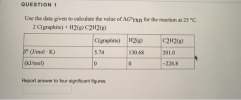 does anyone know how to solve this ?
i
put both -207.6 and also 322.3 as the answer but it was marked
wrong both times.
QUESTION 1 Use the data given to calculate the value of AGºrxn for the reaction at 25 °C. 2 C(graphite) + H2(g) C2H2(g) C(graphite) H2(g) C2H2(g) 5.74 130.68 201.0 S" (J/mol · K) (kJ/mol) 0 0 -226.8 Report answer to four significant figures.
does anyone know how to solve this ?
i
put both -207.6 and also 322.3 as the answer but it was marked
wrong both times.
QUESTION 1 Use the data given to calculate the value of AGºrxn for the reaction at 25 °C. 2 C(graphite) + H2(g) C2H2(g) C(graphite) H2(g) C2H2(g) 5.74 130.68 201.0 S" (J/mol · K) (kJ/mol) 0 0 -226.8 Report answer to four significant figures.
Use the following data to calculate the value of ΔG°rxn at 298 K for the reaction...
Use the following data to calculate the value of ΔG°rxn at 298 K for the reaction described by the given chemical equation. Include the units. Compound S°f (J/molK) DH°f (kJ/mol) CO (g) 197.7 –110.5 H2 (g) 130.7 0 CH4 (g) 186.3 –74.6 H2O (g) 188.8 –241.8 CO (g) + 3H2 (g) → CH4 (g) + H2O (g) I got -141.9 KJ/mol, but i think the units are wrong and I don't know why.
(a) Use the data given below and calculate ∆Ho, ∆So, ∆Go, and Kp at 25° C...
(a) Use the data given below and calculate ∆Ho, ∆So, ∆Go, and Kp at 25° C for the reaction: C2H2 (g) + 2 H2 (g) → C2H6 (g) (b) Calculate ∆G for the reaction at 250 °C. (c) At what temperature (°C) is ∆G equal to zero? In what temperature range is this reaction productfavored? Compound ∆ Ho , kJ/mol S o , J/mol• K C2H2 (g) 226.73 200.94 H2 (g) 0 130.68 C2H6 (g) -84.68 229.6
(a) Use the data given below and calculate ∆Ho, ∆So, ∆Go, and Kp at 25° C...
(a) Use the data given below and calculate ∆Ho, ∆So, ∆Go, and Kp at 25° C for the reaction: C2H2 (g) + 2 H2 (g) → C2H6 (g) (b) Calculate ∆G for the reaction at 250 °C. (c) At what temperature (°C) is ∆G equal to zero? In what temperature range is this reaction productfavored? Compound ∆ Ho , kJ/mol S o , J/mol• K C2H2 (g) 226.73 200.94 H2 (g) 0 130.68 C2H6 (g) -84.68 229.6
For each of the following reactions, calculate ΔH∘rxn, ΔS∘rxn, and ΔG∘rxn at 25 ∘C. State whether...
For each of the following reactions, calculate ΔH∘rxn, ΔS∘rxn, and ΔG∘rxn at 25 ∘C. State whether or not the reaction is spontaneous. If the reaction is not spontaneous, would a change in temperature make it spontaneous? If so, should the temperature be raised or lowered from 25 ∘C? N2(g)+O2(g)→2NO(g) Express your answer using three significant figures. ΔH∘rxn ΔHrxn∘ = 183 kJ SubmitPrevious Answers Correct Part H Part complete Calculate ΔS∘rxn at 25 ∘C. Express your answer to one decimal place....
Calculate the entropy change at 25°C for the following reaction: 6 C (s,graphite) + 3 H2...
Calculate the entropy change at 25°C for the following reaction: 6 C (s,graphite) + 3 H2 (g) → C6H6 (l). The entropy contents of the reactants and product at 25°C are as follows: Substance S, J/mol•K C (s,graphite) 5.74 H2 (g) 130.68 C6H6 (l) 172.8
Use the given data at 700 K to calculate ΔG°for the reaction H2(g) + CO2(g) →...
Use the given data at 700 K to calculate ΔG°for the reaction H2(g) + CO2(g) → H2O(g) + CO(g) Substance H2(g) CO2(g) H2O(g) CO(g) ΔH°f(kJ/mol) 0 -393 -242 -111 S°(J/K·mol) 131 214 189 198 -472 kJ 10.6 kJ -775 kJ -2.94 x 10⁴ kJ
Calculate ΔG° at 298.0 K for this reaction given that ΔH°rxn = –12.0 kJ and ΔS°rxn...
Calculate ΔG° at 298.0 K for this reaction given that ΔH°rxn = –12.0 kJ and ΔS°rxn = –147 J/K
Given the following hypothetical reactions and ΔG°rxn's, calculate the ΔG°rxn in kilojoules per mole for the...
Given the following hypothetical reactions and ΔG°rxn's, calculate the ΔG°rxn in kilojoules per mole for the final reaction. A(g) + 12X2(g) → AX(g) ΔG°rxn = -119.2 kJ/mol ZX4(g) → Z(g) + 2X2(g) ΔG°rxn = 427.6 kJ/mol JX3(g) + 3AX(g) → JA3(g) + 3X2(g) ΔG°rxn = -472.2 kJ/mol Z(g) + 4AX(g) → ZX4(g) + 4A(g) ΔG°rxn = ??? kJ/mol
 Please answer with correct sig figs
Use the data given to calculate the value of AGºrxn for the reaction at 25 °C. 2 C(graphite) + H2(g) C2H2(g) C(graphite) H2(g) C2H2(g) Sº (J/mol · K) 5.74 130.68 201.0 (kJ/mol) 0 0 -226.8 Report answer to four significant figures.
Please answer with correct sig figs
Use the data given to calculate the value of AGºrxn for the reaction at 25 °C. 2 C(graphite) + H2(g) C2H2(g) C(graphite) H2(g) C2H2(g) Sº (J/mol · K) 5.74 130.68 201.0 (kJ/mol) 0 0 -226.8 Report answer to four significant figures.
 does anyone know how to solve this ?
i
put both -207.6 and also 322.3 as the answer but it was marked
wrong both times.
QUESTION 1 Use the data given to calculate the value of AGºrxn for the reaction at 25 °C. 2 C(graphite) + H2(g) C2H2(g) C(graphite) H2(g) C2H2(g) 5.74 130.68 201.0 S" (J/mol · K) (kJ/mol) 0 0 -226.8 Report answer to four significant figures.
does anyone know how to solve this ?
i
put both -207.6 and also 322.3 as the answer but it was marked
wrong both times.
QUESTION 1 Use the data given to calculate the value of AGºrxn for the reaction at 25 °C. 2 C(graphite) + H2(g) C2H2(g) C(graphite) H2(g) C2H2(g) 5.74 130.68 201.0 S" (J/mol · K) (kJ/mol) 0 0 -226.8 Report answer to four significant figures.
Most questions answered within 3 hours.
-
Where is the error in this code sequence?
String s1 = "Hello";
String s2 = "ello";...
asked 10 months ago -
Financial data for Joel de Paris, Inc., for last year
follow:
Joel de Paris, Inc.
Balance...
asked 10 months ago -
Consider this reaction:
Al2(SO4)3 (aq)+ BaCl3
(aq) Al2Cl6 (aq)- +
3BaSO4(s) . What is the...
asked 10 months ago -
Suppose that Savneet is considering increasing her
recent random sample from 20 car rentals to 40...
asked 10 months ago -
Trucks arrive at an unloading terminal at an average rate of 120
per hour.
Trucks arrive...
asked 10 months ago -
Why are methanol and ethanol completely soluble in water while
octanol is not very little soluble....
asked 10 months ago -
A facilities manager at a university reads in a research report
that the mean amount of...
asked 10 months ago -
When the CuSO4 is rehydrated by adding water to the anhydrous
compound, is this an endothermic...
asked 10 months ago -
A ray of sunlight is passing from diamond into crown glass; the
angle of incidence is...
asked 10 months ago -
A block of mass 0.249 kg is placed on top of a light, vertical
spring of...
asked 10 months ago -
how do the kidneys compensate in the presences of acidosis
a) trigger hyperventilate
b) reserve acid...
asked 10 months ago -
Question 501 pts
The rental rate of capital to the firm increases. Which of the
following...
asked 10 months ago