
Homework Answers
The answer is option d
The resolving power of a telescope depends on the diameter of the telescopes light gathering apparatus, or objective. In a reflecting telescope the objective is primary lens the light passes through, As the diameter of objective increases, the light gathering power increases and hence resolving power increases.
Add Answer to:
6. (1 point) Increasing the size of the primary mirror in a reflecting telescope also increases...
6. The Hubble Space Telescope (HST) has a 2.4m diameter primary mirror, which you may assume...
 6. The Hubble Space Telescope (HST) has a 2.4m diameter primary mirror, which you may assume to be diffraction limited. The HST is used to image an object located at a distance of 4000km away from the HST. Estimate the minimum feature size that may be resolved using yellow light (wavelength=580nm) on the distant object? [10 marks]
Question 1: [20 Points] a) The primary mirror of the orbiting Hubble Space Telescope has a...
Question 1: [20 Points] a) The primary mirror of the orbiting Hubble Space Telescope has a diameter of 2.50 m. Being in orbit, this telescope avoids the degrading effects of atmospheric distortion on its resolution. The Hubble Space Telescope is observing light source coming from a very far away galaxy as shown in the figure above. The scientists are debating whether the light being observed is coming from a single light source or two different light sources. You as a...
The large telescope at Mt. Palomar has a concave objective mirror of diameter of 5.0 m...
The large telescope at Mt. Palomar has a concave objective mirror of diameter of 5.0 m and radius of curvature 46 m. What is the magnifying power of the instrument when it is used with an eyepiece of focal length 1.25 cm? A- 1.8 x 10³ B- 1.8 x 101 C- 3.7 x 10³ D- 5.4 x 10⁻⁴
1. A telescope has a focal ratio of 10 (typically stated as f/10). If the aperture...
 1. A telescope has a focal ratio of 10 (typically stated as f/10). If the aperture of the objective mirror or lens is 6 inches (152.4mm), what is the focal length of the lens? 2. What is the light-gathering power of the above telescope's objective when compared to a human eye dilated to 8mm?
ASTRONOMY (Ranking Reflecting Telescopes and Light Collection )
 Part A Listed following are the names and mirror diameters for six of the world’s greatest reflecting telescopes used to gather visible light. Rank the telescopes from left to right based on their light-collecting area from largest to smallest. For telescopes with more than one mirror, rank-based on the combined light-collecting area of the mirrors.Part B Shown following are the primary mirror arrangements and total light-collecting area of five different telescopes. Each mirror uses a different segmented arrangement, but assume that they...
Need answer for all multiple choice 30. If f78 and 1/125 (s) gives the (s) under...
 Need answer for all multiple choice
30. If f78 and 1/125 (s) gives the (s) under the same lighting condition? proper exposure, what f-stop number should be used with 1/500 a) fi4 c)f116 a) You choose a bigger f/# pth of field (DOF) without changing the exposure, you do which of the following? c) You 32. Which of the following is NOT TRUE for a Keplerian telescope? b) You increase the shutter speed. d) You choose a wide-angle camera lens....
Need answer for all multiple choice
30. If f78 and 1/125 (s) gives the (s) under the same lighting condition? proper exposure, what f-stop number should be used with 1/500 a) fi4 c)f116 a) You choose a bigger f/# pth of field (DOF) without changing the exposure, you do which of the following? c) You 32. Which of the following is NOT TRUE for a Keplerian telescope? b) You increase the shutter speed. d) You choose a wide-angle camera lens....
1.) A Convex spherical reflecting mirror has an object distance (p)-+22 cm and a focal length (f)...
 1.) A Convex spherical reflecting mirror has an object distance (p)-+22 cm and a focal length (f) of 35 cm. a.) What is the radius of curvature (r) for the mirror? (3 points) b.) How far (i) is the image from the mirror? 3 points) c.) What is the magnification (M) of this mirror? (2 points) d.) Is the image real or yirtual? (2 points) e.) Is the image inverted or erect? (1 point) f) Does the image appear in...
The Hall-Petch equation shows that increasing grain size in metallic materials: Select one: O a. Increases...
 The Hall-Petch equation shows that increasing grain size in metallic materials: Select one: O a. Increases strength O b. Reduces ductility O c. Decreases strength O d. Increases fracture toughness
For a given word size when representing floating point numbers, increasing the number of bits to...
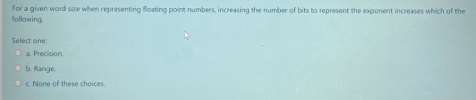 For a given word size when representing floating point numbers, increasing the number of bits to represent the exponent increases which of the following Select one: a. Precision b. Range. c None of these choices.
Telescopes that observe nonvisible types of light work on the same principles as visible telescopes, but...
Telescopes that observe nonvisible types of light work on the same principles as visible telescopes, but they might require different technologies. For instance, instead of lenses or mirrors, a radio telescope (such as the one in the figure) uses technology similar to the television satellite dish you might install on your roof. As with visible light telescopes, bigger radio telescopes yield greater light-gathering power and better angular resolution. However, the angular resolution (θ) of a telescope also depends on the...
 6. The Hubble Space Telescope (HST) has a 2.4m diameter primary mirror, which you may assume to be diffraction limited. The HST is used to image an object located at a distance of 4000km away from the HST. Estimate the minimum feature size that may be resolved using yellow light (wavelength=580nm) on the distant object? [10 marks]
 1. A telescope has a focal ratio of 10 (typically stated as f/10). If the aperture of the objective mirror or lens is 6 inches (152.4mm), what is the focal length of the lens? 2. What is the light-gathering power of the above telescope's objective when compared to a human eye dilated to 8mm?
 Need answer for all multiple choice
30. If f78 and 1/125 (s) gives the (s) under the same lighting condition? proper exposure, what f-stop number should be used with 1/500 a) fi4 c)f116 a) You choose a bigger f/# pth of field (DOF) without changing the exposure, you do which of the following? c) You 32. Which of the following is NOT TRUE for a Keplerian telescope? b) You increase the shutter speed. d) You choose a wide-angle camera lens....
Need answer for all multiple choice
30. If f78 and 1/125 (s) gives the (s) under the same lighting condition? proper exposure, what f-stop number should be used with 1/500 a) fi4 c)f116 a) You choose a bigger f/# pth of field (DOF) without changing the exposure, you do which of the following? c) You 32. Which of the following is NOT TRUE for a Keplerian telescope? b) You increase the shutter speed. d) You choose a wide-angle camera lens....
 1.) A Convex spherical reflecting mirror has an object distance (p)-+22 cm and a focal length (f) of 35 cm. a.) What is the radius of curvature (r) for the mirror? (3 points) b.) How far (i) is the image from the mirror? 3 points) c.) What is the magnification (M) of this mirror? (2 points) d.) Is the image real or yirtual? (2 points) e.) Is the image inverted or erect? (1 point) f) Does the image appear in...
 The Hall-Petch equation shows that increasing grain size in metallic materials: Select one: O a. Increases strength O b. Reduces ductility O c. Decreases strength O d. Increases fracture toughness
 For a given word size when representing floating point numbers, increasing the number of bits to represent the exponent increases which of the following Select one: a. Precision b. Range. c None of these choices.
Most questions answered within 3 hours.
-
Where is the error in this code sequence?
String s1 = "Hello";
String s2 = "ello";...
asked 10 months ago -
Financial data for Joel de Paris, Inc., for last year
follow:
Joel de Paris, Inc.
Balance...
asked 10 months ago -
Consider this reaction:
Al2(SO4)3 (aq)+ BaCl3
(aq) Al2Cl6 (aq)- +
3BaSO4(s) . What is the...
asked 10 months ago -
Suppose that Savneet is considering increasing her
recent random sample from 20 car rentals to 40...
asked 10 months ago -
Trucks arrive at an unloading terminal at an average rate of 120
per hour.
Trucks arrive...
asked 10 months ago -
Why are methanol and ethanol completely soluble in water while
octanol is not very little soluble....
asked 10 months ago -
A facilities manager at a university reads in a research report
that the mean amount of...
asked 10 months ago -
When the CuSO4 is rehydrated by adding water to the anhydrous
compound, is this an endothermic...
asked 10 months ago -
A ray of sunlight is passing from diamond into crown glass; the
angle of incidence is...
asked 10 months ago -
A block of mass 0.249 kg is placed on top of a light, vertical
spring of...
asked 10 months ago -
how do the kidneys compensate in the presences of acidosis
a) trigger hyperventilate
b) reserve acid...
asked 10 months ago -
Question 501 pts
The rental rate of capital to the firm increases. Which of the
following...
asked 10 months ago