1.Suppose the government of a small open economy passes an investment tax exemption to stimulate investment....
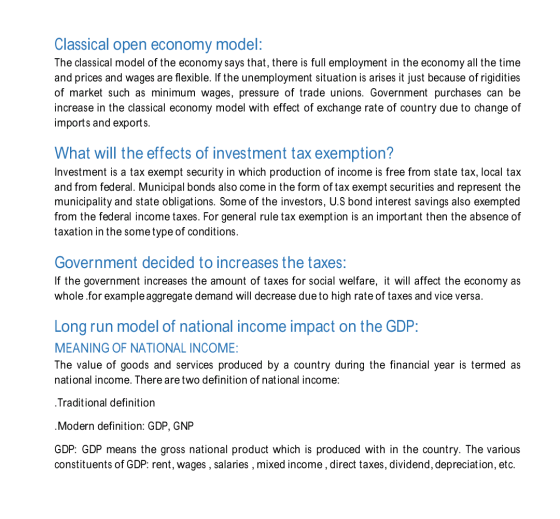
1.Suppose the government of a small open economy passes an investment tax exemption to stimulate investment. Using the classical open economy model from chapter 6, what will the effects of this investment tax exemption?
Suppose a government decides to increase taxes.
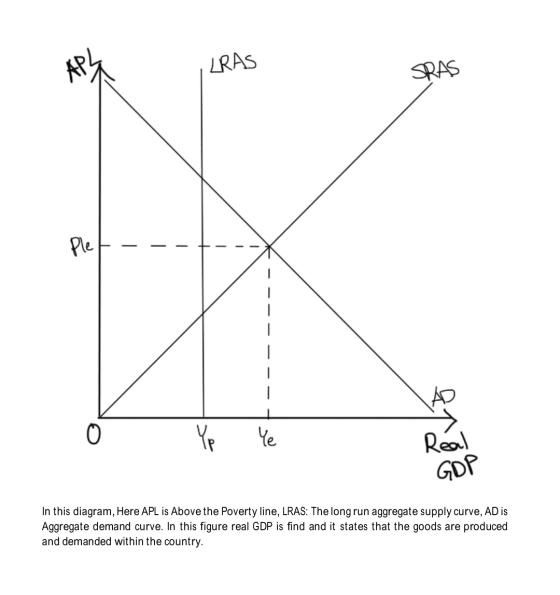
2.Using the long-run model of the economy developed in Chapter 3(national income), graphically illustrate the impact of on GDP. Be sure to label the axes, the curves, the initial equilibrium values, the direction curves shift, and the terminal equilibrium values.
Homework Answers
Add Answer to:
1.Suppose the government of a small open economy passes an
investment tax exemption to stimulate investment....
1.Suppose the government of a small open economy passes an investment tax exemption to stimulate investment....
1.Suppose the government of a small open economy passes an investment tax exemption to stimulate investment. Using the classical open economy model from chapter 6, what will the effects of this investment tax exemption? Suppose a government decides to increase taxes. 2.Using the long-run model of the economy developed in Chapter 3(national income), graphically illustrate the impact of on GDP. Be sure to label the axes, the curves, the initial equilibrium values, the direction curves shift, and the terminal equilibrium...
29. Suppose the government of a small open economy passes an investment tax exemption to stimulate...
29. Suppose the government of a small open economy passes an investment tax exemption to stimulate investment. Using the classical open economy model from chapter 6, what will the effects of this investment tax exemption?
28. Consider the Solow model with exogenous growth. Assume that because of global warming the depreciation...
28. Consider the Solow model with exogenous growth. Assume that because of global warming the depreciation rate increases. Illustrate the change in the steady state. What happens to the growth rate of standard of living in the new steady state? 29.Suppose the government of a small open economy passes an investment tax exemption to stimulate investment. Using the classical open economy model, what will the effects of this investment tax exemption? 30.Suppose a government decides to increase taxes Using the...
Suppose a government decides to increase taxes. 30. Using the long-run model of the economy developed...
 Suppose a government decides to increase taxes. 30. Using the long-run model of the economy developed in Chapter 3, graphically illustrate the impact of on GDP. Be sure to label the axes, the curves, the initial equilibrium values, the direction curves shift, and the terminal equilibrium values.
Suppose a government decides to reduce spending and (lump-sum) income taxes by the same amount. Using...
Suppose a government decides to reduce spending and (lump-sum) income taxes by the same amount. Using the long-run model of the economy, graphically illustrate the impact of the equal reductions in spending and taxes. Be sure to label: i. the axes; ii. the curves; iii. the initial equilibrium values; iv. The direction the curves shift; and v. the terminal equilibrium values. b. State in words what happens to: i. the real interest rate; ii. national saving; iii. investment; iv. consumption;...
4. Using the long-run model of the economy developed in Chapter 3, explain and/or show graphically...
4. Using the long-run model of the economy developed in Chapter 3, explain and/or show graphically the impact of increased investment demand has on the economy. Be sure to label: i. the axes; ii. the curves; iii. the initial equilibrium values; iv. the direction curves shift; and v. the terminal equilibrium values. Be sure to explain what happens to: i. the real interest rate; ii. national saving; iii. investment; iv. consumption; and v. output. 5. Using the long-run model of...
(25pts) 2. Suppose the government wants to reduce its budget deficit. Using the long-run model of...
 (25pts) 2. Suppose the government wants to reduce its budget deficit. Using the long-run model of the economy developed in Chapter 3, illustrate graphically the impact of the alternative fiscal policy measures indicated in parts (a) and (b) below. Be sure to label: (i) the axes, (ii) the curves, (iii) the initial equilibrium values; (iv) the direction curves shift; and (v) the final equilibrium values. (15) a) Suppose the government decides to reduce the government's budget deficit by reducing government...
5. Use the Simple Classical Macroeconomic Model to answer the following questions c. Suppose the tax...
 5. Use the Simple Classical Macroeconomic Model to answer the following questions c. Suppose the tax cut has not been enough to stimulate sufficient job growth. The government passes infrastructure improvement legislation to increase government spending from $3,000 to $4,000. What is the affect on GDP from the combined changes (Taxes and Spending) in government policies? . Suppose the government decides to spend $3,000 and collect $3,500 in taxes, and investment is equal to $1,500. What would GDP be if...
Answer the following Intermediate Macroeconomics questions: a) Suppose that the large open econom...
Answer the following Intermediate Macroeconomics questions: a) Suppose that the large open economy conducts a contractionary fiscal policy (i.e., raising taxes and decreasing government spending), illustrate graphically how the small open economy would be impacted. In your graphs, labeled all your graphs correctly and all terminal equilibrium points and values. b) Based on your graphical analysis, explain briefly what happens to the small open economy net exports, investments, national savings.
1. In a closed economy, suppose GDP equals $21 trillion, consumption equals $13 trillion, the government...
1. In a closed economy, suppose GDP equals $21 trillion, consumption equals $13 trillion, the government spends $7 trillion and has a budget deficit of $800 billion. a. Find government saving, taxes, private saving, national saving, and investment. Please show clearly how you calculated your final answers, and box/circle your final answers (in trillions of dollars) with proper labels No credit will be given to an answer in incorrect units, in notations that differ from what’s used in the lectures,...
 Suppose a government decides to increase taxes. 30. Using the long-run model of the economy developed in Chapter 3, graphically illustrate the impact of on GDP. Be sure to label the axes, the curves, the initial equilibrium values, the direction curves shift, and the terminal equilibrium values.
 (25pts) 2. Suppose the government wants to reduce its budget deficit. Using the long-run model of the economy developed in Chapter 3, illustrate graphically the impact of the alternative fiscal policy measures indicated in parts (a) and (b) below. Be sure to label: (i) the axes, (ii) the curves, (iii) the initial equilibrium values; (iv) the direction curves shift; and (v) the final equilibrium values. (15) a) Suppose the government decides to reduce the government's budget deficit by reducing government...
 5. Use the Simple Classical Macroeconomic Model to answer the following questions c. Suppose the tax cut has not been enough to stimulate sufficient job growth. The government passes infrastructure improvement legislation to increase government spending from $3,000 to $4,000. What is the affect on GDP from the combined changes (Taxes and Spending) in government policies? . Suppose the government decides to spend $3,000 and collect $3,500 in taxes, and investment is equal to $1,500. What would GDP be if...
Most questions answered within 3 hours.
-
Where is the error in this code sequence?
String s1 = "Hello";
String s2 = "ello";...
asked 11 months ago -
Financial data for Joel de Paris, Inc., for last year
follow:
Joel de Paris, Inc.
Balance...
asked 11 months ago -
Consider this reaction:
Al2(SO4)3 (aq)+ BaCl3
(aq) Al2Cl6 (aq)- +
3BaSO4(s) . What is the...
asked 11 months ago -
Suppose that Savneet is considering increasing her
recent random sample from 20 car rentals to 40...
asked 11 months ago -
Trucks arrive at an unloading terminal at an average rate of 120
per hour.
Trucks arrive...
asked 11 months ago -
Why are methanol and ethanol completely soluble in water while
octanol is not very little soluble....
asked 11 months ago -
A facilities manager at a university reads in a research report
that the mean amount of...
asked 11 months ago -
When the CuSO4 is rehydrated by adding water to the anhydrous
compound, is this an endothermic...
asked 11 months ago -
A ray of sunlight is passing from diamond into crown glass; the
angle of incidence is...
asked 11 months ago -
A block of mass 0.249 kg is placed on top of a light, vertical
spring of...
asked 11 months ago -
how do the kidneys compensate in the presences of acidosis
a) trigger hyperventilate
b) reserve acid...
asked 11 months ago -
Question 501 pts
The rental rate of capital to the firm increases. Which of the
following...
asked 11 months ago