

Homework Answers


Add Answer to:
2. Let I be an interval and let f be a function which is differentiable on...
(a) Suppose f is continuously differentiable on the closed and bounded interval I = [0, 1]....
 (a) Suppose f is continuously differentiable on the closed and bounded interval I = [0, 1]. Show that f is uniformly continuous on I. (b) Suppose g is continuously differentiable on the open interval J = (0,1). Give and example of such a function which is NOT uniformly continuous on J, and prove your answer.
7.7.4 The hypotheses of Theorem 7.24 require that f be differentiable on all of the interval I. Y...
 7.7.4 The hypotheses of Theorem 7.24 require that f be differentiable on all of the interval I. You might think that a positive derivative at a single point also implies that the function is increasing, at least in a neighborhood of that point. This is not true. Consider the function /(z) _{0,/2 + ra sin.ri. if 0 (e) Prove that if a function F is differentiable on a neighborhood of ro with F(ro)0 and F is continuous at zo, then...
2. Let f: R R be a continuous function. Suppose that f is differentiable on R\{0} and that there exists an L e R such that lim,of,(z) = L. Prove that f is differentiable at 1-0 with f,(0) = L. (Hint:...
 2. Let f: R R be a continuous function. Suppose that f is differentiable on R\{0} and that there exists an L e R such that lim,of,(z) = L. Prove that f is differentiable at 1-0 with f,(0) = L. (Hint: Use the definition of derivative and then use mean value theorem)
2. Let f: R R be a continuous function. Suppose that f is differentiable on R\{0} and that there exists an L e R such that lim,of,(z) =...
2. Let f: R R be a continuous function. Suppose that f is differentiable on R\{0} and that there exists an L e R such that lim,of,(z) = L. Prove that f is differentiable at 1-0 with f,(0) = L. (Hint: Use the definition of derivative and then use mean value theorem)
2. Let f: R R be a continuous function. Suppose that f is differentiable on R\{0} and that there exists an L e R such that lim,of,(z) =...
Let f be defined on an open interval I containing a point a (1) Prove that if f is differentiable on I and f"(a) exists, then lim h-+0 (a 2 h2 (2) Prove that if f is continuous at a and there...
 Let f be defined on an open interval I containing a point a (1) Prove that if f is differentiable on I and f"(a) exists, then lim h-+0 (a 2 h2 (2) Prove that if f is continuous at a and there exist constants α and β such that the limit L := lim h2 exists, then f(a)-α and f'(a)-β. Does f"(a) exist and equal to 2L?
Let f be defined on an open interval I containing a point a...
Let f be defined on an open interval I containing a point a (1) Prove that if f is differentiable on I and f"(a) exists, then lim h-+0 (a 2 h2 (2) Prove that if f is continuous at a and there exist constants α and β such that the limit L := lim h2 exists, then f(a)-α and f'(a)-β. Does f"(a) exist and equal to 2L?
Let f be defined on an open interval I containing a point a...
1) Let f:R-->R be defined by f(x) = |x+2|. Prove or Disprove: f is differentiable at...
1) Let f:R-->R be defined by f(x) = |x+2|. Prove or Disprove: f is differentiable at -2 f is differentiable at 1 2) Prove the product rule. Hint: Use f(x)g(x)− f(c)g(c) = f(x)g(x)−g(c))+f(x)− f(c))g(c). 3) Prove the quotient rule. Hint: You can do this directly, but it may be easier to find the derivative of 1/x and then use the chain rule and the product rule. 4) For n∈Z, prove that xn is differentiable and find the derivative, unless, of course, n...
Let f be a twice differentiable function on an open interval (a, b). Which statements regarding...
 Let f be a twice differentiable function on an open interval (a, b). Which statements regarding the second derivative and concavity are true? If f"(c) is positive, then the graph of f has a local maximum at x = c. The concavity of a graph changes at an inflection point. If f is increasing, then the graph of f is concave down. The graph of f has a local minimum at x = c if f"(c) = 0. The graph of f is concave up if...
problem1&2 thx! interval in R is a set IC R such that for all <y < z in R, if E I and z e I then Recall t...
 problem1&2 thx!
interval in R is a set IC R such that for all <y < z in R, if E I and z e I then Recall that an points yE I. We call an interval non-degenerate if it contains at least two (1) Let I be a nondegenerate interval in R, and suppose f: IR is continuous (a) Show that f[] is an interval in R. (b) Show that if I is closed and bounded, then so is...
problem1&2 thx!
interval in R is a set IC R such that for all <y < z in R, if E I and z e I then Recall that an points yE I. We call an interval non-degenerate if it contains at least two (1) Let I be a nondegenerate interval in R, and suppose f: IR is continuous (a) Show that f[] is an interval in R. (b) Show that if I is closed and bounded, then so is...
4. Let f be a differentiable function defined on (0, 1) whose derivative is f'(c) =...
 4. Let f be a differentiable function defined on (0, 1) whose derivative is f'(c) = 1 - cos (+) [Note that we can confidently say such an f exists by the FTC.) Prove that f is strictly increasing on (0,1). 5. Let f be defined on [0, 1] by the following formula: 1 x = 1/n (n € N) 0, otherwise (a) Prove that f has an infinite number of discontinuities in [0,1]. (b) Prove that f is nonetheless...
Let f be the function given by f () = on the closed interval [-7,7]. Of...
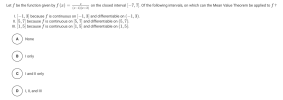 Let f be the function given by f () = on the closed interval [-7,7]. Of the following intervals, on which can the Mean Value Theorem be applied to f? 11-1, 3 because f is continuous on (-1,3] and differentiable on (-1,3). II. [5, 7 because f is continuous on 5,7] and differentiable on (5,7). III. (1,5) because f is continuous on (1,5) and differentiable on (1,5). None © anal only
real analysis 1,2,3,4,8please 5.1.5a Thus iff: I→R is differentiable on n E N. is differentiable on / with g'...
 real analysis
1,2,3,4,8please
5.1.5a
Thus iff: I→R is differentiable on n E N. is differentiable on / with g'(e) ()ain tained from Theorem 5.1.5(b) using mathematical induction, TOu the interal 1i then by the cho 174 Chapter s Differentiation ■ EXERCISES 5.1 the definition to find the derivative of each of the following functions. I. Use r+ 1 2. "Prove that for all integers n, O if n is negative). 3. "a. Prove that (cosx)--sinx. -- b. Find the derivative...
real analysis
1,2,3,4,8please
5.1.5a
Thus iff: I→R is differentiable on n E N. is differentiable on / with g'(e) ()ain tained from Theorem 5.1.5(b) using mathematical induction, TOu the interal 1i then by the cho 174 Chapter s Differentiation ■ EXERCISES 5.1 the definition to find the derivative of each of the following functions. I. Use r+ 1 2. "Prove that for all integers n, O if n is negative). 3. "a. Prove that (cosx)--sinx. -- b. Find the derivative...
 (a) Suppose f is continuously differentiable on the closed and bounded interval I = [0, 1]. Show that f is uniformly continuous on I. (b) Suppose g is continuously differentiable on the open interval J = (0,1). Give and example of such a function which is NOT uniformly continuous on J, and prove your answer.
 7.7.4 The hypotheses of Theorem 7.24 require that f be differentiable on all of the interval I. You might think that a positive derivative at a single point also implies that the function is increasing, at least in a neighborhood of that point. This is not true. Consider the function /(z) _{0,/2 + ra sin.ri. if 0 (e) Prove that if a function F is differentiable on a neighborhood of ro with F(ro)0 and F is continuous at zo, then...
 2. Let f: R R be a continuous function. Suppose that f is differentiable on R\{0} and that there exists an L e R such that lim,of,(z) = L. Prove that f is differentiable at 1-0 with f,(0) = L. (Hint: Use the definition of derivative and then use mean value theorem)
2. Let f: R R be a continuous function. Suppose that f is differentiable on R\{0} and that there exists an L e R such that lim,of,(z) =...
2. Let f: R R be a continuous function. Suppose that f is differentiable on R\{0} and that there exists an L e R such that lim,of,(z) = L. Prove that f is differentiable at 1-0 with f,(0) = L. (Hint: Use the definition of derivative and then use mean value theorem)
2. Let f: R R be a continuous function. Suppose that f is differentiable on R\{0} and that there exists an L e R such that lim,of,(z) =...
 Let f be defined on an open interval I containing a point a (1) Prove that if f is differentiable on I and f"(a) exists, then lim h-+0 (a 2 h2 (2) Prove that if f is continuous at a and there exist constants α and β such that the limit L := lim h2 exists, then f(a)-α and f'(a)-β. Does f"(a) exist and equal to 2L?
Let f be defined on an open interval I containing a point a...
Let f be defined on an open interval I containing a point a (1) Prove that if f is differentiable on I and f"(a) exists, then lim h-+0 (a 2 h2 (2) Prove that if f is continuous at a and there exist constants α and β such that the limit L := lim h2 exists, then f(a)-α and f'(a)-β. Does f"(a) exist and equal to 2L?
Let f be defined on an open interval I containing a point a...
 Let f be a twice differentiable function on an open interval (a, b). Which statements regarding the second derivative and concavity are true? If f"(c) is positive, then the graph of f has a local maximum at x = c. The concavity of a graph changes at an inflection point. If f is increasing, then the graph of f is concave down. The graph of f has a local minimum at x = c if f"(c) = 0. The graph of f is concave up if...
 problem1&2 thx!
interval in R is a set IC R such that for all <y < z in R, if E I and z e I then Recall that an points yE I. We call an interval non-degenerate if it contains at least two (1) Let I be a nondegenerate interval in R, and suppose f: IR is continuous (a) Show that f[] is an interval in R. (b) Show that if I is closed and bounded, then so is...
problem1&2 thx!
interval in R is a set IC R such that for all <y < z in R, if E I and z e I then Recall that an points yE I. We call an interval non-degenerate if it contains at least two (1) Let I be a nondegenerate interval in R, and suppose f: IR is continuous (a) Show that f[] is an interval in R. (b) Show that if I is closed and bounded, then so is...
 4. Let f be a differentiable function defined on (0, 1) whose derivative is f'(c) = 1 - cos (+) [Note that we can confidently say such an f exists by the FTC.) Prove that f is strictly increasing on (0,1). 5. Let f be defined on [0, 1] by the following formula: 1 x = 1/n (n € N) 0, otherwise (a) Prove that f has an infinite number of discontinuities in [0,1]. (b) Prove that f is nonetheless...
 Let f be the function given by f () = on the closed interval [-7,7]. Of the following intervals, on which can the Mean Value Theorem be applied to f? 11-1, 3 because f is continuous on (-1,3] and differentiable on (-1,3). II. [5, 7 because f is continuous on 5,7] and differentiable on (5,7). III. (1,5) because f is continuous on (1,5) and differentiable on (1,5). None © anal only
 real analysis
1,2,3,4,8please
5.1.5a
Thus iff: I→R is differentiable on n E N. is differentiable on / with g'(e) ()ain tained from Theorem 5.1.5(b) using mathematical induction, TOu the interal 1i then by the cho 174 Chapter s Differentiation ■ EXERCISES 5.1 the definition to find the derivative of each of the following functions. I. Use r+ 1 2. "Prove that for all integers n, O if n is negative). 3. "a. Prove that (cosx)--sinx. -- b. Find the derivative...
real analysis
1,2,3,4,8please
5.1.5a
Thus iff: I→R is differentiable on n E N. is differentiable on / with g'(e) ()ain tained from Theorem 5.1.5(b) using mathematical induction, TOu the interal 1i then by the cho 174 Chapter s Differentiation ■ EXERCISES 5.1 the definition to find the derivative of each of the following functions. I. Use r+ 1 2. "Prove that for all integers n, O if n is negative). 3. "a. Prove that (cosx)--sinx. -- b. Find the derivative...
Most questions answered within 3 hours.
-
Where is the error in this code sequence?
String s1 = "Hello";
String s2 = "ello";...
asked 10 months ago -
Financial data for Joel de Paris, Inc., for last year
follow:
Joel de Paris, Inc.
Balance...
asked 10 months ago -
Consider this reaction:
Al2(SO4)3 (aq)+ BaCl3
(aq) Al2Cl6 (aq)- +
3BaSO4(s) . What is the...
asked 10 months ago -
Suppose that Savneet is considering increasing her
recent random sample from 20 car rentals to 40...
asked 10 months ago -
Trucks arrive at an unloading terminal at an average rate of 120
per hour.
Trucks arrive...
asked 10 months ago -
Why are methanol and ethanol completely soluble in water while
octanol is not very little soluble....
asked 10 months ago -
A facilities manager at a university reads in a research report
that the mean amount of...
asked 10 months ago -
When the CuSO4 is rehydrated by adding water to the anhydrous
compound, is this an endothermic...
asked 10 months ago -
A ray of sunlight is passing from diamond into crown glass; the
angle of incidence is...
asked 10 months ago -
A block of mass 0.249 kg is placed on top of a light, vertical
spring of...
asked 10 months ago -
how do the kidneys compensate in the presences of acidosis
a) trigger hyperventilate
b) reserve acid...
asked 10 months ago -
Question 501 pts
The rental rate of capital to the firm increases. Which of the
following...
asked 10 months ago