
Homework Answers
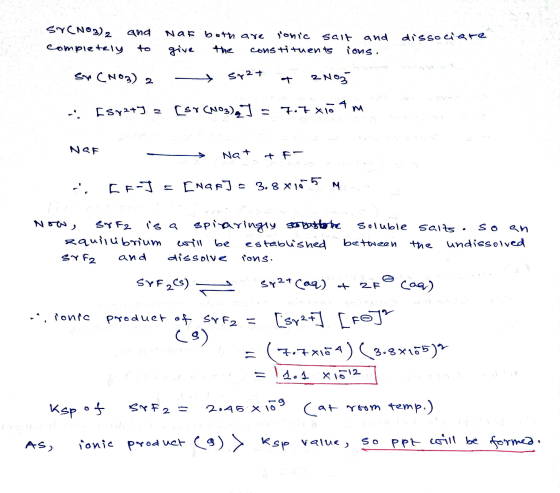
Add Answer to:
Will a ppt of SrF2 (s) form if you mix 7.7 x 10⁻⁴ M Sr(NO3)2 (aq)...
Suppose a solution is made containing 7.3 x 10⁻³ M Sr(NO3)2(aq) and 8.3 x 10² M...
 Suppose a solution is made containing 7.3 x 10⁻³ M Sr(NO3)2(aq) and 8.3 x 10² M NaF (aq). Calculate Q and determine whether a precipitate of SrF2 (s) will form. (In other words, which of the following is entirely correct?) Ksp of SrF2 = 2.8 x 10⁻⁹ a. Q = 5.0 x 10⁵, ppt forms b. Q = 5.0 x 10⁻⁵, no ppt c. Q = 2.0 x 10⁴ ppt forms d. Q = 6.1 x 104.ppt forms e. Q...
solution 15 made containing 7.8 x 10⁻³ (Sr(NO3)2) 25.) suppose and 8.3 x10⁻² NaF (aq). Calculate...
 solution 15 made containing 7.8 x 10⁻³ (Sr(NO3)2) 25.) suppose and 8.3 x10⁻² NaF (aq). Calculate Q and determine wheter a precipate lydstupem of SrFe will form. Ksp of SrF2= 2.8x10⁻⁹ ppt forms forms no ppt CQ = 2.0 110-4 pot forms ppt no ppt e Q= 6.1810-4 a. Q = 5.0 x10⁻⁵ b Q = 5.0 X1D-5 d Q = 6.1 810-4
200 mL of 0.0010 M Sr(NO3)2 (aq) are mixed with 800 mL of 0.0050M NaF (aq)...
200 mL of 0.0010 M Sr(NO3)2 (aq) are mixed with 800 mL of 0.0050M NaF (aq) to make 1.0 L of solution. The Ksp value of SrF2 is 4.3 x 10⁻⁹. Which is correct? I know the answer, I just don't know how they got to it. a. SrF2 will not precipitate. b. SrF2 will precipitate. NaF is the limiting reactant. c. SrF2 will precipitate. NaNO3 is the limiting reactant. d. SrF2 will precipitate. Sr(NO3)2 is the limiting reactant. e....
Suppose 50mL of 8.4x10⁻⁷ M Pb(NO3)2 (aq) is mixed with 200mL of 9.7x10⁻⁴ M Na2CO3(aq). Calculate...
Suppose 50mL of 8.4x10⁻⁷ M Pb(NO3)2 (aq) is mixed with 200mL of 9.7x10⁻⁴ M Na2CO3(aq). Calculate Q and determine whether a ppt of PbCO3(s) will form. (In other words which of the following is entirely correct?) (Suggestion: Write the dissolving equation and Ksp expression for PbCO3 before starting this problem). a. Q=8.1x10⁻¹⁰ , no ppt b. Q=8.1x10⁻¹⁰ , ppt forms c. Q=1.3x10⁻¹⁰ , no ppt d. Q=1.3x10⁻¹⁰ , ppt forms e. Q=2.5x10⁻⁹ , ppt forms
ore for this quiz: 67 out of 100 bmitted Jul 21 at 11:47am is attempt took...
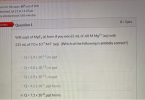 ore for this quiz: 67 out of 100 bmitted Jul 21 at 11:47am is attempt took 160 minutes. 0/3 pts correct Question 1 Will a ppt of MgF2 (s) form if you mix 65 mL of .60 M Mg2+ (aq) with 235 mL of 7.0 x 10⁻⁷MF (aq). (Which of the following is entirely correct?) Q = 3.9 x 10⁻¹⁴, no ppt Q = 4.0 x 10⁻¹³, no ppt Q = 2.9 x 10⁻¹³, no ppt Q = 4.2 x...
12 – A solution of 0.060 M NaF (75 mL) is mixed with 0.15 M Sr(NO3)2...
12 – A solution of 0.060 M NaF (75 mL) is mixed with 0.15 M Sr(NO3)2 (25 mL). Calculate the concentrations of each ion after equilibrium is achieved given Ksp for SrF2 = 2.0 x 10⁻¹⁰.Hint: The ion exchange reaction to produce SrF2 can be considered to go to completion before equilibrium is reestablished starting from the products, much as we’ve done for titration calculations at the equivalence point 13 – a) Calculate the molar solubility of hydroxyapatite given Ksp...
Question 7 Determine the solubility of Cul(s) (Ksp = 1.1 x 10⁻¹²) in 0.15 M Cu(NO3)2(aq)...
 Question 7 Determine the solubility of Cul(s) (Ksp = 1.1 x 10⁻¹²) in 0.15 M Cu(NO3)2(aq) solution 1- 1- Ksp = (S+ 0.15). (25)?. S = (Ksp/0.6) 1/2, S = 1.35 x 10⁻⁶ M 2- 2- Ksp = S . (S + 0.30). S = (Ksp/0.30), S = 3.67 x 10⁻¹² M 3- 3- Ksp = (S + 0.15).S. S = (Ksp/0.15). S = 7.33 x 10⁻¹² M
Will a precipitate form when 35.0 mL of 0.25 M Mg(NO3)2 and 65 mL of 0.15...
 Will a precipitate form when 35.0 mL of 0.25 M Mg(NO3)2 and 65 mL of 0.15 M NaF are mixed together? Ksp for MgF2 = 7.4 x 10". Your work must justify your answer. MgF2 (s) + Mg2+ (aq) + 2 F (aq) Calculate the Ksp for vanadium hydroxide if the solubility of V(OH), in pure water is 1.1 x 10⁻⁷ g/L. V(OH)35 V3+ + 3 OH Label each of the following salts as acidic (A), basic (B) or neutral...
You prepare a solution by mixing 400.0 mL of 1 x 10⁻⁴ M Mg(NO3)2 and 500.0...
You prepare a solution by mixing 400.0 mL of 1 x 10⁻⁴ M Mg(NO3)2 and 500.0 mL of 1.00 x 10⁻⁴ M NaF. What is the observed outcome? For MgF2, Ksp = 6.4 x 10⁻⁹. A. A precipitate forms because Qsp > Ksp. B. No precipitate forms because Qsp > Ksp. C. No precipitate forms because Qsp = Ksp. D. No precipitate forms because Qsp < Ksp. E. A precipitate forms because Qsp < Ksp.
For the reaction Ba(OH)2 (s) -- Ba2+ (aq) + 2 OH (aq) a precipitate will form...
 For the reaction Ba(OH)2 (s) -- Ba2+ (aq) + 2 OH (aq) a precipitate will form if Q< K. Select one: True False Into a solution of 0.10 M KBr and 0.10 M KCYOA you add 0.050 M silver nitrate dropwise until a precipitate forms. Ksp for Ag2Cronis 9.0 x 10⁻¹². Ksp for AgBr is 5.0 x 10⁻¹³. Which of the following will precipitate first? Select one or more: a. silver chromate b. no precipitate will form C. silver bromide...
 Suppose a solution is made containing 7.3 x 10⁻³ M Sr(NO3)2(aq) and 8.3 x 10² M NaF (aq). Calculate Q and determine whether a precipitate of SrF2 (s) will form. (In other words, which of the following is entirely correct?) Ksp of SrF2 = 2.8 x 10⁻⁹ a. Q = 5.0 x 10⁵, ppt forms b. Q = 5.0 x 10⁻⁵, no ppt c. Q = 2.0 x 10⁴ ppt forms d. Q = 6.1 x 104.ppt forms e. Q...
 solution 15 made containing 7.8 x 10⁻³ (Sr(NO3)2) 25.) suppose and 8.3 x10⁻² NaF (aq). Calculate Q and determine wheter a precipate lydstupem of SrFe will form. Ksp of SrF2= 2.8x10⁻⁹ ppt forms forms no ppt CQ = 2.0 110-4 pot forms ppt no ppt e Q= 6.1810-4 a. Q = 5.0 x10⁻⁵ b Q = 5.0 X1D-5 d Q = 6.1 810-4
 ore for this quiz: 67 out of 100 bmitted Jul 21 at 11:47am is attempt took 160 minutes. 0/3 pts correct Question 1 Will a ppt of MgF2 (s) form if you mix 65 mL of .60 M Mg2+ (aq) with 235 mL of 7.0 x 10⁻⁷MF (aq). (Which of the following is entirely correct?) Q = 3.9 x 10⁻¹⁴, no ppt Q = 4.0 x 10⁻¹³, no ppt Q = 2.9 x 10⁻¹³, no ppt Q = 4.2 x...
 Question 7 Determine the solubility of Cul(s) (Ksp = 1.1 x 10⁻¹²) in 0.15 M Cu(NO3)2(aq) solution 1- 1- Ksp = (S+ 0.15). (25)?. S = (Ksp/0.6) 1/2, S = 1.35 x 10⁻⁶ M 2- 2- Ksp = S . (S + 0.30). S = (Ksp/0.30), S = 3.67 x 10⁻¹² M 3- 3- Ksp = (S + 0.15).S. S = (Ksp/0.15). S = 7.33 x 10⁻¹² M
 Will a precipitate form when 35.0 mL of 0.25 M Mg(NO3)2 and 65 mL of 0.15 M NaF are mixed together? Ksp for MgF2 = 7.4 x 10". Your work must justify your answer. MgF2 (s) + Mg2+ (aq) + 2 F (aq) Calculate the Ksp for vanadium hydroxide if the solubility of V(OH), in pure water is 1.1 x 10⁻⁷ g/L. V(OH)35 V3+ + 3 OH Label each of the following salts as acidic (A), basic (B) or neutral...
 For the reaction Ba(OH)2 (s) -- Ba2+ (aq) + 2 OH (aq) a precipitate will form if Q< K. Select one: True False Into a solution of 0.10 M KBr and 0.10 M KCYOA you add 0.050 M silver nitrate dropwise until a precipitate forms. Ksp for Ag2Cronis 9.0 x 10⁻¹². Ksp for AgBr is 5.0 x 10⁻¹³. Which of the following will precipitate first? Select one or more: a. silver chromate b. no precipitate will form C. silver bromide...
Most questions answered within 3 hours.
-
Where is the error in this code sequence?
String s1 = "Hello";
String s2 = "ello";...
asked 11 months ago -
Financial data for Joel de Paris, Inc., for last year
follow:
Joel de Paris, Inc.
Balance...
asked 11 months ago -
Consider this reaction:
Al2(SO4)3 (aq)+ BaCl3
(aq) Al2Cl6 (aq)- +
3BaSO4(s) . What is the...
asked 11 months ago -
Suppose that Savneet is considering increasing her
recent random sample from 20 car rentals to 40...
asked 11 months ago -
Trucks arrive at an unloading terminal at an average rate of 120
per hour.
Trucks arrive...
asked 11 months ago -
Why are methanol and ethanol completely soluble in water while
octanol is not very little soluble....
asked 11 months ago -
A facilities manager at a university reads in a research report
that the mean amount of...
asked 11 months ago -
When the CuSO4 is rehydrated by adding water to the anhydrous
compound, is this an endothermic...
asked 11 months ago -
A ray of sunlight is passing from diamond into crown glass; the
angle of incidence is...
asked 11 months ago -
A block of mass 0.249 kg is placed on top of a light, vertical
spring of...
asked 11 months ago -
how do the kidneys compensate in the presences of acidosis
a) trigger hyperventilate
b) reserve acid...
asked 11 months ago -
Question 501 pts
The rental rate of capital to the firm increases. Which of the
following...
asked 11 months ago