
Homework Answers
Add Answer to:
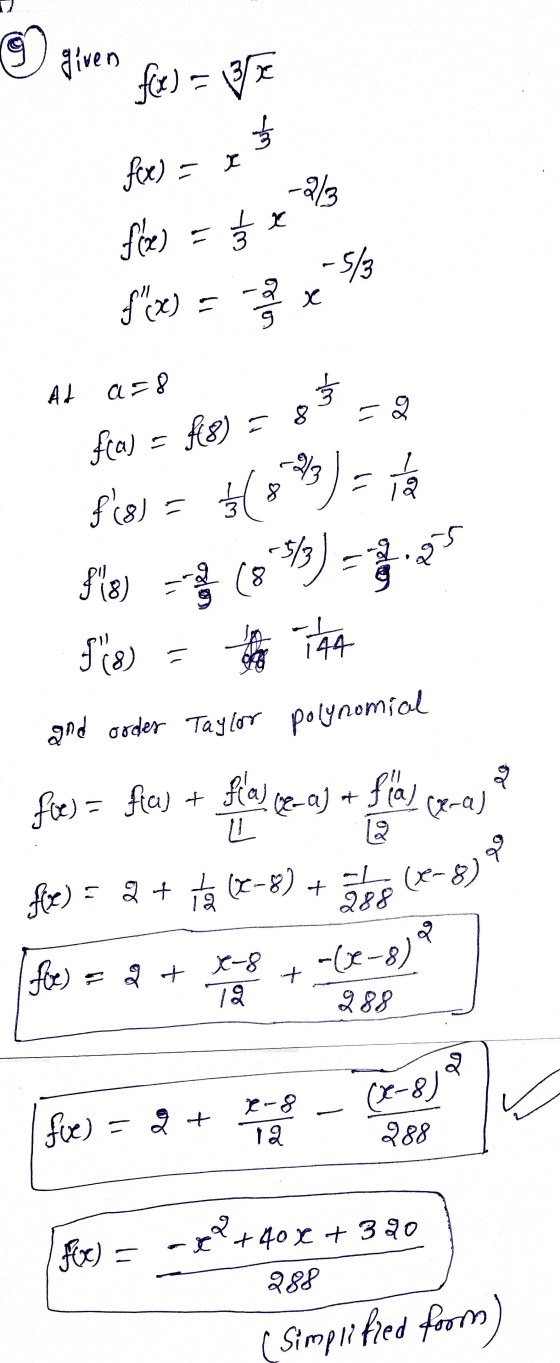
9) Generate the 2nd order Taylor polynomial for f(x)= Vx at a=8 10) Determine an upper...
9) Generate the 2nd order Taylor polynomial for f(x) = Vx at a=1
 9) Generate the 2nd order Taylor polynomial for f(x) = Vx at a=1
The nth-order Taylor polynomial for a function f(x) using the h notation is given as: Pa...
 The nth-order Taylor polynomial for a function f(x) using the h notation is given as: Pa (x + h) = f(x) + f'(a)h + salt) 12 + () +...+ m (s) n." The remainder of the above nth-order Taylor polynomial is defined as: R( +h) = f(n+1)(C) +1 " hn+1, where c is in between x and c+h (n+1)! A student is using 4 terms in the Taylor series of f(x) = 1/x to approximate f(0.7) around x = 1....
need help Determine the third Taylor polynomial at x = 0 for the function f(x)=34x+1. P3(x)...
 need help
Determine the third Taylor polynomial at x = 0 for the function f(x)=34x+1. P3(x) = Determine the fourth Taylor polynomial of f(x) = at x = 0 and use it to estimate e 0.5 P(x)=0 Determine the fourth Taylor polynomial of 11 In x at x = 1. Pax)=0 41 The third remainder for f(x) at x = 0 is R, (x) where c is a number between 0 and x Let f(x) = cos x. (a) Find...
need help
Determine the third Taylor polynomial at x = 0 for the function f(x)=34x+1. P3(x) = Determine the fourth Taylor polynomial of f(x) = at x = 0 and use it to estimate e 0.5 P(x)=0 Determine the fourth Taylor polynomial of 11 In x at x = 1. Pax)=0 41 The third remainder for f(x) at x = 0 is R, (x) where c is a number between 0 and x Let f(x) = cos x. (a) Find...
Find the second Taylor polynomial P2(x) for the function f(x) = ex cos x about xo...
 Find the second Taylor polynomial P2(x) for the function f(x) = ex cos x about xo = 0. Using 4-digit rounding arithmatic. (a). Use P2(0.7) to approximate f(0.7). (b). Find the actual error. (c). Find a bound for the error |f(x) – P2(x) in using P2(x) to approximate f(x) on the interval [0, 1].
[2 marks] Using the Taylor Remainder Theorem, what is the upper bound on f(x) – T3(x)],...
 [2 marks] Using the Taylor Remainder Theorem, what is the upper bound on f(x) – T3(x)], for x E [2, 10] if f(x) = 3 cos x and T3(x) is the Taylor polynomial centered on 6. SH
1. (Taylor Polynomial for cos(ax)) For f(x)cos(ar) do the following. (a) Find the Taylor polynomials T(x) about 0 for f...
 1. (Taylor Polynomial for cos(ax)) For f(x)cos(ar) do the following. (a) Find the Taylor polynomials T(x) about 0 for f(x) for n 1,2,3,4,5 (b) Based on the pattern in part (a), if n is an even number what is the relation between Tn (x) and TR+1()? (c) You might want to approximate cos(az) for all in 0 xS /2 by a Taylor polynomial about 0. Use the Taylor polynomial of order 3 to approximate f(0.25) when a -2, i.e. f(x)...
Compute the Taylor polynomial indicated f(x)-V1 a 8 3888 Use the error bound to find the maximum ...
 Compute the Taylor polynomial indicated f(x)-V1 a 8 3888 Use the error bound to find the maximum possible size of the error. (Round your answer to five decimal places.) lva02-ncs.oz기 s-x 10-12 T3(8.02) S
Compute the Taylor polynomial indicated f(x)-V1 a 8 3888 Use the error bound to find the maximum possible size of the error. (Round your answer to five decimal places.) lva02-ncs.oz기 s-x 10-12 T3(8.02) S
Compute the Taylor polynomial indicated f(x)-V1 a 8 3888 Use the error bound to find the maximum possible size of the error. (Round your answer to five decimal places.) lva02-ncs.oz기 s-x 10-12 T3(8.02) S
Question 1 (20 Points) Find the second Taylor polynomial P2(x) for the function f(x) = ex...
 Question 1 (20 Points) Find the second Taylor polynomial P2(x) for the function f(x) = ex cos x about Xo = 0. Using 4-digit rounding arithmatic. (a). Use P2(0.7) to approximate f(0.7). (b). Find the actual error. (c). Find a bound for the error f(x) - P2(x) in using P2(x) to approximate f(x) on the interval [0, 1].
let a = 35 Please show work! 2. Select a distinctive positive integer a with a > 10 that is not a perfect cube a) Use a third degree Taylor Polynomial to approximate v b) Compute an upper bound for...
 let a = 35
Please show work!
2. Select a distinctive positive integer a with a > 10 that is not a perfect cube a) Use a third degree Taylor Polynomial to approximate v b) Compute an upper bound for the error made in the approximation in (a) (c) Using the output of a calculator or computer as the "exact" value of Va, compute the "exact" error in the approximation in (a).
2. Select a distinctive positive integer a with...
let a = 35
Please show work!
2. Select a distinctive positive integer a with a > 10 that is not a perfect cube a) Use a third degree Taylor Polynomial to approximate v b) Compute an upper bound for the error made in the approximation in (a) (c) Using the output of a calculator or computer as the "exact" value of Va, compute the "exact" error in the approximation in (a).
2. Select a distinctive positive integer a with...
3. Approximate the function f(x) = Vx by T4(x), the Taylor polynomial of degree 4 centred...
 3. Approximate the function f(x) = Vx by T4(x), the Taylor polynomial of degree 4 centred at x = 1. Do this in two ways: (a) Use the general formula at the top of page 60--calculating successive derivatives of vx. (b) Change variable so you can directly use the formula of Ex 4.6: 1 17 1/ 11315 (1 + y)1/2 = 1+3y + 2 + - 41 2 y4 + ... ull- 2 2 2 Now we ask how accurate...
 9) Generate the 2nd order Taylor polynomial for f(x) = Vx at a=1
 The nth-order Taylor polynomial for a function f(x) using the h notation is given as: Pa (x + h) = f(x) + f'(a)h + salt) 12 + () +...+ m (s) n." The remainder of the above nth-order Taylor polynomial is defined as: R( +h) = f(n+1)(C) +1 " hn+1, where c is in between x and c+h (n+1)! A student is using 4 terms in the Taylor series of f(x) = 1/x to approximate f(0.7) around x = 1....
 need help
Determine the third Taylor polynomial at x = 0 for the function f(x)=34x+1. P3(x) = Determine the fourth Taylor polynomial of f(x) = at x = 0 and use it to estimate e 0.5 P(x)=0 Determine the fourth Taylor polynomial of 11 In x at x = 1. Pax)=0 41 The third remainder for f(x) at x = 0 is R, (x) where c is a number between 0 and x Let f(x) = cos x. (a) Find...
need help
Determine the third Taylor polynomial at x = 0 for the function f(x)=34x+1. P3(x) = Determine the fourth Taylor polynomial of f(x) = at x = 0 and use it to estimate e 0.5 P(x)=0 Determine the fourth Taylor polynomial of 11 In x at x = 1. Pax)=0 41 The third remainder for f(x) at x = 0 is R, (x) where c is a number between 0 and x Let f(x) = cos x. (a) Find...
 Find the second Taylor polynomial P2(x) for the function f(x) = ex cos x about xo = 0. Using 4-digit rounding arithmatic. (a). Use P2(0.7) to approximate f(0.7). (b). Find the actual error. (c). Find a bound for the error |f(x) – P2(x) in using P2(x) to approximate f(x) on the interval [0, 1].
 [2 marks] Using the Taylor Remainder Theorem, what is the upper bound on f(x) – T3(x)], for x E [2, 10] if f(x) = 3 cos x and T3(x) is the Taylor polynomial centered on 6. SH
 1. (Taylor Polynomial for cos(ax)) For f(x)cos(ar) do the following. (a) Find the Taylor polynomials T(x) about 0 for f(x) for n 1,2,3,4,5 (b) Based on the pattern in part (a), if n is an even number what is the relation between Tn (x) and TR+1()? (c) You might want to approximate cos(az) for all in 0 xS /2 by a Taylor polynomial about 0. Use the Taylor polynomial of order 3 to approximate f(0.25) when a -2, i.e. f(x)...
 Compute the Taylor polynomial indicated f(x)-V1 a 8 3888 Use the error bound to find the maximum possible size of the error. (Round your answer to five decimal places.) lva02-ncs.oz기 s-x 10-12 T3(8.02) S
Compute the Taylor polynomial indicated f(x)-V1 a 8 3888 Use the error bound to find the maximum possible size of the error. (Round your answer to five decimal places.) lva02-ncs.oz기 s-x 10-12 T3(8.02) S
Compute the Taylor polynomial indicated f(x)-V1 a 8 3888 Use the error bound to find the maximum possible size of the error. (Round your answer to five decimal places.) lva02-ncs.oz기 s-x 10-12 T3(8.02) S
 Question 1 (20 Points) Find the second Taylor polynomial P2(x) for the function f(x) = ex cos x about Xo = 0. Using 4-digit rounding arithmatic. (a). Use P2(0.7) to approximate f(0.7). (b). Find the actual error. (c). Find a bound for the error f(x) - P2(x) in using P2(x) to approximate f(x) on the interval [0, 1].
 let a = 35
Please show work!
2. Select a distinctive positive integer a with a > 10 that is not a perfect cube a) Use a third degree Taylor Polynomial to approximate v b) Compute an upper bound for the error made in the approximation in (a) (c) Using the output of a calculator or computer as the "exact" value of Va, compute the "exact" error in the approximation in (a).
2. Select a distinctive positive integer a with...
let a = 35
Please show work!
2. Select a distinctive positive integer a with a > 10 that is not a perfect cube a) Use a third degree Taylor Polynomial to approximate v b) Compute an upper bound for the error made in the approximation in (a) (c) Using the output of a calculator or computer as the "exact" value of Va, compute the "exact" error in the approximation in (a).
2. Select a distinctive positive integer a with...
 3. Approximate the function f(x) = Vx by T4(x), the Taylor polynomial of degree 4 centred at x = 1. Do this in two ways: (a) Use the general formula at the top of page 60--calculating successive derivatives of vx. (b) Change variable so you can directly use the formula of Ex 4.6: 1 17 1/ 11315 (1 + y)1/2 = 1+3y + 2 + - 41 2 y4 + ... ull- 2 2 2 Now we ask how accurate...
Most questions answered within 3 hours.
-
Where is the error in this code sequence?
String s1 = "Hello";
String s2 = "ello";...
asked 10 months ago -
Financial data for Joel de Paris, Inc., for last year
follow:
Joel de Paris, Inc.
Balance...
asked 10 months ago -
Consider this reaction:
Al2(SO4)3 (aq)+ BaCl3
(aq) Al2Cl6 (aq)- +
3BaSO4(s) . What is the...
asked 10 months ago -
Suppose that Savneet is considering increasing her
recent random sample from 20 car rentals to 40...
asked 10 months ago -
Trucks arrive at an unloading terminal at an average rate of 120
per hour.
Trucks arrive...
asked 10 months ago -
Why are methanol and ethanol completely soluble in water while
octanol is not very little soluble....
asked 10 months ago -
A facilities manager at a university reads in a research report
that the mean amount of...
asked 10 months ago -
When the CuSO4 is rehydrated by adding water to the anhydrous
compound, is this an endothermic...
asked 10 months ago -
A ray of sunlight is passing from diamond into crown glass; the
angle of incidence is...
asked 10 months ago -
A block of mass 0.249 kg is placed on top of a light, vertical
spring of...
asked 10 months ago -
how do the kidneys compensate in the presences of acidosis
a) trigger hyperventilate
b) reserve acid...
asked 10 months ago -
Question 501 pts
The rental rate of capital to the firm increases. Which of the
following...
asked 10 months ago