Suppose X = Exp(1) and Y= -ln(x)
(a)Find the cumulative distribution function of Y .
(b) Find the probability density function of Y .
(c) Let X1, X2, ... , Xk be i.i.d. Exp(1), and let Mk = max{X1,..... , Xk)(Maximum of X1, ..., Xk). Find the probability density function of Mk.(Hint: P(min(X1, X2, X3) > k) = P(X1 >= k, X2 >= k, X3 >= kq, how about max ?)

Homework Answers
Solution,
a)
cdf of Y : 
![[X>0=>\infty lnX<\infty ]=>\infty <-lnX<\infty ]](http://img.homeworklib.com/questions/f7182ba0-fc41-11ea-b047-19049d191620.png?x-oss-process=image/resize,w_560)


 ,
, 
b)
pdf of Y : 
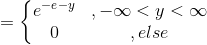
c)
cdf of Mx : 
![=[p(X_{1}\leq y)]^{k}](http://img.homeworklib.com/questions/fae11d40-fc41-11ea-a1a8-bf897e23a016.png?x-oss-process=image/resize,w_560)
![[X_{1},..., X_{k} are iid, Max {X_{1}, ,X_{k}}\leq a=>llX_{i}\leq a]](http://img.homeworklib.com/questions/fb2d78b0-fc41-11ea-8a10-2720bcd5b503.png?x-oss-process=image/resize,w_560)
![=\left [ \int_{0}^{y} f_{X_{1}}(x)\right ]^{k}=\left [ \int_{0}^{y}e^{-x}dx\right ]^{k}=(1-e^{-y})^{k}, y>0](http://img.homeworklib.com/questions/fb86c850-fc41-11ea-8dad-3f1857f7c348.png?x-oss-process=image/resize,w_560)
pdf of Mk :  d)
d)
cdf of Z : 


= FY(z) [ a = -e-z
the hint]
Add Answer to:
Suppose X = Exp(1) and Y= -ln(x)
(a)Find the cumulative distribution function of Y .
(b)...
6. (10 points) Suppose X – Exp(1) and Y = -In(X) (a) Find the cumulative distribution...
 6. (10 points) Suppose X – Exp(1) and Y = -In(X) (a) Find the cumulative distribution function of Y. (b) Find the probability density function of Y. (c) Let X1, X2,...,be i.i.d. Exp(1), and let Mk = max(X1,..., Xk) (Maximum of X1, ..., Xk). Find the probability density function of Mk (Hint: P(min(X1, X2, X3) > k) = P(X1 > k, X2 > k, X3 > k), how about max ?) (d) Show that as k- , the CDF of...
6. (10 points) Suppose X ~ Exp(1) and Y = -ln(X) (a) Find the cumulative distribution...
 6. (10 points) Suppose X ~ Exp(1) and Y = -ln(X) (a) Find the cumulative distribution function of Y. (b) Find the probability density function of Y.
Suppose X1, X2, Xz~exp(1) and they are independent. (a) Compute the cdf of X1 (b) Let...
 Suppose X1, X2, Xz~exp(1) and they are independent. (a) Compute the cdf of X1 (b) Let Y- max(Xi, X2, X3). Find the cdf of Y (c) Derive the pdf of Y
X is a positive continuous random variable with density fX(x). Y = ln(X). Find the cumulative...
 X is a positive continuous random variable with density fX(x). Y
= ln(X).
Find the cumulative distribution function (cdf) Fy(y) of Y in terms of the cdf of X. Find the probability density function (pdf) fy(y) of Y in terms of the pdf of X. For the remaining problem (problem 3 (3),(4) and (5)), suppose X is a uniform random the interval (0,5). Compute the cdf and pdf of X. Compute the expectation and variance of X. What is Fy(y)?...
X is a positive continuous random variable with density fX(x). Y
= ln(X).
Find the cumulative distribution function (cdf) Fy(y) of Y in terms of the cdf of X. Find the probability density function (pdf) fy(y) of Y in terms of the pdf of X. For the remaining problem (problem 3 (3),(4) and (5)), suppose X is a uniform random the interval (0,5). Compute the cdf and pdf of X. Compute the expectation and variance of X. What is Fy(y)?...
4. Suppose Xi, X2, X3 ~exp(1) and they are independent (a) Compute the edf of X...
 4. Suppose Xi, X2, X3 ~exp(1) and they are independent (a) Compute the edf of X (b) Let Y max(Xi, X2, X3). Find the cdf of Y. (c) Derive the pdf of Y
Let f(x,y) = exp(-x) be a probability density function over the plane. Find the probabilities: Parta)P(...
 Let f(x,y) = exp(-x) be a probability density function over the plane. Find the probabilities: Parta)P( X2 + y2 <a), a > 0, Part b)P(x2 + y2 <a), a > 0.
2. Suppose that (X,Y) has the following joint probability density function: f(x,y) = C if -1...
 2. Suppose that (X,Y) has the following joint probability density function: f(x,y) = C if -1 <r< 1 and -1 <y<1, and 0 otherwise. Here is a constant. (a) Determine the value of C. (b) Are X and Y independent? (Explain why or why not.) (c) Calculate the probability that 2X - Y > 0 (d) Calculate the probability that |X+Y| < 2 3. Suppose that X1 and X2 are independent and each is standard uniform on (0,1]. Let Y...
Two independent random variables X1 and X2 both follow UNIF(0, 1). Define Y = e X1X2 . Find the cumulative distribution function (CDF) or the probability density function (pdf) of Y . (You can choose...
Two independent random variables X1 and X2 both follow UNIF(0, 1). Define Y = e X1X2 . Find the cumulative distribution function (CDF) or the probability density function (pdf) of Y . (You can choose either one).
Let random variables X and Y have the bi-variate exponential CDF (cumulative distribution function) : F(x,y)...
Let random variables X and Y have the bi-variate exponential CDF (cumulative distribution function) : F(x,y) = 1 - exp(-x) - exp(-y) + exp(-x-y-xy) Given x > 0, y>0 a) Determine the probability that 4 < X given that Y = 2 b) Determine the probability that 4 < X given that Y is less than or equal to 2
Let X1, X2, X3,…Xn is a random sample, where X~Exp(1/θ) and U=2Y/θ. a) Find the cumulative...
Let X1, X2, X3,…Xn is a random sample, where X~Exp(1/θ) and U=2Y/θ. a) Find the cumulative distribution function of U. (8pts) b) Is U a pivot (2pts) c) Find the 95% CI for θ.(10pts)
 6. (10 points) Suppose X – Exp(1) and Y = -In(X) (a) Find the cumulative distribution function of Y. (b) Find the probability density function of Y. (c) Let X1, X2,...,be i.i.d. Exp(1), and let Mk = max(X1,..., Xk) (Maximum of X1, ..., Xk). Find the probability density function of Mk (Hint: P(min(X1, X2, X3) > k) = P(X1 > k, X2 > k, X3 > k), how about max ?) (d) Show that as k- , the CDF of...
 6. (10 points) Suppose X ~ Exp(1) and Y = -ln(X) (a) Find the cumulative distribution function of Y. (b) Find the probability density function of Y.
 Suppose X1, X2, Xz~exp(1) and they are independent. (a) Compute the cdf of X1 (b) Let Y- max(Xi, X2, X3). Find the cdf of Y (c) Derive the pdf of Y
 X is a positive continuous random variable with density fX(x). Y
= ln(X).
Find the cumulative distribution function (cdf) Fy(y) of Y in terms of the cdf of X. Find the probability density function (pdf) fy(y) of Y in terms of the pdf of X. For the remaining problem (problem 3 (3),(4) and (5)), suppose X is a uniform random the interval (0,5). Compute the cdf and pdf of X. Compute the expectation and variance of X. What is Fy(y)?...
X is a positive continuous random variable with density fX(x). Y
= ln(X).
Find the cumulative distribution function (cdf) Fy(y) of Y in terms of the cdf of X. Find the probability density function (pdf) fy(y) of Y in terms of the pdf of X. For the remaining problem (problem 3 (3),(4) and (5)), suppose X is a uniform random the interval (0,5). Compute the cdf and pdf of X. Compute the expectation and variance of X. What is Fy(y)?...
 4. Suppose Xi, X2, X3 ~exp(1) and they are independent (a) Compute the edf of X (b) Let Y max(Xi, X2, X3). Find the cdf of Y. (c) Derive the pdf of Y
 Let f(x,y) = exp(-x) be a probability density function over the plane. Find the probabilities: Parta)P( X2 + y2 <a), a > 0, Part b)P(x2 + y2 <a), a > 0.
 2. Suppose that (X,Y) has the following joint probability density function: f(x,y) = C if -1 <r< 1 and -1 <y<1, and 0 otherwise. Here is a constant. (a) Determine the value of C. (b) Are X and Y independent? (Explain why or why not.) (c) Calculate the probability that 2X - Y > 0 (d) Calculate the probability that |X+Y| < 2 3. Suppose that X1 and X2 are independent and each is standard uniform on (0,1]. Let Y...
Most questions answered within 3 hours.
-
Where is the error in this code sequence?
String s1 = "Hello";
String s2 = "ello";...
asked 11 months ago -
Financial data for Joel de Paris, Inc., for last year
follow:
Joel de Paris, Inc.
Balance...
asked 11 months ago -
Consider this reaction:
Al2(SO4)3 (aq)+ BaCl3
(aq) Al2Cl6 (aq)- +
3BaSO4(s) . What is the...
asked 11 months ago -
Suppose that Savneet is considering increasing her
recent random sample from 20 car rentals to 40...
asked 11 months ago -
Trucks arrive at an unloading terminal at an average rate of 120
per hour.
Trucks arrive...
asked 11 months ago -
Why are methanol and ethanol completely soluble in water while
octanol is not very little soluble....
asked 11 months ago -
A facilities manager at a university reads in a research report
that the mean amount of...
asked 11 months ago -
When the CuSO4 is rehydrated by adding water to the anhydrous
compound, is this an endothermic...
asked 11 months ago -
A ray of sunlight is passing from diamond into crown glass; the
angle of incidence is...
asked 11 months ago -
A block of mass 0.249 kg is placed on top of a light, vertical
spring of...
asked 11 months ago -
how do the kidneys compensate in the presences of acidosis
a) trigger hyperventilate
b) reserve acid...
asked 11 months ago -
Question 501 pts
The rental rate of capital to the firm increases. Which of the
following...
asked 11 months ago