
Homework Answers
Prove the statement is true. (b) Qn(0, 0) <RR
 Prove the statement is true.
(b) Qn(0, 0) <RR
Prove the statement is true.
(b) Qn(0, 0) <RR
let a,b > 0 . Prove that DI < Val
 let a,b > 0 . Prove that
DI < Val
let a,b > 0 . Prove that
DI < Val
Let U ? Rmxn. Prove that if UTI-In, then n < m.
 Let U ? Rmxn. Prove that if UTI-In, then n < m.
1 4.6.3. (Harder!) Let 0 < a < 1. Prove that for any n EN, (1...
 1 4.6.3. (Harder!) Let 0 < a < 1. Prove that for any n EN, (1 – a)” < 1+n·a
1. Let x, a € R. Prove that if a <a, then -a < x <a.
 1. Let x, a € R. Prove that if a <a, then -a < x <a.
3. (15 pts) Let D be an infinite set with cardinal d. Let A = {X...
 3. (15 pts) Let D be an infinite set with cardinal d. Let A = {X C D | 0(X) <3}. Prove that o(A) = d.
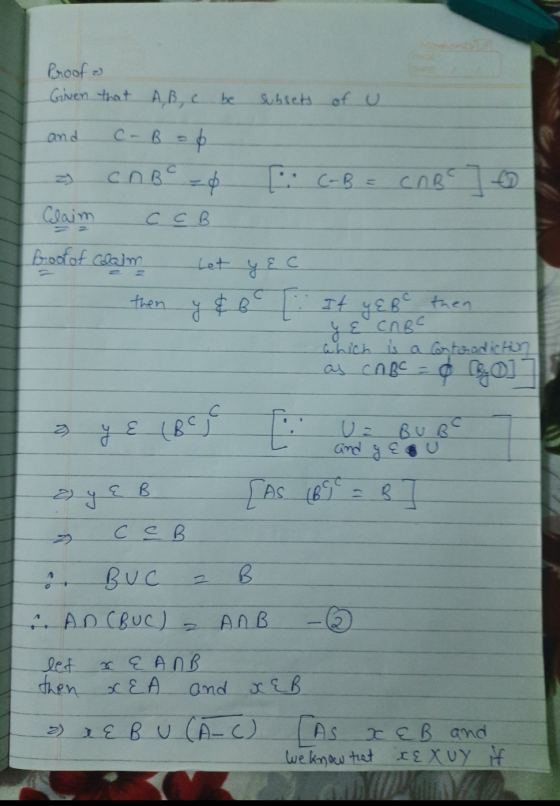
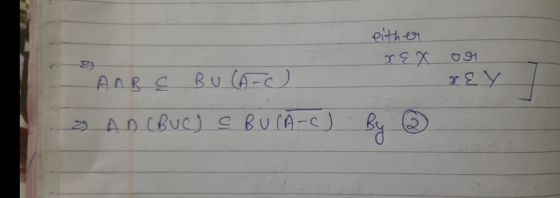
A,C,G please 1. Let A, B, and C be subsets of some universal set u. Prove...
 A,C,G please
1. Let A, B, and C be subsets of some universal set u. Prove the following statements from Theorem 4.2.6 (a) AUA=/1 and AnA=A. (b) AUO- A and An. (c) AnB C A and ACAUB (d) AU(BUC)= (A U B) U C and An(B n C)-(A n B) n C. (e) AUB=BUA and A n B = B n A. (f) AU(BnC) (AU B) n(AUC) (g) (A U B) = A n B (h) AUA=1( and An-=0. hore...
A,C,G please
1. Let A, B, and C be subsets of some universal set u. Prove the following statements from Theorem 4.2.6 (a) AUA=/1 and AnA=A. (b) AUO- A and An. (c) AnB C A and ACAUB (d) AU(BUC)= (A U B) U C and An(B n C)-(A n B) n C. (e) AUB=BUA and A n B = B n A. (f) AU(BnC) (AU B) n(AUC) (g) (A U B) = A n B (h) AUA=1( and An-=0. hore...
1. Assume G=< a>. Let beg. Prove that o(b) is a factor of o(a)
 1. Assume G=< a>. Let beg. Prove that o(b) is a factor of o(a)
Prove for allm ε Ν. Σέ < 2 - Α.
 Prove for allm ε Ν. Σέ < 2 - Α.
Let S be a finite set with cardinality n>0. a. Prove, by constructing a bijection, that...
 Let S be a finite set with cardinality n>0. a. Prove, by constructing a bijection, that the number of subsets of S of size k is equal to the number of subsets of size n- k. Be sure to prove that vour mapping is both injective and surjective. b. Prove, by constructing a bijection, that the number of odd-cardinality subsets of S is equal to the number of even-cardinality subsets of S. Be sure to prove that your mapping is...
 Prove the statement is true.
(b) Qn(0, 0) <RR
Prove the statement is true.
(b) Qn(0, 0) <RR
 let a,b > 0 . Prove that
DI < Val
let a,b > 0 . Prove that
DI < Val
 Let U ? Rmxn. Prove that if UTI-In, then n < m.
 1 4.6.3. (Harder!) Let 0 < a < 1. Prove that for any n EN, (1 – a)” < 1+n·a
 1. Let x, a € R. Prove that if a <a, then -a < x <a.
 3. (15 pts) Let D be an infinite set with cardinal d. Let A = {X C D | 0(X) <3}. Prove that o(A) = d.
 A,C,G please
1. Let A, B, and C be subsets of some universal set u. Prove the following statements from Theorem 4.2.6 (a) AUA=/1 and AnA=A. (b) AUO- A and An. (c) AnB C A and ACAUB (d) AU(BUC)= (A U B) U C and An(B n C)-(A n B) n C. (e) AUB=BUA and A n B = B n A. (f) AU(BnC) (AU B) n(AUC) (g) (A U B) = A n B (h) AUA=1( and An-=0. hore...
A,C,G please
1. Let A, B, and C be subsets of some universal set u. Prove the following statements from Theorem 4.2.6 (a) AUA=/1 and AnA=A. (b) AUO- A and An. (c) AnB C A and ACAUB (d) AU(BUC)= (A U B) U C and An(B n C)-(A n B) n C. (e) AUB=BUA and A n B = B n A. (f) AU(BnC) (AU B) n(AUC) (g) (A U B) = A n B (h) AUA=1( and An-=0. hore...
 1. Assume G=< a>. Let beg. Prove that o(b) is a factor of o(a)
 Prove for allm ε Ν. Σέ < 2 - Α.
 Let S be a finite set with cardinality n>0. a. Prove, by constructing a bijection, that the number of subsets of S of size k is equal to the number of subsets of size n- k. Be sure to prove that vour mapping is both injective and surjective. b. Prove, by constructing a bijection, that the number of odd-cardinality subsets of S is equal to the number of even-cardinality subsets of S. Be sure to prove that your mapping is...
Most questions answered within 3 hours.
-
Where is the error in this code sequence?
String s1 = "Hello";
String s2 = "ello";...
asked 11 months ago -
Financial data for Joel de Paris, Inc., for last year
follow:
Joel de Paris, Inc.
Balance...
asked 11 months ago -
Consider this reaction:
Al2(SO4)3 (aq)+ BaCl3
(aq) Al2Cl6 (aq)- +
3BaSO4(s) . What is the...
asked 11 months ago -
Suppose that Savneet is considering increasing her
recent random sample from 20 car rentals to 40...
asked 11 months ago -
Trucks arrive at an unloading terminal at an average rate of 120
per hour.
Trucks arrive...
asked 11 months ago -
Why are methanol and ethanol completely soluble in water while
octanol is not very little soluble....
asked 11 months ago -
A facilities manager at a university reads in a research report
that the mean amount of...
asked 11 months ago -
When the CuSO4 is rehydrated by adding water to the anhydrous
compound, is this an endothermic...
asked 11 months ago -
A ray of sunlight is passing from diamond into crown glass; the
angle of incidence is...
asked 11 months ago -
A block of mass 0.249 kg is placed on top of a light, vertical
spring of...
asked 11 months ago -
how do the kidneys compensate in the presences of acidosis
a) trigger hyperventilate
b) reserve acid...
asked 11 months ago -
Question 501 pts
The rental rate of capital to the firm increases. Which of the
following...
asked 11 months ago