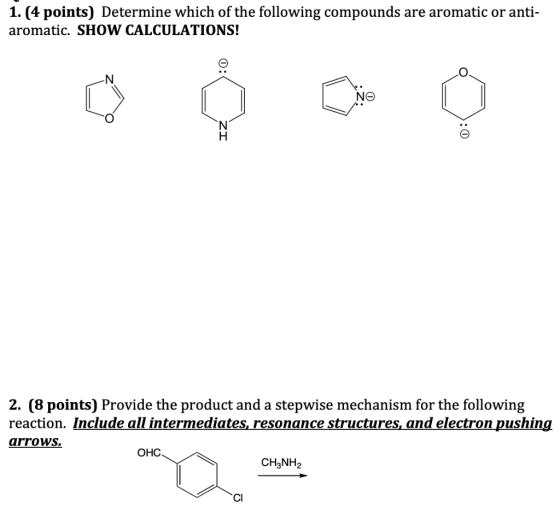
1. Determine which of the following compounds are aromatic or antiaromatic. SHOW CALCULATIONS!
2. Provide the product and a stepwise mechanism for the following reaction. Include all intermediates, resonance structures, and electron pushing arrows.
Homework Answers
Request Answer!
We need at least 10 more requests to produce the answer.
0 / 10 have requested this problem solution
The more requests, the faster the answer.
Add Answer to:
1. Determine which of the following compounds are aromatic or
antiaromatic. SHOW CALCULATIONS!
2. Provide the...
Name: Assuming each compound is planar, state which of the following compounds are aromatic for each...
 Name: Assuming each compound is planar, state which of the following compounds are aromatic for each say why (8 points) b) Using curved arrows show how two more resonance structure can be derived for the following (show the derived structure). (2 points) 2. Considering the effect of the substituent on the benzene ring below. Identify the major product of the following reaction. (20 points) a. (5 points) Br2 FeBrg b. What is the active Electrophile for this reaction? (3 points)...
Name: 3 1. Assuming each compound is planar, state which of the following compounds are aromatic...
 Name: 3 1. Assuming each compound is planar, state which of the following compounds are aromatic and for each say why (8 points). a. b. d. C. HON b) Using curved arrows show how two more resonance structure can be derived for the following (show the derived structure). (2 points) d 2. Considering the effect of the substituent on the benzene ring below. Identify the major product of the following reaction. (20 points) a. (5 points) Hat Аневи Br2 FeBr3...
4. Provide a stepwise mechanism. Include all intermediates, resonance structures, and electron pushing arrows.(ALL OR NOTHING)...
 4. Provide a stepwise mechanism. Include all intermediates, resonance structures, and electron pushing arrows.(ALL OR NOTHING) HEC CH3 AICI D. HCI 5. (Provide the product(s) or reagent(s) for the following reactions. COM ????? ON 77277 HON C ?????
2. Determine if the following compounds are aromatic/ antiaromatic/ non aromatic, Explain your choice: ( 10...
 2. Determine if the following compounds
are aromatic/ antiaromatic/ non aromatic, Explain your choice: ( 10
points) (assume rings are planar unless otherwise
indicated)
2. Determine if the following compounds are aromatic/ antiaromatic/ non aromatic, Explain your choice: (10 points) (assume rings are planar unless otherwise indicated) NH2 N: :N H d.
2. Determine if the following compounds
are aromatic/ antiaromatic/ non aromatic, Explain your choice: ( 10
points) (assume rings are planar unless otherwise
indicated)
2. Determine if the following compounds are aromatic/ antiaromatic/ non aromatic, Explain your choice: (10 points) (assume rings are planar unless otherwise indicated) NH2 N: :N H d.
32. Label the following compounds as aromatic, antiaromatic, nonaromatic. (7 pts) ar anticomac aromatic . aromatic...
 32. Label the following compounds as aromatic, antiaromatic, nonaromatic. (7 pts) ar anticomac aromatic . aromatic r horomete NOD mutic anticanatic Show the mechanisms for the following reactions 33 and 34. Include all steps, intermediates and possible products. 33. For a symmetrical diene (5 pts) initiation HBr 1 H + Br
2. Determine if each of the following compounds are not aromatic, aromatic, or antiaromatic pts). To...
 2. Determine if each of the following compounds are not aromatic, aromatic, or antiaromatic pts). To b.
4.) Determine whether the following ion is aromatic, nonaromatic, or antiaromatic. 5.) Predict the product. If...
 4.)
Determine whether the following ion is aromatic, nonaromatic, or
antiaromatic.
5.) Predict the product. If no reaction, write NR.
6.) Determine the reagents needed. Show each step
4.) Determine whether the following ion is aromatic, nonaromatic, or anti aromatic . Predict the product. If no reaction, write NR, OqN To Allizy Ch 6. Determine the reagents needed. Show each steps HC = CCH .NO2 NH₂
4.)
Determine whether the following ion is aromatic, nonaromatic, or
antiaromatic.
5.) Predict the product. If no reaction, write NR.
6.) Determine the reagents needed. Show each step
4.) Determine whether the following ion is aromatic, nonaromatic, or anti aromatic . Predict the product. If no reaction, write NR, OqN To Allizy Ch 6. Determine the reagents needed. Show each steps HC = CCH .NO2 NH₂
Gradescope #2 This question is worth 10 points. The reaction between (R)-2-bromo-3-methylbutane and water in the...
 Gradescope #2 This question is worth 10 points. The reaction between (R)-2-bromo-3-methylbutane and water in the presence of heat forms Br. H30* and two organic products. Draw a stepwise mechanism for this reaction, clearly showing how each product is formed. Use curved arrows to show electron movement, and include all reactive intermediates, resonance structures, etc. Br H20
V2 Q9. Provide reagents for the following transformations 0 CI Provide a stepwise mechanism for the...
 V2 Q9. Provide reagents for the following transformations 0 CI Provide a stepwise mechanism for the formation of the major product in the following free radical bromination reaction. All steps and intermediates (as well as arrows leading to it) must be shown. Show formation of bromine Br2 (10 points) +HBr NBS, hv 0 Initiation: Propagation Termination Best Wishes! G.Sathianathan
Provide the product(s) and mechanism for the following reactions. Include all intermediates, resonance structures, charges, and...
 Provide the product(s) and mechanism for the following
reactions. Include all intermediates, resonance structures,
charges, and electron pushing arrows to obtain full credit.
1.
2.
3.
4.
1 Ph MgBr 2. Hао 1. сн.MgBr 2. H,о- Et heat Me ОН ??? -ОН
Provide the product(s) and mechanism for the following
reactions. Include all intermediates, resonance structures,
charges, and electron pushing arrows to obtain full credit.
1.
2.
3.
4.
1 Ph MgBr 2. Hао 1. сн.MgBr 2. H,о- Et heat Me ОН ??? -ОН
 Name: Assuming each compound is planar, state which of the following compounds are aromatic for each say why (8 points) b) Using curved arrows show how two more resonance structure can be derived for the following (show the derived structure). (2 points) 2. Considering the effect of the substituent on the benzene ring below. Identify the major product of the following reaction. (20 points) a. (5 points) Br2 FeBrg b. What is the active Electrophile for this reaction? (3 points)...
 Name: 3 1. Assuming each compound is planar, state which of the following compounds are aromatic and for each say why (8 points). a. b. d. C. HON b) Using curved arrows show how two more resonance structure can be derived for the following (show the derived structure). (2 points) d 2. Considering the effect of the substituent on the benzene ring below. Identify the major product of the following reaction. (20 points) a. (5 points) Hat Аневи Br2 FeBr3...
 4. Provide a stepwise mechanism. Include all intermediates, resonance structures, and electron pushing arrows.(ALL OR NOTHING) HEC CH3 AICI D. HCI 5. (Provide the product(s) or reagent(s) for the following reactions. COM ????? ON 77277 HON C ?????
 2. Determine if the following compounds
are aromatic/ antiaromatic/ non aromatic, Explain your choice: ( 10
points) (assume rings are planar unless otherwise
indicated)
2. Determine if the following compounds are aromatic/ antiaromatic/ non aromatic, Explain your choice: (10 points) (assume rings are planar unless otherwise indicated) NH2 N: :N H d.
2. Determine if the following compounds
are aromatic/ antiaromatic/ non aromatic, Explain your choice: ( 10
points) (assume rings are planar unless otherwise
indicated)
2. Determine if the following compounds are aromatic/ antiaromatic/ non aromatic, Explain your choice: (10 points) (assume rings are planar unless otherwise indicated) NH2 N: :N H d.
 32. Label the following compounds as aromatic, antiaromatic, nonaromatic. (7 pts) ar anticomac aromatic . aromatic r horomete NOD mutic anticanatic Show the mechanisms for the following reactions 33 and 34. Include all steps, intermediates and possible products. 33. For a symmetrical diene (5 pts) initiation HBr 1 H + Br
 2. Determine if each of the following compounds are not aromatic, aromatic, or antiaromatic pts). To b.
 4.)
Determine whether the following ion is aromatic, nonaromatic, or
antiaromatic.
5.) Predict the product. If no reaction, write NR.
6.) Determine the reagents needed. Show each step
4.) Determine whether the following ion is aromatic, nonaromatic, or anti aromatic . Predict the product. If no reaction, write NR, OqN To Allizy Ch 6. Determine the reagents needed. Show each steps HC = CCH .NO2 NH₂
4.)
Determine whether the following ion is aromatic, nonaromatic, or
antiaromatic.
5.) Predict the product. If no reaction, write NR.
6.) Determine the reagents needed. Show each step
4.) Determine whether the following ion is aromatic, nonaromatic, or anti aromatic . Predict the product. If no reaction, write NR, OqN To Allizy Ch 6. Determine the reagents needed. Show each steps HC = CCH .NO2 NH₂
 Gradescope #2 This question is worth 10 points. The reaction between (R)-2-bromo-3-methylbutane and water in the presence of heat forms Br. H30* and two organic products. Draw a stepwise mechanism for this reaction, clearly showing how each product is formed. Use curved arrows to show electron movement, and include all reactive intermediates, resonance structures, etc. Br H20
 V2 Q9. Provide reagents for the following transformations 0 CI Provide a stepwise mechanism for the formation of the major product in the following free radical bromination reaction. All steps and intermediates (as well as arrows leading to it) must be shown. Show formation of bromine Br2 (10 points) +HBr NBS, hv 0 Initiation: Propagation Termination Best Wishes! G.Sathianathan
 Provide the product(s) and mechanism for the following
reactions. Include all intermediates, resonance structures,
charges, and electron pushing arrows to obtain full credit.
1.
2.
3.
4.
1 Ph MgBr 2. Hао 1. сн.MgBr 2. H,о- Et heat Me ОН ??? -ОН
Provide the product(s) and mechanism for the following
reactions. Include all intermediates, resonance structures,
charges, and electron pushing arrows to obtain full credit.
1.
2.
3.
4.
1 Ph MgBr 2. Hао 1. сн.MgBr 2. H,о- Et heat Me ОН ??? -ОН
Most questions answered within 3 hours.
-
Where is the error in this code sequence?
String s1 = "Hello";
String s2 = "ello";...
asked 11 months ago -
Financial data for Joel de Paris, Inc., for last year
follow:
Joel de Paris, Inc.
Balance...
asked 11 months ago -
Consider this reaction:
Al2(SO4)3 (aq)+ BaCl3
(aq) Al2Cl6 (aq)- +
3BaSO4(s) . What is the...
asked 11 months ago -
Suppose that Savneet is considering increasing her
recent random sample from 20 car rentals to 40...
asked 11 months ago -
Trucks arrive at an unloading terminal at an average rate of 120
per hour.
Trucks arrive...
asked 11 months ago -
Why are methanol and ethanol completely soluble in water while
octanol is not very little soluble....
asked 11 months ago -
A facilities manager at a university reads in a research report
that the mean amount of...
asked 11 months ago -
When the CuSO4 is rehydrated by adding water to the anhydrous
compound, is this an endothermic...
asked 11 months ago -
A ray of sunlight is passing from diamond into crown glass; the
angle of incidence is...
asked 11 months ago -
A block of mass 0.249 kg is placed on top of a light, vertical
spring of...
asked 11 months ago -
how do the kidneys compensate in the presences of acidosis
a) trigger hyperventilate
b) reserve acid...
asked 11 months ago -
Question 501 pts
The rental rate of capital to the firm increases. Which of the
following...
asked 11 months ago