Suppose that a perfectly competitive industry becomes a monopoly. Describe the effects of this change on consumer...
Suppose that a perfectly competitive industry becomes a monopoly. Describe the effects of this change on consumer surplus, producer surplus and price.
Homework Answers
As the perfectly competitive industry becomes a monopoly, there is a decrease in suppliers from many to one. the demand curve that was horizontal is now downward sloping. Thus, the profit maximization quantity for a seller is such that MR = MC. At this point, the quantity is lower than the perfectly competitive output and the price is higher. As a result the consumer surplus decreases and the producer surplus increases.
Add Answer to:
Suppose that a
perfectly competitive industry becomes a
monopoly. Describe the effects of this change on
consumer...
Suppose the firms in a perfectly competitive industry merge to form a monopoly. Which of the...
Suppose the firms in a perfectly competitive industry merge to form a monopoly. Which of the following would NOT occur? A. A fall in consumer surplus B. A rise in total consumer plus producer surplus C. A deadweight loss D. A rise in producer surplus
The graph shows the consumer surplus for a perfectly competitive industry. The industry is taken over...
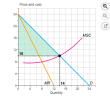 The graph shows the consumer surplus for a perfectly competitive
industry.
The industry is taken over by a monopoly.
Draw the new consumer surplus. Label it
CS1.
Draw and label the consumer surplus that is
transferred to the monopoly. Label it monopoly's
gain.
Price and cost MSC MR 14 12 16 20 24 Quantity
The graph shows the consumer surplus for a perfectly competitive
industry.
The industry is taken over by a monopoly.
Draw the new consumer surplus. Label it
CS1.
Draw and label the consumer surplus that is
transferred to the monopoly. Label it monopoly's
gain.
Price and cost MSC MR 14 12 16 20 24 Quantity
Compare consumer surplus when the market is perfectly competitive and when the market is a monopoly.
Compare consumer surplus when the market is perfectly competitive and when the market is a monopoly.
Perfectly competitive and monopoly firms are complete opposites. The monopoly demand curve is ___ while the...
 Perfectly competitive and monopoly firms are complete
opposites.
The monopoly demand curve is ___ while the perfectly competitive
firm’s demand curve is ___. This is because a monopoly is the only
producer in an industry, so the monopoly firm’s ___ curve is the
same as the market demand curve, while the perfectly competitive
firm produces in a market with ___ competitors.
Perfectly competitive and monopoly firms are complete opposites. Drag word(s) below to fill in the blank(s) in the passage....
Perfectly competitive and monopoly firms are complete
opposites.
The monopoly demand curve is ___ while the perfectly competitive
firm’s demand curve is ___. This is because a monopoly is the only
producer in an industry, so the monopoly firm’s ___ curve is the
same as the market demand curve, while the perfectly competitive
firm produces in a market with ___ competitors.
Perfectly competitive and monopoly firms are complete opposites. Drag word(s) below to fill in the blank(s) in the passage....
Monopoly - End of Chapter Problem 6. Consider the accompanying demand schedule for diamonds. The marginal...
 Monopoly - End of Chapter Problem 6. Consider the accompanying demand schedule for diamonds. The marginal cost of producing diamonds is constant at $100. There is no fixed cost. Price of Quantity of diamonds diamond demanded $500 0 400 300 2 200 100 4 0 1 زرا 5 a. If De Beers charges $300 for a diamond, calculate total consumer surplus by summing individual consumer surpluses. How large is producer surplus? Consumer surplus: $ Producer surplus: $ Suppose that upstart...
As compared to an otherwise identical perfectly competitive industry, in a monopoly, price will be ________,...
As compared to an otherwise identical perfectly competitive industry, in a monopoly, price will be ________, and output will be ________. lower; lower It depends on the particular industry. higher; higher lower; higher higher; lower
1. (18pts) Suppose there are 100 firms in a perfectly competitive industry. Short run marginal costs...
 1. (18pts) Suppose there are 100 firms in a perfectly competitive industry. Short run marginal costs for each firm are given by SMC = q + 2 and market demand is given by Qd = 1000-20P (5pts) Calculate the short run equilibrium price and quantity for each firm.. b. (3pts) Suppose each firm has a U-shaped, long-run average cost curve that reaches a minimum of $10. Calculate the long run equilibrium price and the total industry output.. (4pts) What is...
Consider an industry with a linear inverse demand, p = 300 – 2Q, and MC =...
Consider an industry with a linear inverse demand, p = 300 – 2Q, and MC = AC = $60. Solve for industry output (Q), price (p), and profits if the industry is: 1. Perfectly competitive 2. Monopolistic 3. Show graphically (on the next page) the deadweight loss associated with monopoly when costs are constant as in this case. Point out differences in consumer surplus and producer surplus (if any) between the perfectly competitive and monopoly outcomes.
Describe the firm and industry Organic Pasta and all competitors: Is the industry perfectly competitive, monopolistically...
Describe the firm and industry Organic Pasta and all competitors: Is the industry perfectly competitive, monopolistically competitive, oligopoly or monopoly? Why do you think so?
) Looking at differences between a single firm within a perfectly competitive market and a monopoly,...
) Looking at differences between a single firm within a perfectly competitive market and a monopoly, which of the following is true? a) A single firm within a perfectly competitive market, sees the entire downward sloping demand curve of the perfectly competitive market. b) A single firm within the perfectly competitive market can set its price at any level and will not see a change in the demand. c) Because it is the only producer in the market, the monopoly...
 The graph shows the consumer surplus for a perfectly competitive
industry.
The industry is taken over by a monopoly.
Draw the new consumer surplus. Label it
CS1.
Draw and label the consumer surplus that is
transferred to the monopoly. Label it monopoly's
gain.
Price and cost MSC MR 14 12 16 20 24 Quantity
The graph shows the consumer surplus for a perfectly competitive
industry.
The industry is taken over by a monopoly.
Draw the new consumer surplus. Label it
CS1.
Draw and label the consumer surplus that is
transferred to the monopoly. Label it monopoly's
gain.
Price and cost MSC MR 14 12 16 20 24 Quantity
 Perfectly competitive and monopoly firms are complete
opposites.
The monopoly demand curve is ___ while the perfectly competitive
firm’s demand curve is ___. This is because a monopoly is the only
producer in an industry, so the monopoly firm’s ___ curve is the
same as the market demand curve, while the perfectly competitive
firm produces in a market with ___ competitors.
Perfectly competitive and monopoly firms are complete opposites. Drag word(s) below to fill in the blank(s) in the passage....
Perfectly competitive and monopoly firms are complete
opposites.
The monopoly demand curve is ___ while the perfectly competitive
firm’s demand curve is ___. This is because a monopoly is the only
producer in an industry, so the monopoly firm’s ___ curve is the
same as the market demand curve, while the perfectly competitive
firm produces in a market with ___ competitors.
Perfectly competitive and monopoly firms are complete opposites. Drag word(s) below to fill in the blank(s) in the passage....
 Monopoly - End of Chapter Problem 6. Consider the accompanying demand schedule for diamonds. The marginal cost of producing diamonds is constant at $100. There is no fixed cost. Price of Quantity of diamonds diamond demanded $500 0 400 300 2 200 100 4 0 1 زرا 5 a. If De Beers charges $300 for a diamond, calculate total consumer surplus by summing individual consumer surpluses. How large is producer surplus? Consumer surplus: $ Producer surplus: $ Suppose that upstart...
 1. (18pts) Suppose there are 100 firms in a perfectly competitive industry. Short run marginal costs for each firm are given by SMC = q + 2 and market demand is given by Qd = 1000-20P (5pts) Calculate the short run equilibrium price and quantity for each firm.. b. (3pts) Suppose each firm has a U-shaped, long-run average cost curve that reaches a minimum of $10. Calculate the long run equilibrium price and the total industry output.. (4pts) What is...
Most questions answered within 3 hours.
-
Where is the error in this code sequence?
String s1 = "Hello";
String s2 = "ello";...
asked 10 months ago -
Financial data for Joel de Paris, Inc., for last year
follow:
Joel de Paris, Inc.
Balance...
asked 10 months ago -
Consider this reaction:
Al2(SO4)3 (aq)+ BaCl3
(aq) Al2Cl6 (aq)- +
3BaSO4(s) . What is the...
asked 10 months ago -
Suppose that Savneet is considering increasing her
recent random sample from 20 car rentals to 40...
asked 10 months ago -
Trucks arrive at an unloading terminal at an average rate of 120
per hour.
Trucks arrive...
asked 10 months ago -
Why are methanol and ethanol completely soluble in water while
octanol is not very little soluble....
asked 10 months ago -
A facilities manager at a university reads in a research report
that the mean amount of...
asked 10 months ago -
When the CuSO4 is rehydrated by adding water to the anhydrous
compound, is this an endothermic...
asked 10 months ago -
A ray of sunlight is passing from diamond into crown glass; the
angle of incidence is...
asked 10 months ago -
A block of mass 0.249 kg is placed on top of a light, vertical
spring of...
asked 10 months ago -
how do the kidneys compensate in the presences of acidosis
a) trigger hyperventilate
b) reserve acid...
asked 10 months ago -
Question 501 pts
The rental rate of capital to the firm increases. Which of the
following...
asked 10 months ago