
Homework Answers
Hi,
A 30 year bond's coupon is paid in the terms of 30 years and then Face value is being paid. So the chances of default is more in 30 years compared to 1 year T bill. In T bill, investor can get back its investment in only 1 year itself.So 30 year treasury bond is more riskier than a 1 year T bill..
Thanks
What country has a lower 10-year government bond yield than the US 10 year Treasury bond...
What country has a lower 10-year government bond yield than the US 10 year Treasury bond yield and one that has a higher 10-year government bond yield than the US 10 year Treasury bond? Why the differences in yields?
If the discount yield on a 30-day Treasury bill is 4%, what is its bond-equivalent yield...
If the discount yield on a 30-day Treasury bill is 4%, what is its bond-equivalent yield (investment rate)?
Derive the probability distribution of the 1-year HPR on a 30-year U.S. Treasury bond with an...
Derive the probability distribution of the 1-year HPR on a 30-year U.S. Treasury bond with an 8% coupon if it is currently selling at par and the probability distribution of its yield to maturity a year from now is as follows: State of the EconomyProbabilityYTMBoom.2011.0%Normal growth.508.0Recession.307.0For simplicity, assume the entire 8% coupon is paid at the end of the year rather than every 6 months.
Derive the probability distribution of the 1-year HPR on a 30-year U.S. Treasury bond with a...
Derive the probability distribution of the 1-year HPR on a 30-year U.S. Treasury bond with a coupon of 3.5% if it is currently selling at par and the probability distribution of its yield to maturity a year from now is as shown in the table below. (Assume the entire 3.5% coupon is paid at the end of the year rather than every 6 months. Assume a par value of $100.) Economy Probability YTM Price Capital Gain Coupon Interest HPR Boom...
d. Your broker has offered you two Treasury Bills. . Treasury Bill "A" is offered for...
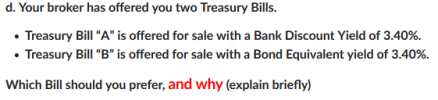 d. Your broker has offered you two Treasury Bills. . Treasury Bill "A" is offered for sale with a Bank Discount Yield of 3.40%. ·Treasury Bill "B" is offered for sale with a Bond Equivalent yield of 3.40%. Which Bill should you prefer, and why (explain briefly)
IGEN WUN A bank is considering two securities: a 30-year Treasury bond yielding 8 percent and...
 IGEN WUN A bank is considering two securities: a 30-year Treasury bond yielding 8 percent and a 30-year municipal bond yielding 3 percent. a. If the bank's tax rate is 35 percent, calculate the Treasury bond's tax equivalent yield. (Round your answer to 1 decimal place. (e.g., 32.1)) b. Which bond offers the higher tax equivalent yield? 1.0: % a. b. Tax equivalent yield Tax equivalent yield 30-year treasury bond
Term Structure A 1-year Treasury bill currently offers a 4% rate of return
Term Structure A 1-year Treasury bill currently offers a 4% rate of return. A 2-year Treasury note offers a 4.5% rate of return. Under the expectations theory, what rate of return do investors expect a 1-year Treasury bill to pay next year? The rate of return investors expect a 1-year Treasury bill to pay next year is _______ %. (Round to two decimal places.)
A one-year Treasury bill offers a 5% yield to maturity. A two-year Treasury bill offers a...
 A one-year Treasury bill offers a 5% yield to maturity. A two-year Treasury bill offers a 5.4% yield to maturity. What is the expected forward rate for the second year if the expectation hypothesis holds? Enter your answer as a percentage. Do not include the percentage sign in your answer. Enter your response below. Enter your answer rounded to 2 DECIMAL PLACES.
Bonds aren't a great investment these days with the 30 year Treasury Bond paying only about...
Bonds aren't a great investment these days with the 30 year Treasury Bond paying only about 2%. However, you decide to buy one of these $1000 bonds and hold it for 30 years, how much is your Treasury Bond worth at the end of the 30 year term?
Derive the probability distribution of the 1-year HPR on a 30-year U.S. Treasury bond with a...
 Derive the probability distribution of the 1-year HPR on a 30-year U.S. Treasury bond with a coupon of 4.0% if it is currently selling at par and the probability distribution of its yield to maturity a year from now is as shown in the table below. (Assume the entire 4.0% coupon is paid at the end of the year rather than every 6 months. Assume a par value of $100.) (Leave no cells blank - be certain to enter "O"...
 d. Your broker has offered you two Treasury Bills. . Treasury Bill "A" is offered for sale with a Bank Discount Yield of 3.40%. ·Treasury Bill "B" is offered for sale with a Bond Equivalent yield of 3.40%. Which Bill should you prefer, and why (explain briefly)
 IGEN WUN A bank is considering two securities: a 30-year Treasury bond yielding 8 percent and a 30-year municipal bond yielding 3 percent. a. If the bank's tax rate is 35 percent, calculate the Treasury bond's tax equivalent yield. (Round your answer to 1 decimal place. (e.g., 32.1)) b. Which bond offers the higher tax equivalent yield? 1.0: % a. b. Tax equivalent yield Tax equivalent yield 30-year treasury bond
 A one-year Treasury bill offers a 5% yield to maturity. A two-year Treasury bill offers a 5.4% yield to maturity. What is the expected forward rate for the second year if the expectation hypothesis holds? Enter your answer as a percentage. Do not include the percentage sign in your answer. Enter your response below. Enter your answer rounded to 2 DECIMAL PLACES.
 Derive the probability distribution of the 1-year HPR on a 30-year U.S. Treasury bond with a coupon of 4.0% if it is currently selling at par and the probability distribution of its yield to maturity a year from now is as shown in the table below. (Assume the entire 4.0% coupon is paid at the end of the year rather than every 6 months. Assume a par value of $100.) (Leave no cells blank - be certain to enter "O"...
Most questions answered within 3 hours.
-
Where is the error in this code sequence?
String s1 = "Hello";
String s2 = "ello";...
asked 10 months ago -
Financial data for Joel de Paris, Inc., for last year
follow:
Joel de Paris, Inc.
Balance...
asked 10 months ago -
Consider this reaction:
Al2(SO4)3 (aq)+ BaCl3
(aq) Al2Cl6 (aq)- +
3BaSO4(s) . What is the...
asked 10 months ago -
Suppose that Savneet is considering increasing her
recent random sample from 20 car rentals to 40...
asked 10 months ago -
Trucks arrive at an unloading terminal at an average rate of 120
per hour.
Trucks arrive...
asked 10 months ago -
Why are methanol and ethanol completely soluble in water while
octanol is not very little soluble....
asked 10 months ago -
A facilities manager at a university reads in a research report
that the mean amount of...
asked 10 months ago -
When the CuSO4 is rehydrated by adding water to the anhydrous
compound, is this an endothermic...
asked 10 months ago -
A ray of sunlight is passing from diamond into crown glass; the
angle of incidence is...
asked 10 months ago -
A block of mass 0.249 kg is placed on top of a light, vertical
spring of...
asked 10 months ago -
how do the kidneys compensate in the presences of acidosis
a) trigger hyperventilate
b) reserve acid...
asked 10 months ago -
Question 501 pts
The rental rate of capital to the firm increases. Which of the
following...
asked 10 months ago