
Homework Answers
Add Answer to:
Use Table 6 values to calculate AGº (in kJ) at 2000 K for the following reaction:...
Use Table 6 values to calculate AGº (in kJ) at 2000 K for the following reaction:...
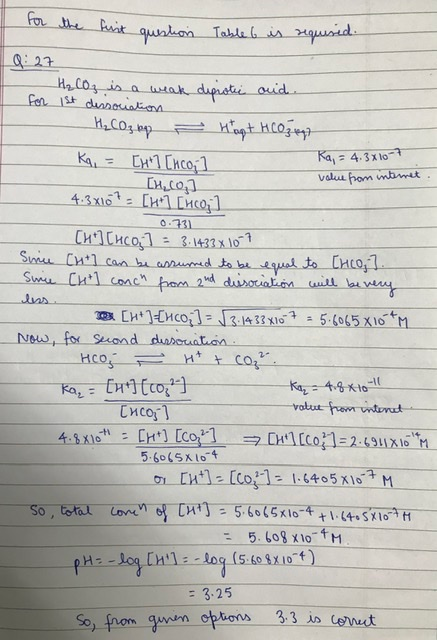
 Use Table 6 values to calculate AGº (in kJ) at 2000 K for the following reaction: NO2(g) + CO(g) + NO(g) + CO2(g) O-420 kJ 0-222 kJ O-1211 kJ 0-199 kJ 0-990 kJ 3 pts Question 27 What is the pH of .731 M H2CO3 (aq)? 8.4 O 5.2 O 3.3 O 6.5 10.7 Table 6 - Thermodynamic Data of 12.0 M HOH ZOH is added to Ag(s) AgBr(s) Agcl(s) AgI (8) AgNO, () Ag20(8) Al(a) Al,0, () Ba (3)...
table 6 Use Table 6 values to calculate AGº (in kJ) at 2000 K for the...
 table 6
Use Table 6 values to calculate AGº (in kJ) at 2000 K for the following reaction: NO2(g) + CO(g) + NO(g) + CO2(g) -990 kJ O-1211kJ O-420 kJ 0-199 kJ 0-222 kJ Table 6 (Cont.) - TI ΔΗ: sº (kJ/mol (J/kmol) AG; (kJ/moll at 25 H3(g) H2SO.) Hg) Ngo (3) 12 (8) K(s) KBr (5) KCl (S) KCIO, (s) KClO(S) KNO (3) Mg(s) MgCl2(s) MgCO3(s) Mgo(s) Mg(OH)2 (8) MgSO4(s) Mn(s) Mno(s) MnO2 (3) N2 (g) NH, (g) NH4Cl...
table 6
Use Table 6 values to calculate AGº (in kJ) at 2000 K for the following reaction: NO2(g) + CO(g) + NO(g) + CO2(g) -990 kJ O-1211kJ O-420 kJ 0-199 kJ 0-222 kJ Table 6 (Cont.) - TI ΔΗ: sº (kJ/mol (J/kmol) AG; (kJ/moll at 25 H3(g) H2SO.) Hg) Ngo (3) 12 (8) K(s) KBr (5) KCl (S) KCIO, (s) KClO(S) KNO (3) Mg(s) MgCl2(s) MgCO3(s) Mgo(s) Mg(OH)2 (8) MgSO4(s) Mn(s) Mno(s) MnO2 (3) N2 (g) NH, (g) NH4Cl...
Use Table 6 values to calculate AGº (in kJ) at 2000 K for the following reaction:...
 Use Table 6 values to calculate AGº (in kJ) at 2000 K for the following reaction: NO2(g) + CO(g) NO(g) + CO2(g) 0 -222 kJ 0-990 kJ 0 - 199 kJ O-1211 kJ O-420 kJ AG; (kJ/mol ) at 25°c AH; Sº (kJ/mol) (KJ/K mol) AG, (kJ/mol) at 25°c ΔΗ: sº (kJ/mol) (kJ/kmol) 0.0 -20.6 H2S (g) -33.6 +0.2057 -814.0 H2SO4(0) +0.1569 -690.1 0.0 Hg(e) 0.0 +0.0760 -90.8 Hgo (3) -58.6 +0.0703 12 () 0.0 0.0 +0.1161 0.0 K(s) +0.0642...
Use the tabulated half-cell potentials to calculate AGº for the following balanced redox reaction 3 12(s)...
 Use the tabulated half-cell potentials to calculate AGº for the following balanced redox reaction 3 12(s) + 2 Fe(s) → 2 Fe3+(aq) + 6 H(aq) +23 x 102 kJ 0 +49 x 101 kJ -1.1 x 10² kJ 0 -9.7 x 101 kJ 0 -3.3 x 10² kJ
QUESTION Use the given data at 298 K to calculate AGº for the reaction 2012(g) +...
 QUESTION Use the given data at 298 K to calculate AGº for the reaction 2012(g) + SO2(g) → SOC12(g) + Cl20(g) Substance: Cl2 (8) SO2(8) SOCI2(g) Cl20(g) AHºf (kJ/mol): 0 -296.8 -212.5 80.3 Sº (J/mol-K): 223.0 248.1 309.77 266.1 O 129.3 kJ 133.6 k) 196.0 k) 199.8 k) 229.6 kJ
Use Hess' law and the data below to calculate AG, in kJ, for the following reaction:...
 Use Hess' law and the data below to calculate AG, in kJ, for the following reaction: NO(g) + O (9) NO2 (g), AG° = ? 2 03 (9) - 3 O2 (g), AG° = +489.6 kJ 02 (9) 20 (9), AGⓇ = +463.4 kJ NO(g) + O2 (9) - NO2 (g) + O2 (g), AG° = -199.5 kJ QUESTION 14 Calculate AG for the following reaction, in kJ, at 0 °C under the following non-standard conditions shown below. 2 Hgo...
Use standard enthalpies of formation (in Appendix G in text) to calculate ∆H°rxn for each reaction. ...
Use standard enthalpies of formation (in Appendix G in text) to calculate ∆H°rxn for each reaction. ∑ m∆H°f (products) - ∑n∆H°f (reactants), where m and n are coefficients. C2H4(g) + H2(g) ----- > C2H6(g) CO (g) + H2O (g) ----- > H2(g) + CO2(g) 3NO2(g) + H2O (l) ----- > 2HNO3(aq) + NO (g) 2SO2(g) + O2(g) -----------> 2SO3(g) 2C4H10 (g) + 13O2 (g) -----------> 8CO2 (g) + 10H2O (g) Substance --- ΔH° (kJ mol–) --- ΔG° (kJ mol–1) --- S°298 (J K–1 mol–1) C2H4 52.4 86.4 219.3 H2 0 0 130.7 C2H6 -84.0 -32.0 229.2 CO -110.52 -137.15 197.7 H2O -285.83 -237.1 70.0 CO2 -393.51 -394.36 213.8 NO2 33.2 51.30 240.1 NO 90.25 87.6 210.8 SO2 -296.83 -300.1 248.2 O2 0 0 205.2 SO3 -395.72 -371.06 256.76
Use data from the table below to calculate the equilibrium constants at 25∘C for each reaction....
Use data from the table below to calculate the equilibrium constants at 25∘C for each reaction. Standard Thermodynamic Quantities for Selected Substances at 25∘C Substance ΔH∘f(kJ/mol) ΔG∘f(kJ/mol) S∘(J/mol⋅K) H2(g) 0 0 130.7 N2(g) 0 0 191.6 O2(g) 0 0 205.2 NO(g) 91.3 87.6 210.8 NO2(g) 33.2 51.3 240.1 CO(g) -110.5 -137.2 197.7 CO2(g) -393.5 -394.4 213.8 H2S(g) -20.6 -33.4 205.8 S2(g) 128.6 79.7 228.2 1. N2(g)+O2(g)⇌2NO(g)
a) Use the tabulated half-cell potentials to calculate AGº for the following balanced redox reaction. (F=...
 a) Use the tabulated half-cell potentials to calculate AGº for the following balanced redox reaction. (F= 96,485 C/mol e) 2Li(s) + Cl2(g) → 2 Cl-(20) + 2Li *(90 E Li (ag) +_ Li(s) -3.04V Cl: (g) + 2e_2 +1.36 V Cl(aq) -8.49 x 10 sk] b. -425 kJ a. C. +324 k] d. -849 kJ | b) Name the following coordination complex: [Fe(H 20) 4F 2]F a. tetraaguadifluoroiron(II) fluoride O b.tetraaquadifluoroiron(III) fluoride c. diflugrotetrahydroiron(II) fluoride O d. difluorotetrahydrgironfluoride c) How...
Use the values of AH; to calculate AF® for the following reactions. Substance and State AH(kJ/mol)...
 Use the values of AH; to calculate AF® for the following reactions. Substance and State AH(kJ/mol) C2H5OH(1) -278 02(9) CO2(9) -393.5 H2O(9) -242 H2O(1) -286 Ticu (9) -736 TiO2(8) _945 H+ (aq) Cl(aq) -167 NiO(s) -241 Ni(OH)2(s) -538 0 + (g) - (g) + он до ос AH = kJ b. TiCl4 (9) + 2H20(1) + TiO2 (s) + 4HCl(aq) AH° = c. NiO(s) + H2O(l) + Ni(OH)2(s) AH° = kJ
 Use Table 6 values to calculate AGº (in kJ) at 2000 K for the following reaction: NO2(g) + CO(g) + NO(g) + CO2(g) O-420 kJ 0-222 kJ O-1211 kJ 0-199 kJ 0-990 kJ 3 pts Question 27 What is the pH of .731 M H2CO3 (aq)? 8.4 O 5.2 O 3.3 O 6.5 10.7 Table 6 - Thermodynamic Data of 12.0 M HOH ZOH is added to Ag(s) AgBr(s) Agcl(s) AgI (8) AgNO, () Ag20(8) Al(a) Al,0, () Ba (3)...
 table 6
Use Table 6 values to calculate AGº (in kJ) at 2000 K for the following reaction: NO2(g) + CO(g) + NO(g) + CO2(g) -990 kJ O-1211kJ O-420 kJ 0-199 kJ 0-222 kJ Table 6 (Cont.) - TI ΔΗ: sº (kJ/mol (J/kmol) AG; (kJ/moll at 25 H3(g) H2SO.) Hg) Ngo (3) 12 (8) K(s) KBr (5) KCl (S) KCIO, (s) KClO(S) KNO (3) Mg(s) MgCl2(s) MgCO3(s) Mgo(s) Mg(OH)2 (8) MgSO4(s) Mn(s) Mno(s) MnO2 (3) N2 (g) NH, (g) NH4Cl...
table 6
Use Table 6 values to calculate AGº (in kJ) at 2000 K for the following reaction: NO2(g) + CO(g) + NO(g) + CO2(g) -990 kJ O-1211kJ O-420 kJ 0-199 kJ 0-222 kJ Table 6 (Cont.) - TI ΔΗ: sº (kJ/mol (J/kmol) AG; (kJ/moll at 25 H3(g) H2SO.) Hg) Ngo (3) 12 (8) K(s) KBr (5) KCl (S) KCIO, (s) KClO(S) KNO (3) Mg(s) MgCl2(s) MgCO3(s) Mgo(s) Mg(OH)2 (8) MgSO4(s) Mn(s) Mno(s) MnO2 (3) N2 (g) NH, (g) NH4Cl...
 Use Table 6 values to calculate AGº (in kJ) at 2000 K for the following reaction: NO2(g) + CO(g) NO(g) + CO2(g) 0 -222 kJ 0-990 kJ 0 - 199 kJ O-1211 kJ O-420 kJ AG; (kJ/mol ) at 25°c AH; Sº (kJ/mol) (KJ/K mol) AG, (kJ/mol) at 25°c ΔΗ: sº (kJ/mol) (kJ/kmol) 0.0 -20.6 H2S (g) -33.6 +0.2057 -814.0 H2SO4(0) +0.1569 -690.1 0.0 Hg(e) 0.0 +0.0760 -90.8 Hgo (3) -58.6 +0.0703 12 () 0.0 0.0 +0.1161 0.0 K(s) +0.0642...
 Use the tabulated half-cell potentials to calculate AGº for the following balanced redox reaction 3 12(s) + 2 Fe(s) → 2 Fe3+(aq) + 6 H(aq) +23 x 102 kJ 0 +49 x 101 kJ -1.1 x 10² kJ 0 -9.7 x 101 kJ 0 -3.3 x 10² kJ
 QUESTION Use the given data at 298 K to calculate AGº for the reaction 2012(g) + SO2(g) → SOC12(g) + Cl20(g) Substance: Cl2 (8) SO2(8) SOCI2(g) Cl20(g) AHºf (kJ/mol): 0 -296.8 -212.5 80.3 Sº (J/mol-K): 223.0 248.1 309.77 266.1 O 129.3 kJ 133.6 k) 196.0 k) 199.8 k) 229.6 kJ
 Use Hess' law and the data below to calculate AG, in kJ, for the following reaction: NO(g) + O (9) NO2 (g), AG° = ? 2 03 (9) - 3 O2 (g), AG° = +489.6 kJ 02 (9) 20 (9), AGⓇ = +463.4 kJ NO(g) + O2 (9) - NO2 (g) + O2 (g), AG° = -199.5 kJ QUESTION 14 Calculate AG for the following reaction, in kJ, at 0 °C under the following non-standard conditions shown below. 2 Hgo...
 a) Use the tabulated half-cell potentials to calculate AGº for the following balanced redox reaction. (F= 96,485 C/mol e) 2Li(s) + Cl2(g) → 2 Cl-(20) + 2Li *(90 E Li (ag) +_ Li(s) -3.04V Cl: (g) + 2e_2 +1.36 V Cl(aq) -8.49 x 10 sk] b. -425 kJ a. C. +324 k] d. -849 kJ | b) Name the following coordination complex: [Fe(H 20) 4F 2]F a. tetraaguadifluoroiron(II) fluoride O b.tetraaquadifluoroiron(III) fluoride c. diflugrotetrahydroiron(II) fluoride O d. difluorotetrahydrgironfluoride c) How...
 Use the values of AH; to calculate AF® for the following reactions. Substance and State AH(kJ/mol) C2H5OH(1) -278 02(9) CO2(9) -393.5 H2O(9) -242 H2O(1) -286 Ticu (9) -736 TiO2(8) _945 H+ (aq) Cl(aq) -167 NiO(s) -241 Ni(OH)2(s) -538 0 + (g) - (g) + он до ос AH = kJ b. TiCl4 (9) + 2H20(1) + TiO2 (s) + 4HCl(aq) AH° = c. NiO(s) + H2O(l) + Ni(OH)2(s) AH° = kJ
Most questions answered within 3 hours.
-
Where is the error in this code sequence?
String s1 = "Hello";
String s2 = "ello";...
asked 10 months ago -
Financial data for Joel de Paris, Inc., for last year
follow:
Joel de Paris, Inc.
Balance...
asked 10 months ago -
Consider this reaction:
Al2(SO4)3 (aq)+ BaCl3
(aq) Al2Cl6 (aq)- +
3BaSO4(s) . What is the...
asked 10 months ago -
Suppose that Savneet is considering increasing her
recent random sample from 20 car rentals to 40...
asked 10 months ago -
Trucks arrive at an unloading terminal at an average rate of 120
per hour.
Trucks arrive...
asked 10 months ago -
Why are methanol and ethanol completely soluble in water while
octanol is not very little soluble....
asked 10 months ago -
A facilities manager at a university reads in a research report
that the mean amount of...
asked 10 months ago -
When the CuSO4 is rehydrated by adding water to the anhydrous
compound, is this an endothermic...
asked 10 months ago -
A ray of sunlight is passing from diamond into crown glass; the
angle of incidence is...
asked 10 months ago -
A block of mass 0.249 kg is placed on top of a light, vertical
spring of...
asked 10 months ago -
how do the kidneys compensate in the presences of acidosis
a) trigger hyperventilate
b) reserve acid...
asked 10 months ago -
Question 501 pts
The rental rate of capital to the firm increases. Which of the
following...
asked 10 months ago