


Homework Answers
Add Answer to:
help me please asap
Question 28 (1 point) What voltaic cell can be constructed to yield...
please help as soon as possible ergent Question 28 (1 point) What voltaic cell can be...
 please help as soon as possible ergent
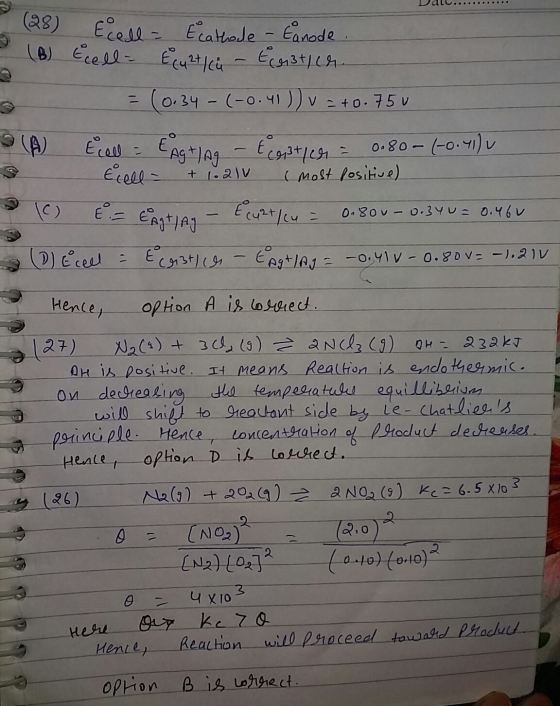
Question 28 (1 point) What voltaic cell can be constructed to yield the most positive standard cell potential using the materials available in the table? 1/2 Reaction E° (V Cu2+ + 2 e Cu +0.34 Cr3+ + 3 e Cr -0.41 Ag+ + e Ag +0.80 - Ag|Ag (1.0 M)||Cr3+(1.0 M) Cr Cu Cu2+(1.0 M)||Ag (1.0 M)|Ag O Cr/Cr3+(1.0 M)||Ag*(1.0 M)|Ag O Cr/Cr3+(1.0 M)||Cu2+(1.0 M)||Cu Question 29 (1 point) formal charge on nitrogen...
please help as soon as possible ergent
Question 28 (1 point) What voltaic cell can be constructed to yield the most positive standard cell potential using the materials available in the table? 1/2 Reaction E° (V Cu2+ + 2 e Cu +0.34 Cr3+ + 3 e Cr -0.41 Ag+ + e Ag +0.80 - Ag|Ag (1.0 M)||Cr3+(1.0 M) Cr Cu Cu2+(1.0 M)||Ag (1.0 M)|Ag O Cr/Cr3+(1.0 M)||Ag*(1.0 M)|Ag O Cr/Cr3+(1.0 M)||Cu2+(1.0 M)||Cu Question 29 (1 point) formal charge on nitrogen...
Enter electrons as e. A voltaic cell is constructed in which the anode is a Cr...
 Enter electrons as e. A voltaic cell is constructed in which the anode is a Cr Cr3+ half cell and the cathode is a SnSn2+ half cell. The half-cell compartments are connected by a salt bridge. (Use the lowest possible coefficients. Use the pull-down boxes to specify states such as (aq) or (s). If a box is not needed, leave it blank.) The anode reaction is: The cathode reaction is: The net cell reaction is: + + In the external...
Hi can someone help me with these questions, Thank you: Question 8 (1 point) The standard...
 Hi can someone help me with these questions, Thank you:
Question 8 (1 point) The standard potential of the cell Ni(s) Ni2+(aq) || Cl(aq) AgCl(s) Ag(s) is +0.45 V at 25°C. If the standard reduction potential of the AgCl|Ag|Ci couple is +0.22 V, calculate the standard reduction potential of the Ni2+INi couple. -0.45 V +0.23 V -0.67 v +0.67 v 0 -0.23 V Question 6 (1 point) The standard reduction potential of the Br2/Brand Sna/Sn couples are +1.07 and -0.14...
Hi can someone help me with these questions, Thank you:
Question 8 (1 point) The standard potential of the cell Ni(s) Ni2+(aq) || Cl(aq) AgCl(s) Ag(s) is +0.45 V at 25°C. If the standard reduction potential of the AgCl|Ag|Ci couple is +0.22 V, calculate the standard reduction potential of the Ni2+INi couple. -0.45 V +0.23 V -0.67 v +0.67 v 0 -0.23 V Question 6 (1 point) The standard reduction potential of the Br2/Brand Sna/Sn couples are +1.07 and -0.14...
please help with question four and five 3. For the reaction PbCl2 (6) Pb2+ + 2CV,...
 please help with question four and five
3. For the reaction PbCl2 (6) Pb2+ + 2CV, what is the value of the equilibrium constant if [Pb 2+] = 0.0022 M and (CI) is 0.027 M? [P621] = 0.002am kc [Pb2+] [...] [cr] =0.027m [PbCl2 (s) [pbela (s)]= Ke=0.0022x10.02222 4. The equilibrium constant for the reaction of nitrogen and hydrogen to produce ammonia is = 1.6.x10-6 0.094 M? at 450°C. If [N2) =0,012 M and [H2] = 0.42 M at equilibrium,...
please help with question four and five
3. For the reaction PbCl2 (6) Pb2+ + 2CV, what is the value of the equilibrium constant if [Pb 2+] = 0.0022 M and (CI) is 0.027 M? [P621] = 0.002am kc [Pb2+] [...] [cr] =0.027m [PbCl2 (s) [pbela (s)]= Ke=0.0022x10.02222 4. The equilibrium constant for the reaction of nitrogen and hydrogen to produce ammonia is = 1.6.x10-6 0.094 M? at 450°C. If [N2) =0,012 M and [H2] = 0.42 M at equilibrium,...
question 1 - A voltaic cell is constructed from a standard Ag+|Ag half cell (E°red =...
question 1 - A voltaic cell is constructed from a standard Ag+|Ag half cell (E°red = 0.799V) and a standard Hg2+|Hg half cell (E°red = 0.855V). The anode reaction (including states) is: The cathode reaction(including states) is: The spontaneous cell reaction is: The cell voltage is .... question 2 A voltaic cell is constructed from a standard Cr3+|Cr half cell (E°red = -0.740V) and a standard Fe3+|Fe2+ half cell (E°red = 0.771V). The anode reaction (including states) is: The cathode...
Question 8 (1 point) Which of these reactions will proceed spontaneously, based on relative strength of...
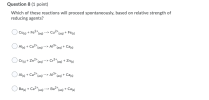 Question 8 (1 point) Which of these reactions will proceed spontaneously, based on relative strength of reducing agents? Cu(s) + Fe2+ (aq) Cu2+ (aq) + Fe(s) Al(s) + Ca2+(aq) A13+ (aq) + Cals) Cr(s) + Zn2+(aq) Cr3+ (aq) + Zn(s) Al(s) + Ca2+ (aq) A/3+ "(aq) + Ca(s) Ba(s) + • Ca2+ (aq) --> Ba2+ (aq) + Ca(s)
Please help. No need for deep explanation just write the correct answer QUESTION 8 Which of...
 Please help. No need for deep explanation just write
the correct answer
QUESTION 8 Which of the following statements is true? Dissolving NH4Cl in pure water produces a basic pH Dissolving KCl in pure water produces a basic pH Dissolving KCl in pure water produces an acidic pH Dissolving NH4Cl in pure water produces an acidic pH QUESTION 9 What is the pH of a 1.0*10 MHI solution? HI is a strong acid. (Hint: the pH is not 9.0) pH...
Please help. No need for deep explanation just write
the correct answer
QUESTION 8 Which of the following statements is true? Dissolving NH4Cl in pure water produces a basic pH Dissolving KCl in pure water produces a basic pH Dissolving KCl in pure water produces an acidic pH Dissolving NH4Cl in pure water produces an acidic pH QUESTION 9 What is the pH of a 1.0*10 MHI solution? HI is a strong acid. (Hint: the pH is not 9.0) pH...
Question 1 (1 point) The cell diagram for the reaction in which hydrogen gas reduces Cu2+(aq)...
 Question 1 (1 point) The cell diagram for the reaction in which hydrogen gas reduces Cu2+(aq) is O Pt(s) | H2(8)| H+(aq) || Cu2+(aq) | Cu(s) O Pt(s) | Cu2+(aq), H+(aq) || H2(g) | Pt(s) Opt(s) | Cu2+(aq) | H2(8) || H+(aq) | Pt(s) O Cu(s) | Cu2+(aq) || Ht(aq)| H2(g) | Pt(s) O Cu(s) | Cu2+(aq) || 02(E) | H2(g) | Pt(s)
help asap please Question 45 (1 point) What is the cell potential (in V) for the...
 help asap please
Question 45 (1 point) What is the cell potential (in V) for the reaction described by the cell notation shown below if the temperature is 25 °C? Show all work to be turned in. Work should include the balanced redox reaction. Ni (s) I Ni2+ (0.67 M) || Cut (0.042 M) i Cu (s) V2 reaction Ered (V) Cut + e +0.52 Your Answer: Ni2+ + 2e Ni -0.23 - Cu Answer
help asap please
Question 45 (1 point) What is the cell potential (in V) for the reaction described by the cell notation shown below if the temperature is 25 °C? Show all work to be turned in. Work should include the balanced redox reaction. Ni (s) I Ni2+ (0.67 M) || Cut (0.042 M) i Cu (s) V2 reaction Ered (V) Cut + e +0.52 Your Answer: Ni2+ + 2e Ni -0.23 - Cu Answer
5) Determine the value of Kc for the following reaction if the equilibrium concentrations are as...
 5) Determine the value of Kc for the following reaction if the equilibrium concentrations are as follows: [NO2]eq = 0.85 M and [NO]eq=0.38 M. 2 NO2(g) - N2048) A) 2.2 B) 1.9 C) 0.022 D) 0.22 E) 0.53 6) Which of the following statements is true? A) If Q=K, it means the reaction is not at equilibrium. B) If Q<K, it means the forward reaction will proceed to the right) to form more reactants. C) IFO <K, it means the...
 please help as soon as possible ergent
Question 28 (1 point) What voltaic cell can be constructed to yield the most positive standard cell potential using the materials available in the table? 1/2 Reaction E° (V Cu2+ + 2 e Cu +0.34 Cr3+ + 3 e Cr -0.41 Ag+ + e Ag +0.80 - Ag|Ag (1.0 M)||Cr3+(1.0 M) Cr Cu Cu2+(1.0 M)||Ag (1.0 M)|Ag O Cr/Cr3+(1.0 M)||Ag*(1.0 M)|Ag O Cr/Cr3+(1.0 M)||Cu2+(1.0 M)||Cu Question 29 (1 point) formal charge on nitrogen...
please help as soon as possible ergent
Question 28 (1 point) What voltaic cell can be constructed to yield the most positive standard cell potential using the materials available in the table? 1/2 Reaction E° (V Cu2+ + 2 e Cu +0.34 Cr3+ + 3 e Cr -0.41 Ag+ + e Ag +0.80 - Ag|Ag (1.0 M)||Cr3+(1.0 M) Cr Cu Cu2+(1.0 M)||Ag (1.0 M)|Ag O Cr/Cr3+(1.0 M)||Ag*(1.0 M)|Ag O Cr/Cr3+(1.0 M)||Cu2+(1.0 M)||Cu Question 29 (1 point) formal charge on nitrogen...
 Enter electrons as e. A voltaic cell is constructed in which the anode is a Cr Cr3+ half cell and the cathode is a SnSn2+ half cell. The half-cell compartments are connected by a salt bridge. (Use the lowest possible coefficients. Use the pull-down boxes to specify states such as (aq) or (s). If a box is not needed, leave it blank.) The anode reaction is: The cathode reaction is: The net cell reaction is: + + In the external...
 Hi can someone help me with these questions, Thank you:
Question 8 (1 point) The standard potential of the cell Ni(s) Ni2+(aq) || Cl(aq) AgCl(s) Ag(s) is +0.45 V at 25°C. If the standard reduction potential of the AgCl|Ag|Ci couple is +0.22 V, calculate the standard reduction potential of the Ni2+INi couple. -0.45 V +0.23 V -0.67 v +0.67 v 0 -0.23 V Question 6 (1 point) The standard reduction potential of the Br2/Brand Sna/Sn couples are +1.07 and -0.14...
Hi can someone help me with these questions, Thank you:
Question 8 (1 point) The standard potential of the cell Ni(s) Ni2+(aq) || Cl(aq) AgCl(s) Ag(s) is +0.45 V at 25°C. If the standard reduction potential of the AgCl|Ag|Ci couple is +0.22 V, calculate the standard reduction potential of the Ni2+INi couple. -0.45 V +0.23 V -0.67 v +0.67 v 0 -0.23 V Question 6 (1 point) The standard reduction potential of the Br2/Brand Sna/Sn couples are +1.07 and -0.14...
 please help with question four and five
3. For the reaction PbCl2 (6) Pb2+ + 2CV, what is the value of the equilibrium constant if [Pb 2+] = 0.0022 M and (CI) is 0.027 M? [P621] = 0.002am kc [Pb2+] [...] [cr] =0.027m [PbCl2 (s) [pbela (s)]= Ke=0.0022x10.02222 4. The equilibrium constant for the reaction of nitrogen and hydrogen to produce ammonia is = 1.6.x10-6 0.094 M? at 450°C. If [N2) =0,012 M and [H2] = 0.42 M at equilibrium,...
please help with question four and five
3. For the reaction PbCl2 (6) Pb2+ + 2CV, what is the value of the equilibrium constant if [Pb 2+] = 0.0022 M and (CI) is 0.027 M? [P621] = 0.002am kc [Pb2+] [...] [cr] =0.027m [PbCl2 (s) [pbela (s)]= Ke=0.0022x10.02222 4. The equilibrium constant for the reaction of nitrogen and hydrogen to produce ammonia is = 1.6.x10-6 0.094 M? at 450°C. If [N2) =0,012 M and [H2] = 0.42 M at equilibrium,...
 Question 8 (1 point) Which of these reactions will proceed spontaneously, based on relative strength of reducing agents? Cu(s) + Fe2+ (aq) Cu2+ (aq) + Fe(s) Al(s) + Ca2+(aq) A13+ (aq) + Cals) Cr(s) + Zn2+(aq) Cr3+ (aq) + Zn(s) Al(s) + Ca2+ (aq) A/3+ "(aq) + Ca(s) Ba(s) + • Ca2+ (aq) --> Ba2+ (aq) + Ca(s)
 Please help. No need for deep explanation just write
the correct answer
QUESTION 8 Which of the following statements is true? Dissolving NH4Cl in pure water produces a basic pH Dissolving KCl in pure water produces a basic pH Dissolving KCl in pure water produces an acidic pH Dissolving NH4Cl in pure water produces an acidic pH QUESTION 9 What is the pH of a 1.0*10 MHI solution? HI is a strong acid. (Hint: the pH is not 9.0) pH...
Please help. No need for deep explanation just write
the correct answer
QUESTION 8 Which of the following statements is true? Dissolving NH4Cl in pure water produces a basic pH Dissolving KCl in pure water produces a basic pH Dissolving KCl in pure water produces an acidic pH Dissolving NH4Cl in pure water produces an acidic pH QUESTION 9 What is the pH of a 1.0*10 MHI solution? HI is a strong acid. (Hint: the pH is not 9.0) pH...
 Question 1 (1 point) The cell diagram for the reaction in which hydrogen gas reduces Cu2+(aq) is O Pt(s) | H2(8)| H+(aq) || Cu2+(aq) | Cu(s) O Pt(s) | Cu2+(aq), H+(aq) || H2(g) | Pt(s) Opt(s) | Cu2+(aq) | H2(8) || H+(aq) | Pt(s) O Cu(s) | Cu2+(aq) || Ht(aq)| H2(g) | Pt(s) O Cu(s) | Cu2+(aq) || 02(E) | H2(g) | Pt(s)
 help asap please
Question 45 (1 point) What is the cell potential (in V) for the reaction described by the cell notation shown below if the temperature is 25 °C? Show all work to be turned in. Work should include the balanced redox reaction. Ni (s) I Ni2+ (0.67 M) || Cut (0.042 M) i Cu (s) V2 reaction Ered (V) Cut + e +0.52 Your Answer: Ni2+ + 2e Ni -0.23 - Cu Answer
help asap please
Question 45 (1 point) What is the cell potential (in V) for the reaction described by the cell notation shown below if the temperature is 25 °C? Show all work to be turned in. Work should include the balanced redox reaction. Ni (s) I Ni2+ (0.67 M) || Cut (0.042 M) i Cu (s) V2 reaction Ered (V) Cut + e +0.52 Your Answer: Ni2+ + 2e Ni -0.23 - Cu Answer
 5) Determine the value of Kc for the following reaction if the equilibrium concentrations are as follows: [NO2]eq = 0.85 M and [NO]eq=0.38 M. 2 NO2(g) - N2048) A) 2.2 B) 1.9 C) 0.022 D) 0.22 E) 0.53 6) Which of the following statements is true? A) If Q=K, it means the reaction is not at equilibrium. B) If Q<K, it means the forward reaction will proceed to the right) to form more reactants. C) IFO <K, it means the...
Most questions answered within 3 hours.
-
Where is the error in this code sequence?
String s1 = "Hello";
String s2 = "ello";...
asked 10 months ago -
Financial data for Joel de Paris, Inc., for last year
follow:
Joel de Paris, Inc.
Balance...
asked 10 months ago -
Consider this reaction:
Al2(SO4)3 (aq)+ BaCl3
(aq) Al2Cl6 (aq)- +
3BaSO4(s) . What is the...
asked 10 months ago -
Suppose that Savneet is considering increasing her
recent random sample from 20 car rentals to 40...
asked 10 months ago -
Trucks arrive at an unloading terminal at an average rate of 120
per hour.
Trucks arrive...
asked 10 months ago -
Why are methanol and ethanol completely soluble in water while
octanol is not very little soluble....
asked 10 months ago -
A facilities manager at a university reads in a research report
that the mean amount of...
asked 10 months ago -
When the CuSO4 is rehydrated by adding water to the anhydrous
compound, is this an endothermic...
asked 10 months ago -
A ray of sunlight is passing from diamond into crown glass; the
angle of incidence is...
asked 10 months ago -
A block of mass 0.249 kg is placed on top of a light, vertical
spring of...
asked 10 months ago -
how do the kidneys compensate in the presences of acidosis
a) trigger hyperventilate
b) reserve acid...
asked 10 months ago -
Question 501 pts
The rental rate of capital to the firm increases. Which of the
following...
asked 10 months ago