
Homework Answers
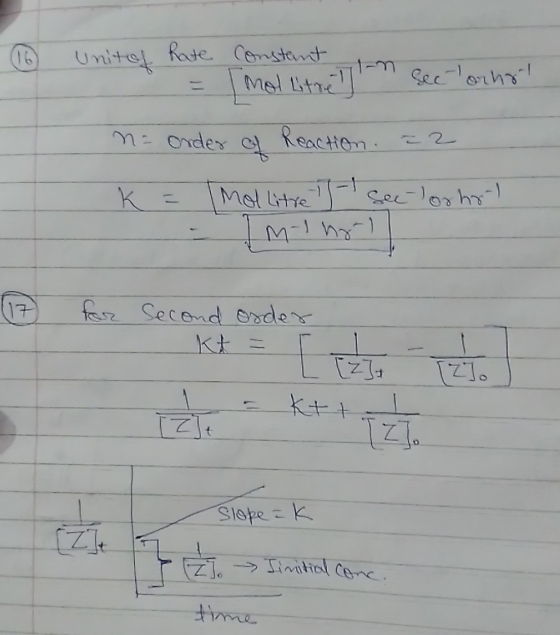
16. Answer is A ( M-1hr-1 )
17. Answer is C ( 1/Z vs time )
Add Answer to:
Question 16 1 pts Which sets of units could represent the units on a second order...
Question 17 1 pts A student performs several kinetic experiments and believes the rate law for...
 Question 17 1 pts A student performs several kinetic experiments and believes the rate law for her reaction is Rate k[Z12. Which of the following graphs would confirm this rate law and allow her to determine the value of k? O IZ] vs. time In[Z] vs. time O 1/[Z] vs time In[Z] vs. T InZ] vs. 1/1 InZ] vs. 1/time
D Question 16 1 pts Which sets of units could represent the units on a second...
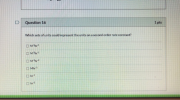 D Question 16 1 pts Which sets of units could represent the units on a second order rate constant? OM Mr1 Mh2 Mhr 1 Ohra
I 'like' all correct answers Question 2 1 pts A student makes three plots of their...
 I
'like' all correct answers
Question 2 1 pts A student makes three plots of their data and finds that a plot of (A) vs t is non-linear, a plot of In[A] vs tis linear, and a plot of 1/[A] vs t is non-linear. What is the rate law of the reaction? Ratek Rate = K[A] Rate - k[A] Rate = k[A] Question 4 2 pts You will need to generate a set of graphs to answer this question. Concentration...
I
'like' all correct answers
Question 2 1 pts A student makes three plots of their data and finds that a plot of (A) vs t is non-linear, a plot of In[A] vs tis linear, and a plot of 1/[A] vs t is non-linear. What is the rate law of the reaction? Ratek Rate = K[A] Rate - k[A] Rate = k[A] Question 4 2 pts You will need to generate a set of graphs to answer this question. Concentration...
D Question 3 1 pts Which of the following sets of units could be appropriate for a zero-order rate constant? O s-1...
 D Question 3 1 pts Which of the following sets of units could be appropriate for a zero-order rate constant? O s-1 O L mol-15-1 O L2 mol-25-1 O L3 mol-35-1 O mol L-15-1
Question 2 1 pts A student makes three plots of their data and finds that a...
 Question 2 1 pts A student makes three plots of their data and finds that a plot of [A] vs t is non- linear, a plot of In[A] vs t is linear, and plot of 1/[A] vs t is non-linear. What is the rate law of the reaction? Rate k Rate k[A] Rate k[A]2 Rate k[A]3
The rate law of a reaction is rate =k[X]³. The units of the rate constant are
1)The rate law of a reaction is rate =k[X]³. The units of the rate constant areL mol-1 s-1mol² L-2 s-1mol L-1S-2L² mol-2 s-1mol L-1S-12)Given the following rate law, how does the rate of reaction change if the concentration of Z is tripled? Rate =k[X]³[Y]²[Z]⁰The rate of reaction will increase by a factor of136803)What data should be plotted to show that experimental concentration data fits a first-order reaction?1 / [reactant] vs. time[reactant] vs. timeln (k) vs. Ealn (k) vs. 1 / Tln [...
5 What are the units of the rate constant (k) for first, second, or zero order reaction? Show how you determined the...
 5 What are the units of the rate constant (k) for first, second, or zero order reaction? Show how you determined the units of each rate constant. >SO2 + Cla: 6. The following data were obtained at 320°C for the reaction of: SO Cla 0.00 4.00 3,00 2.00 Time, hour 1.00 0.874 [SO Cl), M 0.946 1.024 1,200 1.109 Graph: (a) In [SO Cl2] vs. time Label and attach the graphs to the worksheet. If using Excel, provide the equation...
Question 4 2 pts You will need to generate a set of graphs to answer this...
 Question 4 2 pts You will need to generate a set of graphs to answer this question, Concentration vs time data for the following decomposition reaction was collected at 300 K. The data is shown in the table below. What is the rate constant for the reaction at this temperature (in units of min-1)? H2O2(aq) — H2O(1) + 1/2O2(g) time (min) o 500 [H2O2] (mol/L) 0.01524 0.00473 0.00144 0.00045 0.00014 1000 1500 2000
Complete the table below for zero, first and simple second order reactions 1/[A]- kt + 1/A...
 Complete the table below for zero, first and simple second order reactions 1/[A]- kt + 1/A rate = [A] points mol/L -k In (Al, 1/A -kt + 1/[A] [A] = kt + [Al. k 1AL k (AL, TAI E-k!+ [Alo -k 11AL L2/mois k, In [AL, [Al vs. t rato Al eBook [Al vs. + In (A) vs. rate = kA Print rate 1/[A], vs. -k, [AL L/mols In[A]=kt + In[A]. References Zero Order First Order Second Order Rate law...
Question 4 1 pts You will need to generate a set of graphs to answer this...
 Question 4 1 pts You will need to generate a set of graphs to answer this question. Concentration vs time data for the following decomposition reaction was collected at 300 K. The data is shown in the table below. What is the rate constant for the reaction at this temperature (in units of min1)? H2O2(aq) → H20(1) + 1/2O2(g) time (min) [H2021 (mol/L) 0.00915 500 0.00486 1000 1500 2000 0.00256 0.00136 0.00072
 Question 17 1 pts A student performs several kinetic experiments and believes the rate law for her reaction is Rate k[Z12. Which of the following graphs would confirm this rate law and allow her to determine the value of k? O IZ] vs. time In[Z] vs. time O 1/[Z] vs time In[Z] vs. T InZ] vs. 1/1 InZ] vs. 1/time
 D Question 16 1 pts Which sets of units could represent the units on a second order rate constant? OM Mr1 Mh2 Mhr 1 Ohra
 I
'like' all correct answers
Question 2 1 pts A student makes three plots of their data and finds that a plot of (A) vs t is non-linear, a plot of In[A] vs tis linear, and a plot of 1/[A] vs t is non-linear. What is the rate law of the reaction? Ratek Rate = K[A] Rate - k[A] Rate = k[A] Question 4 2 pts You will need to generate a set of graphs to answer this question. Concentration...
I
'like' all correct answers
Question 2 1 pts A student makes three plots of their data and finds that a plot of (A) vs t is non-linear, a plot of In[A] vs tis linear, and a plot of 1/[A] vs t is non-linear. What is the rate law of the reaction? Ratek Rate = K[A] Rate - k[A] Rate = k[A] Question 4 2 pts You will need to generate a set of graphs to answer this question. Concentration...
 D Question 3 1 pts Which of the following sets of units could be appropriate for a zero-order rate constant? O s-1 O L mol-15-1 O L2 mol-25-1 O L3 mol-35-1 O mol L-15-1
 Question 2 1 pts A student makes three plots of their data and finds that a plot of [A] vs t is non- linear, a plot of In[A] vs t is linear, and plot of 1/[A] vs t is non-linear. What is the rate law of the reaction? Rate k Rate k[A] Rate k[A]2 Rate k[A]3
 5 What are the units of the rate constant (k) for first, second, or zero order reaction? Show how you determined the units of each rate constant. >SO2 + Cla: 6. The following data were obtained at 320°C for the reaction of: SO Cla 0.00 4.00 3,00 2.00 Time, hour 1.00 0.874 [SO Cl), M 0.946 1.024 1,200 1.109 Graph: (a) In [SO Cl2] vs. time Label and attach the graphs to the worksheet. If using Excel, provide the equation...
 Question 4 2 pts You will need to generate a set of graphs to answer this question, Concentration vs time data for the following decomposition reaction was collected at 300 K. The data is shown in the table below. What is the rate constant for the reaction at this temperature (in units of min-1)? H2O2(aq) — H2O(1) + 1/2O2(g) time (min) o 500 [H2O2] (mol/L) 0.01524 0.00473 0.00144 0.00045 0.00014 1000 1500 2000
 Complete the table below for zero, first and simple second order reactions 1/[A]- kt + 1/A rate = [A] points mol/L -k In (Al, 1/A -kt + 1/[A] [A] = kt + [Al. k 1AL k (AL, TAI E-k!+ [Alo -k 11AL L2/mois k, In [AL, [Al vs. t rato Al eBook [Al vs. + In (A) vs. rate = kA Print rate 1/[A], vs. -k, [AL L/mols In[A]=kt + In[A]. References Zero Order First Order Second Order Rate law...
 Question 4 1 pts You will need to generate a set of graphs to answer this question. Concentration vs time data for the following decomposition reaction was collected at 300 K. The data is shown in the table below. What is the rate constant for the reaction at this temperature (in units of min1)? H2O2(aq) → H20(1) + 1/2O2(g) time (min) [H2021 (mol/L) 0.00915 500 0.00486 1000 1500 2000 0.00256 0.00136 0.00072
Most questions answered within 3 hours.
-
Where is the error in this code sequence?
String s1 = "Hello";
String s2 = "ello";...
asked 10 months ago -
Financial data for Joel de Paris, Inc., for last year
follow:
Joel de Paris, Inc.
Balance...
asked 10 months ago -
Consider this reaction:
Al2(SO4)3 (aq)+ BaCl3
(aq) Al2Cl6 (aq)- +
3BaSO4(s) . What is the...
asked 10 months ago -
Suppose that Savneet is considering increasing her
recent random sample from 20 car rentals to 40...
asked 10 months ago -
Trucks arrive at an unloading terminal at an average rate of 120
per hour.
Trucks arrive...
asked 10 months ago -
Why are methanol and ethanol completely soluble in water while
octanol is not very little soluble....
asked 10 months ago -
A facilities manager at a university reads in a research report
that the mean amount of...
asked 10 months ago -
When the CuSO4 is rehydrated by adding water to the anhydrous
compound, is this an endothermic...
asked 10 months ago -
A ray of sunlight is passing from diamond into crown glass; the
angle of incidence is...
asked 10 months ago -
A block of mass 0.249 kg is placed on top of a light, vertical
spring of...
asked 10 months ago -
how do the kidneys compensate in the presences of acidosis
a) trigger hyperventilate
b) reserve acid...
asked 10 months ago -
Question 501 pts
The rental rate of capital to the firm increases. Which of the
following...
asked 10 months ago