
Homework Answers
Framework effecting factors:
Design: Structure members are constructed based on designed load. But before a structure is complete and subjected to all loads assumed during structural design, the structural members are subjected to its self weight and construction loads during construction process.
So, to proceed with construction activities at a quicker rate, it is essential to calculate the behaviour of structure under is self load and construction load. If this can be done and structural member is found to be safe, formwork can be stripped-off.
If these calculations are not possible, then following formula can be used for calculation of safe formwork striking times:
Characteristic strength of cube of equal of maturity to the structure required at time of formwork removal

Cement type: Grade and types of cement
- Grade of cement – Higher cement grade makes the concrete achieve higher strength in shorter time.
- Type of Cement – Type of cement affects the strength development of concrete. For example, rapid hardening cement have higher strength gain in shorter period than the Ordinary Portland Cement. Low heat cement takes more time to gain sufficient strength than OPC.
Retarders:Retarding admixtures are used to slow the rate of setting of concrete. By slowing the initial setting time, the concrete mixture can stay in its fresh mix state longer before it gets to its hardened form. Use of retarders is beneficial for:
- Complex concrete placement or grouting
- Special architectural surface finish
- Compensating the accelerating effect of high temperature towards the initial set
- Preventing cold joint formation in successive lifts.
Thus retarders can significantly increases the time of removal of framework structure.
Wether conditions: The factor that mainly govern is whether temperature.The temperature of whether during the placement affects the lateral pressure greatly because it is one of the factors that govern concrete setting time. When the temperature is low, a greater amount of concrete can be poured before fresh concrete at a lower portion of the form stiffens and support itself.This leads to an increase in liquid head depth which results in higher lateral pressure. That is why cold weather needs to be taken into consideration while forms are designed.
Specifications on which the formwork should be removed after casting:
The removal of concrete formwork also called as strike-off or stripping of formwork should be carried out only after the time when concrete has gained sufficient strength, at least twice the stress to which the concrete may be subjected to when the formworks are removed. It is also necessary to ensure the stability of the remaining formwork during formwork removal.
The rate of hardening of concrete or the concrete strength depends on temperature and affects the formwork removal time. For example, time required for removal of concrete in winter will be more than time required during summer.
Special attention is required for formwork removal of flexural members such as beams and slabs. As these members are subjected to self-load as well as live load even during construction, they may deflect if the strength gained is not sufficient to handle to loads.
To estimate the strength of concrete before formwork removal, the tests on concrete cubes or cylinders should be carried out. The concrete cubes or cylinders should be prepared from the same mix as that of the structural members and cured under same circumstances of temperature and moisture as that of structural member.
When it is ensured that the concrete in the structural members has gained sufficient strength to withstand the design load, only then formworks should be removed. If possible, the formworks should be left for longer time as it helps in curing.
Add Answer to:
Explain the effect of the followings on form work - 1 :design a- Cement type b-...
11:33 Form work ( العودة Form work إثنين، ۲۰ پولیو ۲۰۲۰، ۱۰:۰۷ م Explain the effect...
 11:33 Form work ( العودة Form work إثنين، ۲۰ پولیو ۲۰۲۰، ۱۰:۰۷ م Explain the effect of the followings on form work-1 :design a-Cement type b- Retarders C- Weather condition Provide the specifications on which the form -2 .work should be removed after casting
give an example of application of piercing point in ?real life 11:33 Form work ( العودة...
 give an example of application of piercing point in ?real life 11:33 Form work ( العودة Form work إثنين، ۲۰ پولیو ۲۰۲۰، ۱۰:۰۷ م Explain the effect of the followings on form work-1 :design a-Cement type b- Retarders C- Weather condition Provide the specifications on which the form -2 .work should be removed after casting
6. Typically, when comparing a within-subjects design to a between-groups design which of the following describe...
 6. Typically, when comparing a within-subjects design to a between-groups design which of the following describe their differences in error variance? a. Within-subjects designs results in less error variance than between-groups. b. A within-subjects design results in more error variance than a between-groups design. C. A within-subjects design results in the same amount of error variance as a between-groups design d. There is no error variance in a within-subjects design, whereas a between- groups design does present some error variance....
please explain 7- Write the reaction of acidic water with the followings: a- 1- Methylcyclopentene b-...
 please explain
7- Write the reaction of acidic water with the followings: a- 1- Methylcyclopentene b- 1-ethyl-3-methylcyclohexene c- isobutene
please explain
7- Write the reaction of acidic water with the followings: a- 1- Methylcyclopentene b- 1-ethyl-3-methylcyclohexene c- isobutene
Problem Consider the Type 1 system drawn in Fig. We would like to design the compensation Dc(s) to meet the following requirements: (1) The steady-state value of y due to a constant unit disturbance...
 Problem Consider the Type 1 system drawn in Fig. We would like to design the compensation Dc(s) to meet the following requirements: (1) The steady-state value of y due to a constant unit disturbance w should be less than s, and (2) the damping ratio-07. Using root-locus techniques, (a) Show that proportional control alone is not adequate. (b) Show that proportional-derivative control will work. (c) Find values of the gains kp and kD for Dc(s)kp kDs that meet the design...
4. Consider the type I system in Fig. 5.73. We would like to design the compensation...
 4. Consider the type I system in Fig. 5.73. We would like to design the compensation D(s) to meet the following requirements: (1) The steady-state value of y due to a constant unit disturbance w should be less than $, and (2) the damping ratio ( = 0.7. Using root-locus techniques: a) Show that proportional control alone is not adequate. b) Show that proportional-derivative control will work. c) Find values of the gains K and K, for D(s) = K...
1 10 10 10 0 1 (30) A. Design a low-pass fiter (op-amp based cascade design) that meets requirements: 1. Cutoff frequency: 16 KHz 2. Passband gain: 0 dB 3. Stopband gain:-60 dB/decade 4. All resi...
 1 10 10 10 0 1 (30) A. Design a low-pass fiter (op-amp based cascade design) that meets requirements: 1. Cutoff frequency: 16 KHz 2. Passband gain: 0 dB 3. Stopband gain:-60 dB/decade 4. All resistors must be 1.0 k2 or higher You have completed the design and implementation of the LP filter and are ready to deliver the filter for production. However, you are informed that the customer made a mistake and actually needed a stopband gain of-40 dB/decade...
A. Design a low-pass filter (op-amp based cascade design) that meets the following (30) requirements: 1. Cutoff frequency: 3.4 KHz Passband gain: 20 dB 2. 3. Stopband gain: -40 dB/decade 4. All re...
 A. Design a low-pass filter (op-amp based cascade design) that meets the following (30) requirements: 1. Cutoff frequency: 3.4 KHz Passband gain: 20 dB 2. 3. Stopband gain: -40 dB/decade 4. All resistors must be 1.0 kS2 or higher. You have completed the design and implementation of the LP filter and are ready to deliver the filter for production. However, you are informed that the customer made a mistake and actually needed a stopband gain of -60 dB/decade (not-40 dB/decade...
A. Design a low-pass filter (op-amp based cascade design) that meets the following (30) requirements 1. Cutoff frequency: 3.4 KHz 2. Passband gain: 20 dB 3. Stopband gain: -40 dB/decade 4. All re...
 A. Design a low-pass filter (op-amp based cascade design) that meets the following (30) requirements 1. Cutoff frequency: 3.4 KHz 2. Passband gain: 20 dB 3. Stopband gain: -40 dB/decade 4. All resistors must be 1.0 k2 or higher. You have completed the design and implementation of the LP filter and are ready to deliver the filter for production. However, you are informed that the customer made a mistake and actually needed a stopb you have used in your design)....
Help asap 2. (20pts) Let C=1-1 02 Compute the followings if they make sense (otherwise, explain):...
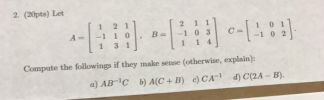 Help asap
2. (20pts) Let C=1-1 02 Compute the followings if they make sense (otherwise, explain): a) AB-IC b) A(C + B) c) CA-1 d) C(2A-B).
Help asap
2. (20pts) Let C=1-1 02 Compute the followings if they make sense (otherwise, explain): a) AB-IC b) A(C + B) c) CA-1 d) C(2A-B).
 11:33 Form work ( العودة Form work إثنين، ۲۰ پولیو ۲۰۲۰، ۱۰:۰۷ م Explain the effect of the followings on form work-1 :design a-Cement type b- Retarders C- Weather condition Provide the specifications on which the form -2 .work should be removed after casting
 give an example of application of piercing point in ?real life 11:33 Form work ( العودة Form work إثنين، ۲۰ پولیو ۲۰۲۰، ۱۰:۰۷ م Explain the effect of the followings on form work-1 :design a-Cement type b- Retarders C- Weather condition Provide the specifications on which the form -2 .work should be removed after casting
 6. Typically, when comparing a within-subjects design to a between-groups design which of the following describe their differences in error variance? a. Within-subjects designs results in less error variance than between-groups. b. A within-subjects design results in more error variance than a between-groups design. C. A within-subjects design results in the same amount of error variance as a between-groups design d. There is no error variance in a within-subjects design, whereas a between- groups design does present some error variance....
 please explain
7- Write the reaction of acidic water with the followings: a- 1- Methylcyclopentene b- 1-ethyl-3-methylcyclohexene c- isobutene
please explain
7- Write the reaction of acidic water with the followings: a- 1- Methylcyclopentene b- 1-ethyl-3-methylcyclohexene c- isobutene
 Problem Consider the Type 1 system drawn in Fig. We would like to design the compensation Dc(s) to meet the following requirements: (1) The steady-state value of y due to a constant unit disturbance w should be less than s, and (2) the damping ratio-07. Using root-locus techniques, (a) Show that proportional control alone is not adequate. (b) Show that proportional-derivative control will work. (c) Find values of the gains kp and kD for Dc(s)kp kDs that meet the design...
 4. Consider the type I system in Fig. 5.73. We would like to design the compensation D(s) to meet the following requirements: (1) The steady-state value of y due to a constant unit disturbance w should be less than $, and (2) the damping ratio ( = 0.7. Using root-locus techniques: a) Show that proportional control alone is not adequate. b) Show that proportional-derivative control will work. c) Find values of the gains K and K, for D(s) = K...
 1 10 10 10 0 1 (30) A. Design a low-pass fiter (op-amp based cascade design) that meets requirements: 1. Cutoff frequency: 16 KHz 2. Passband gain: 0 dB 3. Stopband gain:-60 dB/decade 4. All resistors must be 1.0 k2 or higher You have completed the design and implementation of the LP filter and are ready to deliver the filter for production. However, you are informed that the customer made a mistake and actually needed a stopband gain of-40 dB/decade...
 A. Design a low-pass filter (op-amp based cascade design) that meets the following (30) requirements: 1. Cutoff frequency: 3.4 KHz Passband gain: 20 dB 2. 3. Stopband gain: -40 dB/decade 4. All resistors must be 1.0 kS2 or higher. You have completed the design and implementation of the LP filter and are ready to deliver the filter for production. However, you are informed that the customer made a mistake and actually needed a stopband gain of -60 dB/decade (not-40 dB/decade...
 A. Design a low-pass filter (op-amp based cascade design) that meets the following (30) requirements 1. Cutoff frequency: 3.4 KHz 2. Passband gain: 20 dB 3. Stopband gain: -40 dB/decade 4. All resistors must be 1.0 k2 or higher. You have completed the design and implementation of the LP filter and are ready to deliver the filter for production. However, you are informed that the customer made a mistake and actually needed a stopb you have used in your design)....
 Help asap
2. (20pts) Let C=1-1 02 Compute the followings if they make sense (otherwise, explain): a) AB-IC b) A(C + B) c) CA-1 d) C(2A-B).
Help asap
2. (20pts) Let C=1-1 02 Compute the followings if they make sense (otherwise, explain): a) AB-IC b) A(C + B) c) CA-1 d) C(2A-B).
Most questions answered within 3 hours.
-
Where is the error in this code sequence?
String s1 = "Hello";
String s2 = "ello";...
asked 11 months ago -
Financial data for Joel de Paris, Inc., for last year
follow:
Joel de Paris, Inc.
Balance...
asked 11 months ago -
Consider this reaction:
Al2(SO4)3 (aq)+ BaCl3
(aq) Al2Cl6 (aq)- +
3BaSO4(s) . What is the...
asked 11 months ago -
Suppose that Savneet is considering increasing her
recent random sample from 20 car rentals to 40...
asked 11 months ago -
Trucks arrive at an unloading terminal at an average rate of 120
per hour.
Trucks arrive...
asked 11 months ago -
Why are methanol and ethanol completely soluble in water while
octanol is not very little soluble....
asked 11 months ago -
A facilities manager at a university reads in a research report
that the mean amount of...
asked 11 months ago -
When the CuSO4 is rehydrated by adding water to the anhydrous
compound, is this an endothermic...
asked 11 months ago -
A ray of sunlight is passing from diamond into crown glass; the
angle of incidence is...
asked 11 months ago -
A block of mass 0.249 kg is placed on top of a light, vertical
spring of...
asked 11 months ago -
how do the kidneys compensate in the presences of acidosis
a) trigger hyperventilate
b) reserve acid...
asked 11 months ago -
Question 501 pts
The rental rate of capital to the firm increases. Which of the
following...
asked 11 months ago