
Homework Answers
Considering the casting system as given below.

a)
Height of sprue ht = 0.6 in = 0.6 X 0.0254m = 0.01524m
Velocity of the molten metal at the base of the sprue V=
 t =
t =  = 0.547 m/s
b)
Volume rate of flow at the base of the sprue = Area X Velocity
Area A = 0.5 in2 = 0.5 X 0.0254 X 0.0254 = 0.0003226 m2.
Volume flow rate = 0.0003226 X 0.547 m3/s = 0.000176 m3/s
c)
TIme required to fill the cavity = Volume of the cavity / Volume flow rate at the base of the sprue
Time, t = 75 X 0.02543 m3 / 0.000176 m3/s = 6.965 s
Add Answer to:
Problem 2 (a): A mold has a downsprue of length = 6.0 in. The cross-sectional area...
Problem 2 (a): A mold has a downsprue of length - 6.0 in. The cross-sectional area...
 Problem 2 (a): A mold has a downsprue of length - 6.0 in. The cross-sectional area at the bottom of the sprue is 0.5 in'. The sprue leads into a horizontal runner that feeds the mold cavity, whose volume = 75 in'. Determine (a) the velocity of the molten metal flowing through the base of the downsprue, (b) the volume rate of flow and (c) the time required to fill the mold cavity. Problem 2(b): The total solidification times of...
10.3. The downsprue leading into the runnerofa certain mold has a length = 175 mm. The...
 10.3. The downsprue leading into the runnerofa certain mold has a length = 175 mm. The cross-sectional area at the base of the sprue is 400 mm-. The mold cavity has a volume 0,001 m. Determine (a) the velocity of the molten metal flowing through the base of the downsprue. (b) the volume rate of flow. and (c) the time required to fill the mold cavity. 10 A
please help me solve this manufacturing process problem . The volume rate of flow of molten...
 please help me solve this manufacturing process
problem
. The volume rate of flow of molten metal into the downsprue from the pouring cup is 50 in'/sec. At the top where the pouring cup leads into the downsprue, the cross-sectional area -1.0 in?. Determine what the area should be at the bottom of the sprue if its length 8.0 in. It is desired to maintain a constant flow rate, top and bottom, in order to avoid aspiration of the liquid...
please help me solve this manufacturing process
problem
. The volume rate of flow of molten metal into the downsprue from the pouring cup is 50 in'/sec. At the top where the pouring cup leads into the downsprue, the cross-sectional area -1.0 in?. Determine what the area should be at the bottom of the sprue if its length 8.0 in. It is desired to maintain a constant flow rate, top and bottom, in order to avoid aspiration of the liquid...
Hi, please help me with this problem, please explain me step by step and write with...
 Hi, please help me with this problem, please explain me step by
step and write with very good calligraphy. Thank you very much.
Consider casting sand mold of the piece shown in the figure. The
dimensions are in centimeters.
(i) The molten metal overflows the pouring cup of the mold and
flows down the sprue (downsprue) at a constant rate of 2000
cm3/s. The cross section of the sprue is circular, with
a diameter of 6 cm at the top....
Hi, please help me with this problem, please explain me step by
step and write with very good calligraphy. Thank you very much.
Consider casting sand mold of the piece shown in the figure. The
dimensions are in centimeters.
(i) The molten metal overflows the pouring cup of the mold and
flows down the sprue (downsprue) at a constant rate of 2000
cm3/s. The cross section of the sprue is circular, with
a diameter of 6 cm at the top....
Provide the formula please for each part solved A solid hexagonal shaped casting of thickness 3...
 Provide the formula please for each part solved
A solid hexagonal shaped casting of thickness 3 cm and each side as 8 cm is being casted in a sand mold. The distance from top of the pouring cup to the sprue bottom is 20 cm, which is along the parting line. The diameter of the circular cross section at the base of sprue is 1.5 cm. The part is fully buried in drag side of the mold and top surface...
Provide the formula please for each part solved
A solid hexagonal shaped casting of thickness 3 cm and each side as 8 cm is being casted in a sand mold. The distance from top of the pouring cup to the sprue bottom is 20 cm, which is along the parting line. The diameter of the circular cross section at the base of sprue is 1.5 cm. The part is fully buried in drag side of the mold and top surface...
10.1 Investment casting is more suitable for mass production compare to sand casting: (a)True (b) False (0.1mark) A...
 10.1 Investment casting is more suitable for mass production compare to sand casting: (a)True (b) False (0.1mark) Answer 10.2 Total solidification time is defined as which one of the following: (a) time between pouring and complete solidification, (b) time between pouring and cooling to room temperature, (c) time between solidification and cooling to room temperature, or (d) time to give up the heat of fusion? (0.1mark) Answer. 10.3 A riser in casting is described by which of the following (three...
3. Application to manufacturing/Sprue design: Assume that the top of a round sprue has a diameter...
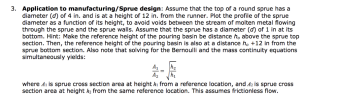 3. Application to manufacturing/Sprue design: Assume that the top of a round sprue has a diameter (d) of 4 in. and is at a height of 12 in. from the runner. Plot the profile of the sprue diameter as a function of its height, to avoid voids between the stream of molten metal flowing through the sprue and the sprue walls. Assume that the sprue has a diameter (d) of 1 in at its bottom. Hint: Make the reference height...
a horizontal pipe has a cross sectional area of 40cm^2 at the wider portions and 10...
a horizontal pipe has a cross sectional area of 40cm^2 at the wider portions and 10 cm^2 at the constriction. if the incompresible air flowing through the pipe with the inlet velocity of 1.5m/s at the wider cross section, what will be the flow velocity at the constriction?
(Metal-Casting Processes) (Groups) 10.47 A round casting is 0.2 m in diameter and 0.75 m in...
 (Metal-Casting Processes) (Groups) 10.47 A round casting is 0.2 m in diameter and 0.75 m in length. Another casting of the same metal is elliptical in cross-section, with a major-to-minor axis ratio of 2, and has the same length and cross-sectional area as the round casting. Both pieces are cast under the same conditions. What is the difference in the solidification times of the two castings? 10.48 A cylinder with a diameter of 50 mm and a height of 75...
A liquid of density 890 kg/m3 flows through a horizontal pipe that has a cross-sectional area...
A liquid of density 890 kg/m3 flows through a horizontal pipe that has a cross-sectional area of 2.50 x 10⁻² m2 in region A and a cross-sectional area of 8.50 x 10⁻²m2 in region B. The pressure difference between the two regions is 7.90 x 10³ Pa. What are (a) the volume flow rate and (b) the mass flow rate?
 Problem 2 (a): A mold has a downsprue of length - 6.0 in. The cross-sectional area at the bottom of the sprue is 0.5 in'. The sprue leads into a horizontal runner that feeds the mold cavity, whose volume = 75 in'. Determine (a) the velocity of the molten metal flowing through the base of the downsprue, (b) the volume rate of flow and (c) the time required to fill the mold cavity. Problem 2(b): The total solidification times of...
 10.3. The downsprue leading into the runnerofa certain mold has a length = 175 mm. The cross-sectional area at the base of the sprue is 400 mm-. The mold cavity has a volume 0,001 m. Determine (a) the velocity of the molten metal flowing through the base of the downsprue. (b) the volume rate of flow. and (c) the time required to fill the mold cavity. 10 A
 please help me solve this manufacturing process
problem
. The volume rate of flow of molten metal into the downsprue from the pouring cup is 50 in'/sec. At the top where the pouring cup leads into the downsprue, the cross-sectional area -1.0 in?. Determine what the area should be at the bottom of the sprue if its length 8.0 in. It is desired to maintain a constant flow rate, top and bottom, in order to avoid aspiration of the liquid...
please help me solve this manufacturing process
problem
. The volume rate of flow of molten metal into the downsprue from the pouring cup is 50 in'/sec. At the top where the pouring cup leads into the downsprue, the cross-sectional area -1.0 in?. Determine what the area should be at the bottom of the sprue if its length 8.0 in. It is desired to maintain a constant flow rate, top and bottom, in order to avoid aspiration of the liquid...
 Hi, please help me with this problem, please explain me step by
step and write with very good calligraphy. Thank you very much.
Consider casting sand mold of the piece shown in the figure. The
dimensions are in centimeters.
(i) The molten metal overflows the pouring cup of the mold and
flows down the sprue (downsprue) at a constant rate of 2000
cm3/s. The cross section of the sprue is circular, with
a diameter of 6 cm at the top....
Hi, please help me with this problem, please explain me step by
step and write with very good calligraphy. Thank you very much.
Consider casting sand mold of the piece shown in the figure. The
dimensions are in centimeters.
(i) The molten metal overflows the pouring cup of the mold and
flows down the sprue (downsprue) at a constant rate of 2000
cm3/s. The cross section of the sprue is circular, with
a diameter of 6 cm at the top....
 Provide the formula please for each part solved
A solid hexagonal shaped casting of thickness 3 cm and each side as 8 cm is being casted in a sand mold. The distance from top of the pouring cup to the sprue bottom is 20 cm, which is along the parting line. The diameter of the circular cross section at the base of sprue is 1.5 cm. The part is fully buried in drag side of the mold and top surface...
Provide the formula please for each part solved
A solid hexagonal shaped casting of thickness 3 cm and each side as 8 cm is being casted in a sand mold. The distance from top of the pouring cup to the sprue bottom is 20 cm, which is along the parting line. The diameter of the circular cross section at the base of sprue is 1.5 cm. The part is fully buried in drag side of the mold and top surface...
 10.1 Investment casting is more suitable for mass production compare to sand casting: (a)True (b) False (0.1mark) Answer 10.2 Total solidification time is defined as which one of the following: (a) time between pouring and complete solidification, (b) time between pouring and cooling to room temperature, (c) time between solidification and cooling to room temperature, or (d) time to give up the heat of fusion? (0.1mark) Answer. 10.3 A riser in casting is described by which of the following (three...
 3. Application to manufacturing/Sprue design: Assume that the top of a round sprue has a diameter (d) of 4 in. and is at a height of 12 in. from the runner. Plot the profile of the sprue diameter as a function of its height, to avoid voids between the stream of molten metal flowing through the sprue and the sprue walls. Assume that the sprue has a diameter (d) of 1 in at its bottom. Hint: Make the reference height...
 (Metal-Casting Processes) (Groups) 10.47 A round casting is 0.2 m in diameter and 0.75 m in length. Another casting of the same metal is elliptical in cross-section, with a major-to-minor axis ratio of 2, and has the same length and cross-sectional area as the round casting. Both pieces are cast under the same conditions. What is the difference in the solidification times of the two castings? 10.48 A cylinder with a diameter of 50 mm and a height of 75...
Most questions answered within 3 hours.
-
Where is the error in this code sequence?
String s1 = "Hello";
String s2 = "ello";...
asked 10 months ago -
Financial data for Joel de Paris, Inc., for last year
follow:
Joel de Paris, Inc.
Balance...
asked 10 months ago -
Consider this reaction:
Al2(SO4)3 (aq)+ BaCl3
(aq) Al2Cl6 (aq)- +
3BaSO4(s) . What is the...
asked 10 months ago -
Suppose that Savneet is considering increasing her
recent random sample from 20 car rentals to 40...
asked 10 months ago -
Trucks arrive at an unloading terminal at an average rate of 120
per hour.
Trucks arrive...
asked 10 months ago -
Why are methanol and ethanol completely soluble in water while
octanol is not very little soluble....
asked 10 months ago -
A facilities manager at a university reads in a research report
that the mean amount of...
asked 10 months ago -
When the CuSO4 is rehydrated by adding water to the anhydrous
compound, is this an endothermic...
asked 10 months ago -
A ray of sunlight is passing from diamond into crown glass; the
angle of incidence is...
asked 10 months ago -
A block of mass 0.249 kg is placed on top of a light, vertical
spring of...
asked 10 months ago -
how do the kidneys compensate in the presences of acidosis
a) trigger hyperventilate
b) reserve acid...
asked 10 months ago -
Question 501 pts
The rental rate of capital to the firm increases. Which of the
following...
asked 10 months ago