
Homework Answers
Add Answer to:
Question 9 2 pts dt -ay, where Using Euler's method on a system of the form...
2. Differential Equation (5 points) Using (i) Euler's method and (ii) modified Euler's method, bo...
 Please show Matlab code and Simulink screenshots
2. Differential Equation (5 points) Using (i) Euler's method and (ii) modified Euler's method, both with step size h-0.01, to construct an approximate solution from t-0 to t-2 for xt 2 , 42 with initial condition x(0)-1. Compare both results by plotting them in the same figure. 3. Simulink (5 points) Solve the above differential equation using simplink. Present the model and result.
2. Differential Equation (5 points) Using (i) Euler's method and...
Please show Matlab code and Simulink screenshots
2. Differential Equation (5 points) Using (i) Euler's method and (ii) modified Euler's method, both with step size h-0.01, to construct an approximate solution from t-0 to t-2 for xt 2 , 42 with initial condition x(0)-1. Compare both results by plotting them in the same figure. 3. Simulink (5 points) Solve the above differential equation using simplink. Present the model and result.
2. Differential Equation (5 points) Using (i) Euler's method and...
Question 11 2 pts For linear ODEs, linear interpolation can be used with the shooting method...
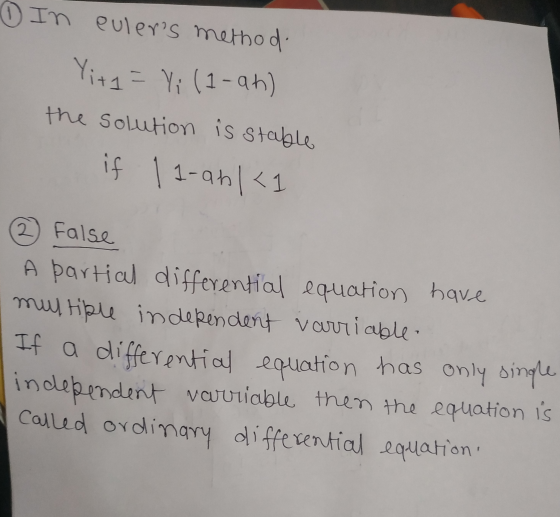
 Question 11 2 pts For linear ODEs, linear interpolation can be used with the shooting method to guarantee the correct solution on the third "shot" O True O False Question 12 2 pts Partial differential equations have more than one independent variable. O True O False
2. In these problems, determine a differential equation of the form dy/dt = ay+b whose solutions...
 2. In these problems, determine a differential equation of the form dy/dt = ay+b whose solutions have the required behavior as t →00. Hint: If y=3 is the equilibrium solution, find an equation to relate a and b to each other. There are many answers that satisfy this, but one governing principle that belies them (a) All solutions approach y = 3. (h) All solutions diverge from u = 1/3
2. Using Laplace transform, solve the system of differential equations d.x: dy dt where x(0)1 2. Using Laplace transform, solve the system of differential equations d.x: dy dt where x(0)1
 2. Using Laplace transform, solve the system of differential equations d.x: dy dt where x(0)1
2. Using Laplace transform, solve the system of differential equations d.x: dy dt where x(0)1
2. Using Laplace transform, solve the system of differential equations d.x: dy dt where x(0)1
Find the value of x(0.5) for the initial value problem at = thx(0)=1 using Euler's method with step size h 0.05 Find the value of x(0.4) for the coupled first order differential equations toge...
 Find the value of x(0.5) for the initial value problem at = thx(0)=1 using Euler's method with step size h 0.05 Find the value of x(0.4) for the coupled first order differential equations together with initial conditions with step size 0.1: 2. dt t+x 3. dx dt = y, dy dt x(0) = 1.2 and --ty +xt2 + y(o) 0.8
Find the value of x(0.5) for the initial value problem at = thx(0)=1 using Euler's method with step size h...
Find the value of x(0.5) for the initial value problem at = thx(0)=1 using Euler's method with step size h 0.05 Find the value of x(0.4) for the coupled first order differential equations together with initial conditions with step size 0.1: 2. dt t+x 3. dx dt = y, dy dt x(0) = 1.2 and --ty +xt2 + y(o) 0.8
Find the value of x(0.5) for the initial value problem at = thx(0)=1 using Euler's method with step size h...
(20 pts) 4. Solve the differential equation dy = yt? - 1.17 dt over the time...
 (20 pts) 4. Solve the differential equation dy = yt? - 1.17 dt over the time interval of [O, 1.5) with the step size of 0.5 and y(0=1. 1) Obtain the analytical result. 2) Use Euler's method. 3. Use Heun's method with iterating the corrector. Do two iterations in the corrector step.
dont ans this question Euler's method is based on the fact that the tangent line gives...
 dont ans this question
Euler's method is based on the fact that the tangent line gives a good local approximation for the function. But why restrict ourselves to linear approximants when higher degree polynomial approximants are available? For example, we can use the Taylor polynomial of degree about = No, which is defined by P.(x) = y(x) + y (xo)(x – Xa) + 21 (x- This polynomial is the nth partial sum of the Taylor series representation (te) (x –...
dont ans this question
Euler's method is based on the fact that the tangent line gives a good local approximation for the function. But why restrict ourselves to linear approximants when higher degree polynomial approximants are available? For example, we can use the Taylor polynomial of degree about = No, which is defined by P.(x) = y(x) + y (xo)(x – Xa) + 21 (x- This polynomial is the nth partial sum of the Taylor series representation (te) (x –...
4. Using inbuilt function in MATLAB, solve the differential equations: dx --t2 dt subject to the ...
 Matlab Code for these please.
4. Using inbuilt function in MATLAB, solve the differential equations: dx --t2 dt subject to the condition (01 integrated from0 tot 2. Compare the obtained numerical solution with exact solution 5. Lotka-Volterra predator prey model in the form of system of differential equations is as follows: dry dt dy dt where r denotes the number of prey, y refer to the number of predators, a defines the growth rate of prey population, B defines the...
Matlab Code for these please.
4. Using inbuilt function in MATLAB, solve the differential equations: dx --t2 dt subject to the condition (01 integrated from0 tot 2. Compare the obtained numerical solution with exact solution 5. Lotka-Volterra predator prey model in the form of system of differential equations is as follows: dry dt dy dt where r denotes the number of prey, y refer to the number of predators, a defines the growth rate of prey population, B defines the...
Using MATLAB_R2017a, solve #3 using the differential equation in question #2 using Simulink, pres...
 Using MATLAB_R2017a, solve #3 using the differential equation in
question #2 using Simulink, present the model and result.
2. Differential Equation (5 points) Using (i) Euler's method and (ii) modified Euler's method, both with step size h-0.01, to construct an approximate solution from F0 to F2 for xt 2, 42 with initial condition x(0)=1. Compare both results by plotting them in the same figure. 3. Simulink (5 points) Solve the above differential equation using simplink. Present the model and result....
Using MATLAB_R2017a, solve #3 using the differential equation in
question #2 using Simulink, present the model and result.
2. Differential Equation (5 points) Using (i) Euler's method and (ii) modified Euler's method, both with step size h-0.01, to construct an approximate solution from F0 to F2 for xt 2, 42 with initial condition x(0)=1. Compare both results by plotting them in the same figure. 3. Simulink (5 points) Solve the above differential equation using simplink. Present the model and result....
(1 point) Consider the system of differential equations dx dt = -1.6x + 0.5y, dy dt...
 (1 point) Consider the system of differential equations dx dt = -1.6x + 0.5y, dy dt = 2.5x – 3.6y. For this system, the smaller eigenvalue is -41/10 and the larger eigenvalue is -11/10 [Note-- you may want to view a phase plane plot (right click to open in a new window).] If y' Ay is a differential equation, how would the solution curves behave? All of the solutions curves would converge towards 0. (Stable node) All of the solution...
 Please show Matlab code and Simulink screenshots
2. Differential Equation (5 points) Using (i) Euler's method and (ii) modified Euler's method, both with step size h-0.01, to construct an approximate solution from t-0 to t-2 for xt 2 , 42 with initial condition x(0)-1. Compare both results by plotting them in the same figure. 3. Simulink (5 points) Solve the above differential equation using simplink. Present the model and result.
2. Differential Equation (5 points) Using (i) Euler's method and...
Please show Matlab code and Simulink screenshots
2. Differential Equation (5 points) Using (i) Euler's method and (ii) modified Euler's method, both with step size h-0.01, to construct an approximate solution from t-0 to t-2 for xt 2 , 42 with initial condition x(0)-1. Compare both results by plotting them in the same figure. 3. Simulink (5 points) Solve the above differential equation using simplink. Present the model and result.
2. Differential Equation (5 points) Using (i) Euler's method and...
 Question 11 2 pts For linear ODEs, linear interpolation can be used with the shooting method to guarantee the correct solution on the third "shot" O True O False Question 12 2 pts Partial differential equations have more than one independent variable. O True O False
 2. In these problems, determine a differential equation of the form dy/dt = ay+b whose solutions have the required behavior as t →00. Hint: If y=3 is the equilibrium solution, find an equation to relate a and b to each other. There are many answers that satisfy this, but one governing principle that belies them (a) All solutions approach y = 3. (h) All solutions diverge from u = 1/3
 2. Using Laplace transform, solve the system of differential equations d.x: dy dt where x(0)1
2. Using Laplace transform, solve the system of differential equations d.x: dy dt where x(0)1
2. Using Laplace transform, solve the system of differential equations d.x: dy dt where x(0)1
 Find the value of x(0.5) for the initial value problem at = thx(0)=1 using Euler's method with step size h 0.05 Find the value of x(0.4) for the coupled first order differential equations together with initial conditions with step size 0.1: 2. dt t+x 3. dx dt = y, dy dt x(0) = 1.2 and --ty +xt2 + y(o) 0.8
Find the value of x(0.5) for the initial value problem at = thx(0)=1 using Euler's method with step size h...
Find the value of x(0.5) for the initial value problem at = thx(0)=1 using Euler's method with step size h 0.05 Find the value of x(0.4) for the coupled first order differential equations together with initial conditions with step size 0.1: 2. dt t+x 3. dx dt = y, dy dt x(0) = 1.2 and --ty +xt2 + y(o) 0.8
Find the value of x(0.5) for the initial value problem at = thx(0)=1 using Euler's method with step size h...
 (20 pts) 4. Solve the differential equation dy = yt? - 1.17 dt over the time interval of [O, 1.5) with the step size of 0.5 and y(0=1. 1) Obtain the analytical result. 2) Use Euler's method. 3. Use Heun's method with iterating the corrector. Do two iterations in the corrector step.
 dont ans this question
Euler's method is based on the fact that the tangent line gives a good local approximation for the function. But why restrict ourselves to linear approximants when higher degree polynomial approximants are available? For example, we can use the Taylor polynomial of degree about = No, which is defined by P.(x) = y(x) + y (xo)(x – Xa) + 21 (x- This polynomial is the nth partial sum of the Taylor series representation (te) (x –...
dont ans this question
Euler's method is based on the fact that the tangent line gives a good local approximation for the function. But why restrict ourselves to linear approximants when higher degree polynomial approximants are available? For example, we can use the Taylor polynomial of degree about = No, which is defined by P.(x) = y(x) + y (xo)(x – Xa) + 21 (x- This polynomial is the nth partial sum of the Taylor series representation (te) (x –...
 Matlab Code for these please.
4. Using inbuilt function in MATLAB, solve the differential equations: dx --t2 dt subject to the condition (01 integrated from0 tot 2. Compare the obtained numerical solution with exact solution 5. Lotka-Volterra predator prey model in the form of system of differential equations is as follows: dry dt dy dt where r denotes the number of prey, y refer to the number of predators, a defines the growth rate of prey population, B defines the...
Matlab Code for these please.
4. Using inbuilt function in MATLAB, solve the differential equations: dx --t2 dt subject to the condition (01 integrated from0 tot 2. Compare the obtained numerical solution with exact solution 5. Lotka-Volterra predator prey model in the form of system of differential equations is as follows: dry dt dy dt where r denotes the number of prey, y refer to the number of predators, a defines the growth rate of prey population, B defines the...
 Using MATLAB_R2017a, solve #3 using the differential equation in
question #2 using Simulink, present the model and result.
2. Differential Equation (5 points) Using (i) Euler's method and (ii) modified Euler's method, both with step size h-0.01, to construct an approximate solution from F0 to F2 for xt 2, 42 with initial condition x(0)=1. Compare both results by plotting them in the same figure. 3. Simulink (5 points) Solve the above differential equation using simplink. Present the model and result....
Using MATLAB_R2017a, solve #3 using the differential equation in
question #2 using Simulink, present the model and result.
2. Differential Equation (5 points) Using (i) Euler's method and (ii) modified Euler's method, both with step size h-0.01, to construct an approximate solution from F0 to F2 for xt 2, 42 with initial condition x(0)=1. Compare both results by plotting them in the same figure. 3. Simulink (5 points) Solve the above differential equation using simplink. Present the model and result....
 (1 point) Consider the system of differential equations dx dt = -1.6x + 0.5y, dy dt = 2.5x – 3.6y. For this system, the smaller eigenvalue is -41/10 and the larger eigenvalue is -11/10 [Note-- you may want to view a phase plane plot (right click to open in a new window).] If y' Ay is a differential equation, how would the solution curves behave? All of the solutions curves would converge towards 0. (Stable node) All of the solution...
Most questions answered within 3 hours.
-
Where is the error in this code sequence?
String s1 = "Hello";
String s2 = "ello";...
asked 10 months ago -
Financial data for Joel de Paris, Inc., for last year
follow:
Joel de Paris, Inc.
Balance...
asked 10 months ago -
Consider this reaction:
Al2(SO4)3 (aq)+ BaCl3
(aq) Al2Cl6 (aq)- +
3BaSO4(s) . What is the...
asked 10 months ago -
Suppose that Savneet is considering increasing her
recent random sample from 20 car rentals to 40...
asked 10 months ago -
Trucks arrive at an unloading terminal at an average rate of 120
per hour.
Trucks arrive...
asked 10 months ago -
Why are methanol and ethanol completely soluble in water while
octanol is not very little soluble....
asked 10 months ago -
A facilities manager at a university reads in a research report
that the mean amount of...
asked 10 months ago -
When the CuSO4 is rehydrated by adding water to the anhydrous
compound, is this an endothermic...
asked 10 months ago -
A ray of sunlight is passing from diamond into crown glass; the
angle of incidence is...
asked 10 months ago -
A block of mass 0.249 kg is placed on top of a light, vertical
spring of...
asked 10 months ago -
how do the kidneys compensate in the presences of acidosis
a) trigger hyperventilate
b) reserve acid...
asked 10 months ago -
Question 501 pts
The rental rate of capital to the firm increases. Which of the
following...
asked 10 months ago