
MATLAB Code. Try not to use SYMS package as it does not load on Octave.
Homework Answers
I'm providing the screenshots of the work please do follow them and please do upvote thank you.
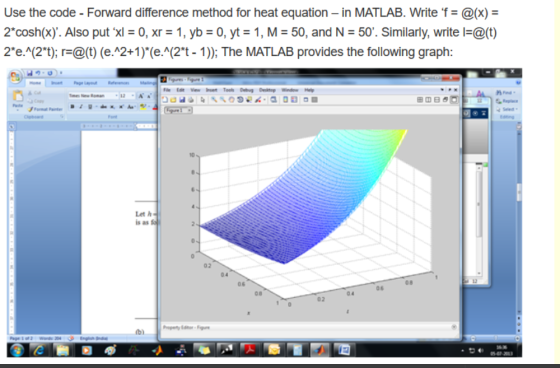
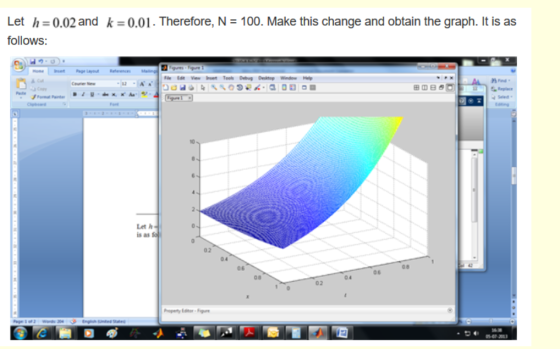
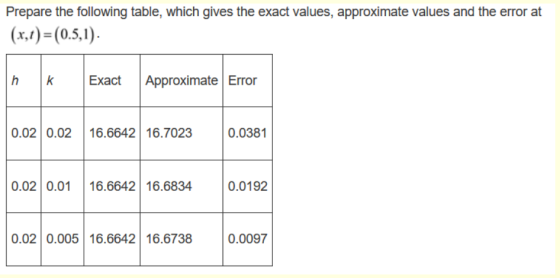
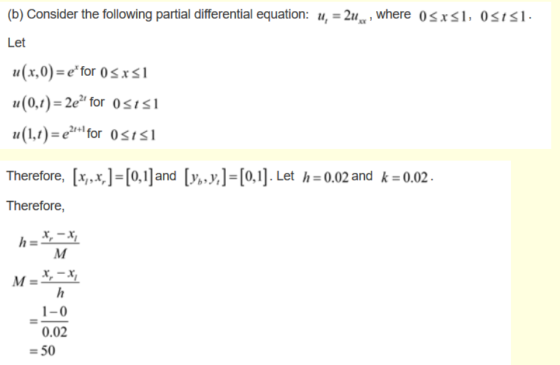
![(«,,x,]= [0,1] and [yo,y;] = [0,1]. Let h=0.02 and k = 0.02. Therefore, h=*, -X M M=*, -X, h 1-0 0.02 = 50 Similarly, k =); N](http://img.homeworklib.com/questions/ce3bfd20-0029-11eb-af00-355dccf2fffa.png?x-oss-process=image/resize,w_560)

Add Answer to:
MATLAB Code. Try not to use SYMS package as it does not load on
Octave.
Use...
Please do not use SYMS package. It does not work on Octave for me. Matlab code...
 Please do not use SYMS package. It does not work on Octave for
me.
Matlab code needed for: 1. Apply the Explicit Trapezoid Method on a grid of step size h = 0.1 in [0, 1] to the initial value problems in Exercise 1. Print a table of the t values, approximations, and global truncation error at each step. IVP (Exercise 1): (a) y'=1 (b) y' = 12y (c) y' = 2(t+1)y (d) y = 564, (e) y'=1/y² (1) y'=1/y2...
Please do not use SYMS package. It does not work on Octave for
me.
Matlab code needed for: 1. Apply the Explicit Trapezoid Method on a grid of step size h = 0.1 in [0, 1] to the initial value problems in Exercise 1. Print a table of the t values, approximations, and global truncation error at each step. IVP (Exercise 1): (a) y'=1 (b) y' = 12y (c) y' = 2(t+1)y (d) y = 564, (e) y'=1/y² (1) y'=1/y2...
SOLVE USING MATLAB ONLY AND SHOW FULL CODE. PLEASE TO SHOW TEXT BOOK SOLUTION. SOLVE PART D ONLY
 SOLVE USING MATLAB ONLY AND SHOW FULL CODE. PLEASE TO SHOW
TEXT BOOK SOLUTION. SOLVE PART D ONLY
Apply Euler's Method with step sizes h # 0.1 and h 0.01 to the initial value problems in Exercise 1. Plot the approximate solutions and the correct solution on [O, 1], and find the global truncation error at t-1. Is the reduction in error for h -0.01 consistent with the order of Euler's Method? REFERENCE: Apply the Euler's Method with step size...
SOLVE USING MATLAB ONLY AND SHOW FULL CODE. PLEASE TO SHOW
TEXT BOOK SOLUTION. SOLVE PART D ONLY
Apply Euler's Method with step sizes h # 0.1 and h 0.01 to the initial value problems in Exercise 1. Plot the approximate solutions and the correct solution on [O, 1], and find the global truncation error at t-1. Is the reduction in error for h -0.01 consistent with the order of Euler's Method? REFERENCE: Apply the Euler's Method with step size...
Matlab & Differential Equations Help Needed I need help with this Matlab project for differential equations. I've got 0 experience with Matlab other than a much easier project I did in another...
 Matlab & Differential Equations Help Needed
I need help with this Matlab project for differential equations.
I've got 0 experience with Matlab other than a much easier project
I did in another class a few semesters ago. All we've been given is
this piece of paper and some sample code. I don't even know how to
begin to approach this. I don't know how to use Matlab at all and I
barely can do this material.
Here's the handout:
Here's...
Matlab & Differential Equations Help Needed
I need help with this Matlab project for differential equations.
I've got 0 experience with Matlab other than a much easier project
I did in another class a few semesters ago. All we've been given is
this piece of paper and some sample code. I don't even know how to
begin to approach this. I don't know how to use Matlab at all and I
barely can do this material.
Here's the handout:
Here's...
Please use MATLAB, screenshot code and results An automotive power train control system is described by...
 Please use MATLAB, screenshot code and results
An automotive power train control system is described by the following matrix equations 1-12 -10 -57 [1] x= 1 0 0 +0 u To 100 y(t) = [ 35 – 5]x where u = -KX+r, and r is a unit step input. Use MATLAB/SIMULINK to plot different responses of the system output Y for the following feedback control gain matrix K: Casel: K = [1 44 67] Case2: K = [10 44 67]...
Please use MATLAB, screenshot code and results
An automotive power train control system is described by the following matrix equations 1-12 -10 -57 [1] x= 1 0 0 +0 u To 100 y(t) = [ 35 – 5]x where u = -KX+r, and r is a unit step input. Use MATLAB/SIMULINK to plot different responses of the system output Y for the following feedback control gain matrix K: Casel: K = [1 44 67] Case2: K = [10 44 67]...
Solve using Matlab Use the forward Euler method, Vi+,-Vi+(4+1-tinti ,Vi) for i= 0,1,2, , taking yo y(to) to be the initial condition, to approximate the solution at t-2 of the IVP y'=y-t2 + 1, 0-...
 Solve using Matlab
Use the forward Euler method, Vi+,-Vi+(4+1-tinti ,Vi) for i= 0,1,2, , taking yo y(to) to be the initial condition, to approximate the solution at t-2 of the IVP y'=y-t2 + 1, 0-t-2, y(0) = 0.5. Use N = 2k, k = 1, 2, , 20 equispaced time steps (so to = 0 and tN-1 = 2). Make a convergence plot, computing the error by comparing with the exact solution, y: t1)2 -exp(t)/2, and plotting the error as...
Solve using Matlab
Use the forward Euler method, Vi+,-Vi+(4+1-tinti ,Vi) for i= 0,1,2, , taking yo y(to) to be the initial condition, to approximate the solution at t-2 of the IVP y'=y-t2 + 1, 0-t-2, y(0) = 0.5. Use N = 2k, k = 1, 2, , 20 equispaced time steps (so to = 0 and tN-1 = 2). Make a convergence plot, computing the error by comparing with the exact solution, y: t1)2 -exp(t)/2, and plotting the error as...
I am new to Matlab so details would be appreciated! Use Matlab or any other Language...
 I am new to Matlab so details would be
appreciated!
Use Matlab or any other Language /Tool to implement the project work Algorithm for Gauss-Seidel Method to solve the linear (n x n) system Ax = b in matrix form is given by x(0) = initial vector x(4+1) = D-1 (b – Lx(k+1) – Ux(k)), k = 0, 1, 2, ...... where A = L+D+U. Here L, D, U are respectively lower, diag- onal and upper matrices constructed from A....
I am new to Matlab so details would be
appreciated!
Use Matlab or any other Language /Tool to implement the project work Algorithm for Gauss-Seidel Method to solve the linear (n x n) system Ax = b in matrix form is given by x(0) = initial vector x(4+1) = D-1 (b – Lx(k+1) – Ux(k)), k = 0, 1, 2, ...... where A = L+D+U. Here L, D, U are respectively lower, diag- onal and upper matrices constructed from A....
Given this pseudocode and problem (as an example), code the continuation algorithm in MATLAB. 1. The...
 Given this pseudocode and problem (as an
example), code the continuation algorithm in MATLAB.
1. The nonlinear system fi(x1, x2) = x - xż + 2x2 = 0, $2(x1, x2) = 2x1 + xź – 6= 0 has two solutions, (0.625204094, 2.179355825)' and (2.109511920, -1.334532188)'. Use the Con- tinuation method and Euler's method with N = 2 to approximate the solutions where a. X(0) = (0,0) b. x(0) = (1, 1) c. x(O) = (3,-2) Continuation Algorithm To approximate the...
Given this pseudocode and problem (as an
example), code the continuation algorithm in MATLAB.
1. The nonlinear system fi(x1, x2) = x - xż + 2x2 = 0, $2(x1, x2) = 2x1 + xź – 6= 0 has two solutions, (0.625204094, 2.179355825)' and (2.109511920, -1.334532188)'. Use the Con- tinuation method and Euler's method with N = 2 to approximate the solutions where a. X(0) = (0,0) b. x(0) = (1, 1) c. x(O) = (3,-2) Continuation Algorithm To approximate the...
Project Being able to analytically calculate the solution to a given partial differential equatio...
 Project Being able to analytically calculate the solution to a given partial differential equation is often a much more difficult (if not impossible) task than presented here. Possible challenges include irregular domains and strange numerical techniques are often used to approximate the solution to a PDE. The most basic of such methods is the finite difference method. To illustrate the method, consider the Dirchlet Poisson equation in one dimension given by 10:Finite Difference Approximation ary conditions. In those cases, The...
please use octave calculator or matlab to answer (a)(ii)and(iii) 2. (a) Use Octave as a Calculator1 to answer this question. Suppose that A and B are two 8 × 9 matrices. The (i, j)-entry of the matri...
 please use octave calculator or matlab to answer
(a)(ii)and(iii)
2. (a) Use Octave as a Calculator1 to answer this question. Suppose that A and B are two 8 × 9 matrices. The (i, j)-entry of the matrix B is given by i *j -1. The (i, j)-entry of the matrix A equals 0 if i + j is divisible by 5 and equals the (i, j)-entry of the matrix B otherwise. i. What are the rank and nullity of matrices...
please use octave calculator or matlab to answer
(a)(ii)and(iii)
2. (a) Use Octave as a Calculator1 to answer this question. Suppose that A and B are two 8 × 9 matrices. The (i, j)-entry of the matrix B is given by i *j -1. The (i, j)-entry of the matrix A equals 0 if i + j is divisible by 5 and equals the (i, j)-entry of the matrix B otherwise. i. What are the rank and nullity of matrices...
I have all of the answers to this can someone just actually explain this matlab code and the results to me so i can get a better understanding? b) (c) and (d) %% Matlab code %% clc; close all; clear...
 I have all of the answers to this can someone just actually
explain this matlab code and the results to me so i can get a
better understanding?
b)
(c) and (d)
%% Matlab code %%
clc;
close all;
clear all;
format long;
f=@(t,y)y*(1-y);
y(1)=0.01;
%%%% Exact solution
[t1 y1]=ode45(f,[0 9],y(1));
figure;
plot(t1,y1,'*');
hold on
% Eular therom
M=[32 64 128];
T=9;
fprintf(' M Max error \n' );
for n=1:length(M)
k=T/M(n);
t=0:k:T;
for h=1:length(t)-1
y(h+1)=y(h)+k*f(t(h),y(h));
end
plot(t,y);
hold on
%%%...
I have all of the answers to this can someone just actually
explain this matlab code and the results to me so i can get a
better understanding?
b)
(c) and (d)
%% Matlab code %%
clc;
close all;
clear all;
format long;
f=@(t,y)y*(1-y);
y(1)=0.01;
%%%% Exact solution
[t1 y1]=ode45(f,[0 9],y(1));
figure;
plot(t1,y1,'*');
hold on
% Eular therom
M=[32 64 128];
T=9;
fprintf(' M Max error \n' );
for n=1:length(M)
k=T/M(n);
t=0:k:T;
for h=1:length(t)-1
y(h+1)=y(h)+k*f(t(h),y(h));
end
plot(t,y);
hold on
%%%...
 Please do not use SYMS package. It does not work on Octave for
me.
Matlab code needed for: 1. Apply the Explicit Trapezoid Method on a grid of step size h = 0.1 in [0, 1] to the initial value problems in Exercise 1. Print a table of the t values, approximations, and global truncation error at each step. IVP (Exercise 1): (a) y'=1 (b) y' = 12y (c) y' = 2(t+1)y (d) y = 564, (e) y'=1/y² (1) y'=1/y2...
Please do not use SYMS package. It does not work on Octave for
me.
Matlab code needed for: 1. Apply the Explicit Trapezoid Method on a grid of step size h = 0.1 in [0, 1] to the initial value problems in Exercise 1. Print a table of the t values, approximations, and global truncation error at each step. IVP (Exercise 1): (a) y'=1 (b) y' = 12y (c) y' = 2(t+1)y (d) y = 564, (e) y'=1/y² (1) y'=1/y2...
 SOLVE USING MATLAB ONLY AND SHOW FULL CODE. PLEASE TO SHOW
TEXT BOOK SOLUTION. SOLVE PART D ONLY
Apply Euler's Method with step sizes h # 0.1 and h 0.01 to the initial value problems in Exercise 1. Plot the approximate solutions and the correct solution on [O, 1], and find the global truncation error at t-1. Is the reduction in error for h -0.01 consistent with the order of Euler's Method? REFERENCE: Apply the Euler's Method with step size...
SOLVE USING MATLAB ONLY AND SHOW FULL CODE. PLEASE TO SHOW
TEXT BOOK SOLUTION. SOLVE PART D ONLY
Apply Euler's Method with step sizes h # 0.1 and h 0.01 to the initial value problems in Exercise 1. Plot the approximate solutions and the correct solution on [O, 1], and find the global truncation error at t-1. Is the reduction in error for h -0.01 consistent with the order of Euler's Method? REFERENCE: Apply the Euler's Method with step size...
 Matlab & Differential Equations Help Needed
I need help with this Matlab project for differential equations.
I've got 0 experience with Matlab other than a much easier project
I did in another class a few semesters ago. All we've been given is
this piece of paper and some sample code. I don't even know how to
begin to approach this. I don't know how to use Matlab at all and I
barely can do this material.
Here's the handout:
Here's...
Matlab & Differential Equations Help Needed
I need help with this Matlab project for differential equations.
I've got 0 experience with Matlab other than a much easier project
I did in another class a few semesters ago. All we've been given is
this piece of paper and some sample code. I don't even know how to
begin to approach this. I don't know how to use Matlab at all and I
barely can do this material.
Here's the handout:
Here's...
 Please use MATLAB, screenshot code and results
An automotive power train control system is described by the following matrix equations 1-12 -10 -57 [1] x= 1 0 0 +0 u To 100 y(t) = [ 35 – 5]x where u = -KX+r, and r is a unit step input. Use MATLAB/SIMULINK to plot different responses of the system output Y for the following feedback control gain matrix K: Casel: K = [1 44 67] Case2: K = [10 44 67]...
Please use MATLAB, screenshot code and results
An automotive power train control system is described by the following matrix equations 1-12 -10 -57 [1] x= 1 0 0 +0 u To 100 y(t) = [ 35 – 5]x where u = -KX+r, and r is a unit step input. Use MATLAB/SIMULINK to plot different responses of the system output Y for the following feedback control gain matrix K: Casel: K = [1 44 67] Case2: K = [10 44 67]...
 Solve using Matlab
Use the forward Euler method, Vi+,-Vi+(4+1-tinti ,Vi) for i= 0,1,2, , taking yo y(to) to be the initial condition, to approximate the solution at t-2 of the IVP y'=y-t2 + 1, 0-t-2, y(0) = 0.5. Use N = 2k, k = 1, 2, , 20 equispaced time steps (so to = 0 and tN-1 = 2). Make a convergence plot, computing the error by comparing with the exact solution, y: t1)2 -exp(t)/2, and plotting the error as...
Solve using Matlab
Use the forward Euler method, Vi+,-Vi+(4+1-tinti ,Vi) for i= 0,1,2, , taking yo y(to) to be the initial condition, to approximate the solution at t-2 of the IVP y'=y-t2 + 1, 0-t-2, y(0) = 0.5. Use N = 2k, k = 1, 2, , 20 equispaced time steps (so to = 0 and tN-1 = 2). Make a convergence plot, computing the error by comparing with the exact solution, y: t1)2 -exp(t)/2, and plotting the error as...
 I am new to Matlab so details would be
appreciated!
Use Matlab or any other Language /Tool to implement the project work Algorithm for Gauss-Seidel Method to solve the linear (n x n) system Ax = b in matrix form is given by x(0) = initial vector x(4+1) = D-1 (b – Lx(k+1) – Ux(k)), k = 0, 1, 2, ...... where A = L+D+U. Here L, D, U are respectively lower, diag- onal and upper matrices constructed from A....
I am new to Matlab so details would be
appreciated!
Use Matlab or any other Language /Tool to implement the project work Algorithm for Gauss-Seidel Method to solve the linear (n x n) system Ax = b in matrix form is given by x(0) = initial vector x(4+1) = D-1 (b – Lx(k+1) – Ux(k)), k = 0, 1, 2, ...... where A = L+D+U. Here L, D, U are respectively lower, diag- onal and upper matrices constructed from A....
 Given this pseudocode and problem (as an
example), code the continuation algorithm in MATLAB.
1. The nonlinear system fi(x1, x2) = x - xż + 2x2 = 0, $2(x1, x2) = 2x1 + xź – 6= 0 has two solutions, (0.625204094, 2.179355825)' and (2.109511920, -1.334532188)'. Use the Con- tinuation method and Euler's method with N = 2 to approximate the solutions where a. X(0) = (0,0) b. x(0) = (1, 1) c. x(O) = (3,-2) Continuation Algorithm To approximate the...
Given this pseudocode and problem (as an
example), code the continuation algorithm in MATLAB.
1. The nonlinear system fi(x1, x2) = x - xż + 2x2 = 0, $2(x1, x2) = 2x1 + xź – 6= 0 has two solutions, (0.625204094, 2.179355825)' and (2.109511920, -1.334532188)'. Use the Con- tinuation method and Euler's method with N = 2 to approximate the solutions where a. X(0) = (0,0) b. x(0) = (1, 1) c. x(O) = (3,-2) Continuation Algorithm To approximate the...
 Project Being able to analytically calculate the solution to a given partial differential equation is often a much more difficult (if not impossible) task than presented here. Possible challenges include irregular domains and strange numerical techniques are often used to approximate the solution to a PDE. The most basic of such methods is the finite difference method. To illustrate the method, consider the Dirchlet Poisson equation in one dimension given by 10:Finite Difference Approximation ary conditions. In those cases, The...
 please use octave calculator or matlab to answer
(a)(ii)and(iii)
2. (a) Use Octave as a Calculator1 to answer this question. Suppose that A and B are two 8 × 9 matrices. The (i, j)-entry of the matrix B is given by i *j -1. The (i, j)-entry of the matrix A equals 0 if i + j is divisible by 5 and equals the (i, j)-entry of the matrix B otherwise. i. What are the rank and nullity of matrices...
please use octave calculator or matlab to answer
(a)(ii)and(iii)
2. (a) Use Octave as a Calculator1 to answer this question. Suppose that A and B are two 8 × 9 matrices. The (i, j)-entry of the matrix B is given by i *j -1. The (i, j)-entry of the matrix A equals 0 if i + j is divisible by 5 and equals the (i, j)-entry of the matrix B otherwise. i. What are the rank and nullity of matrices...
 I have all of the answers to this can someone just actually
explain this matlab code and the results to me so i can get a
better understanding?
b)
(c) and (d)
%% Matlab code %%
clc;
close all;
clear all;
format long;
f=@(t,y)y*(1-y);
y(1)=0.01;
%%%% Exact solution
[t1 y1]=ode45(f,[0 9],y(1));
figure;
plot(t1,y1,'*');
hold on
% Eular therom
M=[32 64 128];
T=9;
fprintf(' M Max error \n' );
for n=1:length(M)
k=T/M(n);
t=0:k:T;
for h=1:length(t)-1
y(h+1)=y(h)+k*f(t(h),y(h));
end
plot(t,y);
hold on
%%%...
I have all of the answers to this can someone just actually
explain this matlab code and the results to me so i can get a
better understanding?
b)
(c) and (d)
%% Matlab code %%
clc;
close all;
clear all;
format long;
f=@(t,y)y*(1-y);
y(1)=0.01;
%%%% Exact solution
[t1 y1]=ode45(f,[0 9],y(1));
figure;
plot(t1,y1,'*');
hold on
% Eular therom
M=[32 64 128];
T=9;
fprintf(' M Max error \n' );
for n=1:length(M)
k=T/M(n);
t=0:k:T;
for h=1:length(t)-1
y(h+1)=y(h)+k*f(t(h),y(h));
end
plot(t,y);
hold on
%%%...
Most questions answered within 3 hours.
-
Where is the error in this code sequence?
String s1 = "Hello";
String s2 = "ello";...
asked 11 months ago -
Financial data for Joel de Paris, Inc., for last year
follow:
Joel de Paris, Inc.
Balance...
asked 11 months ago -
Consider this reaction:
Al2(SO4)3 (aq)+ BaCl3
(aq) Al2Cl6 (aq)- +
3BaSO4(s) . What is the...
asked 11 months ago -
Suppose that Savneet is considering increasing her
recent random sample from 20 car rentals to 40...
asked 11 months ago -
Trucks arrive at an unloading terminal at an average rate of 120
per hour.
Trucks arrive...
asked 11 months ago -
Why are methanol and ethanol completely soluble in water while
octanol is not very little soluble....
asked 11 months ago -
A facilities manager at a university reads in a research report
that the mean amount of...
asked 11 months ago -
When the CuSO4 is rehydrated by adding water to the anhydrous
compound, is this an endothermic...
asked 11 months ago -
A ray of sunlight is passing from diamond into crown glass; the
angle of incidence is...
asked 11 months ago -
A block of mass 0.249 kg is placed on top of a light, vertical
spring of...
asked 11 months ago -
how do the kidneys compensate in the presences of acidosis
a) trigger hyperventilate
b) reserve acid...
asked 11 months ago -
Question 501 pts
The rental rate of capital to the firm increases. Which of the
following...
asked 11 months ago