
Homework Answers
Add Answer to:
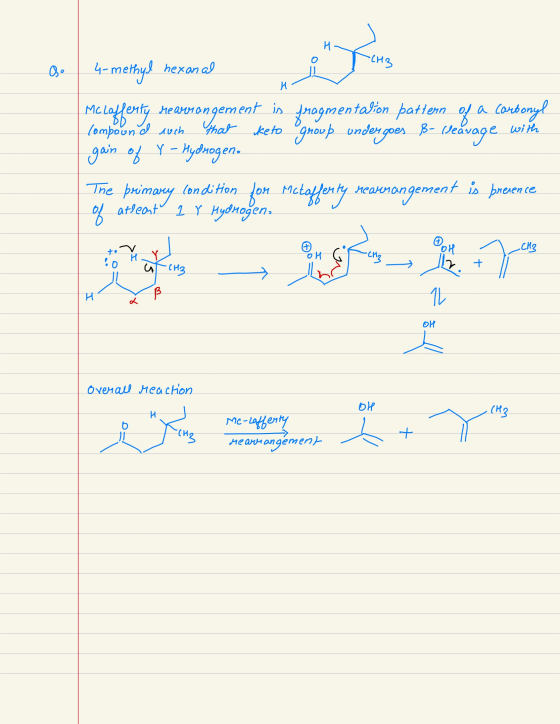
Pusong 5) Draw McLafferty rearrangement of 4-methyl hexanal. Determine ion fragments. 6) Predict a-allylic cleavage fragmentation...
6) Predict a-allylic cleavage fragmentation of 5,5-dimethylhexene-1-ol and determine ion fragment mass. Why is it stable?...
 6) Predict a-allylic cleavage fragmentation of 5,5-dimethylhexene-1-ol and determine ion fragment mass. Why is it stable? 7) Determine ion fragments of methyl-cyclopentane and draw mass spectra. Show all ionic rearrangements.
6) Predict a-allylic cleavage fragmentation of 5,5-dimethylhexene-1-ol and determine ion fragment mass. Why is it stable?...
 6) Predict a-allylic cleavage fragmentation of 5,5-dimethylhexene-1-ol and determine ion fragment mass. Why is it stable?
do alpha allylic cleavage fragmentation of 5,5 dimethylhexen-1-ol and determine the ion mass of the product...
 do alpha allylic cleavage fragmentation of
5,5 dimethylhexen-1-ol and determine the ion mass of the product
formed
also give reason for the stability of the product formed
6) Predict a-allylic cleavage fragmentation of 5,5-dimethylhexene-1-ol and determine ion fragment mass. Why is it stable?
do alpha allylic cleavage fragmentation of
5,5 dimethylhexen-1-ol and determine the ion mass of the product
formed
also give reason for the stability of the product formed
6) Predict a-allylic cleavage fragmentation of 5,5-dimethylhexene-1-ol and determine ion fragment mass. Why is it stable?
4) Based on the structure of 3-penten-2-on and 4-penten-2-on determine which of the two compounds will...
 4) Based on the structure of 3-penten-2-on and 4-penten-2-on determine which of the two compounds will absorb UV light at shorter wavelength. Explain your reasoning. 5) Draw McLafferty rearrangement of 4-methyl hexanal. Determine ion fragments.
4.) Determine whether the following ion is aromatic, nonaromatic, or antiaromatic. 5.) Predict the product. If...
 4.)
Determine whether the following ion is aromatic, nonaromatic, or
antiaromatic.
5.) Predict the product. If no reaction, write NR.
6.) Determine the reagents needed. Show each step
4.) Determine whether the following ion is aromatic, nonaromatic, or anti aromatic . Predict the product. If no reaction, write NR, OqN To Allizy Ch 6. Determine the reagents needed. Show each steps HC = CCH .NO2 NH₂
4.)
Determine whether the following ion is aromatic, nonaromatic, or
antiaromatic.
5.) Predict the product. If no reaction, write NR.
6.) Determine the reagents needed. Show each step
4.) Determine whether the following ion is aromatic, nonaromatic, or anti aromatic . Predict the product. If no reaction, write NR, OqN To Allizy Ch 6. Determine the reagents needed. Show each steps HC = CCH .NO2 NH₂
6. Draw the two chair conformations for cis-1-sec-butyl-2-ethylcyclohexane. Predict the most stable conformer and draw the...
 6. Draw the two chair conformations for cis-1-sec-butyl-2-ethylcyclohexane. Predict the most stable conformer and draw the corresponding Newman projection (4 pts) 7. Convert the following compounds from their 3D structure to their Fisher projection and vice-versa (4 pts) НО Br HO co₂me HN CI CO2Me НО -СІ НЕОН СН2ОН 5| Page 8. The specific rotation for (R)-methyl 2-chloro-2,3-dihydroxypropanoate is -126.7. A student prepare a sample of methyl 2-chloro-2,3-dihydroxypropanoate enantiomers that shows a specific rotation of +89.6, (a) Calculate the percent...
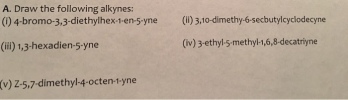
Help please Draw the following alkynes: 4-bromo-3, 3-diethylhex-i-en-5-yne 3, 10-dimethy-6-secbutylcyclodecyne) 1, 3-hexadien-5-yne s-ethyl-s-methyl-1.6.8-decatriyne Z-5, 7-dimethyl-4-octen-1-yne
 Help please
Draw the following alkynes: 4-bromo-3, 3-diethylhex-i-en-5-yne 3, 10-dimethy-6-secbutylcyclodecyne) 1, 3-hexadien-5-yne s-ethyl-s-methyl-1.6.8-decatriyne Z-5, 7-dimethyl-4-octen-1-yne
Help please
Draw the following alkynes: 4-bromo-3, 3-diethylhex-i-en-5-yne 3, 10-dimethy-6-secbutylcyclodecyne) 1, 3-hexadien-5-yne s-ethyl-s-methyl-1.6.8-decatriyne Z-5, 7-dimethyl-4-octen-1-yne
7. The IUPAC name for the followe d in the OH controls a) 3-chloro-2-methylcyclohexanol 5-chloro-2-methylcyclohexanol 2-methyl-3-chlorocyclohexanol...
 7. The IUPAC name for the followe d in the OH controls a) 3-chloro-2-methylcyclohexanol 5-chloro-2-methylcyclohexanol 2-methyl-3-chlorocyclohexanol d) 2-methyl-5 chlorocyclohexanol e) 1-chloro-4-methylcyclohexanol Which of the following cannot be an electrophile? a) H b) CH2-CH; c) 'NO ) BF; d) Fee ased on the following enery diagram, which compound is formed slowly Reaction ) B from A c) Cfrom B d) from C a) A from B b 10. Which of the following has the highest priority? -0-H -CH=CHCH -CH=NCH -SC-CH; 11....
help with questions 5 to 10 please PCB 3023L Lab #4 Protocol & Worksheet (30pt) You...
 help with questions 5 to 10 please
PCB 3023L Lab #4 Protocol & Worksheet (30pt) You may work in your lab groups durine class. but all written answers must be completed individually in your own words. 1) Using the plasmid map for orientation 1 and the cDNA map as a guide, complete the plasmid map for orientation #2. (4pt) 612 1318 1 - EcoRi EcoRI Xbal ECORV -Xbal- 1662 +Bell EcoRI EcoRV Not FP -- Xhol X 2015 PRSP +...
help with questions 5 to 10 please
PCB 3023L Lab #4 Protocol & Worksheet (30pt) You may work in your lab groups durine class. but all written answers must be completed individually in your own words. 1) Using the plasmid map for orientation 1 and the cDNA map as a guide, complete the plasmid map for orientation #2. (4pt) 612 1318 1 - EcoRi EcoRI Xbal ECORV -Xbal- 1662 +Bell EcoRI EcoRV Not FP -- Xhol X 2015 PRSP +...
can someone help me answer these 5 questions and figire this graph out please? Acid-Base Titration...
 can
someone help me answer these 5 questions and figire this graph out
please?
Acid-Base Titration of a Weak Acid with a Strong Base: Determination of K. Introduction: You will be titrating a solution of a weak acid with 0.100 M NaOH, while monitoring the reaction using a pH meter. Weak acids have characteristic acid-ionization constants, K. The purpose of this lab is to use the titration to determine the value of this constant for the weak acid called “benzoic...
can
someone help me answer these 5 questions and figire this graph out
please?
Acid-Base Titration of a Weak Acid with a Strong Base: Determination of K. Introduction: You will be titrating a solution of a weak acid with 0.100 M NaOH, while monitoring the reaction using a pH meter. Weak acids have characteristic acid-ionization constants, K. The purpose of this lab is to use the titration to determine the value of this constant for the weak acid called “benzoic...
 6) Predict a-allylic cleavage fragmentation of 5,5-dimethylhexene-1-ol and determine ion fragment mass. Why is it stable? 7) Determine ion fragments of methyl-cyclopentane and draw mass spectra. Show all ionic rearrangements.
 6) Predict a-allylic cleavage fragmentation of 5,5-dimethylhexene-1-ol and determine ion fragment mass. Why is it stable?
 do alpha allylic cleavage fragmentation of
5,5 dimethylhexen-1-ol and determine the ion mass of the product
formed
also give reason for the stability of the product formed
6) Predict a-allylic cleavage fragmentation of 5,5-dimethylhexene-1-ol and determine ion fragment mass. Why is it stable?
do alpha allylic cleavage fragmentation of
5,5 dimethylhexen-1-ol and determine the ion mass of the product
formed
also give reason for the stability of the product formed
6) Predict a-allylic cleavage fragmentation of 5,5-dimethylhexene-1-ol and determine ion fragment mass. Why is it stable?
 4) Based on the structure of 3-penten-2-on and 4-penten-2-on determine which of the two compounds will absorb UV light at shorter wavelength. Explain your reasoning. 5) Draw McLafferty rearrangement of 4-methyl hexanal. Determine ion fragments.
 4.)
Determine whether the following ion is aromatic, nonaromatic, or
antiaromatic.
5.) Predict the product. If no reaction, write NR.
6.) Determine the reagents needed. Show each step
4.) Determine whether the following ion is aromatic, nonaromatic, or anti aromatic . Predict the product. If no reaction, write NR, OqN To Allizy Ch 6. Determine the reagents needed. Show each steps HC = CCH .NO2 NH₂
4.)
Determine whether the following ion is aromatic, nonaromatic, or
antiaromatic.
5.) Predict the product. If no reaction, write NR.
6.) Determine the reagents needed. Show each step
4.) Determine whether the following ion is aromatic, nonaromatic, or anti aromatic . Predict the product. If no reaction, write NR, OqN To Allizy Ch 6. Determine the reagents needed. Show each steps HC = CCH .NO2 NH₂
 6. Draw the two chair conformations for cis-1-sec-butyl-2-ethylcyclohexane. Predict the most stable conformer and draw the corresponding Newman projection (4 pts) 7. Convert the following compounds from their 3D structure to their Fisher projection and vice-versa (4 pts) НО Br HO co₂me HN CI CO2Me НО -СІ НЕОН СН2ОН 5| Page 8. The specific rotation for (R)-methyl 2-chloro-2,3-dihydroxypropanoate is -126.7. A student prepare a sample of methyl 2-chloro-2,3-dihydroxypropanoate enantiomers that shows a specific rotation of +89.6, (a) Calculate the percent...
 Help please
Draw the following alkynes: 4-bromo-3, 3-diethylhex-i-en-5-yne 3, 10-dimethy-6-secbutylcyclodecyne) 1, 3-hexadien-5-yne s-ethyl-s-methyl-1.6.8-decatriyne Z-5, 7-dimethyl-4-octen-1-yne
Help please
Draw the following alkynes: 4-bromo-3, 3-diethylhex-i-en-5-yne 3, 10-dimethy-6-secbutylcyclodecyne) 1, 3-hexadien-5-yne s-ethyl-s-methyl-1.6.8-decatriyne Z-5, 7-dimethyl-4-octen-1-yne
 7. The IUPAC name for the followe d in the OH controls a) 3-chloro-2-methylcyclohexanol 5-chloro-2-methylcyclohexanol 2-methyl-3-chlorocyclohexanol d) 2-methyl-5 chlorocyclohexanol e) 1-chloro-4-methylcyclohexanol Which of the following cannot be an electrophile? a) H b) CH2-CH; c) 'NO ) BF; d) Fee ased on the following enery diagram, which compound is formed slowly Reaction ) B from A c) Cfrom B d) from C a) A from B b 10. Which of the following has the highest priority? -0-H -CH=CHCH -CH=NCH -SC-CH; 11....
 help with questions 5 to 10 please
PCB 3023L Lab #4 Protocol & Worksheet (30pt) You may work in your lab groups durine class. but all written answers must be completed individually in your own words. 1) Using the plasmid map for orientation 1 and the cDNA map as a guide, complete the plasmid map for orientation #2. (4pt) 612 1318 1 - EcoRi EcoRI Xbal ECORV -Xbal- 1662 +Bell EcoRI EcoRV Not FP -- Xhol X 2015 PRSP +...
help with questions 5 to 10 please
PCB 3023L Lab #4 Protocol & Worksheet (30pt) You may work in your lab groups durine class. but all written answers must be completed individually in your own words. 1) Using the plasmid map for orientation 1 and the cDNA map as a guide, complete the plasmid map for orientation #2. (4pt) 612 1318 1 - EcoRi EcoRI Xbal ECORV -Xbal- 1662 +Bell EcoRI EcoRV Not FP -- Xhol X 2015 PRSP +...
 can
someone help me answer these 5 questions and figire this graph out
please?
Acid-Base Titration of a Weak Acid with a Strong Base: Determination of K. Introduction: You will be titrating a solution of a weak acid with 0.100 M NaOH, while monitoring the reaction using a pH meter. Weak acids have characteristic acid-ionization constants, K. The purpose of this lab is to use the titration to determine the value of this constant for the weak acid called “benzoic...
can
someone help me answer these 5 questions and figire this graph out
please?
Acid-Base Titration of a Weak Acid with a Strong Base: Determination of K. Introduction: You will be titrating a solution of a weak acid with 0.100 M NaOH, while monitoring the reaction using a pH meter. Weak acids have characteristic acid-ionization constants, K. The purpose of this lab is to use the titration to determine the value of this constant for the weak acid called “benzoic...
Most questions answered within 3 hours.
-
Where is the error in this code sequence?
String s1 = "Hello";
String s2 = "ello";...
asked 11 months ago -
Financial data for Joel de Paris, Inc., for last year
follow:
Joel de Paris, Inc.
Balance...
asked 11 months ago -
Consider this reaction:
Al2(SO4)3 (aq)+ BaCl3
(aq) Al2Cl6 (aq)- +
3BaSO4(s) . What is the...
asked 11 months ago -
Suppose that Savneet is considering increasing her
recent random sample from 20 car rentals to 40...
asked 11 months ago -
Trucks arrive at an unloading terminal at an average rate of 120
per hour.
Trucks arrive...
asked 11 months ago -
Why are methanol and ethanol completely soluble in water while
octanol is not very little soluble....
asked 11 months ago -
A facilities manager at a university reads in a research report
that the mean amount of...
asked 11 months ago -
When the CuSO4 is rehydrated by adding water to the anhydrous
compound, is this an endothermic...
asked 11 months ago -
A ray of sunlight is passing from diamond into crown glass; the
angle of incidence is...
asked 11 months ago -
A block of mass 0.249 kg is placed on top of a light, vertical
spring of...
asked 11 months ago -
how do the kidneys compensate in the presences of acidosis
a) trigger hyperventilate
b) reserve acid...
asked 11 months ago -
Question 501 pts
The rental rate of capital to the firm increases. Which of the
following...
asked 11 months ago