A pipe opens at both ends has a fundamental frequency of 260 Hz when the temperature...
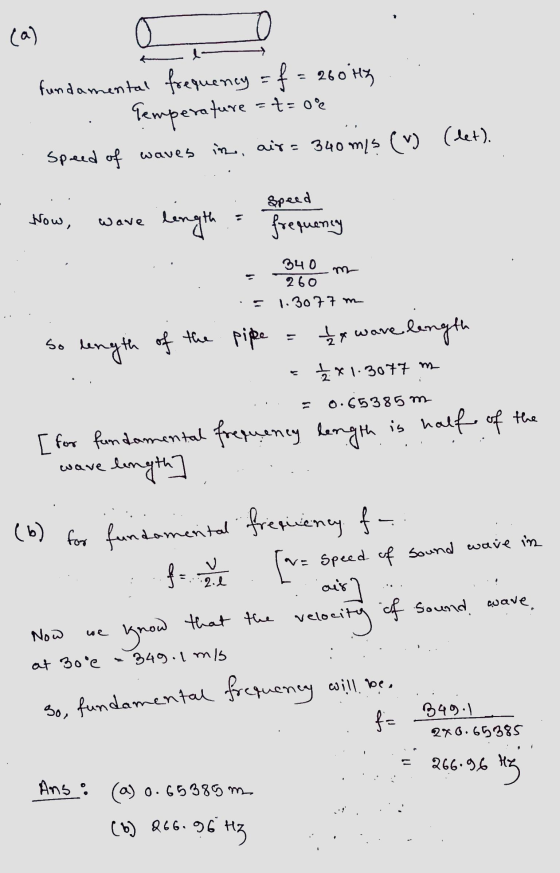
A pipe opens at both ends has a fundamental frequency of 260 Hz when the temperature is o degrees Celsius.
a) What is the length of the pipe?
b) What is the fundamental frequency at a temperature of 30 degrees Celsius?
Homework Answers
Add Answer to:
A pipe opens at both ends has a fundamental frequency of 260 Hz
when the temperature...
Organ pipe A with both ends open has a fundamental frequency of 320.0 Hz. The third...
Organ pipe A with both ends open has a fundamental frequency of 320.0 Hz. The third harmonic of organ pipe B with one end open has the same frequency as the second harmonic of pipe A. Assume a speed of sound of 343 m/s. What is the length of Pipe A? What is the length of Pipe B?
2B.5 An organ pipe open at both ends has a fundamental frequency of 440 Hz (concert...
 2B.5 An organ pipe open at both ends has a fundamental frequency of 440 Hz (concert A). What is the length of this pipe? What are the frequencies of its first three harmonics? 02B.6 An aroan nina
The fundamental frequency of a pipe that is open at both ends is 563 Hz ....
The fundamental frequency of a pipe that is open at both ends is 563 Hz . part a: How long is this pipe? Use v = 344 m/s. L = …….. m pat b: If one end is now closed, find the wavelength of the new fundamental. (lambda) = …… m part c: If one end is now closed, find the frequency of the new fundamental. f = ……. Hz
A certain organ pipe, open at both ends, produces a fundamental frequency of 297 Hz in...
 A certain organ pipe, open at both ends, produces a fundamental frequency of 297 Hz in air. Part A If the pipe is filled with helium at the same temperature, what fundamental frequency fHe will it produce? Take the molar mass of air to be 28.8 g/mol and the molar mass of helium to be 4.00 g/mol. Express your answer in hertz. V ALD O O ? file Submit Request Answer
Organ pipe A, with both ends open, has a fundamental frequency of 320 Hz. The third...
Organ pipe A, with both ends open, has a fundamental frequency of 320 Hz. The third harmonic of organ pipe B, with one end open, has the same frequency as the second harmonic of pipe A. a) How long are pipe A and b) pipe B? (take the speed of sound to be 343 m/s)
A certain organ pipe, open at both ends, produces a fundamental frequency of 271 Hz in...
A certain organ pipe, open at both ends, produces a fundamental frequency of 271 Hz in air. If the pipe is filled with helium at the same temperature, what fundamental frequency f He will it produce? Take the molar mass of air to be 28.8 g/mol and the molar mass of helium to be 4.00g/mol .
A certain organ pipe, open at both ends, produces a fundamental frequency of 297 Hz in...
A certain organ pipe, open at both ends, produces a fundamental frequency of 297 Hz in air. If the pipe is filled with helium at the same temperature, what fundamental frequency fHe will it produce? Take the molar mass of air to be 28.8 g/moland the molar mass of helium to be 4.00 g/mol .
A certain organ pipe, open at both ends, produces a fundamental frequency of 290 Hz in...
 A certain organ pipe, open at both ends, produces a fundamental frequency of 290 Hz in air. If the pipe is filled with helium at the same temperature, what fundamental frequency f_He will it produce? Take the molar mass of air to be 28.8 g/mol and the molar mass of helium to be 4.00 g/mol Express your answer in hertz. Now consider a pipe that is stopped (i.e., closed at one end) but still has a fundamental frequency of 290...
(a) What length of pipe open at both ends has a fundamental frequency of 3.75 102...
(a) What length of pipe open at both ends has a fundamental frequency of 3.75 102 Hz? Find the first overtone. lpipe = .457 Incorrect: m fovertone = 750 Correct: Hz (b) If the one end of this pipe is now closed, what is the new fundamental frequency? Find the first overtone. ffundamental = 750 Incorrect: Hz fovertone = 615 Incorrect: Hz (c) If the pipe is open at one end only, how many harmonics are possible in the normal...
Calculate the length of a pipe that has a fundamental frequency of 316 Hz. (Take the...
 Calculate the length of a pipe that has a fundamental frequency of
316 Hz. (Take the speed of sound in air to be 343 m/s.)
Calculate the length of a pipe that has a fundamental frequency of 316 Hz. (Take the speed of sound in air to be 343 m/s.) (a) Assume the pipe is closed at one end (b) Assume the pipe is open at both ends
Calculate the length of a pipe that has a fundamental frequency of
316 Hz. (Take the speed of sound in air to be 343 m/s.)
Calculate the length of a pipe that has a fundamental frequency of 316 Hz. (Take the speed of sound in air to be 343 m/s.) (a) Assume the pipe is closed at one end (b) Assume the pipe is open at both ends
 2B.5 An organ pipe open at both ends has a fundamental frequency of 440 Hz (concert A). What is the length of this pipe? What are the frequencies of its first three harmonics? 02B.6 An aroan nina
 A certain organ pipe, open at both ends, produces a fundamental frequency of 297 Hz in air. Part A If the pipe is filled with helium at the same temperature, what fundamental frequency fHe will it produce? Take the molar mass of air to be 28.8 g/mol and the molar mass of helium to be 4.00 g/mol. Express your answer in hertz. V ALD O O ? file Submit Request Answer
 A certain organ pipe, open at both ends, produces a fundamental frequency of 290 Hz in air. If the pipe is filled with helium at the same temperature, what fundamental frequency f_He will it produce? Take the molar mass of air to be 28.8 g/mol and the molar mass of helium to be 4.00 g/mol Express your answer in hertz. Now consider a pipe that is stopped (i.e., closed at one end) but still has a fundamental frequency of 290...
 Calculate the length of a pipe that has a fundamental frequency of
316 Hz. (Take the speed of sound in air to be 343 m/s.)
Calculate the length of a pipe that has a fundamental frequency of 316 Hz. (Take the speed of sound in air to be 343 m/s.) (a) Assume the pipe is closed at one end (b) Assume the pipe is open at both ends
Calculate the length of a pipe that has a fundamental frequency of
316 Hz. (Take the speed of sound in air to be 343 m/s.)
Calculate the length of a pipe that has a fundamental frequency of 316 Hz. (Take the speed of sound in air to be 343 m/s.) (a) Assume the pipe is closed at one end (b) Assume the pipe is open at both ends
Most questions answered within 3 hours.
-
Where is the error in this code sequence?
String s1 = "Hello";
String s2 = "ello";...
asked 10 months ago -
Financial data for Joel de Paris, Inc., for last year
follow:
Joel de Paris, Inc.
Balance...
asked 10 months ago -
Consider this reaction:
Al2(SO4)3 (aq)+ BaCl3
(aq) Al2Cl6 (aq)- +
3BaSO4(s) . What is the...
asked 10 months ago -
Suppose that Savneet is considering increasing her
recent random sample from 20 car rentals to 40...
asked 10 months ago -
Trucks arrive at an unloading terminal at an average rate of 120
per hour.
Trucks arrive...
asked 10 months ago -
Why are methanol and ethanol completely soluble in water while
octanol is not very little soluble....
asked 10 months ago -
A facilities manager at a university reads in a research report
that the mean amount of...
asked 10 months ago -
When the CuSO4 is rehydrated by adding water to the anhydrous
compound, is this an endothermic...
asked 10 months ago -
A ray of sunlight is passing from diamond into crown glass; the
angle of incidence is...
asked 10 months ago -
A block of mass 0.249 kg is placed on top of a light, vertical
spring of...
asked 10 months ago -
how do the kidneys compensate in the presences of acidosis
a) trigger hyperventilate
b) reserve acid...
asked 10 months ago -
Question 501 pts
The rental rate of capital to the firm increases. Which of the
following...
asked 10 months ago