
Homework Answers
Add Answer to:
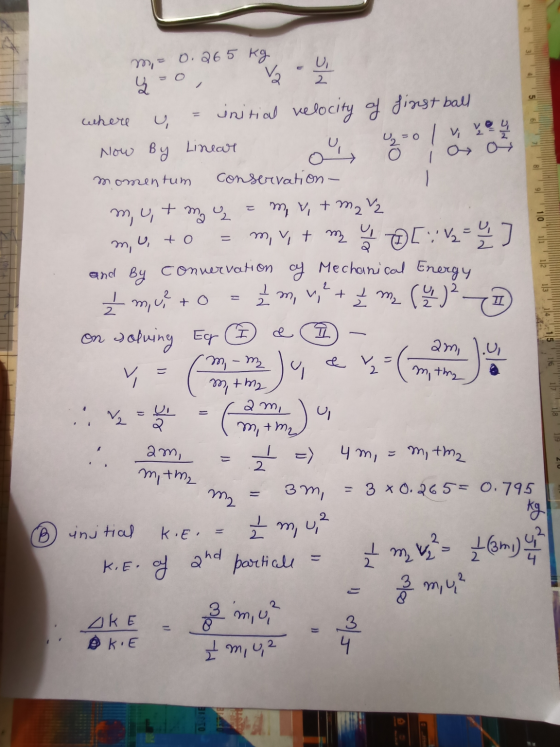
Problem 7.29 11 of 15 Constants A 0.265-kg ball makes an elastic head-on collision with a...
Constants|Periodic Table Part A A 0.265-kg croquet ball makes an elastic head-on collision with a second...
 Constants|Periodic Table Part A A 0.265-kg croquet ball makes an elastic head-on collision with a second ball initially at rest. The second ball moves off with half the original speed of the first ball. What is the mass of the second ball? m2 kg Submit Request Answer Part B What fraction of the original kinetic energy (AK/K) gets transferred to the second ball? AK/K- Submit Request Answer
can someone show all the alegbraic steps as well thanks (II) A 0.280-kg croquet ball makes...
 can someone show all the alegbraic steps as well thanks
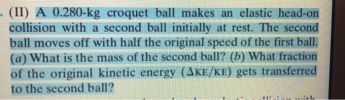
(II) A 0.280-kg croquet ball makes an elastic head-on collision with a second ball initially at rest. The second ball moves off with half the original speed of the first ball. (a) What is the mass of the second ball? (b) What fraction of the original kinetic energy (AKE/KE) gets transferred to the second ball? 11
can someone show all the alegbraic steps as well thanks
(II) A 0.280-kg croquet ball makes an elastic head-on collision with a second ball initially at rest. The second ball moves off with half the original speed of the first ball. (a) What is the mass of the second ball? (b) What fraction of the original kinetic energy (AKE/KE) gets transferred to the second ball? 11
A 0.060-kg tennis ball, moving with a speed of 5.0 m/s, has a head-on collision with...
 A 0.060-kg tennis ball, moving with a speed of 5.0 m/s, has a head-on collision with a 8.0x10⁻²-kg ball initially moving in the same direction at a speed of 2.4 m/s. Part A Assuming a perfectly elastic collision, determine the speed of each ball after the collision. Enter your answers numerically separated by a comma. Express your answers using two significant figures AZO tennis ball ball m/s Submit Request Answer Part B Determine the direction of tennis ball after the...
A 0.060-kg tennis ball, moving with a speed of 5.50 m/s , has a head-on collision...
A 0.060-kg tennis ball, moving with a speed of 5.50 m/s , has a head-on collision with a 0.080-kg ball initially moving in the same direction at a speed of 3.54 m/s . Assume that the collision is perfectly elastic. Part A Determine the speed of the 0.060-kg ball after the collision. Express your answer to two significant figures and include the appropriate units. Part A: Part A Determine the speed of the 0.060-kg ball after the collision. Express your...
A neutron in a reactor makes an elastic head on collision with the nucleus of an...
A neutron in a reactor makes an elastic head on collision with the nucleus of an atom initially at rest. Assume: The mass of the atomic nucleus is about 13.7 the mass of the neutron. a)What fraction of the neutron’s kinetic energy is transferred to the atomic nucleus? b)If the initial kinetic energy of the neutron is 1.93 × 10⁻¹³ J, find its final kinetic energy. Answer in units of J.
A 0.060-kg tennis ball, moving with a speed of 5.84 m/s , has a head-on collision...
A 0.060-kg tennis ball, moving with a speed of 5.84 m/s , has a head-on collision with a 0.090-kg ball initially moving in the same direction at a speed of 3.88 m/s . Assume that the collision is perfectly elastic. A. Determine the speed of the 0.060-kg ball after the collision. (Express the answer to two significant figures and include the appropriate units.) B. Determine the direction of the velocity of the 0.060-kg ball after the collision. C. Determine the...
Constants Periodi Ball 1, with a mass of 150 g and traveling at 15 m/s. collides...
 Constants Periodi Ball 1, with a mass of 150 g and traveling at 15 m/s. collides head on with ball 2, which has a mass of 340 g and is initially at rest. Part A What is the final velocity of the ball 1 If the collision is perfectly elastic? Express your answer in meters per second. ΟΙ ΑΣφ ? redo Submit Request Answer Part 8 What is the final velocity of the bal 2 the collision is perfectly elastic?...
A 0.060-kg tennis ball, moving with a speed of 5.3 m/s , has a head-on collision...
A 0.060-kg tennis ball, moving with a speed of 5.3 m/s , has a head-on collision with a 8.5×10⁻²-kg ball initially moving in the same direction at a speed of 3.1 m/s . Part A Assuming a perfectly elastic collision, determine the speed of each ball after the collision. Enter your answers numerically separated by a comma. Express your answers using two significant figures. v′tennis ball v t e n n i s b a l l ′ , v′ball...
A neutron in a nuclear reactor makes an elastic, head-on collision with the nucleus of a...
 A neutron in a nuclear reactor makes an elastic, head-on collision with the nucleus of a carbon atom initially at rest. (a) What fraction of the neutron's kinetic energy is transferred to the carbon nucleus? (The mass of the carbon nucleus is about 12.0 times the mass of the neutron.) (b) The initial kinetic energy of the neutron is 2.90 X 10^-13 J. Find its final kinetic energy and the kinetic energy of the carbon nucleus after the collision. neutron...
Billiard ball A of mass mA = 0.125 kg moving with speed vA = 2.80 m/s...
Billiard ball A of mass mA = 0.125 kg moving with speed vA = 2.80 m/s strikes ball B, initially at rest, of mass mB = 0.140 kg . As a result of the collision, ball A is deflected off at an angle of θ′A = 30.0∘ with a speed v′A = 2.10 m/s, and ball B moves with a speed v′B at an angle of θ′B to original direction of motion of ball A. Part C Solve these equations...
 Constants|Periodic Table Part A A 0.265-kg croquet ball makes an elastic head-on collision with a second ball initially at rest. The second ball moves off with half the original speed of the first ball. What is the mass of the second ball? m2 kg Submit Request Answer Part B What fraction of the original kinetic energy (AK/K) gets transferred to the second ball? AK/K- Submit Request Answer
 can someone show all the alegbraic steps as well thanks
(II) A 0.280-kg croquet ball makes an elastic head-on collision with a second ball initially at rest. The second ball moves off with half the original speed of the first ball. (a) What is the mass of the second ball? (b) What fraction of the original kinetic energy (AKE/KE) gets transferred to the second ball? 11
can someone show all the alegbraic steps as well thanks
(II) A 0.280-kg croquet ball makes an elastic head-on collision with a second ball initially at rest. The second ball moves off with half the original speed of the first ball. (a) What is the mass of the second ball? (b) What fraction of the original kinetic energy (AKE/KE) gets transferred to the second ball? 11
 A 0.060-kg tennis ball, moving with a speed of 5.0 m/s, has a head-on collision with a 8.0x10⁻²-kg ball initially moving in the same direction at a speed of 2.4 m/s. Part A Assuming a perfectly elastic collision, determine the speed of each ball after the collision. Enter your answers numerically separated by a comma. Express your answers using two significant figures AZO tennis ball ball m/s Submit Request Answer Part B Determine the direction of tennis ball after the...
 Constants Periodi Ball 1, with a mass of 150 g and traveling at 15 m/s. collides head on with ball 2, which has a mass of 340 g and is initially at rest. Part A What is the final velocity of the ball 1 If the collision is perfectly elastic? Express your answer in meters per second. ΟΙ ΑΣφ ? redo Submit Request Answer Part 8 What is the final velocity of the bal 2 the collision is perfectly elastic?...
 A neutron in a nuclear reactor makes an elastic, head-on collision with the nucleus of a carbon atom initially at rest. (a) What fraction of the neutron's kinetic energy is transferred to the carbon nucleus? (The mass of the carbon nucleus is about 12.0 times the mass of the neutron.) (b) The initial kinetic energy of the neutron is 2.90 X 10^-13 J. Find its final kinetic energy and the kinetic energy of the carbon nucleus after the collision. neutron...
Most questions answered within 3 hours.
-
Where is the error in this code sequence?
String s1 = "Hello";
String s2 = "ello";...
asked 11 months ago -
Financial data for Joel de Paris, Inc., for last year
follow:
Joel de Paris, Inc.
Balance...
asked 11 months ago -
Consider this reaction:
Al2(SO4)3 (aq)+ BaCl3
(aq) Al2Cl6 (aq)- +
3BaSO4(s) . What is the...
asked 11 months ago -
Suppose that Savneet is considering increasing her
recent random sample from 20 car rentals to 40...
asked 11 months ago -
Trucks arrive at an unloading terminal at an average rate of 120
per hour.
Trucks arrive...
asked 11 months ago -
Why are methanol and ethanol completely soluble in water while
octanol is not very little soluble....
asked 11 months ago -
A facilities manager at a university reads in a research report
that the mean amount of...
asked 11 months ago -
When the CuSO4 is rehydrated by adding water to the anhydrous
compound, is this an endothermic...
asked 11 months ago -
A ray of sunlight is passing from diamond into crown glass; the
angle of incidence is...
asked 11 months ago -
A block of mass 0.249 kg is placed on top of a light, vertical
spring of...
asked 11 months ago -
how do the kidneys compensate in the presences of acidosis
a) trigger hyperventilate
b) reserve acid...
asked 11 months ago -
Question 501 pts
The rental rate of capital to the firm increases. Which of the
following...
asked 11 months ago