Three charges are located along y-axis with first -77 C charge at origin, second -100 C...
Three charges are located along y-axis with first -77 C charge at origin, second -100 C charge 2m above origin and third +50 C charge 3m below origin.
(a) What is the magnitude and direction of force exerted by second charge on first charge,
(b) what is the magnitude and direction of force exerted by third charge on first charge,
(c) What is the net force on first charge?
(d) If the third charge is replaced by an imaginary test charge find the magnitude and direction of electric field at its location due to first and second charges
Homework Answers
Solution:
Let us name the charges as follows


The pictorial representation of the given problem is shown below
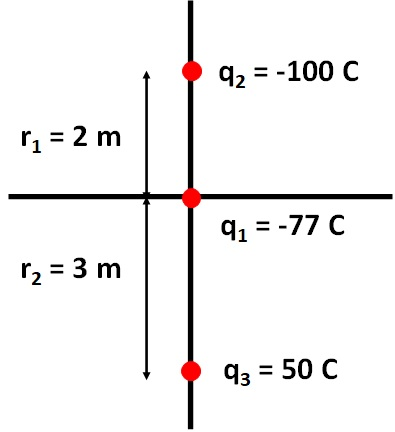

The force exerted by the charge  on
on  can be calculated as follows

Now, substitute the known values


As both
and
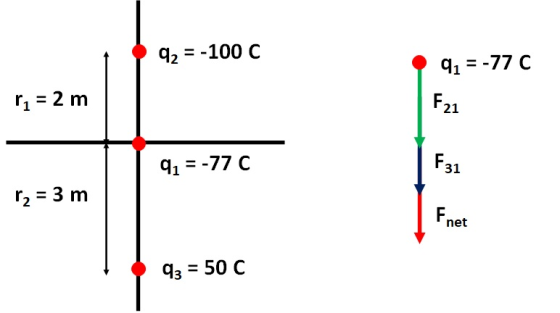
are of same charge this force move the charged away and its
direction is shown in below figure.

The force exerted by the charge  on
can be calculated as follows
on
can be calculated as follows
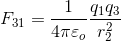
Now, substitute the known values


Here the negative sign indicates that the force attractive in nature and its direction is shown in above figure.

The net force on charge
due to other two charge can be calculated as follows
As both the foces are in same direction we can simply add them



Net force direction is shown in above figure

let us replace the charge
with a test charge 
The electric field due to the charge
on the test charge is
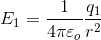
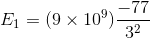

The direction of this field is shown in below figure

Now, we will calculate the field due to the charge
on the test charge is
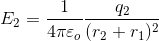

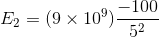

The direction of this field is shown in below figure
Therefore, the net field on the test charge is



The direction of the net field is shown in the above figure
Add Answer to:
Three charges are located along y-axis with first -77 C
charge at origin, second -100 C...
Three charges are located along y-axis with first -50 C charge at origin, second -100 C...
Three charges are located along y-axis with first -50 C charge at origin, second -100 C charge 2m above origin and third +50 C charge 3m below origin. (a) What is the magnitude and direction of force exerted by second charge on first charge, (b) what is the magnitude and direction of force exerted by third charge on first charge, (c) What is the net force on first charge? (d) If the third charge is replaced by an imaginary test...
Three charges are configured as shown. A 3.0 nC charge is located at the origin. A -5.0 nC charge is located at a point on the y axis 0.1 m from the origin.
 Problem 1 Charge Configuration Three charges are configured as shown. A 3.0 nC charge is located at the origin. A -5.0 nC charge is located at a point on the y axis 0.1 m from the origin. The third charge of 4 nC is located on the x axis at a distance of 0.3 m from the origin. a) What is the magnitude and direction of the electric field at the origin? b) What is the magnitude and direction of the force on...
Please show all work:) (a) Three point charges are placed along the y-axis, with charge ql...
 Please show all work:)
(a) Three point charges are placed along the y-axis, with charge ql -3 HC charge at (0,0,0) m, q2 --4-uC at (0,-4,0) m, and q3 -2 uC at (0,3,0) m. What is the net electrostatic force on q3? Answer:0.0045N0) (b) Two point charges are placed along the x-axis, with charge q 3 nC charge at (50,0,0) cm, and q2--4-nC at (0,0,0) cm. At what location along the x-axis, other than infinity, can another charge q3-2 nC...
Please show all work:)
(a) Three point charges are placed along the y-axis, with charge ql -3 HC charge at (0,0,0) m, q2 --4-uC at (0,-4,0) m, and q3 -2 uC at (0,3,0) m. What is the net electrostatic force on q3? Answer:0.0045N0) (b) Two point charges are placed along the x-axis, with charge q 3 nC charge at (50,0,0) cm, and q2--4-nC at (0,0,0) cm. At what location along the x-axis, other than infinity, can another charge q3-2 nC...
Two point charges are located on the y-axis as follows: one charge q1 = -1.50 nC...
Two point charges are located on the y-axis as follows: one charge q1 = -1.50 nC located at y= -0.560 m, and a second charge q2 = 3.60 nC at the origin (y=0). What is the magnitude of the total force exerted by these two charges on a third charge q3 = 4.85 nC located at y3 = -0.440 m? What is the direction of the total force?
Two point charges are located on the y-axis as follows: one charge q1q1q_1 = -1.00 nCnC...
Two point charges are located on the y-axis as follows: one charge q1q1q_1 = -1.00 nCnC located at y=y= -0.605 mm, and a second charge q2q2q_2 = 3.90 nCnC at the origin (y=0)(y=0). What is the magnitude of the total force exerted by these two charges on a third charge q3q3q_3 = 4.95 nCnC located at y3y3y_3 = -0.415 mm? What is the direction of the total force?
Two point charges are placed on the x-axis as follows: Charge q1= 3.90 nC is located...
Two point charges are placed on the x-axis as follows: Charge q1= 3.90 nC is located at x = 0.225m, and charge q2=4.75 nC is at x=-0.295 m. (a) What are the magnitude and direction of the net electric field exerted by these two charges on the origin? (b) What is the voltage (electrostatic potential) at the origin? (c) What is the magnitude and direction of the electrostatic force that acts on a negative point charge q3= -0.610 nC placed...
a) A 3.0 nC charge is located at (0,0). A second charge of 2.0 nC is...
a) A 3.0 nC charge is located at (0,0). A second charge of 2.0 nC is located at x = 5.0 m. At a point P on the y-axis determine the electric potential due to the other two charges. You are free to choose the location of this point along the y-axis. b) How much work is required to bring a third charge from infinity to this point P? You are free to choose the value of this third charge....
Two point charges are located on the y axis as follows: charge q1 = -1.60 nC...
Two point charges are located on the y axis as follows: charge q1 = -1.60 nC at y1 = -0.500 m , and charge q2 = 1.60 nC at the origin (y = 0). A) What is the magnitude of the net force exerted by these two charges on a third charge q3 = 9.00 nC located at y3 = -0.350 m? Fnet= ____ N B) What is the direction of the net force?
2. A charge 20 is located at the origin while a second charge -Qis located at...
 2. A charge 20 is located at the origin while a second charge -Qis located at x 3 cm. Where should a third charge tq be placed so that the net force on this third charge is zero? Start witha diagram, and you may wish to consult your lecture notes. You should be able to determine a single numerical value for x Two point charges are placed at the vertices of an equilateral triangle as shown. a. Find the net...
Question 2 (20 points) a) A 3.0 nC charge is located at (0,0). A second charge...
 Question 2 (20 points) a) A 3.0 nC charge is located at (0,0). A second charge of 2.0 nC is located at x = 5.0 m. At a point P on the y-axis determine the electric potential due to the other two charges. You are free to choose the location of this point along the y-axis. b) How much work is required to bring a third charge from infinity to this point P? You are free to choose the value...
 Please show all work:)
(a) Three point charges are placed along the y-axis, with charge ql -3 HC charge at (0,0,0) m, q2 --4-uC at (0,-4,0) m, and q3 -2 uC at (0,3,0) m. What is the net electrostatic force on q3? Answer:0.0045N0) (b) Two point charges are placed along the x-axis, with charge q 3 nC charge at (50,0,0) cm, and q2--4-nC at (0,0,0) cm. At what location along the x-axis, other than infinity, can another charge q3-2 nC...
Please show all work:)
(a) Three point charges are placed along the y-axis, with charge ql -3 HC charge at (0,0,0) m, q2 --4-uC at (0,-4,0) m, and q3 -2 uC at (0,3,0) m. What is the net electrostatic force on q3? Answer:0.0045N0) (b) Two point charges are placed along the x-axis, with charge q 3 nC charge at (50,0,0) cm, and q2--4-nC at (0,0,0) cm. At what location along the x-axis, other than infinity, can another charge q3-2 nC...
 2. A charge 20 is located at the origin while a second charge -Qis located at x 3 cm. Where should a third charge tq be placed so that the net force on this third charge is zero? Start witha diagram, and you may wish to consult your lecture notes. You should be able to determine a single numerical value for x Two point charges are placed at the vertices of an equilateral triangle as shown. a. Find the net...
 Question 2 (20 points) a) A 3.0 nC charge is located at (0,0). A second charge of 2.0 nC is located at x = 5.0 m. At a point P on the y-axis determine the electric potential due to the other two charges. You are free to choose the location of this point along the y-axis. b) How much work is required to bring a third charge from infinity to this point P? You are free to choose the value...
Most questions answered within 3 hours.
-
Where is the error in this code sequence?
String s1 = "Hello";
String s2 = "ello";...
asked 10 months ago -
Financial data for Joel de Paris, Inc., for last year
follow:
Joel de Paris, Inc.
Balance...
asked 10 months ago -
Consider this reaction:
Al2(SO4)3 (aq)+ BaCl3
(aq) Al2Cl6 (aq)- +
3BaSO4(s) . What is the...
asked 10 months ago -
Suppose that Savneet is considering increasing her
recent random sample from 20 car rentals to 40...
asked 10 months ago -
Trucks arrive at an unloading terminal at an average rate of 120
per hour.
Trucks arrive...
asked 10 months ago -
Why are methanol and ethanol completely soluble in water while
octanol is not very little soluble....
asked 10 months ago -
A facilities manager at a university reads in a research report
that the mean amount of...
asked 10 months ago -
When the CuSO4 is rehydrated by adding water to the anhydrous
compound, is this an endothermic...
asked 10 months ago -
A ray of sunlight is passing from diamond into crown glass; the
angle of incidence is...
asked 10 months ago -
A block of mass 0.249 kg is placed on top of a light, vertical
spring of...
asked 10 months ago -
how do the kidneys compensate in the presences of acidosis
a) trigger hyperventilate
b) reserve acid...
asked 10 months ago -
Question 501 pts
The rental rate of capital to the firm increases. Which of the
following...
asked 10 months ago