

Homework Answers
3-
For the reaction:
Mg(OH)2 (s)  Mg2+ (aq) + 2 OH- (aq)

![AG PIN [AGMg2+ + 2(AGOH-)] – [AGMg(OH)2)](http://img.homeworklib.com/questions/b554b8f0-ff0a-11ea-857c-479ff6f91d55.png?x-oss-process=image/resize,w_560)
![ᎪG. = [-Ꮞ54.8 + 2-157.2)] - [-833.9]Ꭻ }mol TIN](http://img.homeworklib.com/questions/b5a9e380-ff0a-11ea-b4bd-9f555d349ea8.png?x-oss-process=image/resize,w_560)
![AG = (-454.8 – 314.4] + 833.9 kJ/mol Tin](http://img.homeworklib.com/questions/b655f6b0-ff0a-11ea-ae8d-fd8869c1a3c6.png?x-oss-process=image/resize,w_560)


Now,

Here, 
R = 8.314 J/ mol.K
and T = 25'C = 25 +273 = 298 K
then, 




Now, for 

![\Delta H^{o}_{rxn} = [\Delta H^{o}_{Mg^{2+}} + 2 (\Delta H^{o}_{OH^{-}})] - [\Delta H^{o}_{Mg(OH)_{2})} ]](http://img.homeworklib.com/questions/ba7d0460-ff0a-11ea-9d30-5b17ed4f1823.png?x-oss-process=image/resize,w_560)
![\Delta H^{o}_{rxn} = [-466.9 + 2 (-230.0)] - [-924.7] kJ/mol](http://img.homeworklib.com/questions/bae12600-ff0a-11ea-9902-c32304b3c78b.png?x-oss-process=image/resize,w_560)
![\Delta H^{o}_{rxn} = [-466.9 -460] + 924.7\, kJ/mol](http://img.homeworklib.com/questions/bb548170-ff0a-11ea-93fd-ddfeefc7f4dd.png?x-oss-process=image/resize,w_560)


And,

![\Delta S^{o}_{rxn} = [S^{o}_{Mg^{2+}} + 2 (S^{o}_{OH^{-}})] - [S^{o}_{Mg(OH)_{2})} ]](http://img.homeworklib.com/questions/bce20010-ff0a-11ea-9c35-0d69e26b9e0b.png?x-oss-process=image/resize,w_560)
![\Delta S^{o}_{rxn} = [-138.1 + 2(-10.8)] - [63.1]](http://img.homeworklib.com/questions/bd38ad80-ff0a-11ea-b044-ffa69dc7b30e.png?x-oss-process=image/resize,w_560)
![\Delta S^{o}_{rxn} = [-138.1 -21.6] - [63.1]](http://img.homeworklib.com/questions/bda26e80-ff0a-11ea-b119-3feba1a02345.png?x-oss-process=image/resize,w_560)

Add Answer to:
2) Thermochemical data are given below (at T = 25.0 °C) and may be useful in...
2) Thermochemical data are given below (at T = 25.0 °C) and may be useful in...
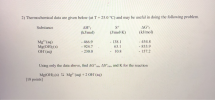 2) Thermochemical data are given below (at T = 25.0 °C) and may be useful in doing the following problem Substance ΔΗ, (kJ/mol) S° (J/mol K) AG° (kJ/mol) Mg? (aq) Mg(OH)2(5) OH(aq) 466.9 - 924.7 - 230.0 138.1 63.1 - 10.8 - 454.8 - 833.9 - 157.2 Using only the data above, find AG , ASºrun, and K for the reaction Mg(OH)2(8) S Mg(aq) + 2 OH(aq) [18 points)
2) Thermochemical data are given below (at T = 25.0 °C) and may be useful in...
 2) Thermochemical data are given below (at T = 25.0 °C) and may be useful in doing the following problem. Substance AHºf (kJ/mol) Sº (J/mol:K) AGⓇE (kJ/mol Mg? (aq) Mg(OH)2(s) OH(aq) - 466.9 - 924.7 - 230.0 - 138.1 63.1 - 10.8 - 454.8 - 833.9 - 157.2 Using only the data above, find AGºrx, AS° rxn, and K for the reaction Mg(OH)2(s) = Mg (aq) + 2 OH(aq) [18 points)
urgent 2) Thermochemical data are given below (at T = 25.0 °C) and may be useful...
 urgent
2) Thermochemical data are given below (at T = 25.0 °C) and may be useful in doing the following problem. Substance ΔΗ, (kJ/mol Sº (J/mol K) AG (kJ/mol) Mg?"(aq) Mg(OH)2(5) OH(aq) 466.9 924.7 230.0 138.1 63.1 10.8 -454.8 833.9 - 1572 Using only the data above, find AG rxn, AS man, and K for the reaction Mg(OH)2(8) = Mg?" (aq) + 2 OH(aq) [18 points)
urgent
2) Thermochemical data are given below (at T = 25.0 °C) and may be useful in doing the following problem. Substance ΔΗ, (kJ/mol Sº (J/mol K) AG (kJ/mol) Mg?"(aq) Mg(OH)2(5) OH(aq) 466.9 924.7 230.0 138.1 63.1 10.8 -454.8 833.9 - 1572 Using only the data above, find AG rxn, AS man, and K for the reaction Mg(OH)2(8) = Mg?" (aq) + 2 OH(aq) [18 points)
2) Thermochemical data are given below (at T = 25.0 °C) and may be useful in...
 2) Thermochemical data are given below (at T = 25.0 °C) and may be useful in doing the following p Substance AHºf (kJ/mol) So (J/mol·K) AG°f (kJ/mol Mg2+(aq) Mg(OH)2(s) OH(aq) - 466.9 - 924.7 - 230.0 - 138.1 63.1 - 10.8 - 454.8 - 833.9 - 157.2 Using only the data above, find AGºrxn, 4Sºn, and K for the reaction Mg(OH)2(s) – Mg2+(aq) + 2 OH(aq) [18 points)
2) Thermochemical data are given below (at T=25.0°C) and may be useful in doing the following...
 2) Thermochemical data are given below (at T=25.0°C) and may be useful in doing the following problem. Substance ΔΗ, AG (kJ/mol (J/mol K) (kJ/mol) Mg?"(aq) - 466.9 - 138.1 - 454,8 Mg(OH):(s) -924.7 63.1 - 833.9 - 230.0 . 10.8 - 1572 OH(aq) Using only the data above, find AG, AS ra, and K for the reaction Mg(OH):(8) Mg?" (aq) + 2 OH"(aq) [18 points)
Part 3. Problems 1) The molarity of naphthaline in a solution of naphthalene (CH. MW-128.8), a...
 Part 3. Problems 1) The molarity of naphthaline in a solution of naphthalene (CH. MW-128.8), a non-ionizing and nonvolatile solute, and benzene (C.HS, MW = 78.11), a volatile solvent, is [CHx] = 0.125 M. The density of the solution is D= 0.8781 g/cm! Find the following: a) The osmotic pressure exerted by the solution, at T = 25.0°C. Give your final answer in units of torr. [8 points] b) Xn, the mole fraction of naphthalene in the solution. [15 points)...
Using enthalpies of formation (Appendix C), calculate ΔH ° for the following reaction at 25°C. Also...
 Using enthalpies of formation
(Appendix C), calculate ΔH ° for the following reaction at 25°C.
Also calculate ΔS ° for this reaction from standard entropies at
25°C. Use these values to calculate ΔG ° for the reaction at this
temperature. COCl2(g) + H2O(l ) h CO2(g) + 2HCl(g).
Appendix C Thermodynamic Quantities for Substances and Ions at 25°C Substance or lon AH; (kW/mol) 0 AG: (kJ/mol) 0 S° (J/mol-K) 20.87 ΔΗ, (kJ/mol) -946.3 - 33422 AG; {kj/mol) --859,3 -2793 (J/mol-K)...
Using enthalpies of formation
(Appendix C), calculate ΔH ° for the following reaction at 25°C.
Also calculate ΔS ° for this reaction from standard entropies at
25°C. Use these values to calculate ΔG ° for the reaction at this
temperature. COCl2(g) + H2O(l ) h CO2(g) + 2HCl(g).
Appendix C Thermodynamic Quantities for Substances and Ions at 25°C Substance or lon AH; (kW/mol) 0 AG: (kJ/mol) 0 S° (J/mol-K) 20.87 ΔΗ, (kJ/mol) -946.3 - 33422 AG; {kj/mol) --859,3 -2793 (J/mol-K)...
Please help with solving Question 1 (A-C) Thank you! Unless otherwise specified in the problem, you...
 Please help with solving Question 1 (A-C) Thank you!
Unless otherwise specified in the problem, you may assume that all solutions are at 25°C. 1. 50.0 mL of a pH 6.00 carbonic acid buffer is titrated with 0.2857 M NaOH, requiring 17.47 mL to reach the second equivalence point. a. Calculate the molarity of carbonic acid and bicarbonate in the original buffer. Carbonic acid: Bicarbonate: b. Calculate the pH of the solution after a total of 100.0 mL of 0.2857...
Please help with solving Question 1 (A-C) Thank you!
Unless otherwise specified in the problem, you may assume that all solutions are at 25°C. 1. 50.0 mL of a pH 6.00 carbonic acid buffer is titrated with 0.2857 M NaOH, requiring 17.47 mL to reach the second equivalence point. a. Calculate the molarity of carbonic acid and bicarbonate in the original buffer. Carbonic acid: Bicarbonate: b. Calculate the pH of the solution after a total of 100.0 mL of 0.2857...
Calculate the standard free-energy change and the equilibrium constant Kc for the following reaction at 25°C....
 Calculate the standard free-energy change and the equilibrium constant Kc for the following reaction at 25°C. See Appendix C for data. Fe(s) + Cu2+ (aq) = Fe2+ (aq) + Cu(s) Find equilibrium constan + K at 25°C Appendix C Thermodynamic Quantities for Substances and Ions at 25°C Substance or lon AH; (kJ/mol) AG; (kJ/mol (J/mol-K) 20.87 Substance or lon Ba(OH),(s) ΔΗ: (kJ/mol) -946.3 --3342.2 AG (kJ/mol) -859.3 -2793 (J/mol K) 107.1 427 Ba(OH), 8H,O(s) BaSO (8) - 1473.2 -1362.3 132.2...
4. Only ideal processes can be thermodynamically "reversible." Why can rear proce y can real process...
 4. Only ideal processes can be thermodynamically "reversible." Why can rear proce y can real processes not be? 5. Consider the following reactions. (Note: if this were an exam we would give you an excerpt on tabular data from Appendix 4 (Table A4.3). 2Fe(s) + 3Cla(s) 2FeCl(s) N2H4(8) + H2(g) + 2NH3(g) (a) Would you expect the entropy change for the above reaction to be >0, <0, or no (small)? Justify your answer. (d) Would you expect the entropy change...
 2) Thermochemical data are given below (at T = 25.0 °C) and may be useful in doing the following problem Substance ΔΗ, (kJ/mol) S° (J/mol K) AG° (kJ/mol) Mg? (aq) Mg(OH)2(5) OH(aq) 466.9 - 924.7 - 230.0 138.1 63.1 - 10.8 - 454.8 - 833.9 - 157.2 Using only the data above, find AG , ASºrun, and K for the reaction Mg(OH)2(8) S Mg(aq) + 2 OH(aq) [18 points)
 2) Thermochemical data are given below (at T = 25.0 °C) and may be useful in doing the following problem. Substance AHºf (kJ/mol) Sº (J/mol:K) AGⓇE (kJ/mol Mg? (aq) Mg(OH)2(s) OH(aq) - 466.9 - 924.7 - 230.0 - 138.1 63.1 - 10.8 - 454.8 - 833.9 - 157.2 Using only the data above, find AGºrx, AS° rxn, and K for the reaction Mg(OH)2(s) = Mg (aq) + 2 OH(aq) [18 points)
 urgent
2) Thermochemical data are given below (at T = 25.0 °C) and may be useful in doing the following problem. Substance ΔΗ, (kJ/mol Sº (J/mol K) AG (kJ/mol) Mg?"(aq) Mg(OH)2(5) OH(aq) 466.9 924.7 230.0 138.1 63.1 10.8 -454.8 833.9 - 1572 Using only the data above, find AG rxn, AS man, and K for the reaction Mg(OH)2(8) = Mg?" (aq) + 2 OH(aq) [18 points)
urgent
2) Thermochemical data are given below (at T = 25.0 °C) and may be useful in doing the following problem. Substance ΔΗ, (kJ/mol Sº (J/mol K) AG (kJ/mol) Mg?"(aq) Mg(OH)2(5) OH(aq) 466.9 924.7 230.0 138.1 63.1 10.8 -454.8 833.9 - 1572 Using only the data above, find AG rxn, AS man, and K for the reaction Mg(OH)2(8) = Mg?" (aq) + 2 OH(aq) [18 points)
 2) Thermochemical data are given below (at T = 25.0 °C) and may be useful in doing the following p Substance AHºf (kJ/mol) So (J/mol·K) AG°f (kJ/mol Mg2+(aq) Mg(OH)2(s) OH(aq) - 466.9 - 924.7 - 230.0 - 138.1 63.1 - 10.8 - 454.8 - 833.9 - 157.2 Using only the data above, find AGºrxn, 4Sºn, and K for the reaction Mg(OH)2(s) – Mg2+(aq) + 2 OH(aq) [18 points)
 2) Thermochemical data are given below (at T=25.0°C) and may be useful in doing the following problem. Substance ΔΗ, AG (kJ/mol (J/mol K) (kJ/mol) Mg?"(aq) - 466.9 - 138.1 - 454,8 Mg(OH):(s) -924.7 63.1 - 833.9 - 230.0 . 10.8 - 1572 OH(aq) Using only the data above, find AG, AS ra, and K for the reaction Mg(OH):(8) Mg?" (aq) + 2 OH"(aq) [18 points)
 Part 3. Problems 1) The molarity of naphthaline in a solution of naphthalene (CH. MW-128.8), a non-ionizing and nonvolatile solute, and benzene (C.HS, MW = 78.11), a volatile solvent, is [CHx] = 0.125 M. The density of the solution is D= 0.8781 g/cm! Find the following: a) The osmotic pressure exerted by the solution, at T = 25.0°C. Give your final answer in units of torr. [8 points] b) Xn, the mole fraction of naphthalene in the solution. [15 points)...
 Using enthalpies of formation
(Appendix C), calculate ΔH ° for the following reaction at 25°C.
Also calculate ΔS ° for this reaction from standard entropies at
25°C. Use these values to calculate ΔG ° for the reaction at this
temperature. COCl2(g) + H2O(l ) h CO2(g) + 2HCl(g).
Appendix C Thermodynamic Quantities for Substances and Ions at 25°C Substance or lon AH; (kW/mol) 0 AG: (kJ/mol) 0 S° (J/mol-K) 20.87 ΔΗ, (kJ/mol) -946.3 - 33422 AG; {kj/mol) --859,3 -2793 (J/mol-K)...
Using enthalpies of formation
(Appendix C), calculate ΔH ° for the following reaction at 25°C.
Also calculate ΔS ° for this reaction from standard entropies at
25°C. Use these values to calculate ΔG ° for the reaction at this
temperature. COCl2(g) + H2O(l ) h CO2(g) + 2HCl(g).
Appendix C Thermodynamic Quantities for Substances and Ions at 25°C Substance or lon AH; (kW/mol) 0 AG: (kJ/mol) 0 S° (J/mol-K) 20.87 ΔΗ, (kJ/mol) -946.3 - 33422 AG; {kj/mol) --859,3 -2793 (J/mol-K)...
 Please help with solving Question 1 (A-C) Thank you!
Unless otherwise specified in the problem, you may assume that all solutions are at 25°C. 1. 50.0 mL of a pH 6.00 carbonic acid buffer is titrated with 0.2857 M NaOH, requiring 17.47 mL to reach the second equivalence point. a. Calculate the molarity of carbonic acid and bicarbonate in the original buffer. Carbonic acid: Bicarbonate: b. Calculate the pH of the solution after a total of 100.0 mL of 0.2857...
Please help with solving Question 1 (A-C) Thank you!
Unless otherwise specified in the problem, you may assume that all solutions are at 25°C. 1. 50.0 mL of a pH 6.00 carbonic acid buffer is titrated with 0.2857 M NaOH, requiring 17.47 mL to reach the second equivalence point. a. Calculate the molarity of carbonic acid and bicarbonate in the original buffer. Carbonic acid: Bicarbonate: b. Calculate the pH of the solution after a total of 100.0 mL of 0.2857...
 Calculate the standard free-energy change and the equilibrium constant Kc for the following reaction at 25°C. See Appendix C for data. Fe(s) + Cu2+ (aq) = Fe2+ (aq) + Cu(s) Find equilibrium constan + K at 25°C Appendix C Thermodynamic Quantities for Substances and Ions at 25°C Substance or lon AH; (kJ/mol) AG; (kJ/mol (J/mol-K) 20.87 Substance or lon Ba(OH),(s) ΔΗ: (kJ/mol) -946.3 --3342.2 AG (kJ/mol) -859.3 -2793 (J/mol K) 107.1 427 Ba(OH), 8H,O(s) BaSO (8) - 1473.2 -1362.3 132.2...
 4. Only ideal processes can be thermodynamically "reversible." Why can rear proce y can real processes not be? 5. Consider the following reactions. (Note: if this were an exam we would give you an excerpt on tabular data from Appendix 4 (Table A4.3). 2Fe(s) + 3Cla(s) 2FeCl(s) N2H4(8) + H2(g) + 2NH3(g) (a) Would you expect the entropy change for the above reaction to be >0, <0, or no (small)? Justify your answer. (d) Would you expect the entropy change...
Most questions answered within 3 hours.
-
Where is the error in this code sequence?
String s1 = "Hello";
String s2 = "ello";...
asked 10 months ago -
Financial data for Joel de Paris, Inc., for last year
follow:
Joel de Paris, Inc.
Balance...
asked 10 months ago -
Consider this reaction:
Al2(SO4)3 (aq)+ BaCl3
(aq) Al2Cl6 (aq)- +
3BaSO4(s) . What is the...
asked 10 months ago -
Suppose that Savneet is considering increasing her
recent random sample from 20 car rentals to 40...
asked 10 months ago -
Trucks arrive at an unloading terminal at an average rate of 120
per hour.
Trucks arrive...
asked 10 months ago -
Why are methanol and ethanol completely soluble in water while
octanol is not very little soluble....
asked 10 months ago -
A facilities manager at a university reads in a research report
that the mean amount of...
asked 10 months ago -
When the CuSO4 is rehydrated by adding water to the anhydrous
compound, is this an endothermic...
asked 10 months ago -
A ray of sunlight is passing from diamond into crown glass; the
angle of incidence is...
asked 10 months ago -
A block of mass 0.249 kg is placed on top of a light, vertical
spring of...
asked 10 months ago -
how do the kidneys compensate in the presences of acidosis
a) trigger hyperventilate
b) reserve acid...
asked 10 months ago -
Question 501 pts
The rental rate of capital to the firm increases. Which of the
following...
asked 10 months ago