
Homework Answers
Add Answer to:
Item 26 26 of 40 Constants Periodic Table (Please write down the known and the unknown...
Item 15 (Please write down the known and the unknown quantities, and the sum of all...
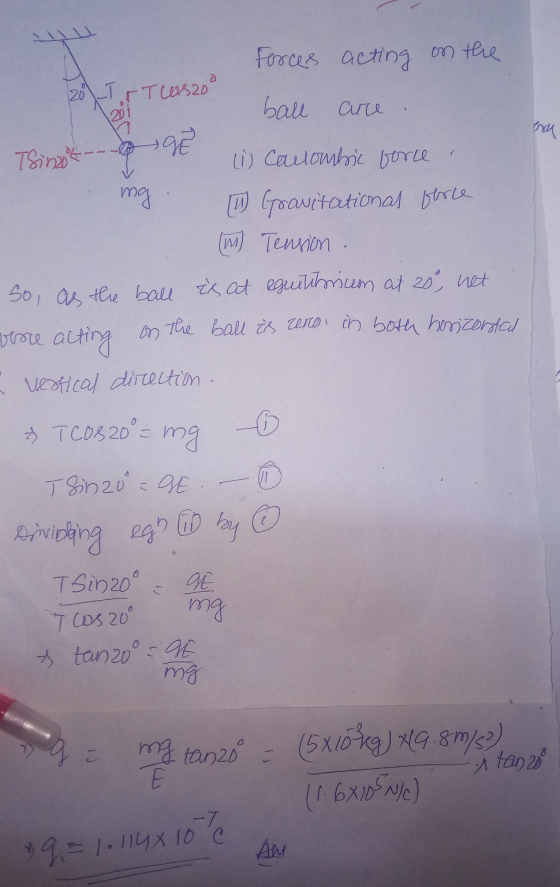
 Item 15 (Please write down the known and the unknown quantities, and the sum of all forces acting on the ball by using Newton's and law. Show all your work clearly on the scratch paper.) An electric field E = (2.0x10⁵ N/C, right) causes the 5.0 g ball in (Figure 1) to hang at a 20° angle. (g - 9.8 m/s2) Part A What is the charge on the ball? Express your answer in nanocoulombs. ΚΑΙ ΑΣΦ 9- Figure Submit...
An electric field E⃗ =( 1.3×10⁵ N/C , right ) causes the 5.0 g ball in...
 An electric field E⃗ =( 1.3×10⁵ N/C , right ) causes
the 5.0 g ball in (Figure 1) to hang at a 20∘ angle.
What is the charge on the ball?
I ReviewI Constants Periodic Table Part A An electric field E1.3x105 N/C, right) causes the 5.0 g ball in (Figure 1) to hang at a 20 angle What is the charge on the ball? Express your answer in nanocoulombs. Figure 1 of 1 nC Submit Previous Answers Request Answer...
An electric field E⃗ =( 1.3×10⁵ N/C , right ) causes
the 5.0 g ball in (Figure 1) to hang at a 20∘ angle.
What is the charge on the ball?
I ReviewI Constants Periodic Table Part A An electric field E1.3x105 N/C, right) causes the 5.0 g ball in (Figure 1) to hang at a 20 angle What is the charge on the ball? Express your answer in nanocoulombs. Figure 1 of 1 nC Submit Previous Answers Request Answer...
Part A Show all your work clearly on the scratch paper.) An electric field E =...
 Part A Show all your work clearly on the scratch paper.) An electric field E = ( 2.0x10⁵ N/C, right) causes the 5.0 g ball in (Figure 1) to hang at a 20° angle. (g = 9.8 m/s2) What is the charge on the ball? Express your answer in nanocoulombs. 10 AP ? 9- 89.2 nC Submit Request Answer gure < 1 of 1 Provide Feedback 20 Ë 9 5.08 Item 22 A capacitor consists of two 4.3-cm-diameter circular plates...
II Review | Constants | Periodic Table An electron with 1.9 eV of kinetic energy collides...
 II Review | Constants | Periodic Table An electron with 1.9 eV of kinetic energy collides with an atom whose energy-level diagram is shown in (Figure 1). Part A The electron kicks the atom into an excited state. What is the electron's kinetic energy after the collision? Express your answer in electron volts. Figure (< 1 of 1 ΑΣΦ n = 3 - E, = 4.0 eV Submit Request Answer n = 2- E, = 1.5 eV E, = 0.0...
A Review Constants Periodic Table Part A Air flows through the tube shown in (Figure 1)...
 A Review Constants Periodic Table Part A Air flows through the tube shown in (Figure 1) at a rate of 1100 cm/s. Assume that air is an ideal fluid. The density of mercury is 13600 kg/m3 and the density of air is 1.20 kg/m3 What is the height h of mercury in the right side of the U-tube? Suppose that di = 2.4 cm and d2 = 5.0 mm Express your answer with the appropriate units. Figure < 1 of...
please help... Constants Periodic Table Part A An alternative approach to bomb calorimetry is to establish...
 please help...
Constants Periodic Table Part A An alternative approach to bomb calorimetry is to establish the heat capacity of the calorimeter exclusive of the water it contains. The heat absorbed by the water and by the rest of the calorimeter must be calculated separately and then added together A1 148 g sample of benzoic acid is burned in excess O(g) in a bomb immersed in 1181 g of water. The temperature of the water rises from 2496 to 30.25...
please help...
Constants Periodic Table Part A An alternative approach to bomb calorimetry is to establish the heat capacity of the calorimeter exclusive of the water it contains. The heat absorbed by the water and by the rest of the calorimeter must be calculated separately and then added together A1 148 g sample of benzoic acid is burned in excess O(g) in a bomb immersed in 1181 g of water. The temperature of the water rises from 2496 to 30.25...
Problem 6.7 Correct Constants Periodic Table In each of the two free-body diagrams, the forces are...
 Problem 6.7 Correct Constants Periodic Table In each of the two free-body diagrams, the forces are acting on a 1.6 kg object Figure 1) (Figure 2) Part Find the value of ag, the a component of the acceleration in diagram (b). Express your answer to two significant figures and include the appropriat Figure < 1012 >) | a# # 1 Value Units 2.82 N Submit Previous Answers Request Answer 1 N 5 N 20° Incorrect; Try Again; 5 attempts remaining...
Review Constants Periodic Table A 180 g ball is dropped from a height of 2.4 m,...
 Review Constants Periodic Table A 180 g ball is dropped from a height of 2.4 m, bounces on a hard floor, and rebounds to a height of 1.9 m (Figure 1) shows the impulse received from the floor. Express your answer to two significant figures and include the appropriate units. 0 UA ? Figure < 1 of 1 Fas Value Units Submit Previous Answers Request Answer max X Incorrect; Try Again 0 1 (ms) Provide Feedback Next >
Constants| Periodic Table Part A In the figure the lower disk, of mass 430 g and...
 Constants| Periodic Table Part A In the figure the lower disk, of mass 430 g and radius 3.1 cm, is rotating at 180 rpm on a frictionless shaft of negligible radius. The upper disk, of mass 270 g and radius 2.5 cm, is initially not rotating. It drops freely down onto the lower disk, and frictional forces bring the two disks to a common rotational speed. (Figure 1) Find the final common frequency in rpm. Express your answer using two...
Exercise 13.36 with eText link 1 of 10 ㎜ Review 1 Constants Periodic Table Part A Refer to Figure 13.4 in the textbook to determine whether each of the given amounts of solid will completely d...
 Exercise 13.36 with eText link 1 of 10 ㎜ Review 1 Constants Periodic Table Part A Refer to Figure 13.4 in the textbook to determine whether each of the given amounts of solid will completely dissolve in the given amount of water at the indicated temperature. Check all that apply 15.0 g KCIO3ìn 115 g of water at 25°C 5o.0 g Pb(NO3)2 in 95.0 g of water at 10 C 45.0 g CaCl2 in 105 g of water at 5°C...
 Item 15 (Please write down the known and the unknown quantities, and the sum of all forces acting on the ball by using Newton's and law. Show all your work clearly on the scratch paper.) An electric field E = (2.0x10⁵ N/C, right) causes the 5.0 g ball in (Figure 1) to hang at a 20° angle. (g - 9.8 m/s2) Part A What is the charge on the ball? Express your answer in nanocoulombs. ΚΑΙ ΑΣΦ 9- Figure Submit...
 An electric field E⃗ =( 1.3×10⁵ N/C , right ) causes
the 5.0 g ball in (Figure 1) to hang at a 20∘ angle.
What is the charge on the ball?
I ReviewI Constants Periodic Table Part A An electric field E1.3x105 N/C, right) causes the 5.0 g ball in (Figure 1) to hang at a 20 angle What is the charge on the ball? Express your answer in nanocoulombs. Figure 1 of 1 nC Submit Previous Answers Request Answer...
An electric field E⃗ =( 1.3×10⁵ N/C , right ) causes
the 5.0 g ball in (Figure 1) to hang at a 20∘ angle.
What is the charge on the ball?
I ReviewI Constants Periodic Table Part A An electric field E1.3x105 N/C, right) causes the 5.0 g ball in (Figure 1) to hang at a 20 angle What is the charge on the ball? Express your answer in nanocoulombs. Figure 1 of 1 nC Submit Previous Answers Request Answer...
 Part A Show all your work clearly on the scratch paper.) An electric field E = ( 2.0x10⁵ N/C, right) causes the 5.0 g ball in (Figure 1) to hang at a 20° angle. (g = 9.8 m/s2) What is the charge on the ball? Express your answer in nanocoulombs. 10 AP ? 9- 89.2 nC Submit Request Answer gure < 1 of 1 Provide Feedback 20 Ë 9 5.08 Item 22 A capacitor consists of two 4.3-cm-diameter circular plates...
 II Review | Constants | Periodic Table An electron with 1.9 eV of kinetic energy collides with an atom whose energy-level diagram is shown in (Figure 1). Part A The electron kicks the atom into an excited state. What is the electron's kinetic energy after the collision? Express your answer in electron volts. Figure (< 1 of 1 ΑΣΦ n = 3 - E, = 4.0 eV Submit Request Answer n = 2- E, = 1.5 eV E, = 0.0...
 A Review Constants Periodic Table Part A Air flows through the tube shown in (Figure 1) at a rate of 1100 cm/s. Assume that air is an ideal fluid. The density of mercury is 13600 kg/m3 and the density of air is 1.20 kg/m3 What is the height h of mercury in the right side of the U-tube? Suppose that di = 2.4 cm and d2 = 5.0 mm Express your answer with the appropriate units. Figure < 1 of...
 please help...
Constants Periodic Table Part A An alternative approach to bomb calorimetry is to establish the heat capacity of the calorimeter exclusive of the water it contains. The heat absorbed by the water and by the rest of the calorimeter must be calculated separately and then added together A1 148 g sample of benzoic acid is burned in excess O(g) in a bomb immersed in 1181 g of water. The temperature of the water rises from 2496 to 30.25...
please help...
Constants Periodic Table Part A An alternative approach to bomb calorimetry is to establish the heat capacity of the calorimeter exclusive of the water it contains. The heat absorbed by the water and by the rest of the calorimeter must be calculated separately and then added together A1 148 g sample of benzoic acid is burned in excess O(g) in a bomb immersed in 1181 g of water. The temperature of the water rises from 2496 to 30.25...
 Problem 6.7 Correct Constants Periodic Table In each of the two free-body diagrams, the forces are acting on a 1.6 kg object Figure 1) (Figure 2) Part Find the value of ag, the a component of the acceleration in diagram (b). Express your answer to two significant figures and include the appropriat Figure < 1012 >) | a# # 1 Value Units 2.82 N Submit Previous Answers Request Answer 1 N 5 N 20° Incorrect; Try Again; 5 attempts remaining...
 Review Constants Periodic Table A 180 g ball is dropped from a height of 2.4 m, bounces on a hard floor, and rebounds to a height of 1.9 m (Figure 1) shows the impulse received from the floor. Express your answer to two significant figures and include the appropriate units. 0 UA ? Figure < 1 of 1 Fas Value Units Submit Previous Answers Request Answer max X Incorrect; Try Again 0 1 (ms) Provide Feedback Next >
 Constants| Periodic Table Part A In the figure the lower disk, of mass 430 g and radius 3.1 cm, is rotating at 180 rpm on a frictionless shaft of negligible radius. The upper disk, of mass 270 g and radius 2.5 cm, is initially not rotating. It drops freely down onto the lower disk, and frictional forces bring the two disks to a common rotational speed. (Figure 1) Find the final common frequency in rpm. Express your answer using two...
 Exercise 13.36 with eText link 1 of 10 ㎜ Review 1 Constants Periodic Table Part A Refer to Figure 13.4 in the textbook to determine whether each of the given amounts of solid will completely dissolve in the given amount of water at the indicated temperature. Check all that apply 15.0 g KCIO3ìn 115 g of water at 25°C 5o.0 g Pb(NO3)2 in 95.0 g of water at 10 C 45.0 g CaCl2 in 105 g of water at 5°C...
Most questions answered within 3 hours.
-
Where is the error in this code sequence?
String s1 = "Hello";
String s2 = "ello";...
asked 11 months ago -
Financial data for Joel de Paris, Inc., for last year
follow:
Joel de Paris, Inc.
Balance...
asked 11 months ago -
Consider this reaction:
Al2(SO4)3 (aq)+ BaCl3
(aq) Al2Cl6 (aq)- +
3BaSO4(s) . What is the...
asked 11 months ago -
Suppose that Savneet is considering increasing her
recent random sample from 20 car rentals to 40...
asked 11 months ago -
Trucks arrive at an unloading terminal at an average rate of 120
per hour.
Trucks arrive...
asked 11 months ago -
Why are methanol and ethanol completely soluble in water while
octanol is not very little soluble....
asked 11 months ago -
A facilities manager at a university reads in a research report
that the mean amount of...
asked 11 months ago -
When the CuSO4 is rehydrated by adding water to the anhydrous
compound, is this an endothermic...
asked 11 months ago -
A ray of sunlight is passing from diamond into crown glass; the
angle of incidence is...
asked 11 months ago -
A block of mass 0.249 kg is placed on top of a light, vertical
spring of...
asked 11 months ago -
how do the kidneys compensate in the presences of acidosis
a) trigger hyperventilate
b) reserve acid...
asked 11 months ago -
Question 501 pts
The rental rate of capital to the firm increases. Which of the
following...
asked 11 months ago