1.7 grams of benzoic acid dissolves in 1 liter of water at 0 degrees Celsius
56.3 grams of benzoic acids dissolves in 1 liter of water at 100 degrees Celsius
Homework Answers
Request Answer!
We need at least 10 more requests to produce the answer.
0 / 10 have requested this problem solution
The more requests, the faster the answer.
Add Answer to:
1.7 grams of benzoic acid dissolves in 1 liter of
water at 0 degrees Celsius
56.3...
Recrystallization Experiment Postlab Questions 1. Calculate the percent recovery of benzoic acid and aspirin. 2. What...
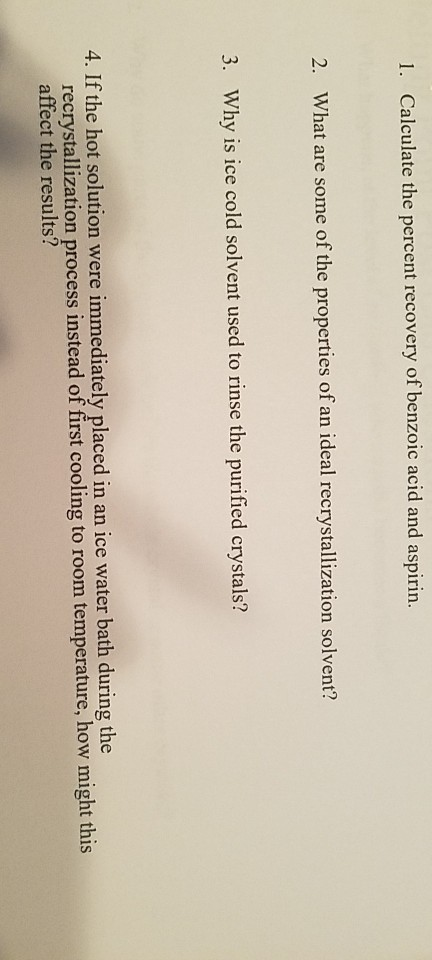
 Recrystallization Experiment Postlab Questions 1. Calculate the percent recovery of benzoic acid and aspirin. 2. What are some of the properties of an ideal recrystallization solvent? 3. Why is ice cold solvent used to rinse the purified crystals? 4. If the hot solution were immediately placed in an ice water bath during the recrystallization process instead of first cooling to room temperature, how might this affect the results?
12) Water was found to be a suitable solvent for recrystallization of benzoic acid. How should...
 12) Water was found to be a suitable solvent for recrystallization of benzoic acid. How should the solution of benzoic acid be prepared during the recrystallization? a. by dissolving the solid in a maximum volume of the boiling solvent b. by dissolving the solid in a minimum volume of the boiling solvent C. by adding 10 ml of hot solvent, in small portions to the solid and stirring until the solid dissolves x d. by adding 10 ml of the...
1. Can benzoic acid be recrystallized using Dichloromethane as a solvent instead of Water. Justify your...
1. Can benzoic acid be recrystallized using Dichloromethane as a solvent instead of Water. Justify your answer. 2. Benzoic acid purified using recrystallization melted at 10 oC less than its actual M.P. Is the sample pure? List possible errors that could have happened during the recrystallization. 3. Where in the IR spectrum of benzoic acid would you expect to find the C=O and C=C bond?
The solubility of benzoic acid in water is 68 g per 1 L at 95 °C...
 The solubility of benzoic acid in water is 68 g per 1 L at 95 °C and 1.7 g per 1 L at 0 °C. What is the minimum amount of water needed to recrystallize a 9.68 g sample of benzoic acid? How many grams of pure benzoic acid will be collected after crystallization is complete? How many grams of benzoic acid will remain in solution after the crystals are collected? (Show your work!)
1. Sodium bicarbonate (baking soda), NaHCO3, can be purified by dissolving it in hot water (60...
1. Sodium bicarbonate (baking soda), NaHCO3, can be purified by dissolving it in hot water (60 degrees Celsius), filtering to remove insoluble impurities, cooling it to 0 degrees Celsius to precipitate solid NaHCO3, and then filtering it to remove the solid, leaving soluble impurities in solution. Any NAHCO3 that remains in solution is not recovered. The solubility of NaHCO3 in hot water of 60 degrees Celsius is 164 g/L. Its solubility in cold water of 0 degrees Celsius is 69...
please answer all parts I am trying to check my answers. Recrystallization of Acetanilide Recrystallization is...
 please answer all parts I am trying to check my
answers.
Recrystallization of Acetanilide Recrystallization is an important method used by chemists to purify solid compounds. When a chemist conducts a chemical reaction as shown in Scheme 1, it will rarely go to 100% completion, and will frequently produce byproducts. These byproducts and some of the unreacted starting materials will be present in the end as impurities. Chemists need ways to remove these unwanted impurities so they can isolate their...
please answer all parts I am trying to check my
answers.
Recrystallization of Acetanilide Recrystallization is an important method used by chemists to purify solid compounds. When a chemist conducts a chemical reaction as shown in Scheme 1, it will rarely go to 100% completion, and will frequently produce byproducts. These byproducts and some of the unreacted starting materials will be present in the end as impurities. Chemists need ways to remove these unwanted impurities so they can isolate their...
Place 3.0 g of salicylic acid in a 125-ml Erlenmeyer flask. Carefully add, stirring constantly, 6...
 Place 3.0 g of salicylic acid in a 125-ml Erlenmeyer flask. Carefully add, stirring constantly, 6 mL of acetic anhydride, followed by 10 drops of concentrated sulfuric acid. Swirl the contents of the flask so that the reactants are thoroughly mixed. Stopper the flask with a one- hole cork fitted with an inverted Pasteur pipet to prevent condensation of water in the reaction flask during heating on the steam bath. Heat the flask in a boiling-water or steam bath for...
QUESTION: Write a flow scheme for the work-up. THE WORK UP:
 QUESTION:
Write a flow scheme for the work-up.
THE WORK UP:
C. Work-up (save all layers) and Isolation of Product MgBrCl Benzoic acid Transfer the mixture into a test tube. Rinse the beaker with about 3 mL of regular (not anhydrous) diethyl ether and pour the washings into the test tube. There should be two distinct layers in the test tube Remove the aqueous layer (to be discarded) and shake the ether layer with about 2 mL of 3 M...
QUESTION:
Write a flow scheme for the work-up.
THE WORK UP:
C. Work-up (save all layers) and Isolation of Product MgBrCl Benzoic acid Transfer the mixture into a test tube. Rinse the beaker with about 3 mL of regular (not anhydrous) diethyl ether and pour the washings into the test tube. There should be two distinct layers in the test tube Remove the aqueous layer (to be discarded) and shake the ether layer with about 2 mL of 3 M...
Write out your separation scheme for this experiment. 1. Heat 75 mL of water to 90...
Write out your separation scheme for this experiment. 1. Heat 75 mL of water to 90 °C in a 250-mL beaker. 2. While the water is being heated, place 250 mg of salicylic acid, 1 drop of 85% phosphoric acid and 0.5 mL of acetic anhydride in a test tube. Add a boiling chip to the mixture and gently shake it in order to mix the reactants. 3. Heat the tube in the beaker of water at 85 - 90...
What are the desirable characteristics of a solvent to be used in the recrystallisation of a...
 What are the desirable characteristics of a solvent to be used
in the recrystallisation of a solid product? (Hint: what is the
underlying purpose of doing recrystallisation, aside from making
the product look attractive?)
EXPERIMENT5 PREPARATION OF BENZOIC ACID Oxidation of a Primary Alcohol In this experiment, a primary alcohol (benzyl alcohol) is oxidised to a carboxylic acid (benzoic acid) by a strong oxidising agent (potassium permanganate) Because the synthesis reaction is carried out in basic conditions, the carboxylic acid...
What are the desirable characteristics of a solvent to be used
in the recrystallisation of a solid product? (Hint: what is the
underlying purpose of doing recrystallisation, aside from making
the product look attractive?)
EXPERIMENT5 PREPARATION OF BENZOIC ACID Oxidation of a Primary Alcohol In this experiment, a primary alcohol (benzyl alcohol) is oxidised to a carboxylic acid (benzoic acid) by a strong oxidising agent (potassium permanganate) Because the synthesis reaction is carried out in basic conditions, the carboxylic acid...
 Recrystallization Experiment Postlab Questions 1. Calculate the percent recovery of benzoic acid and aspirin. 2. What are some of the properties of an ideal recrystallization solvent? 3. Why is ice cold solvent used to rinse the purified crystals? 4. If the hot solution were immediately placed in an ice water bath during the recrystallization process instead of first cooling to room temperature, how might this affect the results?
 12) Water was found to be a suitable solvent for recrystallization of benzoic acid. How should the solution of benzoic acid be prepared during the recrystallization? a. by dissolving the solid in a maximum volume of the boiling solvent b. by dissolving the solid in a minimum volume of the boiling solvent C. by adding 10 ml of hot solvent, in small portions to the solid and stirring until the solid dissolves x d. by adding 10 ml of the...
 The solubility of benzoic acid in water is 68 g per 1 L at 95 °C and 1.7 g per 1 L at 0 °C. What is the minimum amount of water needed to recrystallize a 9.68 g sample of benzoic acid? How many grams of pure benzoic acid will be collected after crystallization is complete? How many grams of benzoic acid will remain in solution after the crystals are collected? (Show your work!)
 please answer all parts I am trying to check my
answers.
Recrystallization of Acetanilide Recrystallization is an important method used by chemists to purify solid compounds. When a chemist conducts a chemical reaction as shown in Scheme 1, it will rarely go to 100% completion, and will frequently produce byproducts. These byproducts and some of the unreacted starting materials will be present in the end as impurities. Chemists need ways to remove these unwanted impurities so they can isolate their...
please answer all parts I am trying to check my
answers.
Recrystallization of Acetanilide Recrystallization is an important method used by chemists to purify solid compounds. When a chemist conducts a chemical reaction as shown in Scheme 1, it will rarely go to 100% completion, and will frequently produce byproducts. These byproducts and some of the unreacted starting materials will be present in the end as impurities. Chemists need ways to remove these unwanted impurities so they can isolate their...
 Place 3.0 g of salicylic acid in a 125-ml Erlenmeyer flask. Carefully add, stirring constantly, 6 mL of acetic anhydride, followed by 10 drops of concentrated sulfuric acid. Swirl the contents of the flask so that the reactants are thoroughly mixed. Stopper the flask with a one- hole cork fitted with an inverted Pasteur pipet to prevent condensation of water in the reaction flask during heating on the steam bath. Heat the flask in a boiling-water or steam bath for...
 QUESTION:
Write a flow scheme for the work-up.
THE WORK UP:
C. Work-up (save all layers) and Isolation of Product MgBrCl Benzoic acid Transfer the mixture into a test tube. Rinse the beaker with about 3 mL of regular (not anhydrous) diethyl ether and pour the washings into the test tube. There should be two distinct layers in the test tube Remove the aqueous layer (to be discarded) and shake the ether layer with about 2 mL of 3 M...
QUESTION:
Write a flow scheme for the work-up.
THE WORK UP:
C. Work-up (save all layers) and Isolation of Product MgBrCl Benzoic acid Transfer the mixture into a test tube. Rinse the beaker with about 3 mL of regular (not anhydrous) diethyl ether and pour the washings into the test tube. There should be two distinct layers in the test tube Remove the aqueous layer (to be discarded) and shake the ether layer with about 2 mL of 3 M...
 What are the desirable characteristics of a solvent to be used
in the recrystallisation of a solid product? (Hint: what is the
underlying purpose of doing recrystallisation, aside from making
the product look attractive?)
EXPERIMENT5 PREPARATION OF BENZOIC ACID Oxidation of a Primary Alcohol In this experiment, a primary alcohol (benzyl alcohol) is oxidised to a carboxylic acid (benzoic acid) by a strong oxidising agent (potassium permanganate) Because the synthesis reaction is carried out in basic conditions, the carboxylic acid...
What are the desirable characteristics of a solvent to be used
in the recrystallisation of a solid product? (Hint: what is the
underlying purpose of doing recrystallisation, aside from making
the product look attractive?)
EXPERIMENT5 PREPARATION OF BENZOIC ACID Oxidation of a Primary Alcohol In this experiment, a primary alcohol (benzyl alcohol) is oxidised to a carboxylic acid (benzoic acid) by a strong oxidising agent (potassium permanganate) Because the synthesis reaction is carried out in basic conditions, the carboxylic acid...
Most questions answered within 3 hours.
-
Where is the error in this code sequence?
String s1 = "Hello";
String s2 = "ello";...
asked 11 months ago -
Financial data for Joel de Paris, Inc., for last year
follow:
Joel de Paris, Inc.
Balance...
asked 11 months ago -
Consider this reaction:
Al2(SO4)3 (aq)+ BaCl3
(aq) Al2Cl6 (aq)- +
3BaSO4(s) . What is the...
asked 11 months ago -
Suppose that Savneet is considering increasing her
recent random sample from 20 car rentals to 40...
asked 11 months ago -
Trucks arrive at an unloading terminal at an average rate of 120
per hour.
Trucks arrive...
asked 11 months ago -
Why are methanol and ethanol completely soluble in water while
octanol is not very little soluble....
asked 11 months ago -
A facilities manager at a university reads in a research report
that the mean amount of...
asked 11 months ago -
When the CuSO4 is rehydrated by adding water to the anhydrous
compound, is this an endothermic...
asked 11 months ago -
A ray of sunlight is passing from diamond into crown glass; the
angle of incidence is...
asked 11 months ago -
A block of mass 0.249 kg is placed on top of a light, vertical
spring of...
asked 11 months ago -
how do the kidneys compensate in the presences of acidosis
a) trigger hyperventilate
b) reserve acid...
asked 11 months ago -
Question 501 pts
The rental rate of capital to the firm increases. Which of the
following...
asked 11 months ago