An experiment to absorb methane gas at 373 K. By using activated carbon. The information is...
An experiment to absorb methane gas at 373 K.
By using activated carbon. The information is shown.
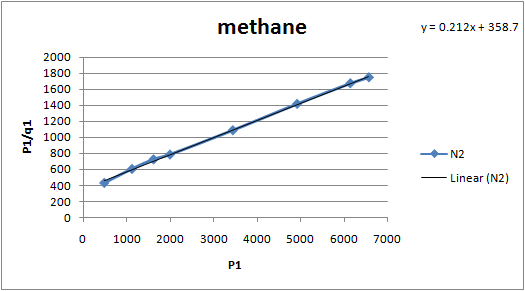
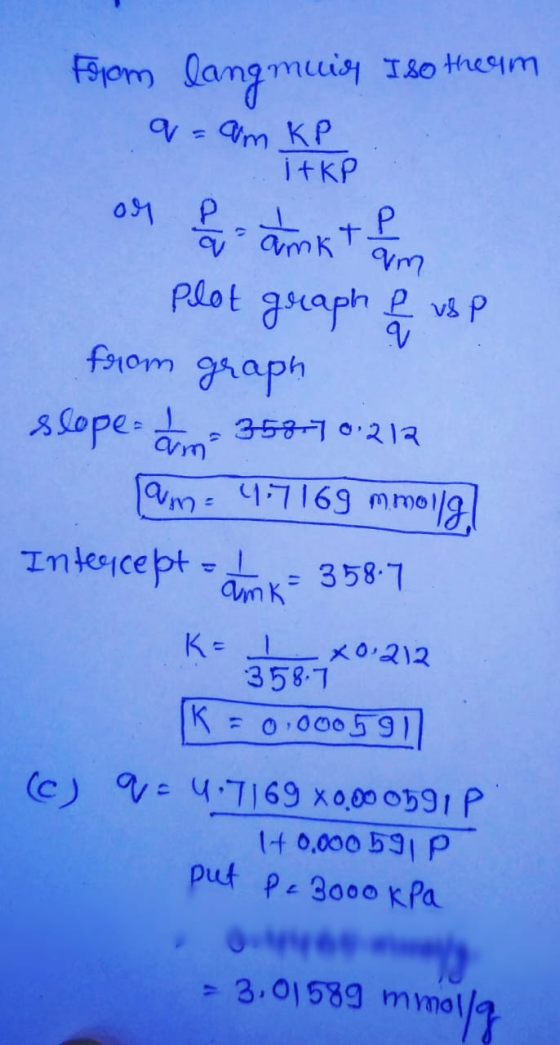
In the table, plot the graph using Langmuir.
isotherm and find the following information
p (kPa) 482.6290 1123.8361 1620.2545 1999.4630 3447.3501 4929.7104 6156.9673 6584.4385
q(mmol/g) 1.1153 1.8515 2.2307 2.5430 3.1676 3.4799 3.6806 3.7699
find
a) qm
b) K
c) q at a pressure of 3000 kPa
Homework Answers
| P1 | q1 | P1/q1 | |
| 482.629 | 1.1153 | 432.7346902 | |
| 1123.8361 | 1.8515 | 606.9868215 | |
| 1620.2545 | 2.2307 | 726.3435245 | |
| 1999.463 | 2.543 | 786.2615022 | |
| 3447.3501 | 3.1676 | 1088.316107 | |
| 4929.7104 | 3.4799 | 1416.624156 | |
| 6156.9673 | 3.6806 | 1672.816198 | |
| 6584.4385 | 3.7699 | 1746.58174 | |
Add Answer to:
An experiment to absorb methane gas at 373 K.
By using activated carbon. The information is...
1. An adsorption experiment was performed in which various amount of powder activated carbon PAC) was...
 1. An adsorption experiment was performed in which various amount of powder activated carbon PAC) was placed in 12 vials with 20ml of phenol solution at concentration of 100 mg L. The mixture was agitated for 24 hours and then the equilibrium phenol concentration C was determined for each vial by HPLC listed as follow Mass of PAC in Vial # Cc (mg L) 92.46 1.3 4.8 12.1 12.2 20.3 20.5 54.4 54.5 8.8 79.0 77.07 6.81 46.77 46.53 27.54...
A system consists of 2.320 g of carbon monoxide gas initially at temperature 400.0 K and...
 A system consists of 2.320 g of carbon monoxide gas initially at temperature 400.0 K and pressure 0.6250 bar. Assume the heat capacity of carbon monoxide is constant at the value found for 298.15 K in the data tables of the Appendix (see also Figure 2.8). The system undergoes the following cyclic process: Step a) Reversible isothermal expansion to double the initial volume. Step b) Constant volume extraction of heat from the system (to a temperature and pressure consistent with...
The combustion of methane (CH4) at 298.0 K produces carbon dioxide gas (CO2) and liquid water....
The combustion of methane (CH4) at 298.0 K produces carbon dioxide gas (CO2) and liquid water. A constant volume vessel of volume V = 0.807 L is loaded with 1.000 mole of each methane and oxygen. Find the total pressure in bar after the reaction has taken place at 298 K. Use an ICE box, and for now you may assume the reaction goes to completion at 298 K
8. A experiment is performed on an isolated gas. During the experiment, the gas pressure of...
 8. A experiment is performed on an isolated gas. During the experiment, the gas pressure of an isolated gas in a constant volume flask (V=0.500L) was measured using a gas pressure sensor as the temperature of the gas was varied. The pressure vs volume for the graph for the experiment is shown below, as well as the corresponding curve fit generated. NOTE: The gas temperature inside the syringe was a constant 22.5°C during this experiment. i. Express value of the...
Show all your work 14. A gas laws experiment was conducted in the physics lab. During this experiment, the gas pres...
 Show all your work
14. A gas laws experiment was conducted in the physics lab. During this experiment, the gas pressure of an isolated gas in an adjustable syringe was measured using a gas pressure sensor as the volume of the syringe was varied. The pressure vs volume for the graph for the experiment is shown below, as well as the corresponding curve fit generated. NOTE: The gas temperature was a constant 23.5°C during this experiment Express value of the...
Show all your work
14. A gas laws experiment was conducted in the physics lab. During this experiment, the gas pressure of an isolated gas in an adjustable syringe was measured using a gas pressure sensor as the volume of the syringe was varied. The pressure vs volume for the graph for the experiment is shown below, as well as the corresponding curve fit generated. NOTE: The gas temperature was a constant 23.5°C during this experiment Express value of the...
A heat engine using a monatomic gas follows the cycle shown in the pV diagram. P11...
 A heat engine using a monatomic gas follows the cycle shown in the pV diagram. P11 The gas starts out at point 1 with a volume of V1 = 318 cm", a pressure of p1 = 147 kPa, and a temperature of 317 K. The gas is held at a constant volume while it is heated until its temperature reaches 455 K (point 2). The gas is then allowed to expand adiabatically until its pressure is again 147 kPa (point...
Problem 1 N molecules of carbon dioxide gas Co, (considered as an ideal gas) undergo the...
 Problem 1 N molecules of carbon dioxide gas Co, (considered as an ideal gas) undergo the cycle shown in the P-V diagram on the right. As a reminder, a CO, molecule has all atoms on a line. Assume that all processes are quasistatic and that the temperature remains such that rotational degrees of freedom are activated, but vibrational degrees of freedom are frozen out. Capital letters A, B, C represent the states at the corners of the cycle, while lowercase...
A 17.0-L tank of carbon dioxide gas (CO2) is at a pressure of 9.40 ✕ 105...
A 17.0-L tank of carbon dioxide gas (CO2) is at a pressure of 9.40 ✕ 105 Pa and temperature of 23.0°C. (a) Calculate the temperature of the gas in Kelvin. (b) Use the ideal gas law to calculate the number of moles of gas in the tank. mol (c) Use the periodic table to compute the molecular weight of carbon dioxide, expressing it in grams per mole. g/mol (d) Obtain the number of grams of carbon dioxide in the tank. (g) (e)...
2. Isochoric/Adiabatic/Isobaric Cycle (10 pts) A heat engine using a monatomic gas follows the cycle shown in the PV diagram to the right. Between stages 1 and 2 the gas is at a constant volume,...
 2. Isochoric/Adiabatic/Isobaric Cycle (10 pts) A heat engine using a monatomic gas follows the cycle shown in the PV diagram to the right. Between stages 1 and 2 the gas is at a constant volume, and between 2 and 3 no heat is transferred in or out, between 3 and 1 the pressure is held constant (a) For each stage of this process, calculate in Joules the heat, Q, transferred to the gas, and the work, W, done by the...
To absorb CH4 contained in nitrogen by using liquid ammonia. The inlet gas speed is 100...
 To absorb CH4 contained in nitrogen by using liquid ammonia. The
inlet gas speed is 100 kmol/h, and the mole fraction of CH4 is
0.2%. It is intended to eliminate 98% of CH4 entering by using pure
liquid ammonia as an absorbent. The absorption process operates at
253.2 K, 175 atm, where the equilibrium information of methane is
yCH4 = 20 × xCH4. The total flow rate of gases and liquids is
assumed to be constant within the absorption tower,...
To absorb CH4 contained in nitrogen by using liquid ammonia. The
inlet gas speed is 100 kmol/h, and the mole fraction of CH4 is
0.2%. It is intended to eliminate 98% of CH4 entering by using pure
liquid ammonia as an absorbent. The absorption process operates at
253.2 K, 175 atm, where the equilibrium information of methane is
yCH4 = 20 × xCH4. The total flow rate of gases and liquids is
assumed to be constant within the absorption tower,...
 1. An adsorption experiment was performed in which various amount of powder activated carbon PAC) was placed in 12 vials with 20ml of phenol solution at concentration of 100 mg L. The mixture was agitated for 24 hours and then the equilibrium phenol concentration C was determined for each vial by HPLC listed as follow Mass of PAC in Vial # Cc (mg L) 92.46 1.3 4.8 12.1 12.2 20.3 20.5 54.4 54.5 8.8 79.0 77.07 6.81 46.77 46.53 27.54...
 A system consists of 2.320 g of carbon monoxide gas initially at temperature 400.0 K and pressure 0.6250 bar. Assume the heat capacity of carbon monoxide is constant at the value found for 298.15 K in the data tables of the Appendix (see also Figure 2.8). The system undergoes the following cyclic process: Step a) Reversible isothermal expansion to double the initial volume. Step b) Constant volume extraction of heat from the system (to a temperature and pressure consistent with...
 8. A experiment is performed on an isolated gas. During the experiment, the gas pressure of an isolated gas in a constant volume flask (V=0.500L) was measured using a gas pressure sensor as the temperature of the gas was varied. The pressure vs volume for the graph for the experiment is shown below, as well as the corresponding curve fit generated. NOTE: The gas temperature inside the syringe was a constant 22.5°C during this experiment. i. Express value of the...
 Show all your work
14. A gas laws experiment was conducted in the physics lab. During this experiment, the gas pressure of an isolated gas in an adjustable syringe was measured using a gas pressure sensor as the volume of the syringe was varied. The pressure vs volume for the graph for the experiment is shown below, as well as the corresponding curve fit generated. NOTE: The gas temperature was a constant 23.5°C during this experiment Express value of the...
Show all your work
14. A gas laws experiment was conducted in the physics lab. During this experiment, the gas pressure of an isolated gas in an adjustable syringe was measured using a gas pressure sensor as the volume of the syringe was varied. The pressure vs volume for the graph for the experiment is shown below, as well as the corresponding curve fit generated. NOTE: The gas temperature was a constant 23.5°C during this experiment Express value of the...
 A heat engine using a monatomic gas follows the cycle shown in the pV diagram. P11 The gas starts out at point 1 with a volume of V1 = 318 cm", a pressure of p1 = 147 kPa, and a temperature of 317 K. The gas is held at a constant volume while it is heated until its temperature reaches 455 K (point 2). The gas is then allowed to expand adiabatically until its pressure is again 147 kPa (point...
 Problem 1 N molecules of carbon dioxide gas Co, (considered as an ideal gas) undergo the cycle shown in the P-V diagram on the right. As a reminder, a CO, molecule has all atoms on a line. Assume that all processes are quasistatic and that the temperature remains such that rotational degrees of freedom are activated, but vibrational degrees of freedom are frozen out. Capital letters A, B, C represent the states at the corners of the cycle, while lowercase...
 2. Isochoric/Adiabatic/Isobaric Cycle (10 pts) A heat engine using a monatomic gas follows the cycle shown in the PV diagram to the right. Between stages 1 and 2 the gas is at a constant volume, and between 2 and 3 no heat is transferred in or out, between 3 and 1 the pressure is held constant (a) For each stage of this process, calculate in Joules the heat, Q, transferred to the gas, and the work, W, done by the...
 To absorb CH4 contained in nitrogen by using liquid ammonia. The
inlet gas speed is 100 kmol/h, and the mole fraction of CH4 is
0.2%. It is intended to eliminate 98% of CH4 entering by using pure
liquid ammonia as an absorbent. The absorption process operates at
253.2 K, 175 atm, where the equilibrium information of methane is
yCH4 = 20 × xCH4. The total flow rate of gases and liquids is
assumed to be constant within the absorption tower,...
To absorb CH4 contained in nitrogen by using liquid ammonia. The
inlet gas speed is 100 kmol/h, and the mole fraction of CH4 is
0.2%. It is intended to eliminate 98% of CH4 entering by using pure
liquid ammonia as an absorbent. The absorption process operates at
253.2 K, 175 atm, where the equilibrium information of methane is
yCH4 = 20 × xCH4. The total flow rate of gases and liquids is
assumed to be constant within the absorption tower,...
Most questions answered within 3 hours.
-
Where is the error in this code sequence?
String s1 = "Hello";
String s2 = "ello";...
asked 10 months ago -
Financial data for Joel de Paris, Inc., for last year
follow:
Joel de Paris, Inc.
Balance...
asked 10 months ago -
Consider this reaction:
Al2(SO4)3 (aq)+ BaCl3
(aq) Al2Cl6 (aq)- +
3BaSO4(s) . What is the...
asked 10 months ago -
Suppose that Savneet is considering increasing her
recent random sample from 20 car rentals to 40...
asked 10 months ago -
Trucks arrive at an unloading terminal at an average rate of 120
per hour.
Trucks arrive...
asked 10 months ago -
Why are methanol and ethanol completely soluble in water while
octanol is not very little soluble....
asked 10 months ago -
A facilities manager at a university reads in a research report
that the mean amount of...
asked 10 months ago -
When the CuSO4 is rehydrated by adding water to the anhydrous
compound, is this an endothermic...
asked 10 months ago -
A ray of sunlight is passing from diamond into crown glass; the
angle of incidence is...
asked 10 months ago -
A block of mass 0.249 kg is placed on top of a light, vertical
spring of...
asked 10 months ago -
how do the kidneys compensate in the presences of acidosis
a) trigger hyperventilate
b) reserve acid...
asked 10 months ago -
Question 501 pts
The rental rate of capital to the firm increases. Which of the
following...
asked 10 months ago