Chemical Engineering I need to solve this question in 10 minutes
Homework Answers
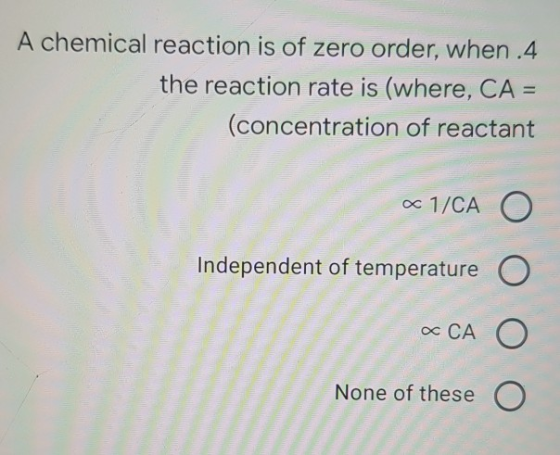
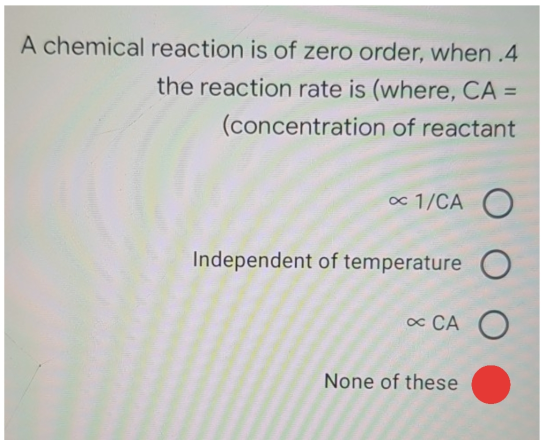
As we know that for zero order reaction, rate is equat to the rate constant(k). So, it is independent of the concentration of the reactant.
rate = k
First and third options are wrong as rate is independent of concentration of the reactant in zero-order reaction.
According to the Arrhenious equation,
Rate constant (k) = A e-Ea/RT
So, as the rate = rate constant, the rate is dependent on the temperature.
Hence, option second is also wrong.
Answer: None of these
Add Answer to:
Chemical Engineering I need to solve this question in
10 minutes
A chemical reaction is of...
Reaction Rates Assessment Question 04 Select all of the factors which affect the rates of chemical...
 Reaction Rates Assessment Question 04 Select all of the factors which affect the rates of chemical reactions. temperature stoichiometry of the reaction O nature of the reactants O contact between the reactants O concentration of the reactants O catalysts relative energy of the products and the reactants Reaction Rate Laws Assessment Question 04 If the reaction rate doubles when the concentration of a reactant is doubled, the reaction is order with respect to that reactant. Reaction Rate Laws Assessment Question...
14.1 Question 3 Learning Goal: To understand how to use integrated rate laws to solve for...
14.1 Question 3 Learning Goal: To understand how to use integrated rate laws to solve for concentration. A car starts at mile marker 145 on a highway and drives at 55 mi/hr in the direction of decreasing marker numbers. What mile marker will the car reach after 2 hours? This problem can easily be solved by calculating how far the car travels and subtracting that distance from the starting marker of 145. 55 mi/hr×2 hr=110 miles traveled milemarker 145−110 miles=milemarker...
1-The rate constant of a chemical reaction was measured at several temperature values and a plot...
1-The rate constant of a chemical reaction was measured at several temperature values and a plot of ln k (on the y-axis) was plotted against 1/T (on the x-axis, temperature was measured in Kelvin). If the slope of the plot was -9.21 x 10³ K and the y-intercept was 13.0, what is the activation energy (EA) of the reaction in kJ mol-1? 2-In an enzyme-catalyzed reaction, the rate of the reaction depends on which of the following at very low...
The rate of a chemical reaction responds in a linear fashion to changes in the concentration...
The rate of a chemical reaction responds in a linear fashion to changes in the concentration of reactant A. What can be said about reactant A? Reactant A is zero order. Reactant A is second order. Reactant A is first order. Reactant A is constant. Reactant A is catalyzed.
1. The following chemical reaction: A → products shows first order kinetics with respect to A;...
1. The following chemical reaction: A → products shows first order kinetics with respect to A; rate = k[A]. Assume k = 10.09 x 10⁻⁴ s-1 . If the initial concentration of A was 0.82 mol L-1 and then decreased to 0.11 mol L-1 , how much time elapsed in minutes? 2. Consider the following balanced chemical equation: H2O2 (aq) + 3 I-(aq) + 2 H+(aq) → I3- (aq) + 2 H2O (l) In the first 62.9 seconds of the...
1. The rate constant for a certain reaction is k = 5.70×10⁻³ s−1 . If the...
1. The rate constant for a certain reaction is k = 5.70×10⁻³ s−1 . If the initial reactant concentration was 0.750 M, what will the concentration be after 13.0 minutes? 2. A zero-order reaction has a constant rate of 4.40×10⁻⁴ M/s. If after 80.0 seconds the concentration has dropped to 1.00×10⁻² M, what was the initial concentration?
The rate constant for a certain reaction is k = 1.70×10⁻³ s−1 . If the initial...
The rate constant for a certain reaction is k = 1.70×10⁻³ s−1 . If the initial reactant concentration was 0.900 M, what will the concentration be after 6.00 minutes? [A]t= B) A zero-order reaction has a constant rate of 3.90×10⁻⁴ M/s. If after 65.0 seconds the concentration has dropped to 4.00×10⁻² M, what was the initial concentration? [A]0=
Learning Goal: To understand how to use integrated rate laws to solve for concentration. A car...
Learning Goal: To understand how to use integrated rate laws to solve for concentration. A car starts at mile marker 145 on a highway and drives at 55 mi/hr in the direction of decreasing marker numbers. What mile marker will the car reach after 2 hours? This problem can easily be solved by calculating how far the car travels and subtracting that distance from the starting marker of 145. 55 mi/hr×2 hr=110 miles traveled milemarker 145−110 miles=milemarker 35 If we...
i need full explanation please thanks in advance i will rate good ? question 1: question...
 i need full explanation please
thanks in advance
i will rate good ?
question 1:
question 2:
For the hydrolysis of methylformate, HCOOCH3, in acid solution Rate = k[HCOOCH3][H] The balanced equation for the reaction is: HCOOCH3 + H2O → HCOOH + CH3OH Why does the [H*] appear in the rate law, when it does not appear in the balanced equation. 9) In the presence of a tungsten catalyst at high temperatures, the decomposition of ammonia to nitrogen and hydrogen...
i need full explanation please
thanks in advance
i will rate good ?
question 1:
question 2:
For the hydrolysis of methylformate, HCOOCH3, in acid solution Rate = k[HCOOCH3][H] The balanced equation for the reaction is: HCOOCH3 + H2O → HCOOH + CH3OH Why does the [H*] appear in the rate law, when it does not appear in the balanced equation. 9) In the presence of a tungsten catalyst at high temperatures, the decomposition of ammonia to nitrogen and hydrogen...
The rate constant for a certain reaction is kkk = 3.50×10⁻³ s−1s−1 . If the initial...
The rate constant for a certain reaction is kkk = 3.50×10⁻³ s−1s−1 . If the initial reactant concentration was 0.450 MM, what will the concentration be after 19.0 minutes? A zero-order reaction has a constant rate of 3.50×10⁻⁴ M/sM/s. If after 65.0 seconds the concentration has dropped to 3.50×10⁻² MM, what was the initial concentration?
 Reaction Rates Assessment Question 04 Select all of the factors which affect the rates of chemical reactions. temperature stoichiometry of the reaction O nature of the reactants O contact between the reactants O concentration of the reactants O catalysts relative energy of the products and the reactants Reaction Rate Laws Assessment Question 04 If the reaction rate doubles when the concentration of a reactant is doubled, the reaction is order with respect to that reactant. Reaction Rate Laws Assessment Question...
 i need full explanation please
thanks in advance
i will rate good ?
question 1:
question 2:
For the hydrolysis of methylformate, HCOOCH3, in acid solution Rate = k[HCOOCH3][H] The balanced equation for the reaction is: HCOOCH3 + H2O → HCOOH + CH3OH Why does the [H*] appear in the rate law, when it does not appear in the balanced equation. 9) In the presence of a tungsten catalyst at high temperatures, the decomposition of ammonia to nitrogen and hydrogen...
i need full explanation please
thanks in advance
i will rate good ?
question 1:
question 2:
For the hydrolysis of methylformate, HCOOCH3, in acid solution Rate = k[HCOOCH3][H] The balanced equation for the reaction is: HCOOCH3 + H2O → HCOOH + CH3OH Why does the [H*] appear in the rate law, when it does not appear in the balanced equation. 9) In the presence of a tungsten catalyst at high temperatures, the decomposition of ammonia to nitrogen and hydrogen...
Most questions answered within 3 hours.
-
Where is the error in this code sequence?
String s1 = "Hello";
String s2 = "ello";...
asked 10 months ago -
Financial data for Joel de Paris, Inc., for last year
follow:
Joel de Paris, Inc.
Balance...
asked 10 months ago -
Consider this reaction:
Al2(SO4)3 (aq)+ BaCl3
(aq) Al2Cl6 (aq)- +
3BaSO4(s) . What is the...
asked 10 months ago -
Suppose that Savneet is considering increasing her
recent random sample from 20 car rentals to 40...
asked 10 months ago -
Trucks arrive at an unloading terminal at an average rate of 120
per hour.
Trucks arrive...
asked 10 months ago -
Why are methanol and ethanol completely soluble in water while
octanol is not very little soluble....
asked 10 months ago -
A facilities manager at a university reads in a research report
that the mean amount of...
asked 10 months ago -
When the CuSO4 is rehydrated by adding water to the anhydrous
compound, is this an endothermic...
asked 10 months ago -
A ray of sunlight is passing from diamond into crown glass; the
angle of incidence is...
asked 10 months ago -
A block of mass 0.249 kg is placed on top of a light, vertical
spring of...
asked 10 months ago -
how do the kidneys compensate in the presences of acidosis
a) trigger hyperventilate
b) reserve acid...
asked 10 months ago -
Question 501 pts
The rental rate of capital to the firm increases. Which of the
following...
asked 10 months ago