
Homework Answers
![- Þ(+) + (x+1) [using the properties of polynomials] os (pca)) + s (~(+1)) tence S preserves addition ü) net and p be a a sca](http://img.homeworklib.com/questions/826c6ea0-1189-11eb-b5cd-09b486e6df9a.png?x-oss-process=image/resize,w_560)
Please give a thumbs up if you are benefited.
Add Answer to:
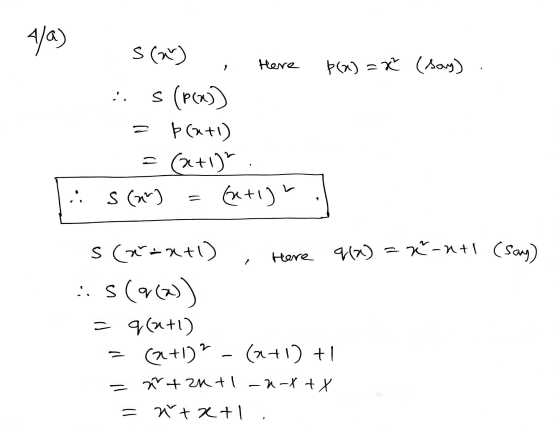
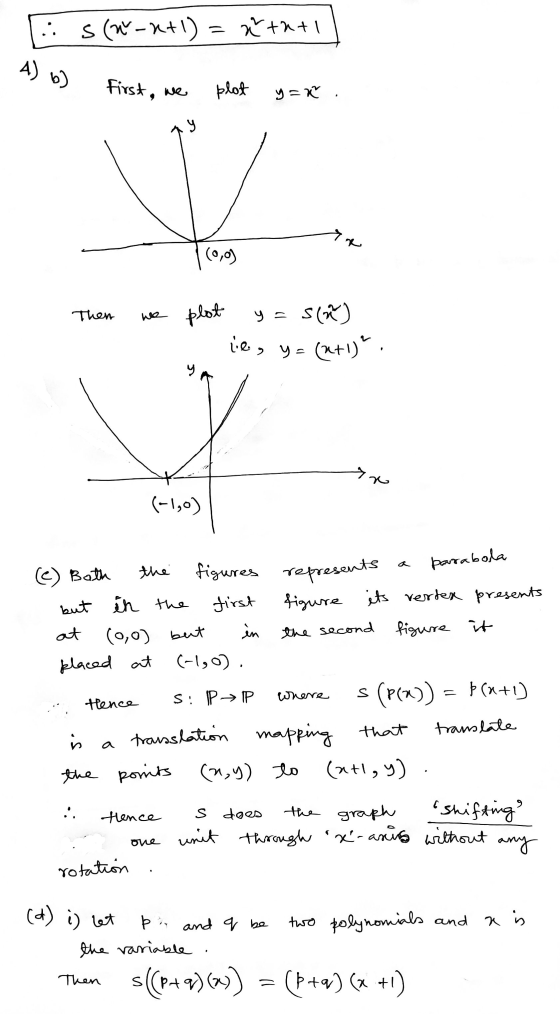
(4) Let S :P+P be the function which sends p(x) to p(x+1); that is, it replaces...
Consider the function T: K3 K3 defined by T(x, y, z) = (0, y,0). This kind...
 Consider the function T: K3 K3 defined by T(x, y, z) = (0, y,0). This kind of function is called a projection, since we are 'projecting' the vector (2, y, z) onto the y-axis. In this problem, you will prove that the function T is linear. In the first part, you will prove that T preserves addition. In the second part, you will prove that T preserves scalar multiplication. There is only one correct answer for each part, so be...
Let V = P1(R) and W = R2. Let B = (1,x) and y=((1,0), (0, 1))...
 Let V = P1(R) and W = R2. Let B = (1,x) and y=((1,0), (0, 1)) be the standard ordered bases for V and W respectively. Define a linear map T:V + W by T(P(x)) = (p(0) – 2p(1), p(0) + p'(0)). (a) Let FEW* be defined by f(a,b) = a – 26. Compute T*(f). (b) Compute [T]y,ß and (T*]*,y* using the definition of the matrix of a linear transformation.
Let L:P1 --> P2 be a function defined by L(p)=tp + 1. Where p is a...
Let L:P1 --> P2 be a function defined by L(p)=tp + 1. Where p is a linear polynomial in P1. which of the following is not true? L is a linear transformation L is not a linear operator L is not a linear transformation L is not a 1-1 function
Problem 4. Let GL2(R) be the vector space of 2 x 2 square matrices with usual matrix addition and...
 Problem 4. Let GL2(R) be the vector space of 2 x 2 square matrices with usual matrix addition and scalar multiplication, and Wー State the incorrect statement from the following five 1. W is a subspace of GL2(R) with basis 2. W -Ker f, where GL2(R) R is the linear transformation defined by: 3. Given the basis B in option1. coordB( 23(1,2,2) 4. GC2(R)-W + V, where: 5. Given the basis B in option1. coordB( 2 3 (1,2,3) Problem 5....
Hint: Apply the rank-nullity theorem to the linear map Pn → Rn+1 that sends p ?→...
 Hint: Apply the rank-nullity theorem to the linear map Pn → Rn+1
that sends p ?→
(p(x0), . . . , p(xn)). Then use the fact that if polynomial of
degree ≤ n has n + 1 distinct roots, then it is the zero
polynomial.
(3 points) Application: polynomial interpolation. Let (20; yo), ..., (In; Yn) be n +1 points R2 with distinct x-coordinates. Show that there exists a unique polynomial p(t) of degree <n such that p(xi) = yi...
Hint: Apply the rank-nullity theorem to the linear map Pn → Rn+1
that sends p ?→
(p(x0), . . . , p(xn)). Then use the fact that if polynomial of
degree ≤ n has n + 1 distinct roots, then it is the zero
polynomial.
(3 points) Application: polynomial interpolation. Let (20; yo), ..., (In; Yn) be n +1 points R2 with distinct x-coordinates. Show that there exists a unique polynomial p(t) of degree <n such that p(xi) = yi...
Let f(x,y) -2(xy 1) be a scalar function in R2. a) Find the vector field F(x, y) for which f(x, y...
 Please describe the contour map and list important aspects of
it, thanks!
Let f(x,y) -2(xy 1) be a scalar function in R2. a) Find the vector field F(x, y) for which f(x, y) is a potential function, b) c) sketch a contour map of f (x, y) and, on the same figure, sketch F(x,y) (on R2). Comment on any important aspects of your sketch.
Let f(x,y) -2(xy 1) be a scalar function in R2. a) Find the vector field F(x,...
Please describe the contour map and list important aspects of
it, thanks!
Let f(x,y) -2(xy 1) be a scalar function in R2. a) Find the vector field F(x, y) for which f(x, y) is a potential function, b) c) sketch a contour map of f (x, y) and, on the same figure, sketch F(x,y) (on R2). Comment on any important aspects of your sketch.
Let f(x,y) -2(xy 1) be a scalar function in R2. a) Find the vector field F(x,...
Let V P2(R) and let T V-V be a linear transformation defined by T(p)-q, where (x)(r...
 Let V P2(R) and let T V-V be a linear transformation defined by T(p)-q, where (x)(r p (r Let B = {x, 1 + x2, 2x-1} be a basis of V. Compute [TIB,B, and deduce if it is eigenvectors basis of
Let D P3P3 be the function that sends a polynomial of degree 3 to its derivative...
 Let D P3P3 be the function that sends a polynomial of degree 3 to its derivative (a) Find an eigenvector for D or explain why no eigenvector exists Write your solution here (b) Let B 1 x, x + x2, x2 + x3,x3}. B is a basis for P3. Find MDB-B Here, MD.- is the unique matrix such that MD-xs = [D(x)]s Write your solution here Recall that D: P is polynomial differentiation. 1x, x +x2, x2 +x3,x3} and C...
Problem 5. (1 point) Let H be the subset of vectors [x. y] in R2 such that the polint (x, y) les ...
 Problem 5. (1 point) Let H be the subset of vectors [x. y] in R2 such that the polint (x, y) les between the lines y -3x and y x/3. (See the picture.) 1. Is H nonempty? choose 2. Is H closed under addition? If it is, enter CLOSED. If it is not, enter two vectors in H whose sum is not in H, using a comma separated list and syntax such as [1.2]. 13,4] 3 Is H closed under...
Problem 3. Let D be the vector space of all differentiable function R wth the usual pointwise add...
 Problem 3. Let D be the vector space of all differentiable function R wth the usual pointwise addition and scalar multiplication of functions. In other words, for f, g E D and λ E R the function R defined by: (f +Ag) ()-f(r) +Ag(x) Let R be four functions defined by: s(x)-: sin 11 c(r) : cosz, co(z)--cos(z + θ), and so(r) sin(z + θ), and Wspanls, c Which of the following statements are true: (a) For each fixed θ...
 Consider the function T: K3 K3 defined by T(x, y, z) = (0, y,0). This kind of function is called a projection, since we are 'projecting' the vector (2, y, z) onto the y-axis. In this problem, you will prove that the function T is linear. In the first part, you will prove that T preserves addition. In the second part, you will prove that T preserves scalar multiplication. There is only one correct answer for each part, so be...
 Let V = P1(R) and W = R2. Let B = (1,x) and y=((1,0), (0, 1)) be the standard ordered bases for V and W respectively. Define a linear map T:V + W by T(P(x)) = (p(0) – 2p(1), p(0) + p'(0)). (a) Let FEW* be defined by f(a,b) = a – 26. Compute T*(f). (b) Compute [T]y,ß and (T*]*,y* using the definition of the matrix of a linear transformation.
 Problem 4. Let GL2(R) be the vector space of 2 x 2 square matrices with usual matrix addition and scalar multiplication, and Wー State the incorrect statement from the following five 1. W is a subspace of GL2(R) with basis 2. W -Ker f, where GL2(R) R is the linear transformation defined by: 3. Given the basis B in option1. coordB( 23(1,2,2) 4. GC2(R)-W + V, where: 5. Given the basis B in option1. coordB( 2 3 (1,2,3) Problem 5....
 Hint: Apply the rank-nullity theorem to the linear map Pn → Rn+1
that sends p ?→
(p(x0), . . . , p(xn)). Then use the fact that if polynomial of
degree ≤ n has n + 1 distinct roots, then it is the zero
polynomial.
(3 points) Application: polynomial interpolation. Let (20; yo), ..., (In; Yn) be n +1 points R2 with distinct x-coordinates. Show that there exists a unique polynomial p(t) of degree <n such that p(xi) = yi...
Hint: Apply the rank-nullity theorem to the linear map Pn → Rn+1
that sends p ?→
(p(x0), . . . , p(xn)). Then use the fact that if polynomial of
degree ≤ n has n + 1 distinct roots, then it is the zero
polynomial.
(3 points) Application: polynomial interpolation. Let (20; yo), ..., (In; Yn) be n +1 points R2 with distinct x-coordinates. Show that there exists a unique polynomial p(t) of degree <n such that p(xi) = yi...
 Please describe the contour map and list important aspects of
it, thanks!
Let f(x,y) -2(xy 1) be a scalar function in R2. a) Find the vector field F(x, y) for which f(x, y) is a potential function, b) c) sketch a contour map of f (x, y) and, on the same figure, sketch F(x,y) (on R2). Comment on any important aspects of your sketch.
Let f(x,y) -2(xy 1) be a scalar function in R2. a) Find the vector field F(x,...
Please describe the contour map and list important aspects of
it, thanks!
Let f(x,y) -2(xy 1) be a scalar function in R2. a) Find the vector field F(x, y) for which f(x, y) is a potential function, b) c) sketch a contour map of f (x, y) and, on the same figure, sketch F(x,y) (on R2). Comment on any important aspects of your sketch.
Let f(x,y) -2(xy 1) be a scalar function in R2. a) Find the vector field F(x,...
 Let V P2(R) and let T V-V be a linear transformation defined by T(p)-q, where (x)(r p (r Let B = {x, 1 + x2, 2x-1} be a basis of V. Compute [TIB,B, and deduce if it is eigenvectors basis of
 Let D P3P3 be the function that sends a polynomial of degree 3 to its derivative (a) Find an eigenvector for D or explain why no eigenvector exists Write your solution here (b) Let B 1 x, x + x2, x2 + x3,x3}. B is a basis for P3. Find MDB-B Here, MD.- is the unique matrix such that MD-xs = [D(x)]s Write your solution here Recall that D: P is polynomial differentiation. 1x, x +x2, x2 +x3,x3} and C...
 Problem 5. (1 point) Let H be the subset of vectors [x. y] in R2 such that the polint (x, y) les between the lines y -3x and y x/3. (See the picture.) 1. Is H nonempty? choose 2. Is H closed under addition? If it is, enter CLOSED. If it is not, enter two vectors in H whose sum is not in H, using a comma separated list and syntax such as [1.2]. 13,4] 3 Is H closed under...
 Problem 3. Let D be the vector space of all differentiable function R wth the usual pointwise addition and scalar multiplication of functions. In other words, for f, g E D and λ E R the function R defined by: (f +Ag) ()-f(r) +Ag(x) Let R be four functions defined by: s(x)-: sin 11 c(r) : cosz, co(z)--cos(z + θ), and so(r) sin(z + θ), and Wspanls, c Which of the following statements are true: (a) For each fixed θ...
Most questions answered within 3 hours.
-
Where is the error in this code sequence?
String s1 = "Hello";
String s2 = "ello";...
asked 10 months ago -
Financial data for Joel de Paris, Inc., for last year
follow:
Joel de Paris, Inc.
Balance...
asked 10 months ago -
Consider this reaction:
Al2(SO4)3 (aq)+ BaCl3
(aq) Al2Cl6 (aq)- +
3BaSO4(s) . What is the...
asked 10 months ago -
Suppose that Savneet is considering increasing her
recent random sample from 20 car rentals to 40...
asked 10 months ago -
Trucks arrive at an unloading terminal at an average rate of 120
per hour.
Trucks arrive...
asked 10 months ago -
Why are methanol and ethanol completely soluble in water while
octanol is not very little soluble....
asked 10 months ago -
A facilities manager at a university reads in a research report
that the mean amount of...
asked 10 months ago -
When the CuSO4 is rehydrated by adding water to the anhydrous
compound, is this an endothermic...
asked 10 months ago -
A ray of sunlight is passing from diamond into crown glass; the
angle of incidence is...
asked 10 months ago -
A block of mass 0.249 kg is placed on top of a light, vertical
spring of...
asked 10 months ago -
how do the kidneys compensate in the presences of acidosis
a) trigger hyperventilate
b) reserve acid...
asked 10 months ago -
Question 501 pts
The rental rate of capital to the firm increases. Which of the
following...
asked 10 months ago