
Homework Answers

Add Answer to:
Unless otherwise specified, you may assume T = 25.0 °C in all of the problems on...
1) What is the value for the van't Hoff factor (i) for Zn(NO:)? a) i =...
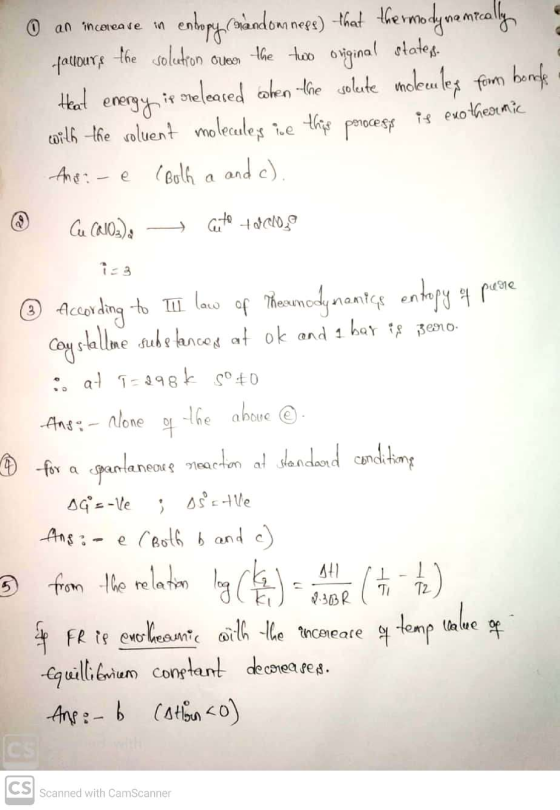
 1) What is the value for the van't Hoff factor (i) for Zn(NO:)? a) i = 1 b) i - 2 di-4 e)i>4 2) Which of the following makes formation of a solution from two pure chemical substances more likely to occur? a) If randomness increases when a solution forms b) If energy decreases when a solution forms c) If energy increases when a solution forms d) Botha and be e) Both a and 3) For a chemical reaction to...
4) For which of the folling pure chemical substances will SⓇ = 0.0 J/mol K when...
 4) For which of the folling pure chemical substances will SⓇ = 0.0 J/mol K when T = 25.0°C? a) O2(g) b) Os(g) c) FeCl(s) d) Both a and e) None of the above 5) For a particular chemical reaction it is found that the value for the equilibrium constant for the reaction decreases as temperature increases. Based on this we can conclude a) AH 0 b) AH > 0 c) AS0 d) AS rx > 0 e) AGºrx <...
1) Which of the following makes formation of a solution from two pure chemical substances more...
 1) Which of the following makes formation of a solution from two pure chemical substances more likely to occur? a) If randomness increases when a solution forms b) If energy decreases when a solution forms c) If energy increases when a solution forms d) Both a and b e) Both a and c 2) What is the value for the van't Hoff factor (1) for Cu(NO3)2? a) i=1 b) i=2 c) i=3 d) i=4 e) i>4 3) For which of...
4) For which of the folling pure chemical substances will sº = 0.0 J/mol.K when T...
 4) For which of the folling pure chemical substances will sº = 0.0 J/mol.K when T = 25.0°C? a) FeCl(s) b) O2(g) c) O3(g) d) Both b and c e) None of the above b) AS 5) For a particular chemical reaction it is found that the value for the equilibrium constant for the reaction decreases as temperature increases. Based on this we can conclude a) AS rxn <0 0 c) AHºrx<0 d) AHºrx>0 <0 e) AGºran
5) For a particular chemical reaction it is found that the value for the equilibrium constant...
 5) For a particular chemical reaction it is found that the value for the equilibrium constant for the reaction decreases as temperature increases. Based on this we can conclude a) AH>0 b) AH® < 0 c) AS > 0 d) AS 0 e) AG < 0 6) When 0.0100 moles of dimethyl amine ((CH3)2NH) is added to 1.000 liters of water, the pH of the water increases above the value pH = 7.0 found for neutral solutions. Based on this,...
1) Which of the following makes formation of a solution from two pure chemical substances more...
 1) Which of the following makes formation of a solution from two pure chemical substances more likely to occur? a) If randomness increases when a solution forms b) If energy increases when a solution forms c) If energy decreases when a solution forms d) Both a and b c) Both a and c 2) What is the value for the van't Hoff factor (1) for Au(NO);? a) i-1 b) i = 2 c) - 3 e)i>4 3) For a chemical...
1) Which of the following makes formation of a solution from two pure chemical substances more...
 1) Which of the following makes formation of a solution from two pure chemical substances more likely to occur? a) If randomness increases when a solution forms b) If energy decreases when a solution forms c) If energy increases when a solution forms d) Both a and b e) Both a and c
1) Which of the following makes formation of a solution from two pure chemical substances more...
 1) Which of the following makes formation of a solution from two pure chemical substances more likely to occur? a) If randomness increases when a solution forms b) If energy decreases when a solution forms c) If energy increases when a solution forms d) Both a and b e) Both a and c
2) Which of the following makes formation of a solution from two pure chemical substances more...
 2) Which of the following makes formation of a solution from two pure chemical substances more likely to occur? a) If randomness increases when a solution forms b) If energy decreases when a solution forms c) If energy increases when a solution forms d) Both a and b e) Both a and c
urgent 2) Which of the following makes formation of a solution from two pure chemical substances...
 urgent
2) Which of the following makes formation of a solution from two pure chemical substances more likely to occur? a) If randomness increases when a solution forms b) If energy decreases when a solution forms c) If energy increases when a solution forms d) Both a and b e) Both a and c
urgent
2) Which of the following makes formation of a solution from two pure chemical substances more likely to occur? a) If randomness increases when a solution forms b) If energy decreases when a solution forms c) If energy increases when a solution forms d) Both a and b e) Both a and c
 1) What is the value for the van't Hoff factor (i) for Zn(NO:)? a) i = 1 b) i - 2 di-4 e)i>4 2) Which of the following makes formation of a solution from two pure chemical substances more likely to occur? a) If randomness increases when a solution forms b) If energy decreases when a solution forms c) If energy increases when a solution forms d) Botha and be e) Both a and 3) For a chemical reaction to...
 4) For which of the folling pure chemical substances will SⓇ = 0.0 J/mol K when T = 25.0°C? a) O2(g) b) Os(g) c) FeCl(s) d) Both a and e) None of the above 5) For a particular chemical reaction it is found that the value for the equilibrium constant for the reaction decreases as temperature increases. Based on this we can conclude a) AH 0 b) AH > 0 c) AS0 d) AS rx > 0 e) AGºrx <...
 1) Which of the following makes formation of a solution from two pure chemical substances more likely to occur? a) If randomness increases when a solution forms b) If energy decreases when a solution forms c) If energy increases when a solution forms d) Both a and b e) Both a and c 2) What is the value for the van't Hoff factor (1) for Cu(NO3)2? a) i=1 b) i=2 c) i=3 d) i=4 e) i>4 3) For which of...
 4) For which of the folling pure chemical substances will sº = 0.0 J/mol.K when T = 25.0°C? a) FeCl(s) b) O2(g) c) O3(g) d) Both b and c e) None of the above b) AS 5) For a particular chemical reaction it is found that the value for the equilibrium constant for the reaction decreases as temperature increases. Based on this we can conclude a) AS rxn <0 0 c) AHºrx<0 d) AHºrx>0 <0 e) AGºran
 5) For a particular chemical reaction it is found that the value for the equilibrium constant for the reaction decreases as temperature increases. Based on this we can conclude a) AH>0 b) AH® < 0 c) AS > 0 d) AS 0 e) AG < 0 6) When 0.0100 moles of dimethyl amine ((CH3)2NH) is added to 1.000 liters of water, the pH of the water increases above the value pH = 7.0 found for neutral solutions. Based on this,...
 1) Which of the following makes formation of a solution from two pure chemical substances more likely to occur? a) If randomness increases when a solution forms b) If energy increases when a solution forms c) If energy decreases when a solution forms d) Both a and b c) Both a and c 2) What is the value for the van't Hoff factor (1) for Au(NO);? a) i-1 b) i = 2 c) - 3 e)i>4 3) For a chemical...
 1) Which of the following makes formation of a solution from two pure chemical substances more likely to occur? a) If randomness increases when a solution forms b) If energy decreases when a solution forms c) If energy increases when a solution forms d) Both a and b e) Both a and c
 1) Which of the following makes formation of a solution from two pure chemical substances more likely to occur? a) If randomness increases when a solution forms b) If energy decreases when a solution forms c) If energy increases when a solution forms d) Both a and b e) Both a and c
 2) Which of the following makes formation of a solution from two pure chemical substances more likely to occur? a) If randomness increases when a solution forms b) If energy decreases when a solution forms c) If energy increases when a solution forms d) Both a and b e) Both a and c
 urgent
2) Which of the following makes formation of a solution from two pure chemical substances more likely to occur? a) If randomness increases when a solution forms b) If energy decreases when a solution forms c) If energy increases when a solution forms d) Both a and b e) Both a and c
urgent
2) Which of the following makes formation of a solution from two pure chemical substances more likely to occur? a) If randomness increases when a solution forms b) If energy decreases when a solution forms c) If energy increases when a solution forms d) Both a and b e) Both a and c
Most questions answered within 3 hours.
-
Where is the error in this code sequence?
String s1 = "Hello";
String s2 = "ello";...
asked 10 months ago -
Financial data for Joel de Paris, Inc., for last year
follow:
Joel de Paris, Inc.
Balance...
asked 10 months ago -
Consider this reaction:
Al2(SO4)3 (aq)+ BaCl3
(aq) Al2Cl6 (aq)- +
3BaSO4(s) . What is the...
asked 10 months ago -
Suppose that Savneet is considering increasing her
recent random sample from 20 car rentals to 40...
asked 10 months ago -
Trucks arrive at an unloading terminal at an average rate of 120
per hour.
Trucks arrive...
asked 10 months ago -
Why are methanol and ethanol completely soluble in water while
octanol is not very little soluble....
asked 10 months ago -
A facilities manager at a university reads in a research report
that the mean amount of...
asked 10 months ago -
When the CuSO4 is rehydrated by adding water to the anhydrous
compound, is this an endothermic...
asked 10 months ago -
A ray of sunlight is passing from diamond into crown glass; the
angle of incidence is...
asked 10 months ago -
A block of mass 0.249 kg is placed on top of a light, vertical
spring of...
asked 10 months ago -
how do the kidneys compensate in the presences of acidosis
a) trigger hyperventilate
b) reserve acid...
asked 10 months ago -
Question 501 pts
The rental rate of capital to the firm increases. Which of the
following...
asked 10 months ago