
Homework Answers
Request Answer!
We need at least 10 more requests to produce the answer.
0 / 10 have requested this problem solution
The more requests, the faster the answer.
Add Answer to:
2. (7 pts) What is the sequence of the following HEXAPEPTIDE? *PROVIDE WORK/ANSWER for B-F! (Use...
(7 pts) What is the sequence of the following HEXAPEPTIDE? *PROVIDE WORK/ANSWER for B-F! (Use deductive...
(7 pts) What is the sequence of the following HEXAPEPTIDE? *PROVIDE WORK/ANSWER for B-F! (Use deductive reasoning) Observations from Sequencing Experiments: A. The Sequence contains the following amino acids: Y, R, M, K, G, D B. Reaction with 1-fluoro-2,4-dinitrobenzene yielded DNP-G. ___ ___ ___ ____ ___ ___ y = 0.058x + 0.0081 y = 0.2711x + 0.0105 -0.02 0 0.02 0.04 0.06 0.08 0.1 0.12 0.14 -0.2 -0.1 0 0.1 0.2 0.3 0.4 0.5 Velocity ( mM/min) -1 [S] mM-1...
1. An HEXAPEPTIDE was sequenced using differing enzyme and chemical reagents. The results of these experiments,...
1. An HEXAPEPTIDE was sequenced using differing enzyme and chemical reagents. The results of these experiments, along with an explanation of how to interpret the results, are provided below. Using this information, provide the 1˚ structure for this HEXAPEPTIDE. For the answer, be sure to include the following: A. Work/answers for Points B-F. B. The final sequence using 1 letter abbreviations for each amino acid. C. The structure of the final peptide drawn in MarvinSketch. Results from Sequencing Experiments on...
Deduce the sequence of a heptapeptide that contains the amino acids Met, Gln, Phe, Leu, Cys,...
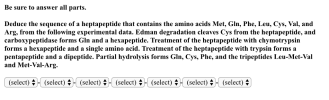 Deduce the sequence of a heptapeptide that contains the amino
acids Met, Gln, Phe, Leu, Cys, Val, and Arg, from the following
experimental data. Edman degradation cleaves Cys from the
heptapeptide, and carboxypeptidase forms Gln and a hexapeptide.
Treatment of the heptapeptide with chymotrypsin forms a hexapeptide
and a single amino acid. Treatment of the heptapeptide with trypsin
forms a pentapeptide and a dipeptide. Partial hydrolysis forms Gln,
Cys, Phe, and the tripeptides Leu-Met-Val and Met-Val-Arg.
Be sure to answer...
Deduce the sequence of a heptapeptide that contains the amino
acids Met, Gln, Phe, Leu, Cys, Val, and Arg, from the following
experimental data. Edman degradation cleaves Cys from the
heptapeptide, and carboxypeptidase forms Gln and a hexapeptide.
Treatment of the heptapeptide with chymotrypsin forms a hexapeptide
and a single amino acid. Treatment of the heptapeptide with trypsin
forms a pentapeptide and a dipeptide. Partial hydrolysis forms Gln,
Cys, Phe, and the tripeptides Leu-Met-Val and Met-Val-Arg.
Be sure to answer...
1. Partial hydrolysis of lysozyme yielded an octapeptide that was later identified as the N-terminal segment of...
1. Partial hydrolysis of lysozyme yielded an octapeptide that was later identified as the N-terminal segment of the protein. From the following information, determine the sequence of this octapeptide. a. The following amino acids were identified after complete hydrolysis of the octapeptide: Arginine (Arg) Glycine (Gly) Phenylalanine (Phe) Cysteine (Cys) Leucine (Leu) Valine (Val) Glutamic Acid (Glu) Lysine (Lys) b. Treatment of the octapeptide with dinitroflurobenzene (Sanger reagent) followed by complete hydrolysis gave lysine (Lys) labeled with two dinitrophenyl (DNP) groups. c. Treatment of the octapeptide with trypsin gave lysine...
1. Partial hydrolysis of lysozyme yielded an octapeptide that was later identified as the N-terminal segment of...
1. Partial hydrolysis of lysozyme yielded an octapeptide that was later identified as the N-terminal segment of the protein. From the following information, determine the sequence of this octapeptide. a. The following amino acids were identified after complete hydrolysis of the octapeptide: Arginine (Arg) Glycine (Gly) Phenylalanine (Phe) Cysteine (Cys) Leucine (Leu) Valine (Val) Glutamic Acid (Glu) Lysine (Lys) b. Treatment of the octapeptide with dinitroflurobenzene (Sanger reagent) followed by complete hydrolysis gave lysine (Lys) labeled with two dinitrophenyl (DNP) groups. c. Treatment of the octapeptide with trypsin gave lysine...
7. A peptide was isolated from sheep hypothalamus and subjected to sequence analysis. The experimental data...
 7. A peptide was isolated from sheep hypothalamus and subjected to sequence analysis. The experimental data are as follows. Deduce the amino acid sequence from this data. a. Composition (2Ala, 2Gly, Thr, Phe, Lys, His, Ser, Trp, Arg, Val) b. Reaction of dinitrofluorobenzene with the intact peptide yielded DNP-Thr. A brief treatment with carboxypeptidase a yielded glycine. c. Trypsin digestion yielded three fragments: i. Phe, Thr, Ala, Lys ii. Gly, Val iii. Trp, His, Ser, Gly, Arg, Ala Treatment of...
Need help with #2 Clearly provide the 3-letter symbol for the correct sequence of cach amino...
 Need help with #2
Clearly provide the 3-letter symbol for the correct sequence of cach amino acid in each of listings of the amino acids in the peptide or in any fragments are simply listed in alphabetical order. A subscriptive the number of that amino acid. Use parentheses to incorporate the unknown amino acids after each treatment 1. A five amino acid peptide contains: Arg. Glu, His, Phe, and Ser This peptide yields the following results when broken down into...
Need help with #2
Clearly provide the 3-letter symbol for the correct sequence of cach amino acid in each of listings of the amino acids in the peptide or in any fragments are simply listed in alphabetical order. A subscriptive the number of that amino acid. Use parentheses to incorporate the unknown amino acids after each treatment 1. A five amino acid peptide contains: Arg. Glu, His, Phe, and Ser This peptide yields the following results when broken down into...
biochemistry please show your work 2. A mutant form of polypeptide hormone angiotensin II has the...
 biochemistry please show your work
2. A mutant form of polypeptide hormone angiotensin II has the amino acid composition: Ile, Arg, Met, Leu, Phe, Asp, Tyr, and Val. The following observations are made: 1) Treatment with trypsin yields a dipeptide containing Asp and Arg, and a hexapeptide with all the rest. 2) Cyanogen bromide yields a dipeptide containing Phe and Leu and a hexapeptide containing all the rest. 3) Chymotrypsin cleaves the hormone into two tetrapeptides of composition: Val, Tyr,...
biochemistry please show your work
2. A mutant form of polypeptide hormone angiotensin II has the amino acid composition: Ile, Arg, Met, Leu, Phe, Asp, Tyr, and Val. The following observations are made: 1) Treatment with trypsin yields a dipeptide containing Asp and Arg, and a hexapeptide with all the rest. 2) Cyanogen bromide yields a dipeptide containing Phe and Leu and a hexapeptide containing all the rest. 3) Chymotrypsin cleaves the hormone into two tetrapeptides of composition: Val, Tyr,...
I need someone to help explain this to me please in great detail! Explain it to...
 I need someone to help explain this to me please in great
detail! Explain it to me very simply. thank you!
31) A nonapeptide was determined to have the following amino acid composition: (Lys)2, (Gly)2, (Phe) 2, His, Leu, Met. The following are possible sequences for the peptide. A) G-F-K-K-G-L-M -F-H B) H-L-G-K-K-F-F-G-M C) H-L-F-G-K-K-F-M -G D) H-F-L-G-K-K-F-M-G E) M-L-F-K-F-G-G-K-H The following observations were made during sequence determination. (Hint: FDNB reacts with N-terminal amino groups and specificities of proteases listed...
I need someone to help explain this to me please in great
detail! Explain it to me very simply. thank you!
31) A nonapeptide was determined to have the following amino acid composition: (Lys)2, (Gly)2, (Phe) 2, His, Leu, Met. The following are possible sequences for the peptide. A) G-F-K-K-G-L-M -F-H B) H-L-G-K-K-F-F-G-M C) H-L-F-G-K-K-F-M -G D) H-F-L-G-K-K-F-M-G E) M-L-F-K-F-G-G-K-H The following observations were made during sequence determination. (Hint: FDNB reacts with N-terminal amino groups and specificities of proteases listed...
Yassmeen is a starting Biochemist. A sequence is required. The information that Yassmeen has is as...
 Yassmeen is a starting Biochemist. A sequence is required. The information that Yassmeen has is as follows: A.) The Peptide is composed of 18 Amino Acids. They are: [A-1; C-2; D-1; F-2; G-2; K-1; L-1; N-2; S-1; T-1; V-1; Y-1; W-1]. B.) Treatment of the Peptide DNFB gave the following adducts: --8-0-y -N-C-C-oH I H Nar C.) Treatment of the intact peptide with Carboxypeptidase "C" gave. "N" D.) Treatment of the intact Peptide with "Elastase" gave the following: 1.) T-A;...
 Deduce the sequence of a heptapeptide that contains the amino
acids Met, Gln, Phe, Leu, Cys, Val, and Arg, from the following
experimental data. Edman degradation cleaves Cys from the
heptapeptide, and carboxypeptidase forms Gln and a hexapeptide.
Treatment of the heptapeptide with chymotrypsin forms a hexapeptide
and a single amino acid. Treatment of the heptapeptide with trypsin
forms a pentapeptide and a dipeptide. Partial hydrolysis forms Gln,
Cys, Phe, and the tripeptides Leu-Met-Val and Met-Val-Arg.
Be sure to answer...
Deduce the sequence of a heptapeptide that contains the amino
acids Met, Gln, Phe, Leu, Cys, Val, and Arg, from the following
experimental data. Edman degradation cleaves Cys from the
heptapeptide, and carboxypeptidase forms Gln and a hexapeptide.
Treatment of the heptapeptide with chymotrypsin forms a hexapeptide
and a single amino acid. Treatment of the heptapeptide with trypsin
forms a pentapeptide and a dipeptide. Partial hydrolysis forms Gln,
Cys, Phe, and the tripeptides Leu-Met-Val and Met-Val-Arg.
Be sure to answer...
 7. A peptide was isolated from sheep hypothalamus and subjected to sequence analysis. The experimental data are as follows. Deduce the amino acid sequence from this data. a. Composition (2Ala, 2Gly, Thr, Phe, Lys, His, Ser, Trp, Arg, Val) b. Reaction of dinitrofluorobenzene with the intact peptide yielded DNP-Thr. A brief treatment with carboxypeptidase a yielded glycine. c. Trypsin digestion yielded three fragments: i. Phe, Thr, Ala, Lys ii. Gly, Val iii. Trp, His, Ser, Gly, Arg, Ala Treatment of...
 Need help with #2
Clearly provide the 3-letter symbol for the correct sequence of cach amino acid in each of listings of the amino acids in the peptide or in any fragments are simply listed in alphabetical order. A subscriptive the number of that amino acid. Use parentheses to incorporate the unknown amino acids after each treatment 1. A five amino acid peptide contains: Arg. Glu, His, Phe, and Ser This peptide yields the following results when broken down into...
Need help with #2
Clearly provide the 3-letter symbol for the correct sequence of cach amino acid in each of listings of the amino acids in the peptide or in any fragments are simply listed in alphabetical order. A subscriptive the number of that amino acid. Use parentheses to incorporate the unknown amino acids after each treatment 1. A five amino acid peptide contains: Arg. Glu, His, Phe, and Ser This peptide yields the following results when broken down into...
 biochemistry please show your work
2. A mutant form of polypeptide hormone angiotensin II has the amino acid composition: Ile, Arg, Met, Leu, Phe, Asp, Tyr, and Val. The following observations are made: 1) Treatment with trypsin yields a dipeptide containing Asp and Arg, and a hexapeptide with all the rest. 2) Cyanogen bromide yields a dipeptide containing Phe and Leu and a hexapeptide containing all the rest. 3) Chymotrypsin cleaves the hormone into two tetrapeptides of composition: Val, Tyr,...
biochemistry please show your work
2. A mutant form of polypeptide hormone angiotensin II has the amino acid composition: Ile, Arg, Met, Leu, Phe, Asp, Tyr, and Val. The following observations are made: 1) Treatment with trypsin yields a dipeptide containing Asp and Arg, and a hexapeptide with all the rest. 2) Cyanogen bromide yields a dipeptide containing Phe and Leu and a hexapeptide containing all the rest. 3) Chymotrypsin cleaves the hormone into two tetrapeptides of composition: Val, Tyr,...
 I need someone to help explain this to me please in great
detail! Explain it to me very simply. thank you!
31) A nonapeptide was determined to have the following amino acid composition: (Lys)2, (Gly)2, (Phe) 2, His, Leu, Met. The following are possible sequences for the peptide. A) G-F-K-K-G-L-M -F-H B) H-L-G-K-K-F-F-G-M C) H-L-F-G-K-K-F-M -G D) H-F-L-G-K-K-F-M-G E) M-L-F-K-F-G-G-K-H The following observations were made during sequence determination. (Hint: FDNB reacts with N-terminal amino groups and specificities of proteases listed...
I need someone to help explain this to me please in great
detail! Explain it to me very simply. thank you!
31) A nonapeptide was determined to have the following amino acid composition: (Lys)2, (Gly)2, (Phe) 2, His, Leu, Met. The following are possible sequences for the peptide. A) G-F-K-K-G-L-M -F-H B) H-L-G-K-K-F-F-G-M C) H-L-F-G-K-K-F-M -G D) H-F-L-G-K-K-F-M-G E) M-L-F-K-F-G-G-K-H The following observations were made during sequence determination. (Hint: FDNB reacts with N-terminal amino groups and specificities of proteases listed...
 Yassmeen is a starting Biochemist. A sequence is required. The information that Yassmeen has is as follows: A.) The Peptide is composed of 18 Amino Acids. They are: [A-1; C-2; D-1; F-2; G-2; K-1; L-1; N-2; S-1; T-1; V-1; Y-1; W-1]. B.) Treatment of the Peptide DNFB gave the following adducts: --8-0-y -N-C-C-oH I H Nar C.) Treatment of the intact peptide with Carboxypeptidase "C" gave. "N" D.) Treatment of the intact Peptide with "Elastase" gave the following: 1.) T-A;...
Most questions answered within 3 hours.
-
Where is the error in this code sequence?
String s1 = "Hello";
String s2 = "ello";...
asked 11 months ago -
Financial data for Joel de Paris, Inc., for last year
follow:
Joel de Paris, Inc.
Balance...
asked 11 months ago -
Consider this reaction:
Al2(SO4)3 (aq)+ BaCl3
(aq) Al2Cl6 (aq)- +
3BaSO4(s) . What is the...
asked 11 months ago -
Suppose that Savneet is considering increasing her
recent random sample from 20 car rentals to 40...
asked 11 months ago -
Trucks arrive at an unloading terminal at an average rate of 120
per hour.
Trucks arrive...
asked 11 months ago -
Why are methanol and ethanol completely soluble in water while
octanol is not very little soluble....
asked 11 months ago -
A facilities manager at a university reads in a research report
that the mean amount of...
asked 11 months ago -
When the CuSO4 is rehydrated by adding water to the anhydrous
compound, is this an endothermic...
asked 11 months ago -
A ray of sunlight is passing from diamond into crown glass; the
angle of incidence is...
asked 11 months ago -
A block of mass 0.249 kg is placed on top of a light, vertical
spring of...
asked 11 months ago -
how do the kidneys compensate in the presences of acidosis
a) trigger hyperventilate
b) reserve acid...
asked 11 months ago -
Question 501 pts
The rental rate of capital to the firm increases. Which of the
following...
asked 11 months ago