
Homework Answers
![From surface reac - k. Pas (S) -Ya Kz Pos Pcs from eq 1, 2 & 3 -8=K, KA PA [s]²- Kz (KB P8) [s] (kPc ) [5] -8=k, KA PA (5)² -](http://img.homeworklib.com/questions/7c51da90-0c7b-11eb-8b92-f7ea08912f80.png?x-oss-process=image/resize,w_560)
Add Answer to:
QUESTION 2: 20 marks 20 points Kinetic studies on a solid-catalyzed reversible gas phase reaction, A...
advanced CRE subject step by step solution QUESTION 2: 20 marks 20 points Kinetic studies on...
 advanced CRE subject
step by step solution
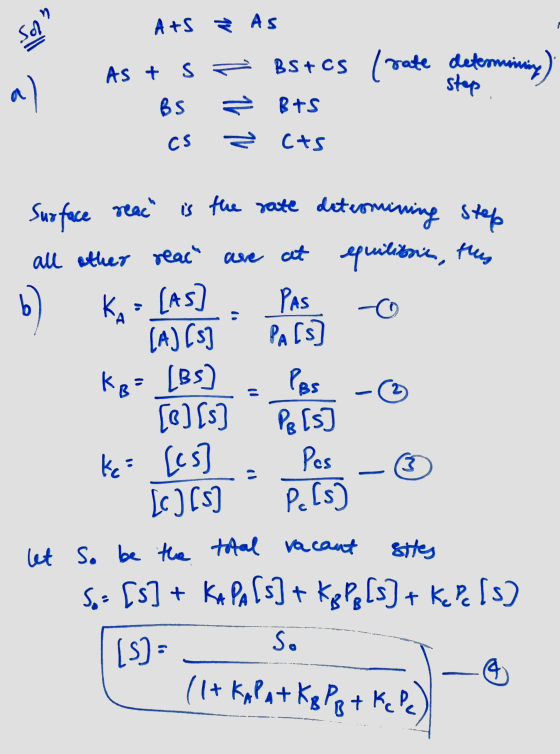
QUESTION 2: 20 marks 20 points Kinetic studies on a solid-catalyzed reversible gas phase reaction, A B+C yielded the following rate law shown in Equation 1, which is a function of partial pressures of A, B and Ci.e. PA, PB and PC from the experimental observations, a) Propose a dual-site mechanism which is consistent with the rate law given above, using the standard guidelines (8 marks) b) Making use of the proposed mechanism,...
advanced CRE subject
step by step solution
QUESTION 2: 20 marks 20 points Kinetic studies on a solid-catalyzed reversible gas phase reaction, A B+C yielded the following rate law shown in Equation 1, which is a function of partial pressures of A, B and Ci.e. PA, PB and PC from the experimental observations, a) Propose a dual-site mechanism which is consistent with the rate law given above, using the standard guidelines (8 marks) b) Making use of the proposed mechanism,...
please i have deadtime at 8:00am Problem 1 The following experimental data for a gas phase catalyzed reaction: A-B + C RunA (mole/gcat. h) PA (atm) Ps (atm) Pc (atm 0 4.5 27 54 112 229 4.5 54 2 0....
 please i have deadtime at 8:00am
Problem 1 The following experimental data for a gas phase catalyzed reaction: A-B + C RunA (mole/gcat. h) PA (atm) Ps (atm) Pc (atm 0 4.5 27 54 112 229 4.5 54 2 0.275 0.50 0.77 0.77 0.50 0.275 0.77 5 3 6 10 10 8 10 A) Derive a rate law consistent with experimental data. Explain clearly your observations and indicate which runs you used to arrive to your conclusions. B) Evaluate the...
please i have deadtime at 8:00am
Problem 1 The following experimental data for a gas phase catalyzed reaction: A-B + C RunA (mole/gcat. h) PA (atm) Ps (atm) Pc (atm 0 4.5 27 54 112 229 4.5 54 2 0.275 0.50 0.77 0.77 0.50 0.275 0.77 5 3 6 10 10 8 10 A) Derive a rate law consistent with experimental data. Explain clearly your observations and indicate which runs you used to arrive to your conclusions. B) Evaluate the...
Physical Chemistry II 2. Hydrogen iodide can be synthesized from the elements in a gas-phase reaction....
 Physical Chemistry II
2. Hydrogen iodide can be synthesized from the elements in a gas-phase reaction. One proposed mechanism for the process is (20 pts) 1, 21(1" order) and E= 320kJ/mol ki k 21—1, (20 order) and E, = 440kJ/mol 21+H, → 2HI (36d order) and E, = 210kJ/mol Derive a differential rate law for the rate of production of HI if a) 1, and I are in equilibrium throughout the reaction (Rapid Equilibrium) b) Derive the differential rate law...
Physical Chemistry II
2. Hydrogen iodide can be synthesized from the elements in a gas-phase reaction. One proposed mechanism for the process is (20 pts) 1, 21(1" order) and E= 320kJ/mol ki k 21—1, (20 order) and E, = 440kJ/mol 21+H, → 2HI (36d order) and E, = 210kJ/mol Derive a differential rate law for the rate of production of HI if a) 1, and I are in equilibrium throughout the reaction (Rapid Equilibrium) b) Derive the differential rate law...
1. The following mechanism has been proposed for the pas-phase reaction of chloroform and chlorine Ch> 20 (fast)...
 1. The following mechanism has been proposed for the pas-phase reaction of chloroform and chlorine Ch> 20 (fast) CI + CHCI, - HCI +CCI, (slow) Cl + CCI - CCI (fast) a) Identify any intermediate(s): b) Identify any catalyst(s): b) Write the balanced equation for the overall reaction: c) Molecularity of each step: step 1. step 2. step 3 d) rds (circle): 1 2 3 d) What is the observable rate law predicted by this mechanism? e) What is the...
A2. Chemical Kinetics (20 marks) MBr2 Br Br M k1 |(1) k2. Br H2 HBr H k2,r (2) k3,f HBr2 HBr Br (3) + Experimentally me...
 A2. Chemical Kinetics (20 marks) MBr2 Br Br M k1 |(1) k2. Br H2 HBr H k2,r (2) k3,f HBr2 HBr Br (3) + Experimentally measured rate expression for [HBr] given as below: d [HBr] A1exp[H2] [Br2]1/2 HBr 1+ A2exp TBr2 dt Consider the above elementary reactions mechanism proposed by Bodenstein to explain their experimental findings of the reaction rate of HBr. Reactions 1 and 2 are bi-directional (forward and reverse) while reaction 3 is uni-directional (forward only) as written....
(25 points) Kinetics and Mechanism of a New Drug Candidate, then a Look Back at Part...
 (25 points) Kinetics and Mechanism of a New Drug Candidate, then a Look Back at Part I. It is likely that remdesivir (GS-5734 in the last problem) will not turn out to be effective against COVID-19. Very few drugs in trial studies make it through to therapeutic use. Perhaps another research group will find a "natural product that is effective against COVID-19. Natural products are biological molecules that are often synthetic targets of organic chemists. Ifa natural product is found...
 advanced CRE subject
step by step solution
QUESTION 2: 20 marks 20 points Kinetic studies on a solid-catalyzed reversible gas phase reaction, A B+C yielded the following rate law shown in Equation 1, which is a function of partial pressures of A, B and Ci.e. PA, PB and PC from the experimental observations, a) Propose a dual-site mechanism which is consistent with the rate law given above, using the standard guidelines (8 marks) b) Making use of the proposed mechanism,...
advanced CRE subject
step by step solution
QUESTION 2: 20 marks 20 points Kinetic studies on a solid-catalyzed reversible gas phase reaction, A B+C yielded the following rate law shown in Equation 1, which is a function of partial pressures of A, B and Ci.e. PA, PB and PC from the experimental observations, a) Propose a dual-site mechanism which is consistent with the rate law given above, using the standard guidelines (8 marks) b) Making use of the proposed mechanism,...
 please i have deadtime at 8:00am
Problem 1 The following experimental data for a gas phase catalyzed reaction: A-B + C RunA (mole/gcat. h) PA (atm) Ps (atm) Pc (atm 0 4.5 27 54 112 229 4.5 54 2 0.275 0.50 0.77 0.77 0.50 0.275 0.77 5 3 6 10 10 8 10 A) Derive a rate law consistent with experimental data. Explain clearly your observations and indicate which runs you used to arrive to your conclusions. B) Evaluate the...
please i have deadtime at 8:00am
Problem 1 The following experimental data for a gas phase catalyzed reaction: A-B + C RunA (mole/gcat. h) PA (atm) Ps (atm) Pc (atm 0 4.5 27 54 112 229 4.5 54 2 0.275 0.50 0.77 0.77 0.50 0.275 0.77 5 3 6 10 10 8 10 A) Derive a rate law consistent with experimental data. Explain clearly your observations and indicate which runs you used to arrive to your conclusions. B) Evaluate the...
 Physical Chemistry II
2. Hydrogen iodide can be synthesized from the elements in a gas-phase reaction. One proposed mechanism for the process is (20 pts) 1, 21(1" order) and E= 320kJ/mol ki k 21—1, (20 order) and E, = 440kJ/mol 21+H, → 2HI (36d order) and E, = 210kJ/mol Derive a differential rate law for the rate of production of HI if a) 1, and I are in equilibrium throughout the reaction (Rapid Equilibrium) b) Derive the differential rate law...
Physical Chemistry II
2. Hydrogen iodide can be synthesized from the elements in a gas-phase reaction. One proposed mechanism for the process is (20 pts) 1, 21(1" order) and E= 320kJ/mol ki k 21—1, (20 order) and E, = 440kJ/mol 21+H, → 2HI (36d order) and E, = 210kJ/mol Derive a differential rate law for the rate of production of HI if a) 1, and I are in equilibrium throughout the reaction (Rapid Equilibrium) b) Derive the differential rate law...
 1. The following mechanism has been proposed for the pas-phase reaction of chloroform and chlorine Ch> 20 (fast) CI + CHCI, - HCI +CCI, (slow) Cl + CCI - CCI (fast) a) Identify any intermediate(s): b) Identify any catalyst(s): b) Write the balanced equation for the overall reaction: c) Molecularity of each step: step 1. step 2. step 3 d) rds (circle): 1 2 3 d) What is the observable rate law predicted by this mechanism? e) What is the...
 A2. Chemical Kinetics (20 marks) MBr2 Br Br M k1 |(1) k2. Br H2 HBr H k2,r (2) k3,f HBr2 HBr Br (3) + Experimentally measured rate expression for [HBr] given as below: d [HBr] A1exp[H2] [Br2]1/2 HBr 1+ A2exp TBr2 dt Consider the above elementary reactions mechanism proposed by Bodenstein to explain their experimental findings of the reaction rate of HBr. Reactions 1 and 2 are bi-directional (forward and reverse) while reaction 3 is uni-directional (forward only) as written....
 (25 points) Kinetics and Mechanism of a New Drug Candidate, then a Look Back at Part I. It is likely that remdesivir (GS-5734 in the last problem) will not turn out to be effective against COVID-19. Very few drugs in trial studies make it through to therapeutic use. Perhaps another research group will find a "natural product that is effective against COVID-19. Natural products are biological molecules that are often synthetic targets of organic chemists. Ifa natural product is found...
Most questions answered within 3 hours.
-
Where is the error in this code sequence?
String s1 = "Hello";
String s2 = "ello";...
asked 10 months ago -
Financial data for Joel de Paris, Inc., for last year
follow:
Joel de Paris, Inc.
Balance...
asked 10 months ago -
Consider this reaction:
Al2(SO4)3 (aq)+ BaCl3
(aq) Al2Cl6 (aq)- +
3BaSO4(s) . What is the...
asked 10 months ago -
Suppose that Savneet is considering increasing her
recent random sample from 20 car rentals to 40...
asked 10 months ago -
Trucks arrive at an unloading terminal at an average rate of 120
per hour.
Trucks arrive...
asked 10 months ago -
Why are methanol and ethanol completely soluble in water while
octanol is not very little soluble....
asked 10 months ago -
A facilities manager at a university reads in a research report
that the mean amount of...
asked 10 months ago -
When the CuSO4 is rehydrated by adding water to the anhydrous
compound, is this an endothermic...
asked 10 months ago -
A ray of sunlight is passing from diamond into crown glass; the
angle of incidence is...
asked 10 months ago -
A block of mass 0.249 kg is placed on top of a light, vertical
spring of...
asked 10 months ago -
how do the kidneys compensate in the presences of acidosis
a) trigger hyperventilate
b) reserve acid...
asked 10 months ago -
Question 501 pts
The rental rate of capital to the firm increases. Which of the
following...
asked 10 months ago