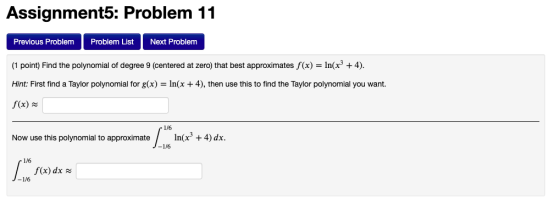
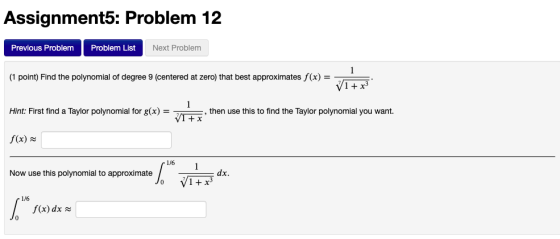
Please answer both questions if possible. Thank you :)
Homework Answers
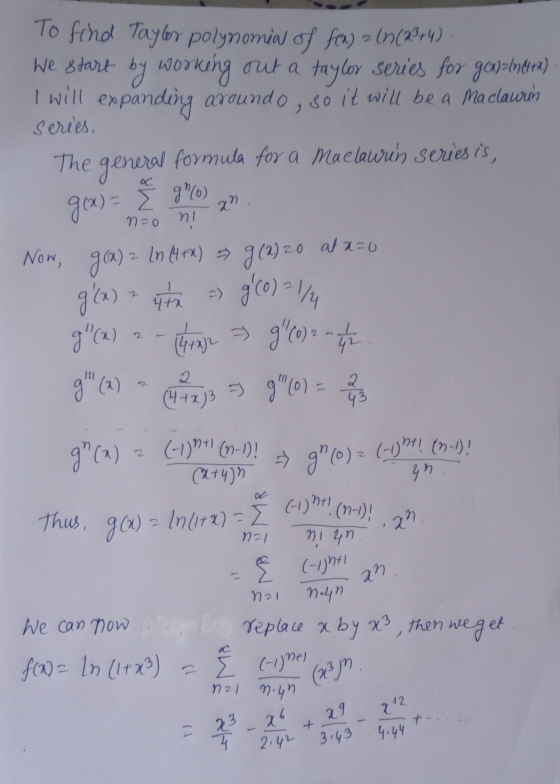
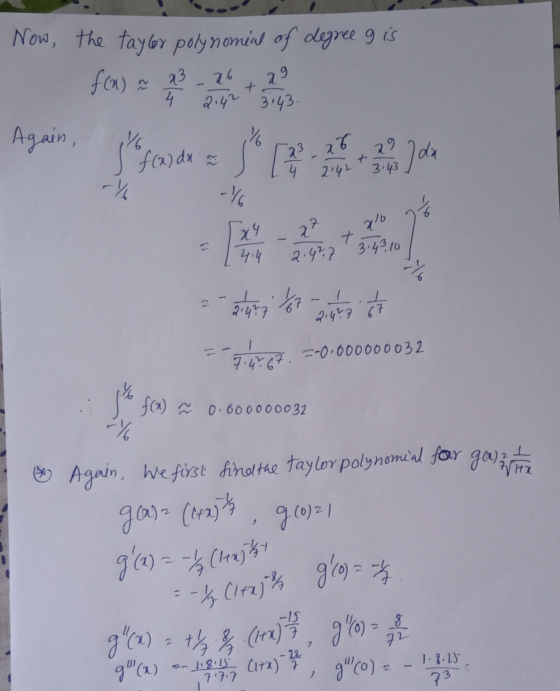
 To
find Taylor polynomial of f(x)=ln(1+x^3), We start by working out a
Taylor series for g(x)=ln(1+x). I will expanding around 0 , so it
will be a Maclaurin series.
To
find Taylor polynomial of f(x)=ln(1+x^3), We start by working out a
Taylor series for g(x)=ln(1+x). I will expanding around 0 , so it
will be a Maclaurin series.
Add Answer to:
Please answer both questions if possible. Thank you :)
Assignment5: Problem 11 Previous Problem Problem List...
(1 point) Find the polynomial of degree 9 (centered at zero) that best approximates f(x) =...
 (1 point) Find the polynomial of degree 9 (centered at zero) that best approximates f(x) = ln(° +5). Hint: First find a Taylor polynomial for g(x) = ln(x + 5), then use this to find the Taylor polynomial you want 1/2 Now use this polynomial to approximate L'iniz? +5) da. -1/2 Lis(z) dx =
(1 point) Find the polynomial of degree 9 (centered at zero) that best approximates f(x) 71...
 (1 point) Find the polynomial of degree 9 (centered at zero) that best approximates f(x) 71 +23 Hint: First find a Taylor polynomial for g(2) vite then use this to find the Taylor polynomial you want. 1/2 Now use this polynomial to approximate 1 dx. 1+ 3 Do" s(2) de
D4: Problem 11 Previous Problem Problem List Next Problem 1 point) Find the second-degree Taylor ...
 D4: Problem 11 Previous Problem Problem List Next Problem 1 point) Find the second-degree Taylor polynomial T2(x) for the function f(x)- V15 + x2 at the number x1. (x)- Answer: 12
D4: Problem 11 Previous Problem Problem List Next Problem 1 point) Find the second-degree Taylor polynomial T2(x) for the function f(x)- V15 + x2 at the number x1. (x)- Answer: 12
D4: Problem 11 Previous Problem Problem List Next Problem 1 point) Find the second-degree Taylor polynomial T2(x) for the function f(x)- V15 + x2 at the number x1. (x)- Answer: 12
(1 point) Find the Taylor polynomials (centered at zero) of degree h 2, 3, and 4...
 (1 point) Find the Taylor polynomials (centered at zero) of degree h 2, 3, and 4 of f(x) = ln(3x + 7). Taylor polynomial of degree 1 is Taylor polynomial of degree 2 is Taylor polynomial of degree 3 is Taylor polynomial of degree 4 is
Problem 4 Answer the following questions about f(1) = VI. (Show all details.) (a.) Find the...
 Problem 4 Answer the following questions about f(1) = VI. (Show all details.) (a.) Find the degree n = 3 Taylor polynomial centered at a = 1 for the function f(x). (Don't use a table, show all work when determining the polynomial). (b.) Use your answer from (a.) to estimate V1.1. Do not simplify!
Please do questions 21, 25, 29, and 33. Thanks! In Exercises 21 - 24, approximate the...
 Please do questions 21, 25, 29, and 33.
Thanks!
In Exercises 21 - 24, approximate the function value with the indicated Taylor polynomial and give approximate bounds on the error. 21. Approximate sin 0.1 with the Maclaurin polynomial of de- gree 3. Exercises 25 - 28 ask for an n to be found such that pn(x) ap- proximates f(x) within a certain bound of accuracy. 25. Find n such that the Maclaurin polynomial of degree n of f(x) = et...
Please do questions 21, 25, 29, and 33.
Thanks!
In Exercises 21 - 24, approximate the function value with the indicated Taylor polynomial and give approximate bounds on the error. 21. Approximate sin 0.1 with the Maclaurin polynomial of de- gree 3. Exercises 25 - 28 ask for an n to be found such that pn(x) ap- proximates f(x) within a certain bound of accuracy. 25. Find n such that the Maclaurin polynomial of degree n of f(x) = et...
please assist Problem 3 (8 points). Find a Taylor polynomial centered at 0 that approximates f(x)...
 please assist
Problem 3 (8 points). Find a Taylor polynomial centered at 0 that approximates f(x) = et on the interval (-2,2] to within an error of 0.1.
please assist
Problem 3 (8 points). Find a Taylor polynomial centered at 0 that approximates f(x) = et on the interval (-2,2] to within an error of 0.1.
Let f be a function having derivatives of all orders for all real numbers. Selected values of f and its first four derivatives are shown in the table above.
 Let f be a function having derivatives of all orders for all real numbers. Selected values of f and its first four derivatives are shown in the table above. (a) Write the second-degree Taylor polynomial for f about x = 0 and use it to approximate f(0.2). (b) Let g be a function such that g(x) =f(x3). Write the fifth-degree Taylor polynomial for g', the derivative of g, about x = 0. (c) Write the third-degree Taylor polynomial for f about x =...
I need these calculus 2 questions answered for me. I seem to be some kind of close but not quite there. Please answer BOTH question and I will upvote se a series to find the first five terms of tan-...
 I need these calculus 2 questions answered for me. I seem to be
some kind of close but not quite there. Please answer BOTH question
and I will upvote
se a series to find the first five terms of tan-tx3dx b) Find the minimum found in part a) nccessary to approximate dx so that error < 5 × 10 s, and approximate the definite integral with a partial mber of terms. c) Find an upper bound of the lerrorl of...
I need these calculus 2 questions answered for me. I seem to be
some kind of close but not quite there. Please answer BOTH question
and I will upvote
se a series to find the first five terms of tan-tx3dx b) Find the minimum found in part a) nccessary to approximate dx so that error < 5 × 10 s, and approximate the definite integral with a partial mber of terms. c) Find an upper bound of the lerrorl of...
8 pts . Answer parts a through e using the function f(x)- isd br cipah Tperpebynomia.ced0 Find th...
 8 pts . Answer parts a through e using the function f(x)- isd br cipah Tperpebynomia.ced0 Find the eighth degree Taylor polynomial, centered at 0, to approximate f(x) a. . Be sure to simplify your answer. b. Using your eighth degree polynomial from part a and Taylor's Inequality, ii fork-als,the E find the magnitude of the maximum possible error on [0, .1]. x-ato (n 1)! c. Approximateusing your eighth degree Taylor polynomial. What is the actual 1.1 error? Is it...
 (1 point) Find the polynomial of degree 9 (centered at zero) that best approximates f(x) = ln(° +5). Hint: First find a Taylor polynomial for g(x) = ln(x + 5), then use this to find the Taylor polynomial you want 1/2 Now use this polynomial to approximate L'iniz? +5) da. -1/2 Lis(z) dx =
 (1 point) Find the polynomial of degree 9 (centered at zero) that best approximates f(x) 71 +23 Hint: First find a Taylor polynomial for g(2) vite then use this to find the Taylor polynomial you want. 1/2 Now use this polynomial to approximate 1 dx. 1+ 3 Do" s(2) de
 D4: Problem 11 Previous Problem Problem List Next Problem 1 point) Find the second-degree Taylor polynomial T2(x) for the function f(x)- V15 + x2 at the number x1. (x)- Answer: 12
D4: Problem 11 Previous Problem Problem List Next Problem 1 point) Find the second-degree Taylor polynomial T2(x) for the function f(x)- V15 + x2 at the number x1. (x)- Answer: 12
D4: Problem 11 Previous Problem Problem List Next Problem 1 point) Find the second-degree Taylor polynomial T2(x) for the function f(x)- V15 + x2 at the number x1. (x)- Answer: 12
 (1 point) Find the Taylor polynomials (centered at zero) of degree h 2, 3, and 4 of f(x) = ln(3x + 7). Taylor polynomial of degree 1 is Taylor polynomial of degree 2 is Taylor polynomial of degree 3 is Taylor polynomial of degree 4 is
 Problem 4 Answer the following questions about f(1) = VI. (Show all details.) (a.) Find the degree n = 3 Taylor polynomial centered at a = 1 for the function f(x). (Don't use a table, show all work when determining the polynomial). (b.) Use your answer from (a.) to estimate V1.1. Do not simplify!
 Please do questions 21, 25, 29, and 33.
Thanks!
In Exercises 21 - 24, approximate the function value with the indicated Taylor polynomial and give approximate bounds on the error. 21. Approximate sin 0.1 with the Maclaurin polynomial of de- gree 3. Exercises 25 - 28 ask for an n to be found such that pn(x) ap- proximates f(x) within a certain bound of accuracy. 25. Find n such that the Maclaurin polynomial of degree n of f(x) = et...
Please do questions 21, 25, 29, and 33.
Thanks!
In Exercises 21 - 24, approximate the function value with the indicated Taylor polynomial and give approximate bounds on the error. 21. Approximate sin 0.1 with the Maclaurin polynomial of de- gree 3. Exercises 25 - 28 ask for an n to be found such that pn(x) ap- proximates f(x) within a certain bound of accuracy. 25. Find n such that the Maclaurin polynomial of degree n of f(x) = et...
 please assist
Problem 3 (8 points). Find a Taylor polynomial centered at 0 that approximates f(x) = et on the interval (-2,2] to within an error of 0.1.
please assist
Problem 3 (8 points). Find a Taylor polynomial centered at 0 that approximates f(x) = et on the interval (-2,2] to within an error of 0.1.
 I need these calculus 2 questions answered for me. I seem to be
some kind of close but not quite there. Please answer BOTH question
and I will upvote
se a series to find the first five terms of tan-tx3dx b) Find the minimum found in part a) nccessary to approximate dx so that error < 5 × 10 s, and approximate the definite integral with a partial mber of terms. c) Find an upper bound of the lerrorl of...
I need these calculus 2 questions answered for me. I seem to be
some kind of close but not quite there. Please answer BOTH question
and I will upvote
se a series to find the first five terms of tan-tx3dx b) Find the minimum found in part a) nccessary to approximate dx so that error < 5 × 10 s, and approximate the definite integral with a partial mber of terms. c) Find an upper bound of the lerrorl of...
 8 pts . Answer parts a through e using the function f(x)- isd br cipah Tperpebynomia.ced0 Find the eighth degree Taylor polynomial, centered at 0, to approximate f(x) a. . Be sure to simplify your answer. b. Using your eighth degree polynomial from part a and Taylor's Inequality, ii fork-als,the E find the magnitude of the maximum possible error on [0, .1]. x-ato (n 1)! c. Approximateusing your eighth degree Taylor polynomial. What is the actual 1.1 error? Is it...
Most questions answered within 3 hours.
-
Where is the error in this code sequence?
String s1 = "Hello";
String s2 = "ello";...
asked 10 months ago -
Financial data for Joel de Paris, Inc., for last year
follow:
Joel de Paris, Inc.
Balance...
asked 10 months ago -
Consider this reaction:
Al2(SO4)3 (aq)+ BaCl3
(aq) Al2Cl6 (aq)- +
3BaSO4(s) . What is the...
asked 10 months ago -
Suppose that Savneet is considering increasing her
recent random sample from 20 car rentals to 40...
asked 10 months ago -
Trucks arrive at an unloading terminal at an average rate of 120
per hour.
Trucks arrive...
asked 10 months ago -
Why are methanol and ethanol completely soluble in water while
octanol is not very little soluble....
asked 10 months ago -
A facilities manager at a university reads in a research report
that the mean amount of...
asked 10 months ago -
When the CuSO4 is rehydrated by adding water to the anhydrous
compound, is this an endothermic...
asked 10 months ago -
A ray of sunlight is passing from diamond into crown glass; the
angle of incidence is...
asked 10 months ago -
A block of mass 0.249 kg is placed on top of a light, vertical
spring of...
asked 10 months ago -
how do the kidneys compensate in the presences of acidosis
a) trigger hyperventilate
b) reserve acid...
asked 10 months ago -
Question 501 pts
The rental rate of capital to the firm increases. Which of the
following...
asked 10 months ago