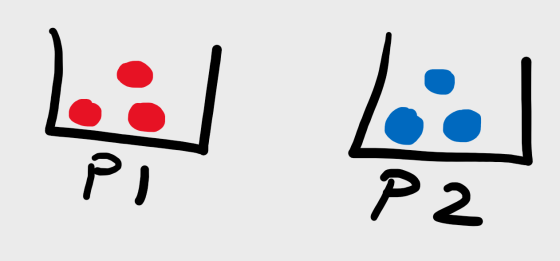
Your task is to get all the blue marbles in P1 and red marbles in
P2
The actions available are as follows:
- You can move 2 marbles from P1 to P2 if they are of the same color (either you can move 2 red or you can move 2 blue)
- You can move 2 marbles from P2 to P1 if they are each of different colors (one blue or one red)
Give the PDDL description to represent the above as a Planning
Problem. Do not forget to also define and describe the predicates
and constants that your are going to use.
Also, give a complete plan (using the actions described) for
getting from the start to the goal state
Homework Answers
Planning Problem
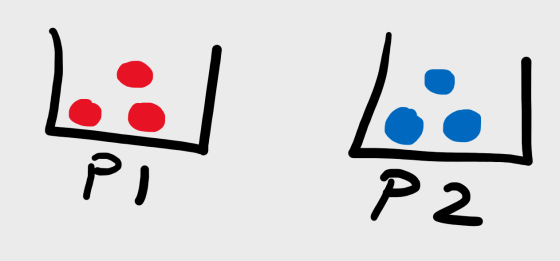
This problem will be solves in 6 steps-
1. Initialy- P1-3 Red Balls , P2= 3 Blue balls
here i will Mention Red Balls as R and Blue Balls as B.
2. Move 2 R balls from P1 to P2-
Result- P1=R , P2=BBBRR
3. Move 2 balls B and R from P2 to P1-
Result- P1=RRB , P2=BBR
4. Move 2 balls B and R from P2 to P1-
Result- P1=RRBBR , P2=B
5. Move 2 balls R and R from P1 to P2-
Result- P1=BBR , P2=BRR
6. Move 2 balls B and R from P2 to P1-
Result- P1=BBRRB , P2=R
7. Move 2 balls R and R from P1 to P2-
Result- P1=BBB , P2=RRR
Therefor all the balls have been moves in just 6 simple steps.
Add Answer to:
Your task is to get all the blue marbles in P1 and red marbles in
P2...
A bag contains 10 red marbles, 10 white marbles, and 10 blue marbles. a. What is...
A bag contains 10 red marbles, 10 white marbles, and 10 blue marbles. a. What is the minimum no. of marbles you have to choose randomly from the bag to ensure that we get 4 marbles of same color? b.How many marbles must you select to be sure of getting at least 3 blue marbles?
(Adapted from Tolga Tasdizen): We have a bag with 5 red marbles and 9 blue marbles....
 (Adapted from Tolga Tasdizen): We have a bag with 5 red marbles
and 9 blue marbles. You draw three marbles out of the bag without
replacement.
(a) What is the probability that you got a red, blue, and red
marble in that order? Hint: use the multiplication rule to get the
size of the sample space (and size of the event set) as if the
marbles were distinguishable.
(b) What is the probability of not getting any blue marbles?
(c)...
(Adapted from Tolga Tasdizen): We have a bag with 5 red marbles
and 9 blue marbles. You draw three marbles out of the bag without
replacement.
(a) What is the probability that you got a red, blue, and red
marble in that order? Hint: use the multiplication rule to get the
size of the sample space (and size of the event set) as if the
marbles were distinguishable.
(b) What is the probability of not getting any blue marbles?
(c)...
A jar has 20 marbles; 18 of them are blue, the rest are red. If you...
A jar has 20 marbles; 18 of them are blue, the rest are red. If you draw 2 marbles without replacement, what is the chance you will get one of each color? Give the probability rounded to four decimal places.
Q4. You have 600 small marbles in a bag which are Yellow or Red colors. You...
 Q4. You have 600 small marbles in a bag which are Yellow or Red colors. You know that 20% of the marbles are the color "Red". You challenge a family member to randomly remove 5 marbles from the bag, and if there is one and only one" Red marble in the five marbles they can decide where to order take out dinner tonight. What is the probability that the family member decides where to order take out dinner tonight? (Please...
7. (14 points) A bag contains 7 marbles: 2 blue, 3 green, and 2 red. You...
 7. (14 points) A bag contains 7 marbles: 2 blue, 3 green, and 2 red. You randomly choose 2 marbles from the bag (without replacement) (a) What is the probability that both are green? (b) What is the probability that at least one of the two marbles is blue? (e) What is the probability that you select one of the marbles you select is blue and the other one is red? (d) What is the probability that both are green,...
Answers for all questions please!! 8) A bag contains 10 red marbles and 8 green marbles....
 Answers for all questions please!!
8) A bag contains 10 red marbles and 8 green marbles. Anne picks 3 replacement, and observes the color of each marble. The number of green binomial random variable. If we let success correspond to getting success probability, p?What is the number of trials? marbles at random, with 8) marbles, X, is a a green marble, what is the A) P- n3 Solve the problem. 9) One hundred people were asked, "Do you favor the...
Answers for all questions please!!
8) A bag contains 10 red marbles and 8 green marbles. Anne picks 3 replacement, and observes the color of each marble. The number of green binomial random variable. If we let success correspond to getting success probability, p?What is the number of trials? marbles at random, with 8) marbles, X, is a a green marble, what is the A) P- n3 Solve the problem. 9) One hundred people were asked, "Do you favor the...
1. What colors would be reflected by an orange tab if you placed it in red, green, or blue light? Justify your response...
1. What colors would be reflected by an orange tab if you placed it in red, green, or blue light? Justify your response with the results you had for red and yellow tabs in red, green, and blue 2.If you have a yellow light source and every color filter to use, could you produce every other possible color? Explain. 3. If an object is 20 cm from a lens and the image is formed 10 cm behind the lens, what...
discrete math 1) a. A box contains 4 marbles: 1 red, 1 blue, 1 green, 1...
 discrete math
1) a. A box contains 4 marbles: 1 red, 1 blue, 1 green, 1 yellow. Consider an experiment that consists of taking 1 marble from the box, replacing it and then drawing a second marble. Describe the sample space. How does the sample space differ if the first marble was not replaced before the second marble was drawn? (2 marks) a. A bag contains 5 red balls and 8 blue balls. Each time a ball is selected, its...
discrete math
1) a. A box contains 4 marbles: 1 red, 1 blue, 1 green, 1 yellow. Consider an experiment that consists of taking 1 marble from the box, replacing it and then drawing a second marble. Describe the sample space. How does the sample space differ if the first marble was not replaced before the second marble was drawn? (2 marks) a. A bag contains 5 red balls and 8 blue balls. Each time a ball is selected, its...
You are working with an ornamental fish that shows two color phenotypes, red or blue. The...
 You are working with an ornamental fish that shows two color phenotypes, red or blue. The color is controlled by a single gene. These fish are hermaphrodites-meaning they can either (1) self-fertilize or (2) mate with another fish. You have three fish: fish 1, fish 2, and fish 3. While working further with this fish, you discover one other mutation (in a different gene) that leads to the recessive phenotype of long dorsal fins. Further research establishes that the genes...
Shapes Cube, Cuboid, Sphere, Cylinder, Cone Colors Red, Green, Blue, Black This controller shall have the...
 Shapes Cube, Cuboid, Sphere, Cylinder, Cone Colors Red, Green, Blue, Black This controller shall have the follow modules: 3-D object printing: This printer reads 3-D object data (including shape, color, and dimensions) from user and print one object 3-D objects statistics: All 3-D objects' data shall be stored properly to allow user to retrieve their statistics. For example, the following are some typical statistics user would be interested in o What is the percentage of each color of printed objects?...
 (Adapted from Tolga Tasdizen): We have a bag with 5 red marbles
and 9 blue marbles. You draw three marbles out of the bag without
replacement.
(a) What is the probability that you got a red, blue, and red
marble in that order? Hint: use the multiplication rule to get the
size of the sample space (and size of the event set) as if the
marbles were distinguishable.
(b) What is the probability of not getting any blue marbles?
(c)...
(Adapted from Tolga Tasdizen): We have a bag with 5 red marbles
and 9 blue marbles. You draw three marbles out of the bag without
replacement.
(a) What is the probability that you got a red, blue, and red
marble in that order? Hint: use the multiplication rule to get the
size of the sample space (and size of the event set) as if the
marbles were distinguishable.
(b) What is the probability of not getting any blue marbles?
(c)...
 Q4. You have 600 small marbles in a bag which are Yellow or Red colors. You know that 20% of the marbles are the color "Red". You challenge a family member to randomly remove 5 marbles from the bag, and if there is one and only one" Red marble in the five marbles they can decide where to order take out dinner tonight. What is the probability that the family member decides where to order take out dinner tonight? (Please...
 7. (14 points) A bag contains 7 marbles: 2 blue, 3 green, and 2 red. You randomly choose 2 marbles from the bag (without replacement) (a) What is the probability that both are green? (b) What is the probability that at least one of the two marbles is blue? (e) What is the probability that you select one of the marbles you select is blue and the other one is red? (d) What is the probability that both are green,...
 Answers for all questions please!!
8) A bag contains 10 red marbles and 8 green marbles. Anne picks 3 replacement, and observes the color of each marble. The number of green binomial random variable. If we let success correspond to getting success probability, p?What is the number of trials? marbles at random, with 8) marbles, X, is a a green marble, what is the A) P- n3 Solve the problem. 9) One hundred people were asked, "Do you favor the...
Answers for all questions please!!
8) A bag contains 10 red marbles and 8 green marbles. Anne picks 3 replacement, and observes the color of each marble. The number of green binomial random variable. If we let success correspond to getting success probability, p?What is the number of trials? marbles at random, with 8) marbles, X, is a a green marble, what is the A) P- n3 Solve the problem. 9) One hundred people were asked, "Do you favor the...
 discrete math
1) a. A box contains 4 marbles: 1 red, 1 blue, 1 green, 1 yellow. Consider an experiment that consists of taking 1 marble from the box, replacing it and then drawing a second marble. Describe the sample space. How does the sample space differ if the first marble was not replaced before the second marble was drawn? (2 marks) a. A bag contains 5 red balls and 8 blue balls. Each time a ball is selected, its...
discrete math
1) a. A box contains 4 marbles: 1 red, 1 blue, 1 green, 1 yellow. Consider an experiment that consists of taking 1 marble from the box, replacing it and then drawing a second marble. Describe the sample space. How does the sample space differ if the first marble was not replaced before the second marble was drawn? (2 marks) a. A bag contains 5 red balls and 8 blue balls. Each time a ball is selected, its...
 You are working with an ornamental fish that shows two color phenotypes, red or blue. The color is controlled by a single gene. These fish are hermaphrodites-meaning they can either (1) self-fertilize or (2) mate with another fish. You have three fish: fish 1, fish 2, and fish 3. While working further with this fish, you discover one other mutation (in a different gene) that leads to the recessive phenotype of long dorsal fins. Further research establishes that the genes...
 Shapes Cube, Cuboid, Sphere, Cylinder, Cone Colors Red, Green, Blue, Black This controller shall have the follow modules: 3-D object printing: This printer reads 3-D object data (including shape, color, and dimensions) from user and print one object 3-D objects statistics: All 3-D objects' data shall be stored properly to allow user to retrieve their statistics. For example, the following are some typical statistics user would be interested in o What is the percentage of each color of printed objects?...
Most questions answered within 3 hours.
-
Where is the error in this code sequence?
String s1 = "Hello";
String s2 = "ello";...
asked 10 months ago -
Financial data for Joel de Paris, Inc., for last year
follow:
Joel de Paris, Inc.
Balance...
asked 10 months ago -
Consider this reaction:
Al2(SO4)3 (aq)+ BaCl3
(aq) Al2Cl6 (aq)- +
3BaSO4(s) . What is the...
asked 10 months ago -
Suppose that Savneet is considering increasing her
recent random sample from 20 car rentals to 40...
asked 10 months ago -
Trucks arrive at an unloading terminal at an average rate of 120
per hour.
Trucks arrive...
asked 10 months ago -
Why are methanol and ethanol completely soluble in water while
octanol is not very little soluble....
asked 10 months ago -
A facilities manager at a university reads in a research report
that the mean amount of...
asked 10 months ago -
When the CuSO4 is rehydrated by adding water to the anhydrous
compound, is this an endothermic...
asked 10 months ago -
A ray of sunlight is passing from diamond into crown glass; the
angle of incidence is...
asked 10 months ago -
A block of mass 0.249 kg is placed on top of a light, vertical
spring of...
asked 10 months ago -
how do the kidneys compensate in the presences of acidosis
a) trigger hyperventilate
b) reserve acid...
asked 10 months ago -
Question 501 pts
The rental rate of capital to the firm increases. Which of the
following...
asked 10 months ago