
Homework Answers
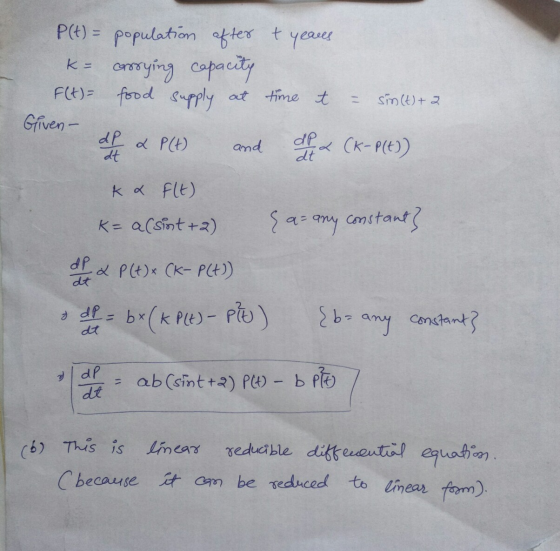
(c)
write below equation in mathematica
In[1]:= DSolve[P'[t] == a*b*P[t]*(sin[t] + 2) - b*(P[t])^2, P[t], t ]
result will be -
Out[1] =
![{{P[t] = \frac{e^{ab(-cost + 2t)}}{\int be^{ab(-cost + 2t)}dt}}}](http://img.homeworklib.com/questions/b970ac20-1186-11eb-a221-9dcec4220bae.png?x-oss-process=image/resize,w_560)
.
.
Please give it a thumbs up if this solution helped you. Still any doubt ? Comment box is all yours, I will be happy to help you :)
Add Answer to:
3. A certain population of short lived insects is known to reproduce at a rate proportional...
A population of insects in a certain region will grow at a rate that is proportional to their current population wi...
 A population of insects in a certain region will grow at a rate that is proportional to their current population with proportionality constant k. In the absence of any outside factors the population will triple in two weeks in time. On any given day there is a net migration into the area of 15 insects and 16 are eaten by the local bird population and 7 die of natural causes. If there are initially 100 insects in the area, will...
Part B Please!! Scenario The population of fish in a fishery has a growth rate that...
 Part B Please!!
Scenario The population of fish in a fishery has a growth rate that is proportional to its size when the population is small. However, the fishery has a fixed capacity and the growth rate will be negative if the population exceeds that capacity. A. Formulate a differential equation for the population of fish described in the scenario, defining all parameters and variables. 1. Explain why the differential equation models both condition in the scenario. t time a...
Part B Please!!
Scenario The population of fish in a fishery has a growth rate that is proportional to its size when the population is small. However, the fishery has a fixed capacity and the growth rate will be negative if the population exceeds that capacity. A. Formulate a differential equation for the population of fish described in the scenario, defining all parameters and variables. 1. Explain why the differential equation models both condition in the scenario. t time a...
The population of a community is known to increase at a rate proportional to the number...
 The population of a community is known to increase at a rate proportional to the number of people present at time t. The initial population P. has doubled in 5 years. Suppose it is known that the population is 11,000 after 3 years. What was the initial population Po? (Round your answer to one decimal place.) Po= What will be the population in 10 years? (Round your answer to the nearest person.) persons How fast is the population growing at...
2. The growth rate of a population of bacteria is directly proportional to the population p()...
 2. The growth rate of a population of bacteria is directly proportional to the population p() (measured in millions) at time t (measured in hours). (a) Model this situation using a differential equation. (b) Find the general solution to the differential equation (c) If the number of bacteria in the culture grew from p(0) = 200 to p(24) = 800 in 24 hours, what was the population after the first 12 hours?
&7 4. A population P grows at a constant rate of a organisms per unit time, and the death rate is proportional...
 &7 4. A population P grows at a constant rate of a organisms per unit time, and the death rate is proportional to the population size with the proportionality constant k. A. Assume the initial population P(0) Po. Write a differential equation that models the size of the population P(t) at ay time t. B. Write the equation from part A in standard form, and solve. (The answe terms Po, a, k and a constant C.) wer must contain the...
POPULATION MODELS: PLEASE ANSWSER ASAP: ALL 3 AND WILL RATE U ASAP. The logistic growth model...
 POPULATION MODELS: PLEASE
ANSWSER ASAP: ALL 3 AND WILL RATE U ASAP.
The logistic growth model describes population growth when
resources are constrained. It
is an extension to the exponential growth model that includes an
additional term introducing
the carrying capacity of the habitat.
The differential equation for this model is:
dP/dt=kP(t)(1-P(t)/M)
Where P(t) is the population (or population density) at time t,
k > 0 is a growth constant,
and M is the carrying capacity of the habitat. This...
POPULATION MODELS: PLEASE
ANSWSER ASAP: ALL 3 AND WILL RATE U ASAP.
The logistic growth model describes population growth when
resources are constrained. It
is an extension to the exponential growth model that includes an
additional term introducing
the carrying capacity of the habitat.
The differential equation for this model is:
dP/dt=kP(t)(1-P(t)/M)
Where P(t) is the population (or population density) at time t,
k > 0 is a growth constant,
and M is the carrying capacity of the habitat. This...
Q2- Fish Population In this question, we will use differential equations to study the fish population...
 Q2- Fish Population In this question, we will use differential equations to study the fish population in a certain lake. An acceptable model for fish population change should take into account the birth rate, death rate, as well as harvesting rate Let P(t) denote the living fish population (measured in tonnes) at time t (measured in year) Then the net rate of change of the fish population in tonnes of fish per year is P'(t): P'(t) birth rate - death...
The growth of a certain bacteria in a reactor... 3. The growth of a certain bacteria...
 The growth of a certain bacteria in a reactor...
3. The growth of a certain bacteria in a reactor is assumed to be governed by the logistic equation: d P dt where P is the population in millions and t is the time in days. Recall that M is the carrying capacity of the reactor and k is a constant that depends on the growth rate (a) Suppose that the carrying capacity of the reactor is 10 million bacteria, and...
The growth of a certain bacteria in a reactor...
3. The growth of a certain bacteria in a reactor is assumed to be governed by the logistic equation: d P dt where P is the population in millions and t is the time in days. Recall that M is the carrying capacity of the reactor and k is a constant that depends on the growth rate (a) Suppose that the carrying capacity of the reactor is 10 million bacteria, and...
Urgently need the answers. Please give right answers. Q2 Fish Population In this question, we will...
 Urgently need the answers. Please give right answers.
Q2 Fish Population In this question, we will use differential equations to study the fish population in a certain lake. An acceptable model for fish population change should take into account the birth rate, death rate, as well as harvesting rate. Let P(t) denote the living fish population (measured in tonnes) at time t (measured in year) Then the net rate of change of the fish population in tonnes of fish per...
Urgently need the answers. Please give right answers.
Q2 Fish Population In this question, we will use differential equations to study the fish population in a certain lake. An acceptable model for fish population change should take into account the birth rate, death rate, as well as harvesting rate. Let P(t) denote the living fish population (measured in tonnes) at time t (measured in year) Then the net rate of change of the fish population in tonnes of fish per...
One model for the spread of a rumor is that the rate of spread is proportional to the product of the fraction y of the population who have heard the rumor and the fraction who have not heard the rumo...
 One model for the spread of a rumor is that the rate of spread is proportional to the product of the fraction y of the population who have heard the rumor and the fraction who have not heard the rumor. (a) Write a differential equation that is satisfied by y. (Use k for the constant of proportionality.) dy (b) Solve the differential equation. Assume y(o) (c) A small town has 2100 inhabitants. At 8 AM, 100 people have heard a...
 A population of insects in a certain region will grow at a rate that is proportional to their current population with proportionality constant k. In the absence of any outside factors the population will triple in two weeks in time. On any given day there is a net migration into the area of 15 insects and 16 are eaten by the local bird population and 7 die of natural causes. If there are initially 100 insects in the area, will...
 Part B Please!!
Scenario The population of fish in a fishery has a growth rate that is proportional to its size when the population is small. However, the fishery has a fixed capacity and the growth rate will be negative if the population exceeds that capacity. A. Formulate a differential equation for the population of fish described in the scenario, defining all parameters and variables. 1. Explain why the differential equation models both condition in the scenario. t time a...
Part B Please!!
Scenario The population of fish in a fishery has a growth rate that is proportional to its size when the population is small. However, the fishery has a fixed capacity and the growth rate will be negative if the population exceeds that capacity. A. Formulate a differential equation for the population of fish described in the scenario, defining all parameters and variables. 1. Explain why the differential equation models both condition in the scenario. t time a...
 The population of a community is known to increase at a rate proportional to the number of people present at time t. The initial population P. has doubled in 5 years. Suppose it is known that the population is 11,000 after 3 years. What was the initial population Po? (Round your answer to one decimal place.) Po= What will be the population in 10 years? (Round your answer to the nearest person.) persons How fast is the population growing at...
 2. The growth rate of a population of bacteria is directly proportional to the population p() (measured in millions) at time t (measured in hours). (a) Model this situation using a differential equation. (b) Find the general solution to the differential equation (c) If the number of bacteria in the culture grew from p(0) = 200 to p(24) = 800 in 24 hours, what was the population after the first 12 hours?
 &7 4. A population P grows at a constant rate of a organisms per unit time, and the death rate is proportional to the population size with the proportionality constant k. A. Assume the initial population P(0) Po. Write a differential equation that models the size of the population P(t) at ay time t. B. Write the equation from part A in standard form, and solve. (The answe terms Po, a, k and a constant C.) wer must contain the...
 POPULATION MODELS: PLEASE
ANSWSER ASAP: ALL 3 AND WILL RATE U ASAP.
The logistic growth model describes population growth when
resources are constrained. It
is an extension to the exponential growth model that includes an
additional term introducing
the carrying capacity of the habitat.
The differential equation for this model is:
dP/dt=kP(t)(1-P(t)/M)
Where P(t) is the population (or population density) at time t,
k > 0 is a growth constant,
and M is the carrying capacity of the habitat. This...
POPULATION MODELS: PLEASE
ANSWSER ASAP: ALL 3 AND WILL RATE U ASAP.
The logistic growth model describes population growth when
resources are constrained. It
is an extension to the exponential growth model that includes an
additional term introducing
the carrying capacity of the habitat.
The differential equation for this model is:
dP/dt=kP(t)(1-P(t)/M)
Where P(t) is the population (or population density) at time t,
k > 0 is a growth constant,
and M is the carrying capacity of the habitat. This...
 Q2- Fish Population In this question, we will use differential equations to study the fish population in a certain lake. An acceptable model for fish population change should take into account the birth rate, death rate, as well as harvesting rate Let P(t) denote the living fish population (measured in tonnes) at time t (measured in year) Then the net rate of change of the fish population in tonnes of fish per year is P'(t): P'(t) birth rate - death...
 The growth of a certain bacteria in a reactor...
3. The growth of a certain bacteria in a reactor is assumed to be governed by the logistic equation: d P dt where P is the population in millions and t is the time in days. Recall that M is the carrying capacity of the reactor and k is a constant that depends on the growth rate (a) Suppose that the carrying capacity of the reactor is 10 million bacteria, and...
The growth of a certain bacteria in a reactor...
3. The growth of a certain bacteria in a reactor is assumed to be governed by the logistic equation: d P dt where P is the population in millions and t is the time in days. Recall that M is the carrying capacity of the reactor and k is a constant that depends on the growth rate (a) Suppose that the carrying capacity of the reactor is 10 million bacteria, and...
 Urgently need the answers. Please give right answers.
Q2 Fish Population In this question, we will use differential equations to study the fish population in a certain lake. An acceptable model for fish population change should take into account the birth rate, death rate, as well as harvesting rate. Let P(t) denote the living fish population (measured in tonnes) at time t (measured in year) Then the net rate of change of the fish population in tonnes of fish per...
Urgently need the answers. Please give right answers.
Q2 Fish Population In this question, we will use differential equations to study the fish population in a certain lake. An acceptable model for fish population change should take into account the birth rate, death rate, as well as harvesting rate. Let P(t) denote the living fish population (measured in tonnes) at time t (measured in year) Then the net rate of change of the fish population in tonnes of fish per...
 One model for the spread of a rumor is that the rate of spread is proportional to the product of the fraction y of the population who have heard the rumor and the fraction who have not heard the rumor. (a) Write a differential equation that is satisfied by y. (Use k for the constant of proportionality.) dy (b) Solve the differential equation. Assume y(o) (c) A small town has 2100 inhabitants. At 8 AM, 100 people have heard a...
Most questions answered within 3 hours.
-
Where is the error in this code sequence?
String s1 = "Hello";
String s2 = "ello";...
asked 11 months ago -
Financial data for Joel de Paris, Inc., for last year
follow:
Joel de Paris, Inc.
Balance...
asked 11 months ago -
Consider this reaction:
Al2(SO4)3 (aq)+ BaCl3
(aq) Al2Cl6 (aq)- +
3BaSO4(s) . What is the...
asked 11 months ago -
Suppose that Savneet is considering increasing her
recent random sample from 20 car rentals to 40...
asked 11 months ago -
Trucks arrive at an unloading terminal at an average rate of 120
per hour.
Trucks arrive...
asked 11 months ago -
Why are methanol and ethanol completely soluble in water while
octanol is not very little soluble....
asked 11 months ago -
A facilities manager at a university reads in a research report
that the mean amount of...
asked 11 months ago -
When the CuSO4 is rehydrated by adding water to the anhydrous
compound, is this an endothermic...
asked 11 months ago -
A ray of sunlight is passing from diamond into crown glass; the
angle of incidence is...
asked 11 months ago -
A block of mass 0.249 kg is placed on top of a light, vertical
spring of...
asked 11 months ago -
how do the kidneys compensate in the presences of acidosis
a) trigger hyperventilate
b) reserve acid...
asked 11 months ago -
Question 501 pts
The rental rate of capital to the firm increases. Which of the
following...
asked 11 months ago