
Homework Answers
Add Answer to:
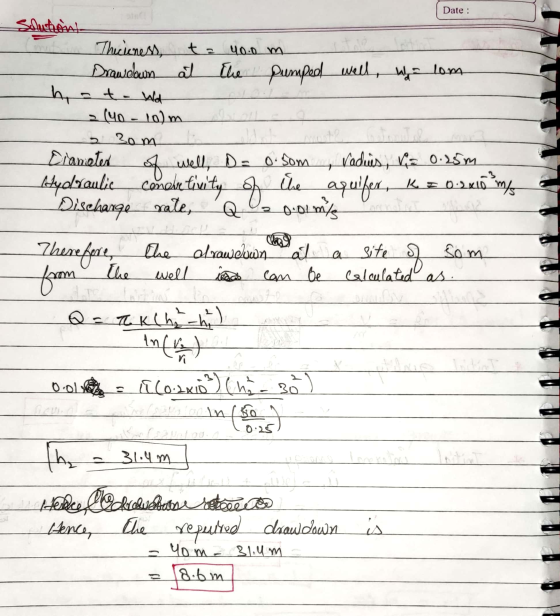
A 0.5-m diameter well fully penetrates an unconfined aquifer, which is 40.0 m thick. The drawdown...
Examples Example 3: A well of diameter 0.5 m fully penetrates a confined aquifer. The well...
 Examples Example 3: A well of diameter 0.5 m fully penetrates a confined aquifer. The well is pumped for a test at 0.833 m3/min and the values of the drawdown at an observation well 20 m from the pumped well are measured at different times. The results are tabulated below. Determine the transmissivity and the storage coefficient of the aquifer using Jacob equation. Time,t min) Prawdown, 0.57 1.49 10 2.43 20 3.31 40 4.34 60 4.97 s (m)
6TH question 5. A 6-in.-diameter well that fully penetrates a 40-ft-thick open aquifer is pumped at...
 6TH question
5. A 6-in.-diameter well that fully penetrates a 40-ft-thick open aquifer is pumped at a rate of 100 gpm. The drawdown in the well is 22 ft when a steady water level is established. The drawdown in a well 152 ft distant is 12 ft. Estimate the coefficient of permeability of the soil deposit. CHAPTER 5 STRESS ANALYSIS AND ENGINEERING PROPERTIES 6. Discuss the validity of the answer obtained in Problem 5. Suggest how you would improve the...
6TH question
5. A 6-in.-diameter well that fully penetrates a 40-ft-thick open aquifer is pumped at a rate of 100 gpm. The drawdown in the well is 22 ft when a steady water level is established. The drawdown in a well 152 ft distant is 12 ft. Estimate the coefficient of permeability of the soil deposit. CHAPTER 5 STRESS ANALYSIS AND ENGINEERING PROPERTIES 6. Discuss the validity of the answer obtained in Problem 5. Suggest how you would improve the...
a. A well 50 cm in diameter penetrates 33 m below the static water table. After...
 a. A well 50 cm in diameter penetrates 33 m below the static water table. After a long period of pumping at a rate of 80 m/h, the drawdowns in two observation wells A and B, 18 and 45 m from the pumped well, were found to be 1.8 and 1.1 m respectively. Determine . the hydraulic conductivity of the aquifer (in m/d) . the expected drawdown in the pumped well • the radius of influence of the pumped well,...
Question 4 a. A well 50 cm in diameter penetrates 33 m below the static water...
 Question 4 a. A well 50 cm in diameter penetrates 33 m below the static water table. After a long period of pumping at a rate of 80 m/h, the drawdowns in two observation wells A and B, 18 and 45 m from the pumped well, were found to be 1.8 and 1.1 m respectively. Determine . the hydraulic conductivity of the aquifer (in m/d) . the expected drawdown in the pumped well the radius of influence of the pumped...
6.124pts) Giselle has installed a water production well in an unconfined aquifer, She is concerne...
 please explain the answer for part D.
6.124pts) Giselle has installed a water production well in an unconfined aquifer, She is concerned about the possibility that when the well is in use drawdown will ower the piezometric and that the water will stop flowing. She has asked for your help in the analysis well surface to the bottom of the Currently, the drawdown at observation well A, 120.0 m from the pumped well, s 12.0m. Observation at 80.0 meters is...
please explain the answer for part D.
6.124pts) Giselle has installed a water production well in an unconfined aquifer, She is concerned about the possibility that when the well is in use drawdown will ower the piezometric and that the water will stop flowing. She has asked for your help in the analysis well surface to the bottom of the Currently, the drawdown at observation well A, 120.0 m from the pumped well, s 12.0m. Observation at 80.0 meters is...
An unconfined aquifer has an initial thickness of 15.80 m. The initial water table is horizontal...
An unconfined aquifer has an initial thickness of 15.80 m. The initial water table is horizontal and located 4.7 m below the ground surface. A 15-cm diameter well is driven to the bottom of the aquifer and pumped at 3000 Lpm until steady state conditions are achieved. At this time the drawdown at the well is 4.35 m and the drawdown in an observation well located 850 m away is 0.12 m. (a) Make a sketch that defines the problem....
Problem # 4 (12 points) (a) A 30 cm diameter well completely penetrates a confined aquifer...
 Problem # 4 (12 points) (a) A 30 cm diameter well completely penetrates a confined aquifer of permeability 45 m/day.The length of the strainer i s 20 m. Under steady state of ping, the drawdown at the well was found to be 3.0 m and the radius of oints) influence was 300m. Calculate the discharge. (6 p
Question. A 50 m thick homogeneous confined aquifer is shortened length wide by two parallel impermeable...
 Question. A 50 m thick homogeneous confined aquifer is shortened length wide by two parallel impermeable boundaries as shown below. The well is pumped at 0.3 mº/s for 3 days. Before pumping started, the real well (R) and observation well (A) are positioned at 300 m and 200 m from the barrier of the right hand side aquifer. Calculate the drawdown at a point A at the end of the last day (t = 3 days). Assume T = 0.01...
estion 4 a. A well 50 cm in diameter penetrates 33 m below the static water...
 estion 4 a. A well 50 cm in diameter penetrates 33 m below the static water table. After a long period of pumping at a rate of 80 m/h, the drawdowns in two observation wells A and B, 18 and 45 m from the pumped well, were found to be 1.8 and 1.1 m respectively. Determine . the hydraulic conductivity of the aquifer (in m/d) the expected drawdown in the pumped well the radius of influence of the pumped well,...
Question 4 A well 50 cm in diameter penetrates 33 m below the static water table....
 Question 4 A well 50 cm in diameter penetrates 33 m below the static water table. After a long period of pumping at a rate of 80 m2/h, the drawdowns in two observation wells A and B, 18 and 45 m from the pumped well, were found to be 1.8 and 1.1 m respectively. Determine the hydraulic conductivity of the aquifer (in m/d) . the expected drawdown in the pumped well . the radius of influence of the pumped well,...
 Examples Example 3: A well of diameter 0.5 m fully penetrates a confined aquifer. The well is pumped for a test at 0.833 m3/min and the values of the drawdown at an observation well 20 m from the pumped well are measured at different times. The results are tabulated below. Determine the transmissivity and the storage coefficient of the aquifer using Jacob equation. Time,t min) Prawdown, 0.57 1.49 10 2.43 20 3.31 40 4.34 60 4.97 s (m)
 6TH question
5. A 6-in.-diameter well that fully penetrates a 40-ft-thick open aquifer is pumped at a rate of 100 gpm. The drawdown in the well is 22 ft when a steady water level is established. The drawdown in a well 152 ft distant is 12 ft. Estimate the coefficient of permeability of the soil deposit. CHAPTER 5 STRESS ANALYSIS AND ENGINEERING PROPERTIES 6. Discuss the validity of the answer obtained in Problem 5. Suggest how you would improve the...
6TH question
5. A 6-in.-diameter well that fully penetrates a 40-ft-thick open aquifer is pumped at a rate of 100 gpm. The drawdown in the well is 22 ft when a steady water level is established. The drawdown in a well 152 ft distant is 12 ft. Estimate the coefficient of permeability of the soil deposit. CHAPTER 5 STRESS ANALYSIS AND ENGINEERING PROPERTIES 6. Discuss the validity of the answer obtained in Problem 5. Suggest how you would improve the...
 a. A well 50 cm in diameter penetrates 33 m below the static water table. After a long period of pumping at a rate of 80 m/h, the drawdowns in two observation wells A and B, 18 and 45 m from the pumped well, were found to be 1.8 and 1.1 m respectively. Determine . the hydraulic conductivity of the aquifer (in m/d) . the expected drawdown in the pumped well • the radius of influence of the pumped well,...
 Question 4 a. A well 50 cm in diameter penetrates 33 m below the static water table. After a long period of pumping at a rate of 80 m/h, the drawdowns in two observation wells A and B, 18 and 45 m from the pumped well, were found to be 1.8 and 1.1 m respectively. Determine . the hydraulic conductivity of the aquifer (in m/d) . the expected drawdown in the pumped well the radius of influence of the pumped...
 please explain the answer for part D.
6.124pts) Giselle has installed a water production well in an unconfined aquifer, She is concerned about the possibility that when the well is in use drawdown will ower the piezometric and that the water will stop flowing. She has asked for your help in the analysis well surface to the bottom of the Currently, the drawdown at observation well A, 120.0 m from the pumped well, s 12.0m. Observation at 80.0 meters is...
please explain the answer for part D.
6.124pts) Giselle has installed a water production well in an unconfined aquifer, She is concerned about the possibility that when the well is in use drawdown will ower the piezometric and that the water will stop flowing. She has asked for your help in the analysis well surface to the bottom of the Currently, the drawdown at observation well A, 120.0 m from the pumped well, s 12.0m. Observation at 80.0 meters is...
 Problem # 4 (12 points) (a) A 30 cm diameter well completely penetrates a confined aquifer of permeability 45 m/day.The length of the strainer i s 20 m. Under steady state of ping, the drawdown at the well was found to be 3.0 m and the radius of oints) influence was 300m. Calculate the discharge. (6 p
 Question. A 50 m thick homogeneous confined aquifer is shortened length wide by two parallel impermeable boundaries as shown below. The well is pumped at 0.3 mº/s for 3 days. Before pumping started, the real well (R) and observation well (A) are positioned at 300 m and 200 m from the barrier of the right hand side aquifer. Calculate the drawdown at a point A at the end of the last day (t = 3 days). Assume T = 0.01...
 estion 4 a. A well 50 cm in diameter penetrates 33 m below the static water table. After a long period of pumping at a rate of 80 m/h, the drawdowns in two observation wells A and B, 18 and 45 m from the pumped well, were found to be 1.8 and 1.1 m respectively. Determine . the hydraulic conductivity of the aquifer (in m/d) the expected drawdown in the pumped well the radius of influence of the pumped well,...
 Question 4 A well 50 cm in diameter penetrates 33 m below the static water table. After a long period of pumping at a rate of 80 m2/h, the drawdowns in two observation wells A and B, 18 and 45 m from the pumped well, were found to be 1.8 and 1.1 m respectively. Determine the hydraulic conductivity of the aquifer (in m/d) . the expected drawdown in the pumped well . the radius of influence of the pumped well,...
Most questions answered within 3 hours.
-
Where is the error in this code sequence?
String s1 = "Hello";
String s2 = "ello";...
asked 10 months ago -
Financial data for Joel de Paris, Inc., for last year
follow:
Joel de Paris, Inc.
Balance...
asked 10 months ago -
Consider this reaction:
Al2(SO4)3 (aq)+ BaCl3
(aq) Al2Cl6 (aq)- +
3BaSO4(s) . What is the...
asked 10 months ago -
Suppose that Savneet is considering increasing her
recent random sample from 20 car rentals to 40...
asked 10 months ago -
Trucks arrive at an unloading terminal at an average rate of 120
per hour.
Trucks arrive...
asked 10 months ago -
Why are methanol and ethanol completely soluble in water while
octanol is not very little soluble....
asked 10 months ago -
A facilities manager at a university reads in a research report
that the mean amount of...
asked 10 months ago -
When the CuSO4 is rehydrated by adding water to the anhydrous
compound, is this an endothermic...
asked 10 months ago -
A ray of sunlight is passing from diamond into crown glass; the
angle of incidence is...
asked 10 months ago -
A block of mass 0.249 kg is placed on top of a light, vertical
spring of...
asked 10 months ago -
how do the kidneys compensate in the presences of acidosis
a) trigger hyperventilate
b) reserve acid...
asked 10 months ago -
Question 501 pts
The rental rate of capital to the firm increases. Which of the
following...
asked 10 months ago