
Homework Answers
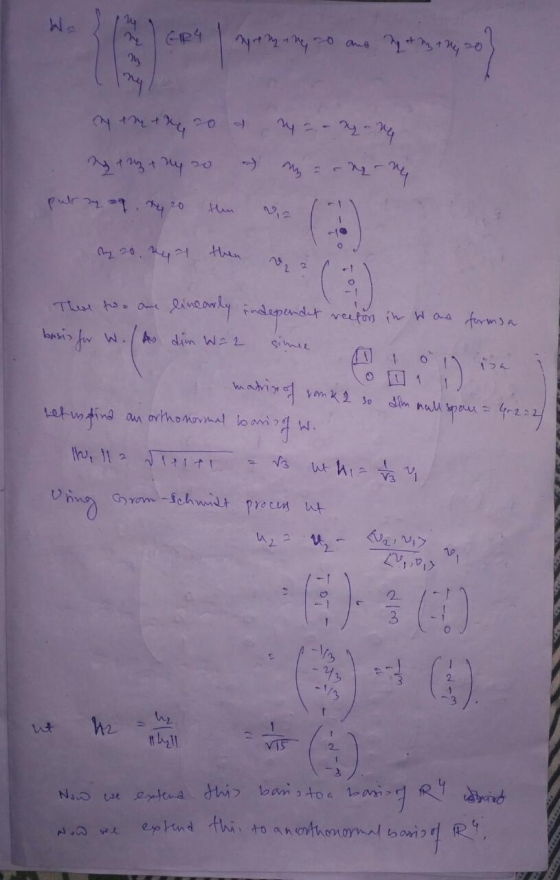
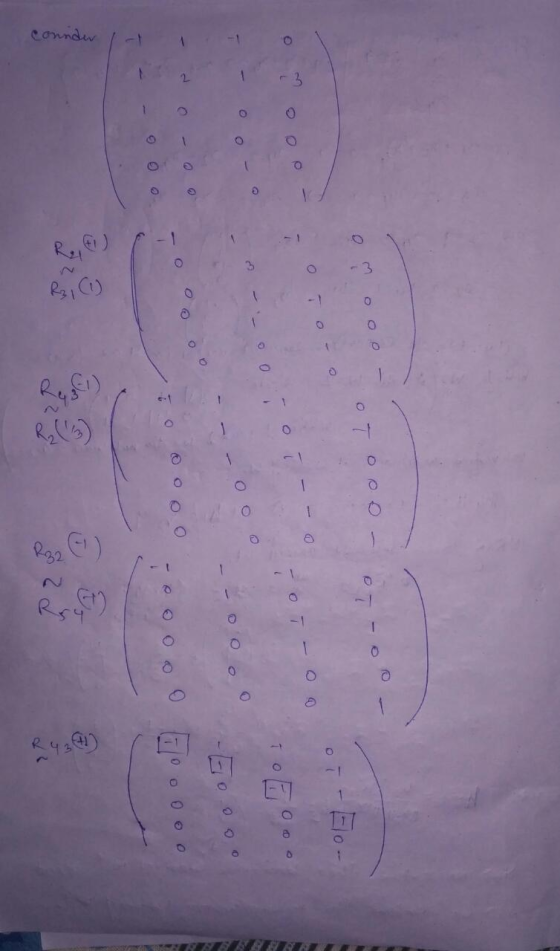
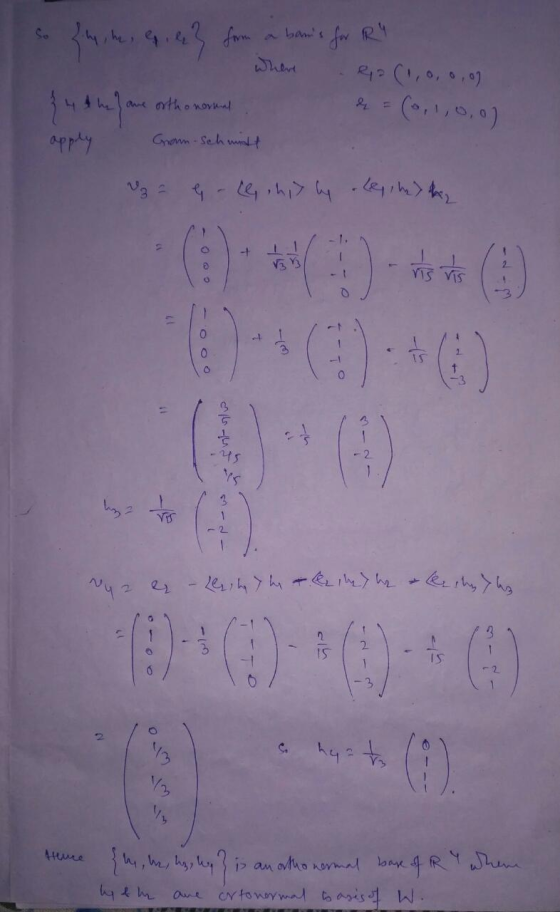

Consider the subspace W C R4 given by X1 X2 W = ER4 X1 + x2...
 Consider the subspace W C R4 given by X1 X2 W = ER4 X1 + x2 + x4 = 0 and x2 + x3 + x4 = 0 X3 X4 = Find an orthonormal basis H {h1, h2, h3, h4} for R4 with the property that hy and h2 are elements of an orthonormal basis for W, where orthonormality is defined with respect to the dot product on R4 x R4.
(c) Consider the subspace W R4 given by W = ER4 21 +12 + 24 =...
 (c) Consider the subspace W R4 given by W = ER4 21 +12 + 24 = 0 and x2 + x3 + 14 = 0 14 Find an orthonormal basis H = {h1, h2, h3, h4} for R4 with the property that hy and h2 are elements of an orthonormal basis for W, where orth onormality is defined with respect to the dot product on R4 x R4
Consider the subspace W CR4 given by 22 W= - {O ER4 21 + x2 +...
 Consider the subspace W CR4 given by 22 W= - {O ER4 21 + x2 + 34 = 0 and 32 +33 +24 = 0 23 24, Find an orthonormal basis H = {h1, h2, h3, h4} for R$ with the property that h¡ and he are elements of an orthonormal basis for W, where orthonormality is defined with respect to the dot product on R4 x R4
3) consider the subspace WCIR given by X 13 X4 ER? x + X₂ + xy...
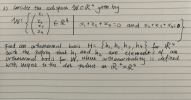 3) consider the subspace WCIR given by X 13 X4 ER? x + X₂ + xy = 0 and 4tX3+X450 Find an orthonormal basis H= {h, he he , hu} for IR4 with the property that he and he are elements of an wrth mal basis for W, ale athew mality is defined with respect to the dot poduct in IR 4+1R4
6. Find a basis for the subspace W= {xeR* | x1 +x2 +xy + x4 =...
 6. Find a basis for the subspace W= {xeR* | x1 +x2 +xy + x4 = 0, x2 +x4 = 0 } and determine its dimension: 4. Prove or disprove: A set with only one vector in it is linearly independent
The set of vectors {x1, x2} spans a subspace W of R’, where x1 = 4...
 The set of vectors {x1, x2} spans a subspace W of R’, where x1 = 4 2 5 and x2 ܕ ܩ ܟ 6 -7 (a) Use the Gram-Schmidt process to find an orthogonal basis for W. (b) Then normalize this new basis, so that it is an orthonormal basis. (c) Once you've found an orthonormal basis, demonstrate that it is indeed orthogonal after normalization. (d) For a bonus 2 points, calculate a third vector orthogonal to your basis and...
The set of vectors {x1, x2} spans a subspace W of R’, where x1 = 4...
 The set of vectors {x1, x2} spans a subspace W of R’, where x1 = 4 2 5 and x2 ܕ ܩ ܟ 6 -7 (a) Use the Gram-Schmidt process to find an orthogonal basis for W. (b) Then normalize this new basis, so that it is an orthonormal basis. (c) Once you've found an orthonormal basis, demonstrate that it is indeed orthogonal after normalization. (d) For a bonus 2 points, calculate a third vector orthogonal to your basis and...
0 5 The set of vectors {x1, x2} spans a subspace W of R3, where x1...
 0 5 The set of vectors {x1, x2} spans a subspace W of R3, where x1 = 19- and X 2 -- 2 (a) Use the Gram-Schmidt process to find an orthogonal basis for W. (b) Then normalize this new basis, so that it is an orthonormal basis. (c) Once you've found an orthonormal basis, demonstrate that it is indeed orthogonal after normalization. (d) For a bonus 2 points, calculate a third vector orthogonal to your basis and normalize it...
Use the Gram-Schmidt process to find an or- thonormal basis for the subspace of R4 spanned...
 Use the Gram-Schmidt process to find an or- thonormal basis for the subspace of R4 spanned by Xi = (4, 2, 2, 1)", X2 (2,0, 0, 2)", X3 = (1,1, -1, 1). Let A = (x1 X2 X3) and b = (1, 2, 3,1)7. Factor A into a product QR, where Q has an orthonormal set of column vectors and R is up- per triangular. Solve the least squares problem Ax = b.
The set x1, x2} is a basis for a subspace W. Use the Gram-Schmidt process to produce an orthonormal basis for W exactly...
 The set x1, x2} is a basis for a subspace W. Use the Gram-Schmidt process to produce an orthonormal basis for W exactly as described in the book. Instructions: You must perform the process by using the first vector in the list as X1 and the second vector as x2. The answer is unique! Round your answer to three decimal places. 3 2 1 -1 -9 X1 X2= -6 -6 0.309 0.154 V1 V2 -0.154 -0.926
The set x1, x2}...
The set x1, x2} is a basis for a subspace W. Use the Gram-Schmidt process to produce an orthonormal basis for W exactly as described in the book. Instructions: You must perform the process by using the first vector in the list as X1 and the second vector as x2. The answer is unique! Round your answer to three decimal places. 3 2 1 -1 -9 X1 X2= -6 -6 0.309 0.154 V1 V2 -0.154 -0.926
The set x1, x2}...
 Consider the subspace W C R4 given by X1 X2 W = ER4 X1 + x2 + x4 = 0 and x2 + x3 + x4 = 0 X3 X4 = Find an orthonormal basis H {h1, h2, h3, h4} for R4 with the property that hy and h2 are elements of an orthonormal basis for W, where orthonormality is defined with respect to the dot product on R4 x R4.
 (c) Consider the subspace W R4 given by W = ER4 21 +12 + 24 = 0 and x2 + x3 + 14 = 0 14 Find an orthonormal basis H = {h1, h2, h3, h4} for R4 with the property that hy and h2 are elements of an orthonormal basis for W, where orth onormality is defined with respect to the dot product on R4 x R4
 Consider the subspace W CR4 given by 22 W= - {O ER4 21 + x2 + 34 = 0 and 32 +33 +24 = 0 23 24, Find an orthonormal basis H = {h1, h2, h3, h4} for R$ with the property that h¡ and he are elements of an orthonormal basis for W, where orthonormality is defined with respect to the dot product on R4 x R4
 3) consider the subspace WCIR given by X 13 X4 ER? x + X₂ + xy = 0 and 4tX3+X450 Find an orthonormal basis H= {h, he he , hu} for IR4 with the property that he and he are elements of an wrth mal basis for W, ale athew mality is defined with respect to the dot poduct in IR 4+1R4
 6. Find a basis for the subspace W= {xeR* | x1 +x2 +xy + x4 = 0, x2 +x4 = 0 } and determine its dimension: 4. Prove or disprove: A set with only one vector in it is linearly independent
 The set of vectors {x1, x2} spans a subspace W of R’, where x1 = 4 2 5 and x2 ܕ ܩ ܟ 6 -7 (a) Use the Gram-Schmidt process to find an orthogonal basis for W. (b) Then normalize this new basis, so that it is an orthonormal basis. (c) Once you've found an orthonormal basis, demonstrate that it is indeed orthogonal after normalization. (d) For a bonus 2 points, calculate a third vector orthogonal to your basis and...
 The set of vectors {x1, x2} spans a subspace W of R’, where x1 = 4 2 5 and x2 ܕ ܩ ܟ 6 -7 (a) Use the Gram-Schmidt process to find an orthogonal basis for W. (b) Then normalize this new basis, so that it is an orthonormal basis. (c) Once you've found an orthonormal basis, demonstrate that it is indeed orthogonal after normalization. (d) For a bonus 2 points, calculate a third vector orthogonal to your basis and...
 0 5 The set of vectors {x1, x2} spans a subspace W of R3, where x1 = 19- and X 2 -- 2 (a) Use the Gram-Schmidt process to find an orthogonal basis for W. (b) Then normalize this new basis, so that it is an orthonormal basis. (c) Once you've found an orthonormal basis, demonstrate that it is indeed orthogonal after normalization. (d) For a bonus 2 points, calculate a third vector orthogonal to your basis and normalize it...
 Use the Gram-Schmidt process to find an or- thonormal basis for the subspace of R4 spanned by Xi = (4, 2, 2, 1)", X2 (2,0, 0, 2)", X3 = (1,1, -1, 1). Let A = (x1 X2 X3) and b = (1, 2, 3,1)7. Factor A into a product QR, where Q has an orthonormal set of column vectors and R is up- per triangular. Solve the least squares problem Ax = b.
 The set x1, x2} is a basis for a subspace W. Use the Gram-Schmidt process to produce an orthonormal basis for W exactly as described in the book. Instructions: You must perform the process by using the first vector in the list as X1 and the second vector as x2. The answer is unique! Round your answer to three decimal places. 3 2 1 -1 -9 X1 X2= -6 -6 0.309 0.154 V1 V2 -0.154 -0.926
The set x1, x2}...
The set x1, x2} is a basis for a subspace W. Use the Gram-Schmidt process to produce an orthonormal basis for W exactly as described in the book. Instructions: You must perform the process by using the first vector in the list as X1 and the second vector as x2. The answer is unique! Round your answer to three decimal places. 3 2 1 -1 -9 X1 X2= -6 -6 0.309 0.154 V1 V2 -0.154 -0.926
The set x1, x2}...
Most questions answered within 3 hours.
-
Where is the error in this code sequence?
String s1 = "Hello";
String s2 = "ello";...
asked 10 months ago -
Financial data for Joel de Paris, Inc., for last year
follow:
Joel de Paris, Inc.
Balance...
asked 10 months ago -
Consider this reaction:
Al2(SO4)3 (aq)+ BaCl3
(aq) Al2Cl6 (aq)- +
3BaSO4(s) . What is the...
asked 10 months ago -
Suppose that Savneet is considering increasing her
recent random sample from 20 car rentals to 40...
asked 10 months ago -
Trucks arrive at an unloading terminal at an average rate of 120
per hour.
Trucks arrive...
asked 10 months ago -
Why are methanol and ethanol completely soluble in water while
octanol is not very little soluble....
asked 10 months ago -
A facilities manager at a university reads in a research report
that the mean amount of...
asked 10 months ago -
When the CuSO4 is rehydrated by adding water to the anhydrous
compound, is this an endothermic...
asked 10 months ago -
A ray of sunlight is passing from diamond into crown glass; the
angle of incidence is...
asked 10 months ago -
A block of mass 0.249 kg is placed on top of a light, vertical
spring of...
asked 10 months ago -
how do the kidneys compensate in the presences of acidosis
a) trigger hyperventilate
b) reserve acid...
asked 10 months ago -
Question 501 pts
The rental rate of capital to the firm increases. Which of the
following...
asked 10 months ago